Help us get this right
Does this portrait look right for Khotanese?
Nobody has judged this one yet. You would be the first.
Khotanese Erotic
Oasis kingdom of Khotan on the southern edge of the Tarim Basin, between the Kunlun Mountains and the Taklamakan Desert; today Hotan Prefecture, Xinjiang, China
Khotanese Saka (Eastern Iranian, Indo-European), written in Brahmi script; Gandhari Prakrit, Sanskrit, Chinese and Tibetan also used in administration and religion
Mahayana Buddhism; descendants adopted Islam after the Kara-Khanid conquest of about 1006
Saka branch of the Eastern Iranian peoples; closest kin were the Tumshuqese Saka of the northern Tarim; absorbed into the ancestors of the modern Uyghurs
About Khotanese People
The Khotanese were an Iranian-speaking Saka people who ran the oasis kingdom of Khotan, on the southern rim of the Tarim Basin in what is now Hotan, Xinjiang, from the last centuries BCE until the Kara-Khanid conquest of about 1006. They did not vanish so much as dissolve: over the following centuries their descendants became Muslim and Turkic-speaking, and they count among the ancestors of today's Uyghurs of Hotan.
What set them apart was position and product. Khotan sat where two rivers, the Yurungkash and the Karakash, come down out of the Kunlun carrying jade, white in one and dark in the other, and Chinese courts wanted that stone for over a thousand years. The kingdom was also among the first places outside China to make silk, and its own legend credits a Chinese bride who hid silkworm eggs in her headdress to get them past the border guards. A painted wooden panel at Dandan Oilik shows the scene, with an attendant pointing at her hair.
Their language, Khotanese Saka, was Eastern Iranian, a cousin of Sogdian and a distant one of Pashto, with a sister tongue in Tumshuqese to the northwest and, some linguists argue, its nearest living relative in Wakhi of the Pamirs. It was written in a Brahmi script borrowed from India, the early administration ran in Gandhari Prakrit, and the kingdom's founding story claims exiles from Taxila in the time of Ashoka. Khotan looked south for its models.
Buddhism was the organizing fact of public life. Khotan was a Mahayana stronghold where Chinese monks came looking for texts. Faxian, around 400, described a procession of images that the king came out to meet barefoot; Xuanzang, two and a half centuries later, counted about a hundred monasteries. The longest surviving work in the language, the Book of Zambasta, is a Buddhist verse compendium whose author grumbles that his countrymen did not accept the teaching as the real thing when it was put in Khotanese.
Khotan was a small state between large ones: a Tang garrison seat in the seventh and eighth centuries, under Tibetan rule from the end of the eighth century to the middle of the ninth, then independent again and tied by marriage to the rulers of Dunhuang, where King Viśa Sambhava appears as a donor in the Mogao caves wearing Chinese imperial dress. The kingdom fell to the Muslim Kara-Khanids of Kashgar after decades of war. Most of what is known about them comes from what the desert kept: manuscripts sealed in the Dunhuang library cave, and documents and paintings dug from the sand-buried sites around Hotan, many by Aurel Stein in the early 1900s.
Related ethnic groups
Groups that share Khotanese's homeland, region, language, or religious tradition. These are likely candidates for comparative phenotype reference.
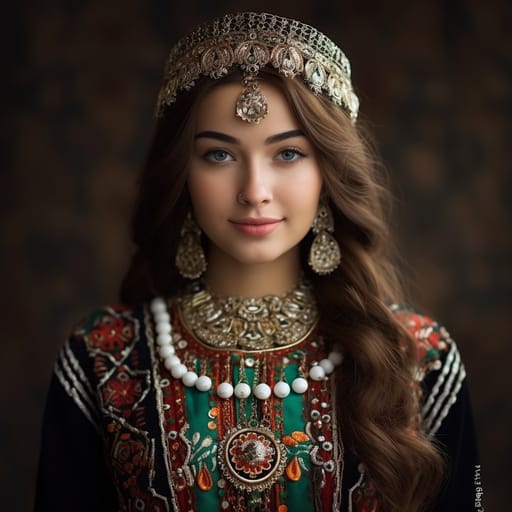
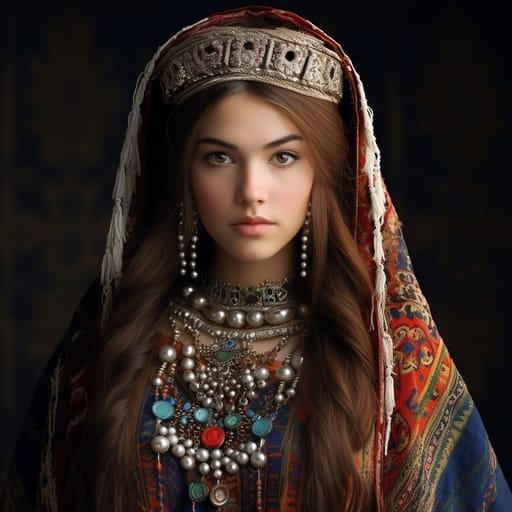
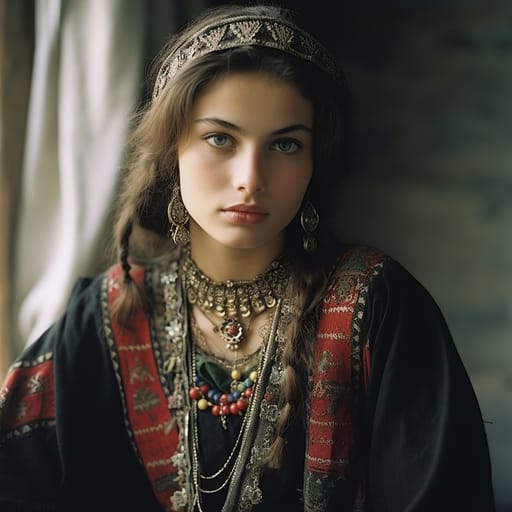
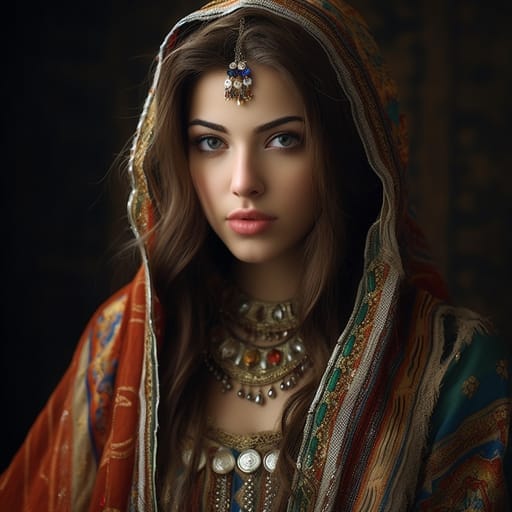
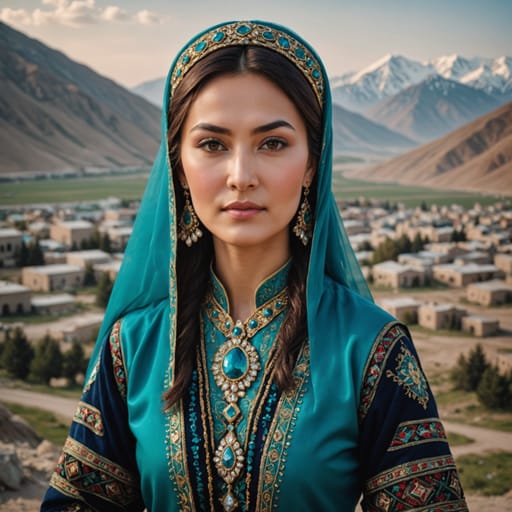
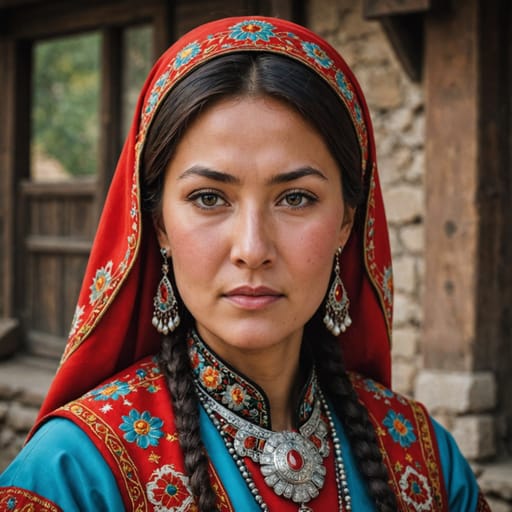
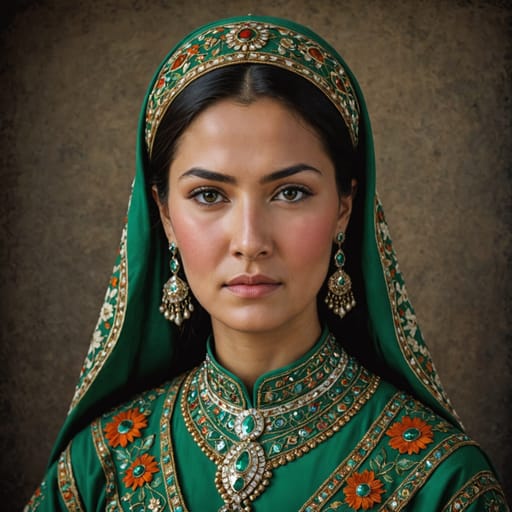
Typical Khotanese Phenotypes
Reference for AI generation: hair, eyes, skin, facial structure, build
Khotanese Body & Anatomy Reference
Central Asian Turkic-Mongolic phenotype: anatomy reference for AI nude generation
Khotanese Boobs & Breasts
Khotanese boobs follow the Central Asian Turkic-Mongolic profile: medium cup, moderate projection. Areolar diameter is usually 30-42mm, and the coloring is medium-brown areolar pigmentation against the tan-to-light-brown skin tone. Breast shape tracks body composition (mesomorph, broader frame than the East Asian norm, mean adult female BMI 23-26), so Khotanese breasts tend to be full and modestly projecting. Expect a forward-set shape, not the smaller East Asian bust.
Khotanese Ass & Hips
Khotanese ass and hip morphology presents as medium, moderate projection, broader hip profile than the East Asian norm, distinctly different from the slim East Asian narrow-hip profile. The Khotanese pelvic profile shows medium iliac crests, moderate gluteal-femoral fat deposition, anchored in the Central Asian Turkic-Mongolic skeletal pattern. Khotanese butt shots in adult AI imagery should render the medium, moderate projection, broader hip profile than the East Asian norm silhouette with the overall build (mesomorph, broader frame than the East Asian norm) and the fat distribution typical of the Central Asian Turkic-Mongolic phenotype.
Khotanese Vagina & Pussy
Khotanese pussy anatomy typically shows medium-brown labial pigmentation. Pubic hair is usually straight-to-wavy medium-coarse texture. In AI-generated Khotanese nudes, labial color should blend into the tan to light-brown skin with a gradual transition, and the hair should keep its straight-to-wavy medium-coarse texture.
Khotanese Dicks & Penis
Penis reference for Khotanese men: regional mean ~13cm erect, moderate girth. Coloring: medium-brown shaft pigmentation. An accurate Khotanese cock in AI imagery matches the surrounding tan to light-brown skin rather than a generic porn default. Circumcision depends on religion and custom, not ancestry.
Khotanese Body, Curves & Build
The Khotanese figure is generally mesomorph, broader frame than the East Asian norm, with mean adult female BMI 23-26, characteristic of Central Asian Turkic-Mongolic ancestry. AI image tools tend to flatten regional body types into a few stock shapes; here the Khotanese build is kept as its own reference.
Khotanese Skin Tone & Hair Texture
Skin: tan to light-brown (Fitzpatrick III-IV). Hair: straight 1A-1B, dark-brown to black. Both are typical of Central Asian Turkic-Mongolic ancestry. The most common mistake in AI nudes of Khotanese women is a body rendered lighter than the face.
Explore phenotype categories
Structured taxonomy with peer-reviewed scales · 22 anatomical categories
Erotic Poses & Sex Positions
From the pose catalog: 219 named positions with reference skeletons
Frequently asked questions about Khotanese people
Where is the Khotanese homeland?
The Khotanese homeland is Oasis kingdom of Khotan on the southern edge of the Tarim Basin, between the Kunlun Mountains and the Taklamakan Desert; today Hotan Prefecture, Xinjiang, China in Central Asia.
What language do Khotanese people speak?
Khotanese people primarily speak Khotanese Saka (Eastern Iranian, Indo-European), written in Brahmi script; Gandhari Prakrit, Sanskrit, Chinese and Tibetan also used in administration and religion.
What religion do Khotanese people practice?
The predominant religion among Khotanese people is Mahayana Buddhism; descendants adopted Islam after the Kara-Khanid conquest of about 1006.






Make your own Khotanese images
Five a day, free, no credits to buy. The studio starts from this group's phenotype data, so you can set body type, pose and style and keep the traits accurate.
Start with Khotanese