Help us get this right
Does this portrait look right for Karakalpaks?
Nobody has judged this one yet. You would be the first.
Karakalpaks Erotic
Also known as: Karakalpak
Karakalpakstan (Uzbekistan)
Islam / Sunni Islam
About Karakalpaks People
The Karakalpaks are a Turkic people whose name — "black hat" — sticks to them as a marker of distinction from the Kazakhs and Uzbeks they sit between. Their homeland is the autonomous republic of Karakalpakstan in northwestern Uzbekistan, a flat country of irrigated cotton fields, desert, and the wreckage of the Aral Sea. That last detail is not incidental. The drying of the Aral, one of the worst environmental collapses of the twentieth century, happened on Karakalpak land, and the consequences — salt-laden dust, vanished fisheries, water-borne illness, demographic strain — are part of how the group understands itself now. The old port city of Moynaq, once a fishing town, is the symbol most often cited; rusting trawlers sit dozens of kilometers from any shoreline.
Their language is Kipchak Turkic, in the same branch as Kazakh, and to a Kazakh ear Karakalpak is mostly intelligible — closer to Kazakh than Kazakh is to Uzbek, despite the political geography. The two peoples share a pastoral nomadic past on the Eurasian steppe and a clan-based social memory; Karakalpaks recognize a tribal structure (the Aris division into On Tort Uruw and Qonghirat) that older generations can still place themselves within. The split from the Kazakhs is generally traced to the seventeenth and eighteenth centuries, when groups settled along the Amu Darya delta and shifted toward a semi-sedentary life of fishing, herding, and irrigated farming — a hybrid that distinguishes them in the region.
Islam arrived through Central Asian channels and is Sunni, generally Hanafi, layered over older Turko-Mongol practices in the way common across the steppe. Religious observance tends to be moderate and embedded in life-cycle events rather than performed publicly; Soviet decades left the usual mark. Pre-Islamic survivals show up in healing practices, in the importance attached to ancestral spirits, and in the epic tradition — the Qyrq Qyz, "Forty Girls," is the Karakalpak national epic, a long narrative poem about a band of warrior women defending their land, performed by jyraws to the accompaniment of the two-stringed qobyz. It is unusually woman-centered for the genre and is taken seriously as a source of identity. Carpet weaving, yurt-building craft, and silver jewelry remain practiced, less as folklore than as ordinary skill carried by particular families.
Related ethnic groups
Groups that share Karakalpaks's homeland, region, language, or religious tradition. These are likely candidates for comparative phenotype reference.
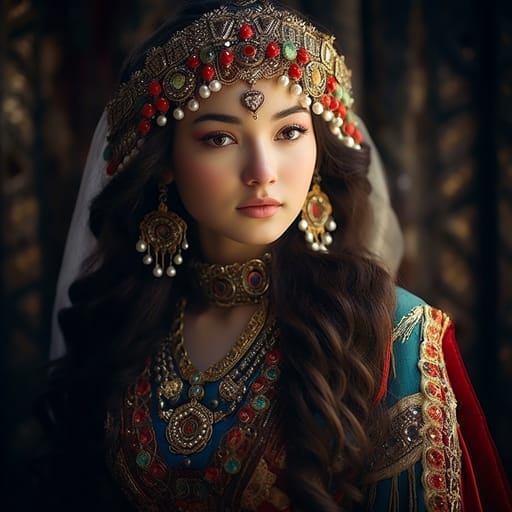
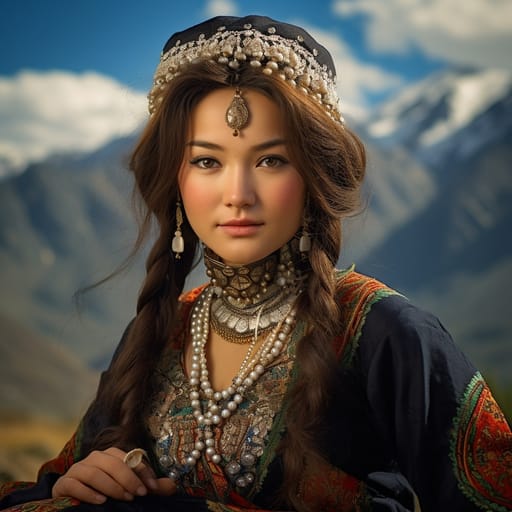
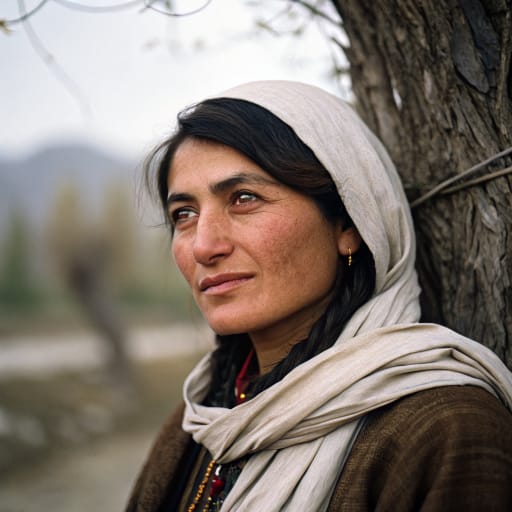
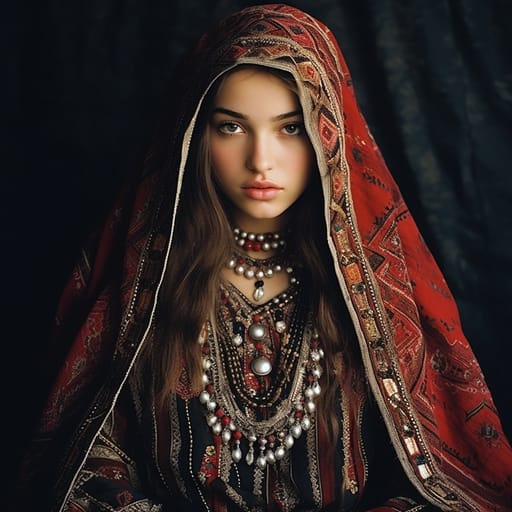
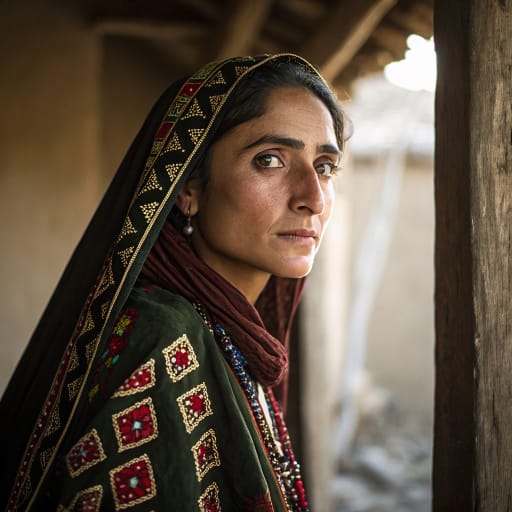
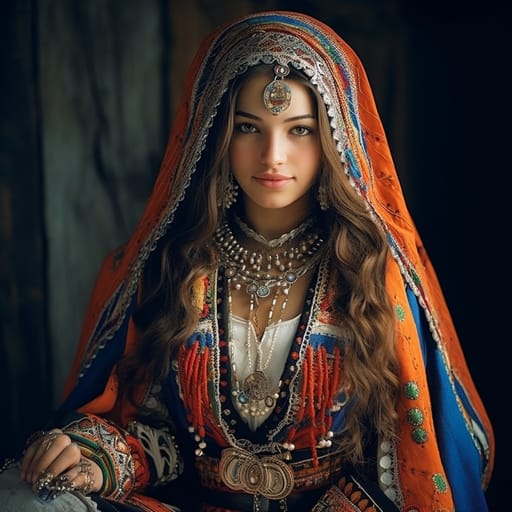
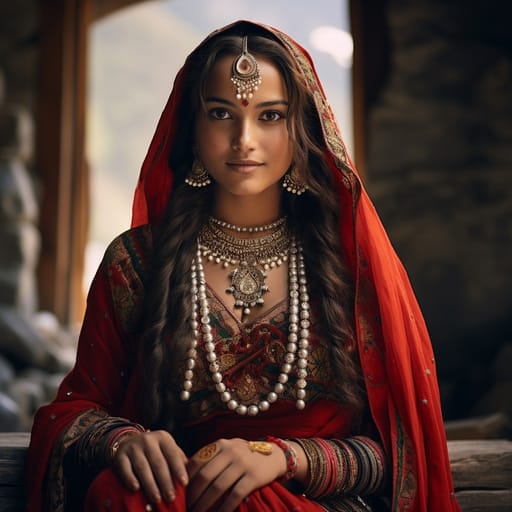
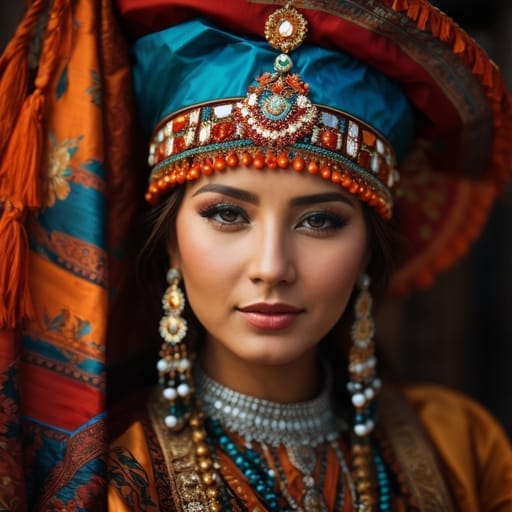
Typical Karakalpaks Phenotypes
Reference for AI generation: hair, eyes, skin, facial structure, build
Karakalpaks sit at a phenotypic crossroads — a Kipchak Turkic population shaped by centuries on the Aral steppe, carrying a roughly even mixture of West Eurasian and East Eurasian ancestry. The result is a face that often reads as intermediate: more Mongoloid-shifted than neighboring Uzbeks of the Ferghana valley, less so than Kazakhs to the north, and visibly distinct from the Iranian-leaning Tajiks to the south.
Hair is overwhelmingly dark — black to very dark brown, with coarse, straight to slightly wavy texture and high density. Premature graying is common in older men. Beard growth is moderate; full thick beards are less typical than among Iranian-speaking neighbors. Eyes run dark brown to near-black, with lighter hazel appearing occasionally in western clans. The epicanthic fold is present in a clear majority — usually partial rather than the full medial fold seen in East Asians — and palpebral fissures tend to narrow and slightly upslanted. Brows are straight and not heavily arched.
Skin tone clusters around Fitzpatrick III–IV: a light-to-medium wheatish base with warm yellow-olive undertones that tans deeply and rarely burns cleanly. Steppe sun and wind leave weathered, ruddy cheeks on rural older adults.
The facial architecture is the most distinctive feature. Cheekbones are broad, high, and laterally projecting, giving the face a wide bizygomatic span and a flatter mid-face profile. Noses are typically straight or slightly low-bridged with medium alar width — neither the high aquiline of Persian neighbors nor the very flat, broad nose of farther-east Turkic groups. Lips are medium in fullness. Jawlines are square in men, softer and rounder in women, and the overall head shape trends brachycephalic.
Build is solid and compact. Men average around 168–172 cm, women around 156–160 cm, with sturdy bone structure, broad shoulders relative to height, and a tendency toward central weight gain in middle age. Younger adults are often lean and wiry from a still-pastoral diet. Northern Aral-shore subgroups skew slightly more East Eurasian in feature; southern Amu Darya communities show somewhat more Iranian-Uzbek admixture.
Karakalpaks Body & Anatomy Reference
Anatomy by feature, Indo-Aryan / Dravidian South Asian phenotype
Karakalpaks Boobs & Breasts
Karakalpaks boobs follow the Indo-Aryan / Dravidian South Asian profile: medium-to-large cup, moderate-to-full projection. Areolar diameter is usually 32-46mm, and the coloring is medium-brown to dark-brown areolar pigmentation against the wheatish-to-brown skin tone. Breast shape tracks body composition (endomorph-to-mesomorph with fuller hip deposition, mean adult female BMI 22-25), so Karakalpaks breasts tend to be full and soft, generally fuller than the East Asian norm. Expect a forward-set shape, not the smaller East Asian bust profile.
Karakalpaks Ass & Hips
Karakalpaks ass and hip morphology presents as medium-to-full, moderate-to-high projection, classic curvy hip profile, distinctly different from the slim hip profile of East Asian women. The Karakalpaks pelvic profile shows medium-to-wide iliac crests, full gluteal-femoral fat distribution, anchored in the Indo-Aryan / Dravidian South Asian skeletal pattern. Karakalpaks butt shots in adult AI imagery should render the medium-to-full, moderate-to-high projection, classic curvy hip profile silhouette with the overall build (endomorph-to-mesomorph with fuller hip deposition) and the fat distribution typical of the Indo-Aryan / Dravidian South Asian phenotype.
Karakalpaks Vagina & Pussy
Karakalpaks pussy anatomy typically shows medium-brown to dark-brown labial pigmentation, fuller labia minora projection. Pubic hair is usually straight-to-wavy coarse texture, dense distribution. In AI-generated Karakalpaks nudes, labial color should blend into the wheatish to brown skin with a gradual transition, and the hair should keep its straight-to-wavy coarse texture.
Karakalpaks Dicks & Penis
Penis reference for Karakalpaks men: regional mean ~13cm erect, moderate girth. Coloring: medium-brown shaft pigmentation. An accurate Karakalpaks cock in AI imagery matches the surrounding wheatish to brown skin rather than a generic porn default. Circumcision depends on religion and custom, not ancestry.
Karakalpaks Body, Curves & Build
The Karakalpaks figure is generally endomorph-to-mesomorph with fuller hip deposition, with mean adult female BMI 22-25, characteristic of Indo-Aryan / Dravidian South Asian ancestry. AI image tools tend to flatten regional body types into a few stock shapes; here the Karakalpaks build is kept as its own reference.
Karakalpaks Skin Tone & Hair Texture
Skin: wheatish to brown (Fitzpatrick III-V). Hair: straight-to-wavy 1A-2B, dense, dark-brown to black. Both are typical of Indo-Aryan / Dravidian South Asian ancestry. The most common mistake in AI nudes of Karakalpaks women is a body rendered lighter than the face.
Data depth
0/100Coverage of image-grounded phenotype observations · drives AI generation diversity
- Sample size
- 0/40· 0 images
- Image quality
- 0/30· 0% high
- Confidence
- 0/20
- Source diversity
- 0/10
- ·No image observations yet
Explore phenotype categories
Structured taxonomy with peer-reviewed scales · 22 anatomical categories
Erotic Poses & Sex Positions
From the pose catalog: 219 named positions with reference skeletons
Frequently asked questions about Karakalpaks people
Where is the Karakalpaks homeland?
The Karakalpaks homeland is Karakalpakstan (Uzbekistan) in Southern Asia.
What language do Karakalpaks people speak?
Karakalpaks people primarily speak Turkic / Kipchak / Karakalpak.
What religion do Karakalpaks people practice?
The predominant religion among Karakalpaks people is Islam / Sunni Islam.
What are other names for Karakalpaks people?
Karakalpaks people are also known as Karakalpak.






Make your own Karakalpaks images
Five a day, free, no credits to buy. The studio starts from this group's phenotype data, so you can set body type, pose and style and keep the traits accurate.
Start with Karakalpaks