Help us get this right
Does this portrait look right for Kapampangans?
Nobody has judged this one yet. You would be the first.
Kapampangans Erotic
Also known as: Kapampangan
Pampanga (Philippines)
Christianity / Catholicism
About Kapampangans People
The Kapampangans occupy a stretch of the Central Luzon plain north of Manila Bay, a flat alluvial country fed by the Pampanga River and shadowed at its western edge by Mount Pinatubo. The land is fertile, much of it given to rice and sugarcane, and the Kapampangans have farmed it long enough that their reputation in the Philippines is bound up with what they do at the table. They are widely considered the country's most ambitious cooks — the kitchens of the old haciendas developed an idiom of their own, heavy on offal, river fish, fermentations, and dishes like sisig, tocino, and betute that other Filipinos treat as Kapampangan signatures rather than national common property.
Their language, Kapampangan, sits inside the Central Luzon branch of the Philippine languages and is a close relative of Sambal but a clear outlier from Tagalog, which surrounds it on three sides. It is one of the larger non-Tagalog languages of Luzon, with on the order of two million speakers, though everyday bilingualism with Tagalog has thinned its presence among younger people in Manila's commuter belt. The vocabulary carries an unusually dense Spanish layer, partly because Pampanga was an early and deeply colonized province — its men were recruited heavily into Spanish military service, and Kapampangan soldiers fought as far afield as the Moluccas and against the British occupation of Manila in 1762.
Catholicism arrived in the sixteenth century and rooted unusually deep. The province is known for the most theatrical expressions of Holy Week in the country: the pamamaku king krus in San Fernando, where penitents are nailed to wooden crosses each Good Friday, and the village processions of self-flagellants that the Church officially discourages and quietly tolerates. Town fiestas remain the unit through which much of social life is organized, and the giant lantern festival in San Fernando each December has become the closest thing the Philippines has to a national Christmas symbol.
The 1991 eruption of Pinatubo is the modern inflection point. Lahars buried towns, displaced hundreds of thousands, and reshaped the river systems for a generation; the recovery is recent enough to still inform local memory and politics. Kapampangans are also represented disproportionately in the country's political and military elite — a legacy of that early Spanish entanglement, and a sore point in regional commentary about Manila power.
Related ethnic groups
Groups that share Kapampangans's homeland, region, language, or religious tradition. These are likely candidates for comparative phenotype reference.
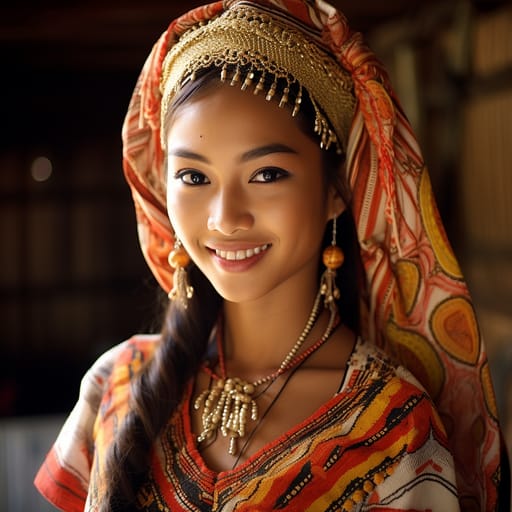
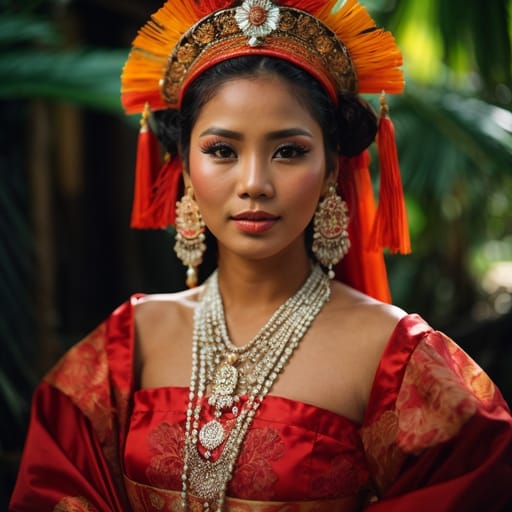
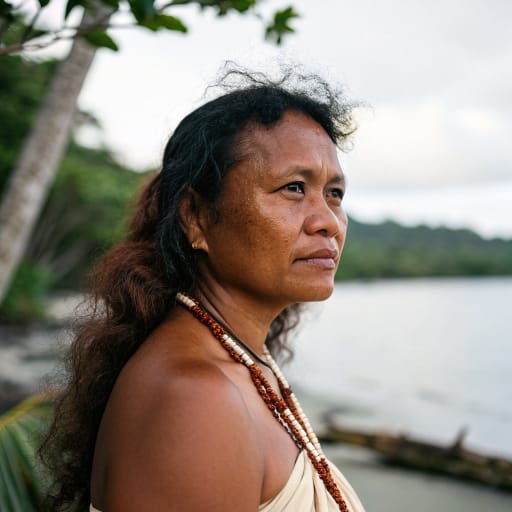
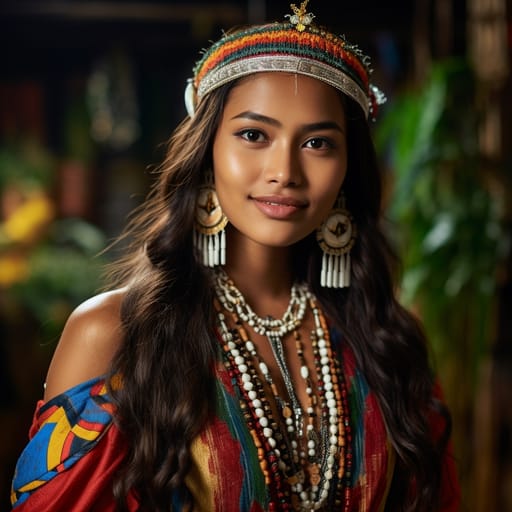
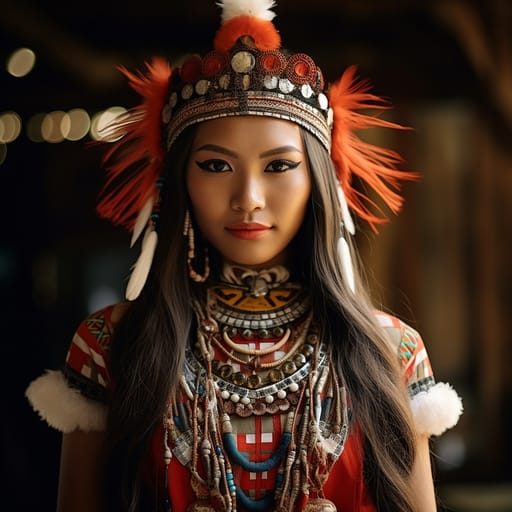
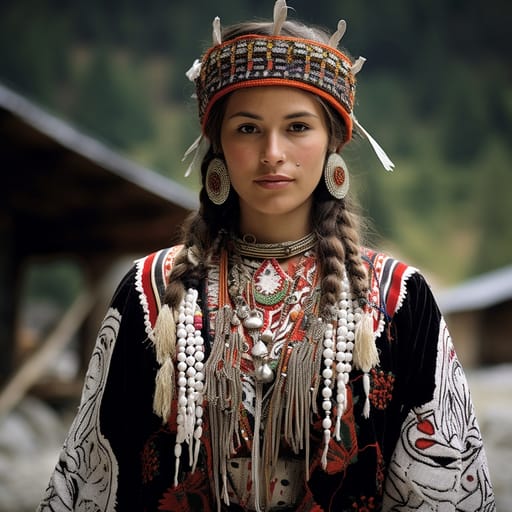
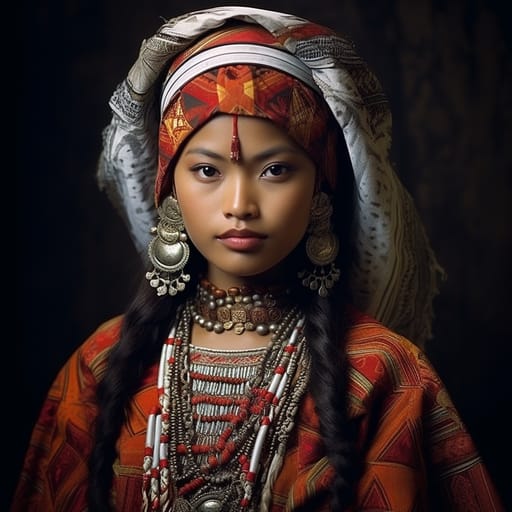
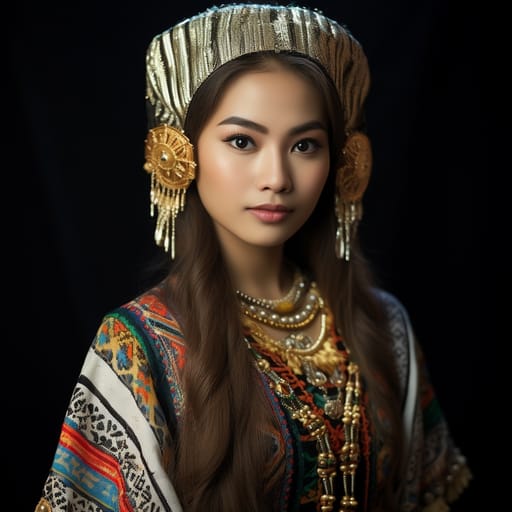
Typical Kapampangans Phenotypes
Reference for AI generation: hair, eyes, skin, facial structure, build
Kapampangans are a lowland Central Luzon population whose phenotype reflects the Austronesian (Malayo-Polynesian) Filipino baseline with a noticeable layer of Hispanic-Mexican admixture from the long colonial period and a thinner stratum of Hokkien Chinese ancestry from generations of mestizo intermarriage in towns like San Fernando, Bacolor, and Guagua. The result is a population that reads as visibly lighter and more European-influenced on average than many other Filipino regional groups, though plenty of Kapampangans sit firmly within the standard Southeast Asian range.
Hair is almost universally black to very dark brown, straight to gently wavy, with a soft to medium-coarse texture; natural light-brown highlights show up occasionally in mestizo lines. Eyes are dark brown to near-black, almond-shaped, with a low-set epicanthic fold that is usually present but often less pronounced than in Northeast Asian populations — a partial or "soft" fold is common, and a small mestizo minority show fully open lids and lighter brown irises. Skin tones run from Fitzpatrick III through V, with neutral-to-warm golden undertones; an honest distribution is roughly: a fair "mestizo" tier (III), a broad olive-tan majority (IV), and a sun-darkened farming and outdoor-worker tier (V). Sunburn is uncommon below the lightest tier; tanning is even and warm rather than ruddy.
Facial structure tends toward soft, rounded features: a low to medium nasal bridge with a slightly broader alar base than East Asian norms but narrower than Melanesian-influenced southern Filipino groups; medium-full lips, often with a defined cupid's bow; round to lightly heart-shaped face with moderate cheekbones and a small, often slightly recessed chin. The "Kapampangan mestiza" look — fair skin, soft features, faint epicanthic fold, wavy dark hair — is a recognizable regional archetype.
Build is small-to-medium framed: average male stature roughly 162–168 cm, female 150–156 cm, with short-to-medium limb proportions, narrow shoulders relative to hips in women, and a tendency toward soft, even fat distribution rather than muscular definition without training.
Kapampangans Body & Anatomy Reference
Per-feature anatomical profile for AI nude generation: Southeast Asian Austronesian / Austroasiatic phenotype
Kapampangans Boobs & Breasts
Kapampangans tits and boobs run small-to-medium cup, modest projection, the classic Southeast Asian Austronesian / Austroasiatic bust profile. Kapampangans nipples and areolas show medium-brown to dark-brown areolar pigmentation against the tan-to-medium-brown skin tone, with areolar diameter typically in the 26-38mm range and forward-set positioning rather than the fuller South Asian or Polynesian bust. Kapampangans breasts trend firm, modest projection, a function of the ectomorph, petite frame body habitus and the mean adult female BMI 20-23. For anatomically accurate AI-generated Kapampangans nudes the render preserves the small-to-medium cup, modest projection shape, 26-38mm areolas with medium-brown to dark-brown pigmentation, and the torso proportions of the Southeast Asian Austronesian / Austroasiatic phenotype.
Kapampangans Ass & Hips
Kapampangans hips and butt usually read as small-to-medium, modest projection, narrower hip profile. The skeletal base is narrow-to-medium iliac crests, the Southeast Asian Austronesian / Austroasiatic pattern. Set against the fuller glutes of the Pacific Islander phenotype, the difference is easy to see, and the hip-to-waist ratio is often what identifies Kapampangans women in photos.
Kapampangans Vagina & Pussy
Expect medium-brown to dark-brown labial pigmentation on Kapampangans women, in keeping with Southeast Asian Austronesian / Austroasiatic ancestry. The pubic hair is straight-to-wavy fine-to-medium texture. Coloring should run evenly from the tan to medium-brown skin of the thighs to the labia, and Kapampangans nude imagery should keep the hair's straight-to-wavy fine-to-medium texture.
Kapampangans Dicks & Penis
Kapampangans dick and penile anatomy in adult AI generation should anchor on the regional reference data: regional mean ~11cm erect, moderate girth, and medium-brown shaft pigmentation. The Kapampangans cock profile reflects the Southeast Asian Austronesian / Austroasiatic population's anthropometric measurements. The shaft pigmentation should track the surrounding tan to medium-brown skin tone, and the pubic hair should keep its straight-to-wavy fine-to-medium texture in the typical inverted-V escutcheon.
Kapampangans Body, Curves & Build
Kapampangans body type: ectomorph, petite frame, with mean adult female BMI 20-23. This is the typical Southeast Asian Austronesian / Austroasiatic build. Height range, shoulder-to-hip ratio and fat distribution all follow from it, which is what an accurate Kapampangans nude body should show.
Kapampangans Skin Tone & Hair Texture
Kapampangans skin tone falls in the tan to medium-brown (Fitzpatrick III-V) band, the surface signal most often miscalibrated by generic AI nude generators. Kapampangans hair texture is typically straight-to-wavy 1A-2A, dark-brown to black, characteristic of the Southeast Asian Austronesian / Austroasiatic phenotype. In Kapampangans nude renders the skin should hold that band consistently across the body.
Data depth
0/100Coverage of image-grounded phenotype observations · drives AI generation diversity
- Sample size
- 0/40· 0 images
- Image quality
- 0/30· 0% high
- Confidence
- 0/20
- Source diversity
- 0/10
- ·No image observations yet
Explore phenotype categories
Structured taxonomy with peer-reviewed scales · 22 anatomical categories
Erotic Poses & Sex Positions
From the pose catalog: 219 named positions with reference skeletons
Frequently asked questions about Kapampangans people
Where is the Kapampangans homeland?
The Kapampangans homeland is Pampanga (Philippines) in Southeast Asia.
What language do Kapampangans people speak?
Kapampangans people primarily speak Austronesian / Philippine / Kapampangan.
What religion do Kapampangans people practice?
The predominant religion among Kapampangans people is Christianity / Catholicism.
What are other names for Kapampangans people?
Kapampangans people are also known as Kapampangan.






Make your own Kapampangans images
Five a day, free, no credits to buy. The studio starts from this group's phenotype data, so you can set body type, pose and style and keep the traits accurate.
Start with Kapampangans