No image yet

Haddad Erotic

Homeland

Western and central Chad, especially Kanem, Bahr el Ghazal and the Lake Chad shore, with smaller communities in eastern Niger

Language

Kanembu and Dazaga (Saharan) or Chadian Arabic (Semitic, Afroasiatic), depending on the host community; no separate Haddad language

Religion

Sunni Islam

Subgroups

Not a single ethnic group but a hereditary caste of hunters and artisans; called Duu among the Kanembu and Aza among the Daza and Teda (Tubu), with other communities living among Chadian Arabs

About Haddad People

The Haddad are defined less by where they come from than by where they have been placed. The name is Arabic for smith, and across Chad and the edge of neighboring Niger it marks a hereditary class of hunters and craftworkers who live among larger peoples without ever fully belonging to them. A Haddad family in Kanem speaks Kanembu, dresses like its Kanembu neighbors and prays in the same mosques. Once marriage comes up, though, the family is set apart. That boundary has held for generations, and it is what makes the Haddad a recognizable group at all.

There is no Haddad language. Each community speaks the language of the society it is attached to: Kanembu around Lake Chad and in southern Kanem, Dazaga among Daza and Teda communities farther north, and Chadian Arabic among Arab herders and in the towns. Each host people also has its own word for them. The Kanembu say Duu, and the Tubu say Aza. The name changes from place to place, but the social position mostly does not. The Haddad are Muslims like everyone around them, and sharing that faith has done little to loosen the old rules about who may marry whom.

The work tied to the name goes well beyond the forge. Haddad smiths have made spear points, hoes and knives, but many communities lived mainly by hunting, with nets or with bows, and leatherwork falls to them too. Herding and ruling groups in this part of the Sahel have long treated that kind of labor with both dependence and disdain. They need the tools, the leather goods and the meat, and they keep the people who supply them at a distance. Smiths are also widely believed to handle forces that others would rather not touch, so wariness sits alongside the contempt.

Where the Haddad came from is still argued over. Some see them as descendants of people who lived in the Lake Chad basin before the Kanem state took shape. Others see a status that families were born into rather than a separate ancestry. The present is clearer. Drought, the loss of much of the wildlife they once hunted and the pull of N'Djamena have pushed many Haddad toward farming, wage work and trade. In that life the caste line is quieter, but it still shows up in marriage, in reputation and in what people get called.

Typical Haddad Phenotypes

Reference for AI generation — hair, eyes, skin, facial structure, build

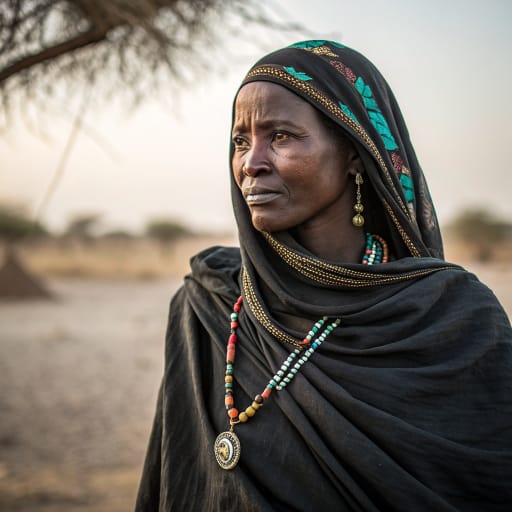
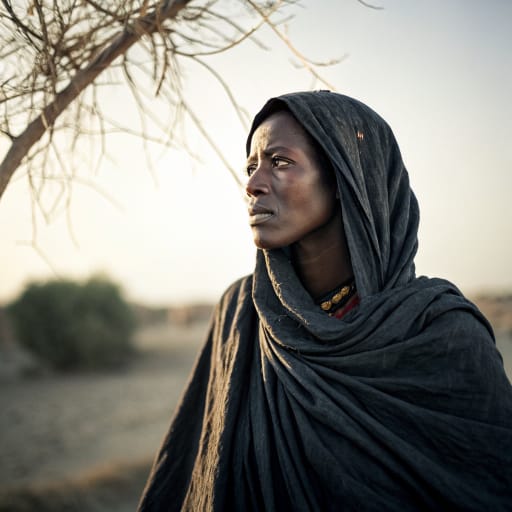
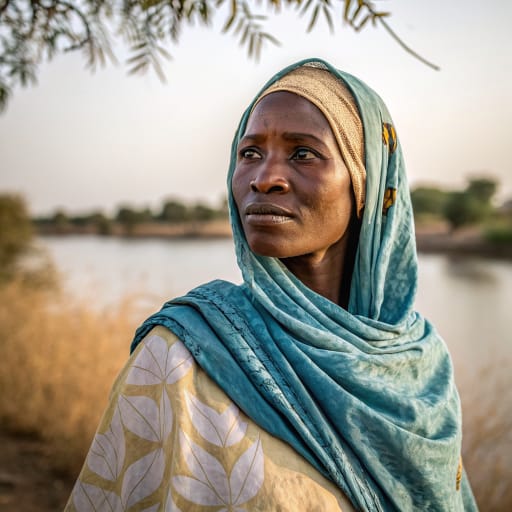
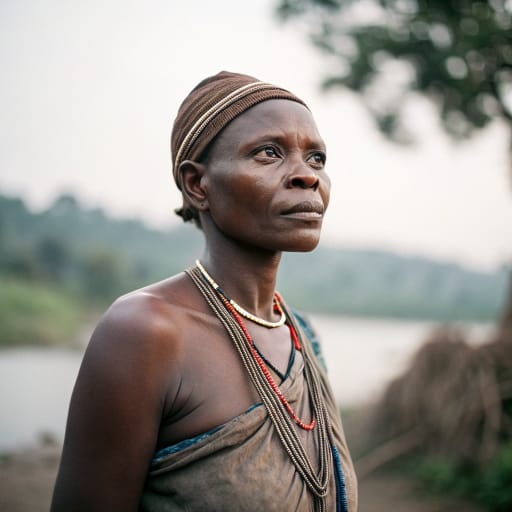
Physically the Haddad cannot be told apart from the peoples they live among; what sets them apart is social, not physical. Most have dark brown skin and the lean build common across the Chadian Sahel. Men usually wear long robes with a turban or cap, and women wear wrapped cloths with a head covering, following the dress of their Kanembu, Daza or Arab neighbors.

Haddad Body & Anatomy Reference

Per-feature anatomical profile for AI nude generation — Bantu / Central African Niger-Congo phenotype

Haddad Boobs & Breasts

Haddad tits and boobs run medium-to-large cup, full, projecting — the classic Bantu / Central African Niger-Congo bust profile. Haddad nipples and areolas show deep-brown areolar pigmentation against the deep-brown skin tone, with areolar diameter typically in the 32-48mm range and forward-set positioning rather than the smaller East African conical profile. Haddad breasts trend fuller projection than East African; comparable to West African norm, a function of the mesomorph with strong gluteal-femoral fat deposition body habitus and the mean adult female BMI 23-26. For anatomically-accurate AI-generated Haddad nudes the render preserves: medium-to-large cup, full, projecting shape, 32-48mm areolas with deep-brown pigmentation, and the torso proportions of the Bantu / Central African Niger-Congo phenotype.

Haddad Ass & Hips

Haddad ass and hip morphology presents as full, projected, wide-set glutes — distinctly different from the slim narrow-hip Cushitic East African profile. The Haddad pelvic profile shows broad iliac crests, gynoid pelvic pattern, anchored in the Bantu / Central African Niger-Congo skeletal pattern. Haddad butt shots in adult AI imagery should render the full, projected, wide-set glutes silhouette with the mesomorph with strong gluteal-femoral fat deposition build and the gluteal-femoral fat distribution typical of the Bantu / Central African Niger-Congo phenotype rather than defaulting to a globally-averaged "ethnic" butt that generic AI generators produce. The hip-to-waist ratio characteristic of Haddad women is one of the identifying features of the Bantu / Central African Niger-Congo regional phenotype.

Haddad Vagina & Pussy

Haddad pussy and vulvar anatomy presents deep-brown labial pigmentation, fuller labia minora — consistent with the Bantu / Central African Niger-Congo phenotype's pigmentation pattern. Haddad pubic hair is typically tightly-coiled coarse texture, dense distribution, distributed in the inverted-triangle pattern with regional-typical density. AI-generated Haddad nude imagery should preserve the deep-brown labial pigmentation and the tightly-coiled coarse texture hair texture rather than defaulting to a Western-European pink-and-sparse template. For anatomically-accurate Haddad pussy renders the labial pigmentation and coloration should match the surrounding deep-brown skin tone of the Bantu / Central African Niger-Congo phenotype, with continuous gradient rather than an abrupt color transition.

Haddad Dicks & Penis

Haddad dick and penile anatomy in adult AI generation should anchor on the regional reference data: regional mean ~14cm erect, above-average girth, and deep-brown shaft pigmentation. The Haddad cock profile reflects the Bantu / Central African Niger-Congo ancestral population's anthropometric measurements rather than a globally-averaged Western-pornography default. For anatomically-accurate Haddad nude male imagery the shaft pigmentation should track the surrounding deep-brown skin tone, the glans-to-shaft pigmentation transition should be continuous, and the pubic hair pattern should match tightly-coiled coarse texture texture distributed in the typical inverted-V escutcheon. Circumcision status in Haddad populations varies by religious-cultural tradition rather than ancestral phenotype.

Haddad Body, Curves & Build

Haddad body type and overall build presents as mesomorph with strong gluteal-femoral fat deposition, with mean adult female BMI 23-26 — the characteristic Bantu / Central African Niger-Congo habitus. Haddad curves and proportions in adult AI imagery should preserve the regional skeletal frame (height, shoulder-to-hip ratio, limb proportions) rather than scaling to a Western-European mesomorph default. The Haddad nude female form, when rendered with anatomical fidelity, shows the height range, frame width, and adipose distribution pattern typical of the Bantu / Central African Niger-Congo phenotype. Generic AI image generators tend to collapse regional body types into a few default shapes; the EthnicErotic phenotype-anchored approach preserves the Haddad build as its own reference category.

Haddad Skin Tone & Hair Texture

Haddad skin tone falls in the deep-brown (Fitzpatrick VI) band — the surface signal most often miscalibrated by generic AI nude generators trained on Western-photographic datasets. Haddad hair texture is typically tight 4A-4C coil, characteristic of the Bantu / Central African Niger-Congo phenotype. For anatomically-accurate Haddad nude renders the skin should hold the Fitzpatrick band consistently across body surface rather than showing the lighter-than-face body shading that AI generators default to. Haddad hair pigmentation and texture on body, pubic, and head should match across the figure rather than mixing textures (a common AI artefact).

Get notified when there’s a new post about Haddad.

Discussion Board

Have a view on this? Sign in to post — your first one earns 2 generation credits.

No posts on this board yet

Log in to start the conversation.

See what’s active across the community →

Erotic Poses & Sex Positions

From the pose catalog — 219 named positions with reference skeletons

Frequently asked questions about Haddad people

Where is the Haddad homeland?

The Haddad homeland is Western and central Chad, especially Kanem, Bahr el Ghazal and the Lake Chad shore, with smaller communities in eastern Niger in Central Africa.

What language do Haddad people speak?

Haddad people primarily speak Kanembu and Dazaga (Saharan) or Chadian Arabic (Semitic, Afroasiatic), depending on the host community; no separate Haddad language.

What religion do Haddad people practice?

The predominant religion among Haddad people is Sunni Islam.

What does a typical Haddad woman look like?

Physically the Haddad cannot be told apart from the peoples they live among; what sets them apart is social, not physical. Most have dark brown skin and the lean build common across the Chadian Sahel.