No image yet

Digo Erotic

Homeland

Southern coast of Kenya (Kwale County, south of Mombasa) and the adjoining northeastern coast of Tanzania (Tanga Region)

Language

Chidigo (Bantu, Sabaki branch of Northeast Coast Bantu); Swahili widely spoken as an everyday second language

Religion

Predominantly Sunni Islam, alongside continuing practices of spirit possession, traditional healing and kaya forest ritual

Subgroups

One of the nine Mijikenda peoples, with the Giriama, Duruma, Rabai, Chonyi, Kambe, Ribe, Jibana and Kauma; split between Kenyan and Tanzanian communities by the international border

About Digo People

The Digo are the southernmost of the nine Mijikenda peoples and the most closely tied to the Muslim Swahili world of the East African coast. Their country runs along the shore and the low coastal ridge south of Mombasa, through Kwale County in Kenya and over the border into the Tanga Region of Tanzania. It is a country of coconut palms, cassava and maize plots, mangrove creeks and small fishing landings. These days it also takes in the resort strip at Diani, where hotel jobs are a short walk from farming villages that have stood for generations.

Like the other Mijikenda, the Digo remember a northern homeland called Shungwaya and a migration south into the forested hills behind the coast. There they built fortified settlements known as kaya: clearings deep in the forest, with a protective charm buried at the center and elders who governed from inside. The Digo moved out of the kaya into open homesteads long ago, but the forests were never cut down. Kaya Kinondo, near Diani, is still kept by elders under strict rules about who may enter and what may be taken out. In 2008 the Mijikenda kaya forests were listed together as a UNESCO World Heritage site.

What sets the Digo apart from their Mijikenda neighbors most of all is Islam. Generations of trade, marriage and politics with the coastal towns made them overwhelmingly Muslim, and a Digo village typically has its mosque and Quranic school. Older institutions have not gone away, though. Spirit possession, healers and divination remain part of life for many families. Descent was traditionally traced through the mother's line, an arrangement that has long sat uneasily with Islamic inheritance law.

Their language, Chidigo, belongs to the Sabaki group of Bantu languages, the same branch as Swahili, and nearly all Digo also use Swahili every day. In the late nineteenth century the colonial partition drew the boundary between British and German territory straight through Digo country, and that line became today's border between Kenya and Tanzania. More than a century later it still divides two states, not two peoples.

Typical Digo Phenotypes

Reference for AI generation — hair, eyes, skin, facial structure, build

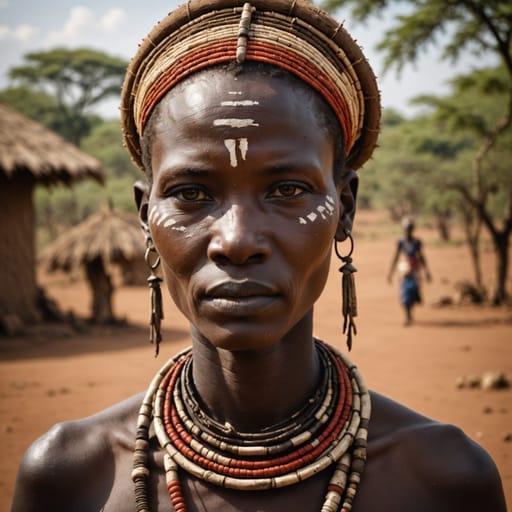
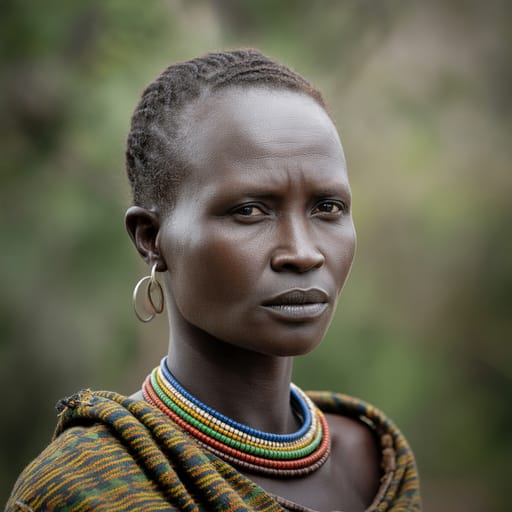
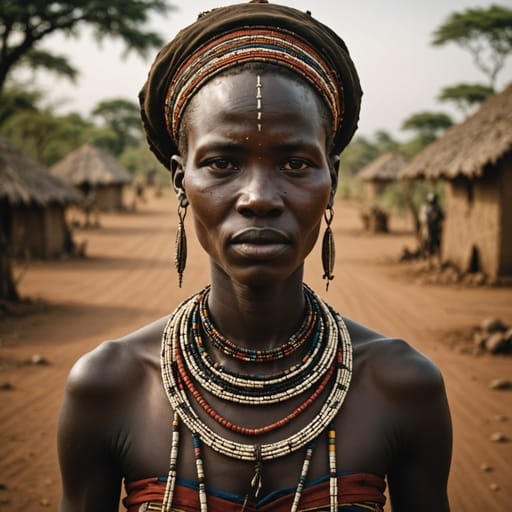
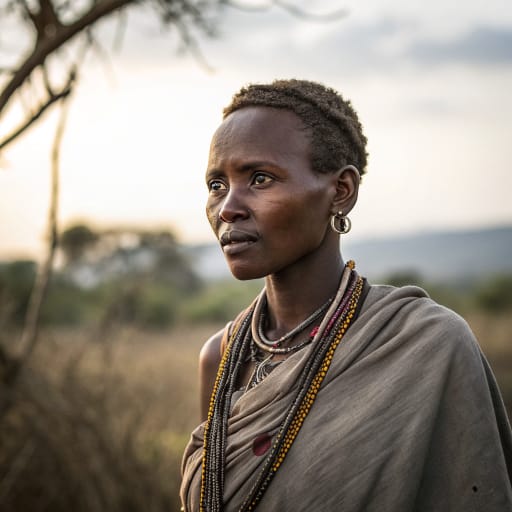
Dark brown skin and tightly coiled black hair, broadly similar to neighboring Bantu-speaking peoples of the coast. Everyday dress follows Muslim coastal fashion: men wear the long white kanzu with an embroidered kofia cap, or a kikoi wrap, and women wear printed kanga cloths and headscarves, often with a black buibui robe outdoors. Western clothing is common among younger people and in towns.

Digo Body & Anatomy Reference

Per-feature anatomical profile for AI nude generation — Cushitic / Nilo-Cushitic East African phenotype

Digo Boobs & Breasts

Digo tits and boobs run small-to-medium-cup, high-set, conical — the classic Cushitic / Nilo-Cushitic East African bust profile. Digo nipples and areolas show moderate-to-high areolar pigmentation against the brown-to-deep-brown skin tone, with areolar diameter typically in the 28-38mm range and forward-set positioning rather than the lateral spread of the West African phenotype. Digo breasts trend firmer and less projecting than the African-American or West African norm, a function of the lean ectomorph-to-mesomorph body habitus and the mean adult female BMI 19-22. For anatomically-accurate AI-generated Digo nudes the render preserves: small-to-medium-cup, high-set, conical shape, 28-38mm areolas with moderate-to-high pigmentation, and the torso proportions of the Cushitic / Nilo-Cushitic East African phenotype.

Digo Ass & Hips

Digo ass and hip morphology presents as small-to-medium, high-set, rounded — distinctly different from the wide-set heavy-projection West African or African-American norm. The Digo pelvic profile shows narrow-to-medium iliac crests, longer torso-to-leg ratio, anchored in the Cushitic / Nilo-Cushitic East African skeletal pattern. Digo butt shots in adult AI imagery should render the small-to-medium, high-set, rounded silhouette with the lean ectomorph-to-mesomorph build and the gluteal-femoral fat distribution typical of the Cushitic / Nilo-Cushitic East African phenotype rather than defaulting to a globally-averaged "ethnic" butt that generic AI generators produce. The hip-to-waist ratio characteristic of Digo women is one of the identifying features of the Cushitic / Nilo-Cushitic East African regional phenotype.

Digo Vagina & Pussy

Digo pussy and vulvar anatomy presents brown-to-deep-brown labial pigmentation, narrow-to-medium labia minora projection — consistent with the Cushitic / Nilo-Cushitic East African phenotype's pigmentation pattern. Digo pubic hair is typically tightly-coiled coarse texture, densely distributed, distributed in the inverted-triangle pattern with regional-typical density. AI-generated Digo nude imagery should preserve the brown-to-deep-brown labial pigmentation and the tightly-coiled coarse texture hair texture rather than defaulting to a Western-European pink-and-sparse template. For anatomically-accurate Digo pussy renders the labial pigmentation and coloration should match the surrounding brown to deep brown skin tone of the Cushitic / Nilo-Cushitic East African phenotype, with continuous gradient rather than an abrupt color transition.

Digo Dicks & Penis

Digo dick and penile anatomy in adult AI generation should anchor on the regional reference data: regional mean ~13.5cm erect, moderate girth, ~12cm circumference, and deeper-pigmented than the West African norm. The Digo cock profile reflects the Cushitic / Nilo-Cushitic East African ancestral population's anthropometric measurements rather than a globally-averaged Western-pornography default. For anatomically-accurate Digo nude male imagery the shaft pigmentation should track the surrounding brown to deep brown skin tone, the glans-to-shaft pigmentation transition should be continuous, and the pubic hair pattern should match tightly-coiled coarse texture texture distributed in the typical inverted-V escutcheon. Circumcision status in Digo populations varies by religious-cultural tradition rather than ancestral phenotype.

Digo Body, Curves & Build

Digo body type and overall build presents as lean ectomorph-to-mesomorph, with mean adult female BMI 19-22 — the characteristic Cushitic / Nilo-Cushitic East African habitus. Digo curves and proportions in adult AI imagery should preserve the regional skeletal frame (height, shoulder-to-hip ratio, limb proportions) rather than scaling to a Western-European mesomorph default. The Digo nude female form, when rendered with anatomical fidelity, shows the height range, frame width, and adipose distribution pattern typical of the Cushitic / Nilo-Cushitic East African phenotype. Generic AI image generators tend to collapse regional body types into a few default shapes; the EthnicErotic phenotype-anchored approach preserves the Digo build as its own reference category.

Digo Skin Tone & Hair Texture

Digo skin tone falls in the brown to deep brown (Fitzpatrick V-VI) band — the surface signal most often miscalibrated by generic AI nude generators trained on Western-photographic datasets. Digo hair texture is typically tight 4A-4C coil, often worn natural or in braided/twisted protective styles, characteristic of the Cushitic / Nilo-Cushitic East African phenotype. For anatomically-accurate Digo nude renders the skin should hold the Fitzpatrick band consistently across body surface rather than showing the lighter-than-face body shading that AI generators default to. Digo hair pigmentation and texture on body, pubic, and head should match across the figure rather than mixing textures (a common AI artefact).

Get notified when there’s a new post about Digo.

Discussion Board

Have a view on this? Sign in to post — your first one earns 2 generation credits.

No posts on this board yet

Log in to start the conversation.

See what’s active across the community →

Frequently asked questions about Digo people

Where is the Digo homeland?

The Digo homeland is Southern coast of Kenya (Kwale County, south of Mombasa) and the adjoining northeastern coast of Tanzania (Tanga Region) in Eastern Africa.

What language do Digo people speak?

Digo people primarily speak Chidigo (Bantu, Sabaki branch of Northeast Coast Bantu); Swahili widely spoken as an everyday second language.

What religion do Digo people practice?

The predominant religion among Digo people is Predominantly Sunni Islam, alongside continuing practices of spirit possession, traditional healing and kaya forest ritual.


What does a typical Digo woman look like?

Dark brown skin and tightly coiled black hair, broadly similar to neighboring Bantu-speaking peoples of the coast. Everyday dress follows Muslim coastal fashion: men wear the long white kanzu with an embroidered kofia cap, or a kikoi wrap, and women wear printed kanga cloths and headscarves, often with a black buibui robe outdoors.