Help us get this right
Does this portrait look right for Chimbu?
Nobody has judged this one yet. You would be the first.
Chimbu Erotic
Chimbu (Simbu) Province in the central highlands of Papua New Guinea, around Kundiawa and the Chimbu, Koronigl and upper Wahgi valleys below Mount Wilhelm; migrant communities in Port Moresby, Lae and Goroka.
Kuman (Chimbu-Wahgi family, usually placed within Trans-New Guinea); related Chimbu languages include Golin, Sinasina, Dom and Chuave. Tok Pisin is the common second language.
Christian, mainly Roman Catholic and Lutheran, alongside persisting beliefs in ancestral spirits and witchcraft (kumo).
Highland Papuan peoples of the Chimbu-Wahgi language group. Narrowly the Kuman speakers; broadly also the Golin, Sinasina, Dom, Chuave, Salt-Yui and Nomane of the same province. Organized in patrilineal clans and named tribes.
About Chimbu People
The Chimbu, who mostly spell it Simbu today, are the people of the steep central highlands of Papua New Guinea, packed into the valleys of the Chimbu, Koronigl and upper Wahgi rivers below Mount Wilhelm, the country's highest peak. The name is an accident of first contact. When an Australian patrol walked in during 1933, as the story goes, people greeted the gifts they were handed with simbu, an exclamation of pleased surprise in Kuman, and the outsiders wrote it down as the name of the place and everyone in it. Strictly, the Chimbu are the Kuman speakers around Kundiawa and the valleys to its north. Loosely, the word also covers neighbors across the province such as the Golin, Sinasina, Dom and Chuave, whose languages sit with Kuman in the Chimbu-Wahgi family. Tok Pisin handles dealings with everyone else.
What shapes Chimbu life is pressure on land. This is some of the most densely settled country in New Guinea, and sweet potato gardens climb slopes that look too steep to stand on, fenced against pigs and laid out to hold the soil. People belong to patrilineal clans grouped into named tribes, and land rights, marriage payments, compensation claims and old enmities all run along those lines. Leadership was earned, not inherited: a big man made his name by organizing exchanges and speaking well. The grandest exchange was the bugla gende, the great pig feast a tribe staged after years of building its herds, when hundreds of animals were killed, allies were repaid, and dancers turned out in plumes and shell. Men once slept in communal men's houses while women, children and pigs lived near the gardens. Family houses have largely replaced that arrangement.
Missionaries followed the patrols within a year, Catholics settling at Mingende and Lutherans near Kundiawa, and nearly all Chimbu now count themselves Christian, mostly in those two churches. Older convictions about ancestral ghosts and about kumo, witchcraft, have not gone away, and accusations after an unexpected death remain a real and sometimes violent problem. Coffee arrived in the 1950s and is still the main source of cash, but there is not enough ground to go around. Chimbu have been leaving for decades, first to coastal plantations, then to Port Moresby, Lae and Goroka, where they are known as energetic traders, public servants and politicians. Outsiders tend to know them for the skeleton dancers, painted head to foot in black and white bones, who appear at the Goroka and Mount Hagen shows. That is one small performance tradition in a society with far more going on.
Related ethnic groups
Groups that share Chimbu's homeland, region, language, or religious tradition. These are likely candidates for comparative phenotype reference.
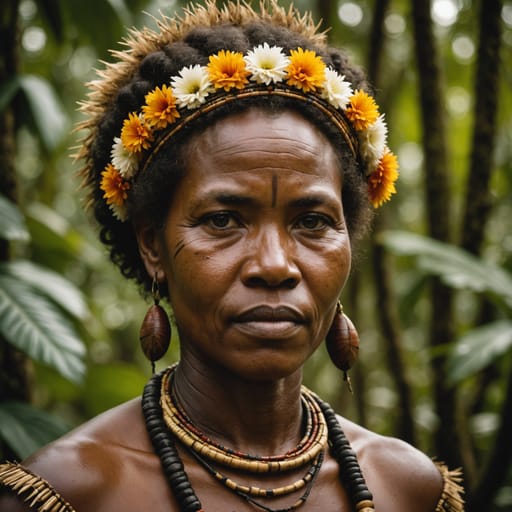
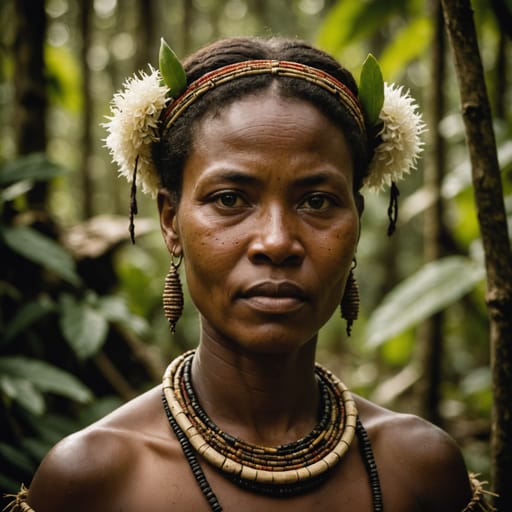
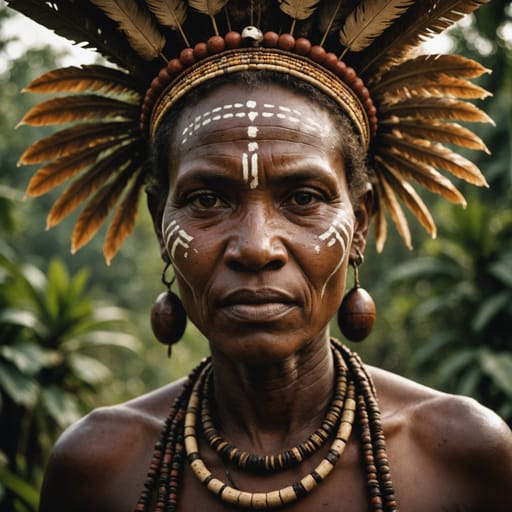
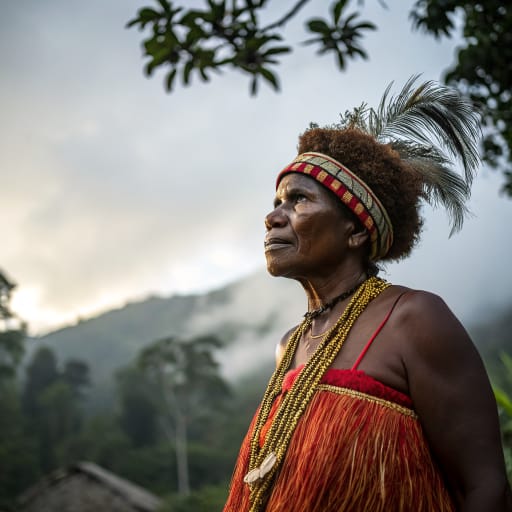
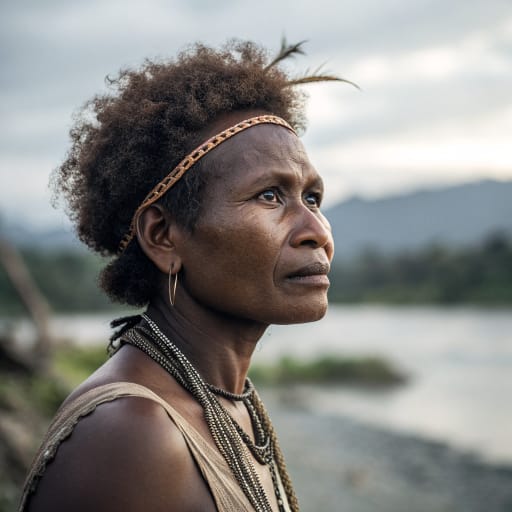
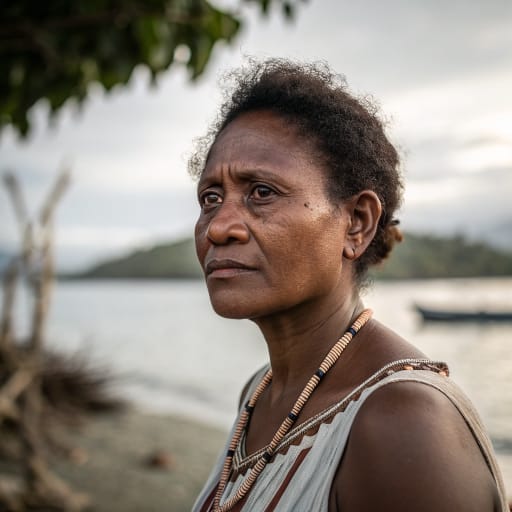
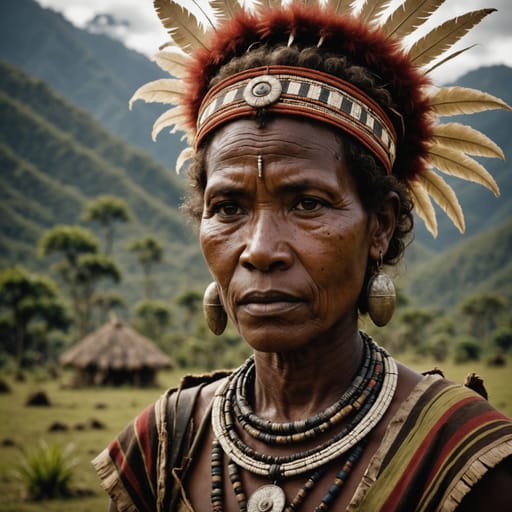
Typical Chimbu Phenotypes
Reference for AI generation: hair, eyes, skin, facial structure, build
Chimbu Body & Anatomy Reference
Per-feature anatomical profile for AI nude generation: Melanesian / Papuan phenotype
Chimbu Boobs & Breasts
Chimbu boobs follow the Melanesian / Papuan profile: medium-to-large cup, full, moderate projection. Areolar diameter is usually 32-46mm, and the coloring is deep-brown to near-black areolar pigmentation against the deep-brown skin tone. Breast shape tracks body composition (mesomorph, mean adult female BMI 25-28), so Chimbu breasts tend to be full, moderate projection. Expect a forward-set shape, not the smaller Aboriginal Australian bust.
Chimbu Ass & Hips
Chimbu ass and hip morphology presents as medium-to-full, moderate-to-high projection, distinctly different from the slim Aboriginal Australian narrow-hip profile. The Chimbu pelvic profile shows medium-to-wide iliac crests, full gluteal-femoral fat deposition, anchored in the Melanesian / Papuan skeletal pattern. Chimbu butt shots in adult AI imagery should render the medium-to-full, moderate-to-high projection silhouette with the overall build (mesomorph) and the fat distribution typical of the Melanesian / Papuan phenotype.
Chimbu Vagina & Pussy
Chimbu pussy anatomy typically shows deep-brown labial pigmentation. Pubic hair is usually tightly-coiled coarse texture, dense distribution. In AI-generated Chimbu nudes, labial color should blend into the deep-brown skin with a gradual transition, and the hair should keep its tightly-coiled coarse texture.
Chimbu Dicks & Penis
Penis reference for Chimbu men: regional mean ~13cm erect, moderate-to-above-average girth. Coloring: deep-brown shaft pigmentation. An accurate Chimbu cock in AI imagery matches the surrounding deep-brown skin rather than a generic porn default. Circumcision depends on religion and custom, not ancestry.
Chimbu Body, Curves & Build
The Chimbu figure is generally mesomorph, with mean adult female BMI 25-28, characteristic of Melanesian / Papuan ancestry. AI image tools tend to flatten regional body types into a few stock shapes; here the Chimbu build is kept as its own reference.
Chimbu Skin Tone & Hair Texture
Skin: deep-brown (Fitzpatrick V-VI); the distinctive blond-hair-on-dark-skin trait widely documented in Solomon Islands populations. Hair: tight 4A-4C coil; the blond-on-dark trait is a TYRP1 variant unique to Melanesia. Both are typical of Melanesian / Papuan ancestry. The most common mistake in AI nudes of Chimbu women is a body rendered lighter than the face.
Explore phenotype categories
Structured taxonomy with peer-reviewed scales · 22 anatomical categories
Erotic Poses & Sex Positions
From the pose catalog: 219 named positions with reference skeletons
Frequently asked questions about Chimbu people
Where is the Chimbu homeland?
The Chimbu homeland is Chimbu (Simbu) Province in the central highlands of Papua New Guinea, around Kundiawa and the Chimbu, Koronigl and upper Wahgi valleys below Mount Wilhelm; migrant communities in Port Moresby, Lae and Goroka. in Melanesia.
What language do Chimbu people speak?
Chimbu people primarily speak Kuman (Chimbu-Wahgi family, usually placed within Trans-New Guinea); related Chimbu languages include Golin, Sinasina, Dom and Chuave. Tok Pisin is the common second language..
What religion do Chimbu people practice?
The predominant religion among Chimbu people is Christian, mainly Roman Catholic and Lutheran, alongside persisting beliefs in ancestral spirits and witchcraft (kumo)..






Make your own Chimbu images
Five a day, free, no credits to buy. The studio starts from this group's phenotype data, so you can set body type, pose and style and keep the traits accurate.
Start with Chimbu