Help us get this right
Does this portrait look right for Camunni?
Nobody has judged this one yet. You would be the first.
Camunni Erotic
Val Camonica, the upper Oglio valley in the central Alps, province of Brescia, Lombardy, northern Italy.
Camunic, written in a north Italic alphabet derived from Etruscan. Classification unresolved: tentatively linked to Rhaetic, with Celtic influence argued by some.
Pre-Roman Alpine religion centered on springs, rock sanctuaries and an antlered deity, later merged into Roman cult after 16 BC, as at the Minerva sanctuary at Spinera.
One of the pre-Roman Alpine peoples. Assigned by Pliny to the Euganei and by Strabo to the Rhaetian tribes. Neighbors of the Rhaetians, Lepontii and the Cenomani Gauls. The modern Camuni of Val Camonica are their descendants.
About Camunni People
The Camunni were an Iron Age people of the central Alps, conquered by Rome in 16 BC and absorbed over the following centuries into the population of the valley they came from, Val Camonica, where the inhabitants still call themselves Camuni today. The valley is the deep glacial trench the Oglio cuts north of Brescia, in what is now Lombardy. Ancient writers could not agree on who the Camunni were: Pliny filed them with the Euganei, Strabo counted them among the Rhaetians to the north, and the Roman victory monument at La Turbie simply listed them alongside dozens of other Alpine tribes that had made the passes dangerous. Their own language is no help. They wrote it in an alphabet borrowed from Etruscan by way of their northern neighbors, and fewer than two hundred short inscriptions survive. The letters can be sounded out; the language behind them has never been convincingly placed. The closest arguments tie it to Rhaetic, others hear Celtic in it, and it may be the tail end of something older than either. After the conquest the valley became the Civitas Camunnorum, its center at modern Cividate Camuno, with a theater and an amphitheater to go with the name, and within a few generations local men were putting up Latin epitaphs.
They are known now for what they carved. The rock faces of the valley hold one of the largest bodies of prehistoric engraving anywhere, well over a hundred thousand figures, and the first site in Italy that UNESCO added to its list. Carving there began thousands of years before the Camunni were a recognizable people and did not stop when Rome arrived, but the Iron Age is its loudest phase: praying figures with arms raised, duelists in crested helmets, hunters, plowmen, wagons, houses on posts, footprints, and overhead compositions of walled fields that look uncannily like maps. One panel shows an antlered figure with torcs and a snake beside it, usually read as a horned god of a kind found across the Celtic world. Worship here attached to water and to particular places: at Spinera, near Breno, a spring sanctuary was in use long before the Romans rebuilt it as a temple of Minerva, which is what conquerors do with a shrine they cannot dislodge. One of the engraved motifs, a looping figure of nine cup marks known as the Camunian rose, is now the emblem of the Lombardy region. That is an unusual afterlife for a symbol nobody can read.
Related ethnic groups
Groups that share Camunni's homeland, region, language, or religious tradition. These are likely candidates for comparative phenotype reference.
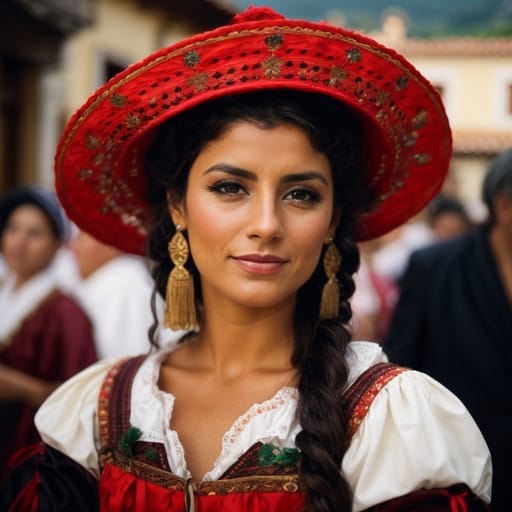
Basques
same region (Southern Europe)
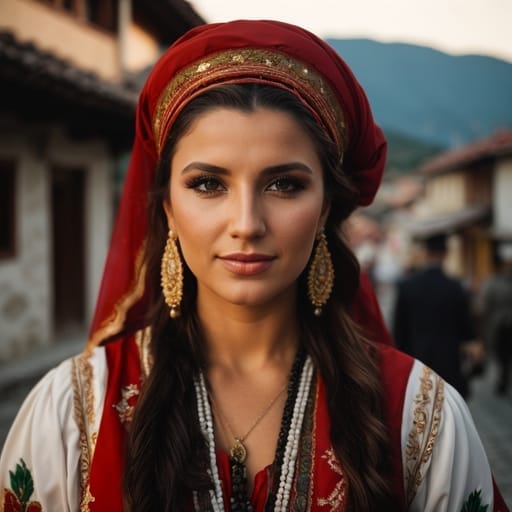
Bosniaks
same region (Southern Europe)
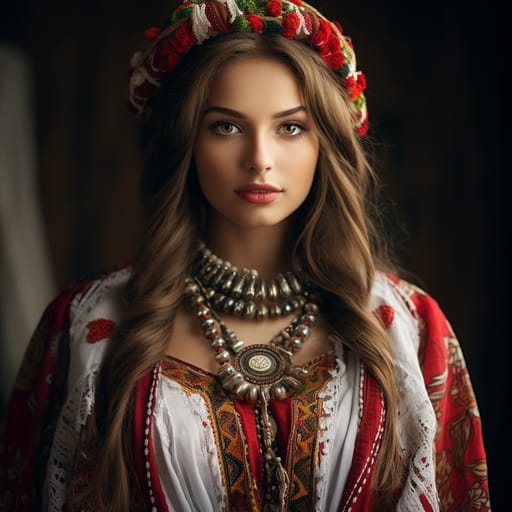
Moldovans
same region (Southern Europe)
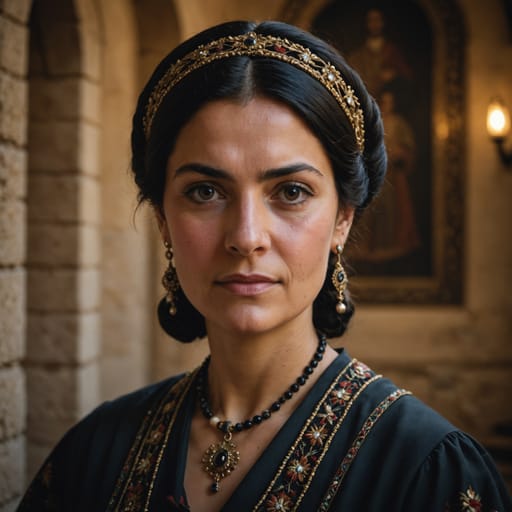
Maltese
same region (Southern Europe)
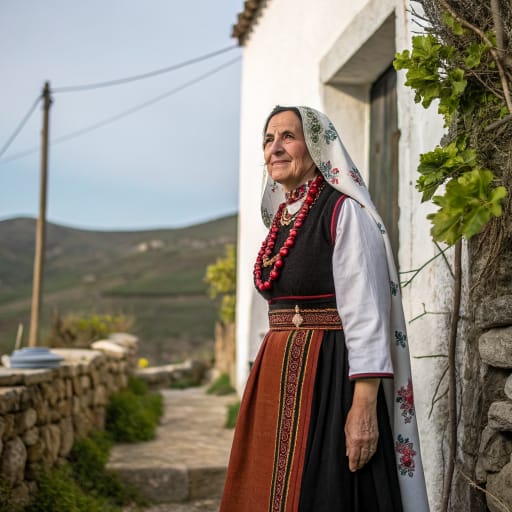
Celsitani
same region (Southern Europe)
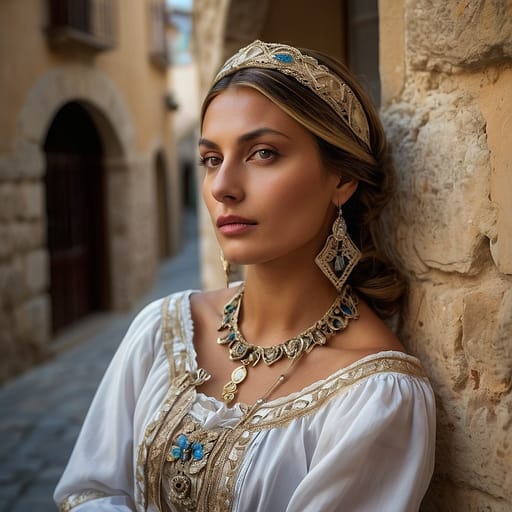
San Marino Italian
same region (Southern Europe)
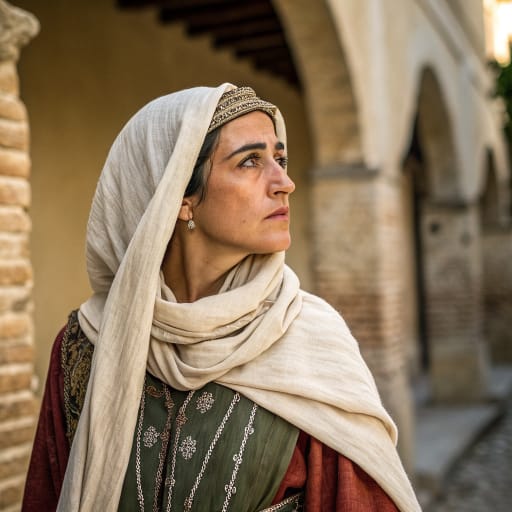
Mozarabs
same region (Southern Europe)
Sephardi Jews
same region (Southern Europe)
Typical Camunni Phenotypes
Reference for AI generation: hair, eyes, skin, facial structure, build
Camunni Body & Anatomy Reference
Southern European / Mediterranean phenotype: anatomy reference for AI nude generation
Camunni Boobs & Breasts
The typical Camunni bust is medium-to-large cup, full, moderate-to-high projection, in line with the wider Southern European / Mediterranean pattern. Areolas usually fall in the 32-46mm range, with medium-brown to dark-brown areolar pigmentation against the olive-to-light-brown skin tone. Compared with the lighter pigmentation of the Northern European bust, Camunni breasts sit forward and are generally full and projecting, generally the classic Mediterranean curvy bust profile. A faithful AI render of Camunni tits keeps that shape and areola size.
Camunni Ass & Hips
Butt shape among Camunni women: medium-to-full, moderate-to-high projection, broader hip profile, over medium-to-wide iliac crests, full gluteal-femoral fat distribution. This follows Southern European / Mediterranean ancestry and looks quite unlike the slim Northern European narrow-hip pattern. An accurate Camunni ass in adult AI imagery keeps both the silhouette and the overall build (mesomorph with full hip-and-bust deposition) instead of a generic average.
Camunni Vagina & Pussy
Vulvar anatomy among Camunni women: medium-brown to dark-brown labial pigmentation, fuller labia minora. Pubic hair tends to be wavy-to-curly medium-coarse dark texture, dense distribution, in the usual inverted-triangle pattern. Both follow Southern European / Mediterranean pigmentation, which is why Camunni pussy renders should not fall back on a pale, sparse Western template.
Camunni Dicks & Penis
The Camunni cock profile, from Southern European / Mediterranean anthropometric data: regional mean ~13-14cm erect; moderate girth; medium-brown shaft pigmentation. Pubic hair has a wavy-to-curly medium-coarse dark texture and forms the usual inverted-V pattern. Whether Camunni men are circumcised follows religious and cultural practice rather than phenotype.
Camunni Body, Curves & Build
Build and curves among Camunni women follow the Southern European / Mediterranean pattern: mesomorph with full hip-and-bust deposition, mean adult female BMI 24-28. Proportions matter as much as skin tone, so Camunni figures should keep their regional height and limb ratios.
Camunni Skin Tone & Hair Texture
The Camunni skin range is olive to medium (Fitzpatrick III-IV), and hair tends to be wavy-to-curly 2B-3B, dark-brown to black. That combination marks the Southern European / Mediterranean phenotype, and skin tone is the trait AI generators most often get wrong for Camunni women.
Explore phenotype categories
Structured taxonomy with peer-reviewed scales · 22 anatomical categories
Erotic Poses & Sex Positions
From the pose catalog: 219 named positions with reference skeletons
Frequently asked questions about Camunni people
Where is the Camunni homeland?
The Camunni homeland is Val Camonica, the upper Oglio valley in the central Alps, province of Brescia, Lombardy, northern Italy. in Southern Europe.
What language do Camunni people speak?
Camunni people primarily speak Camunic, written in a north Italic alphabet derived from Etruscan. Classification unresolved: tentatively linked to Rhaetic, with Celtic influence argued by some..
What religion do Camunni people practice?
The predominant religion among Camunni people is Pre-Roman Alpine religion centered on springs, rock sanctuaries and an antlered deity, later merged into Roman cult after 16 BC, as at the Minerva sanctuary at Spinera..






Make your own Camunni images
Five a day, free, no credits to buy. The studio starts from this group's phenotype data, so you can set body type, pose and style and keep the traits accurate.
Start with Camunni