Help us get this right
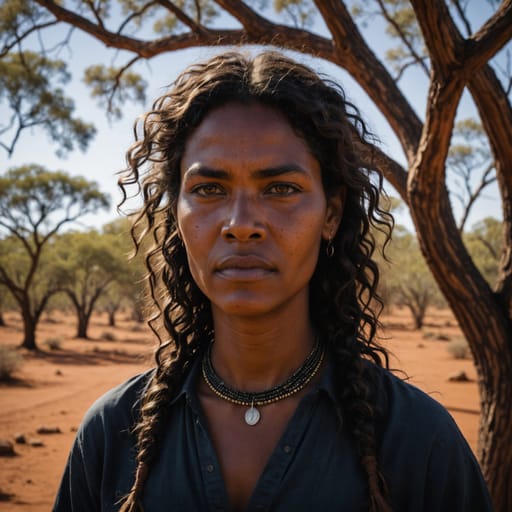
Does this portrait look right for Bundjalung?
Nobody has judged this one yet. You would be the first.
Bundjalung Erotic
Northern Rivers region of northeastern New South Wales, from the Clarence valley north through the Richmond and Tweed valleys to the border ranges, extending into southeastern Queensland, Australia
Bundjalung, a dialect chain closely related to Yugambeh (Bandjalangic, Pama-Nyungan); English is now the everyday language
Christianity, introduced through missions and reserves, alongside Aboriginal law and sacred sites such as Wollumbin
Aboriginal Australians; clans and dialect groups include the Githabul, Widjabul Wia-bal, Minjungbal, Arakwal and Waalubal, with the Yugambeh as close northern kin
About Bundjalung People
Travel north from the Clarence River to the Queensland border and you are in Bundjalung country for most of the way: the Richmond and Tweed valleys, the beaches at Ballina and Byron Bay, and the old volcanic ranges behind Lismore and Kyogle. The Bundjalung are not one tribe in the colonial sense. They are a nation of clans who share a language, a body of law and a set of ancestral stories. Each clan has its own dialect and its own stretch of river or coast. The Githabul hold the rainforest ranges along the border, the Widjabul Wia-bal the country around Lismore, the Minjungbal the lower Tweed and the Arakwal the headlands at Byron Bay. People introduce themselves by those names as readily as by the larger one.
The language is a chain of dialects, not one standard tongue. It belongs to the Bandjalangic branch of the Pama-Nyungan family. Yugambeh, spoken just to the north around the Gold Coast, is close enough that linguists often treat the two as one language. Gumbaynggirr, to the south, sits in a separate branch. By the late twentieth century few fluent speakers were left, and today's community classes and school programs draw heavily on work recorded with elders from the 1960s onward. Some of the language is on the map: Nimbin and Wollumbin both come from Bundjalung speech.
Law and country are bound together through sacred places. The best known is Wollumbin, the peak Captain Cook named Mount Warning. Custodians have long asked visitors not to climb it, and the summit track has been closed since 2020. Bundjalung tradition also tells of three brothers who arrived from the sea, and their descendants became the clans. Christianity came in through the missions and reserves and is still part of community life, alongside ceremony and obligations to country.
Colonization moved quickly once cedar cutters pushed up the Richmond and Tweed in the 1840s, with sugar cane and dairy farming close behind. Massacres, including one at Evans Head, tore through the coastal clans. Survivors were pushed onto reserves such as Cabbage Tree Island, Box Ridge near Coraki and Muli Muli near Woodenbong, and all three are still Aboriginal communities. At Baryulgil on the Clarence, Aboriginal men mined asbestos for decades while dust from the tailings settled over the settlement nearby. The illness that followed led to a federal parliamentary inquiry in the 1980s. In 2007 the Githabul won recognition of native title over parks and forests along the border, one of several land and heritage wins for a people who have stayed on their country throughout.
Related ethnic groups
Groups that share Bundjalung's homeland, region, language, or religious tradition. These are likely candidates for comparative phenotype reference.
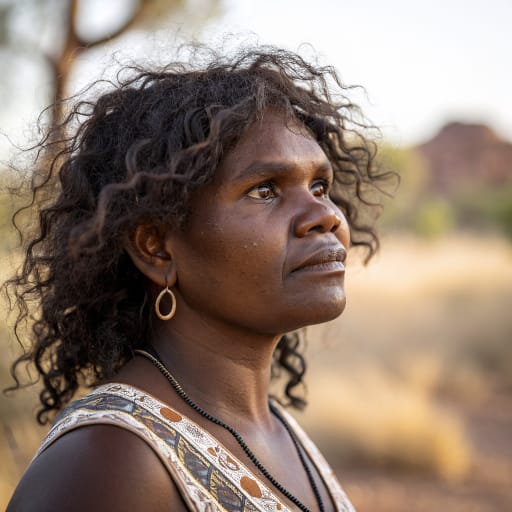
Arrernte
same region (Australia / New Zealand)
Noongar
same region (Australia / New Zealand)
Yolngu
same region (Australia / New Zealand)
Tiwi
same region (Australia / New Zealand)
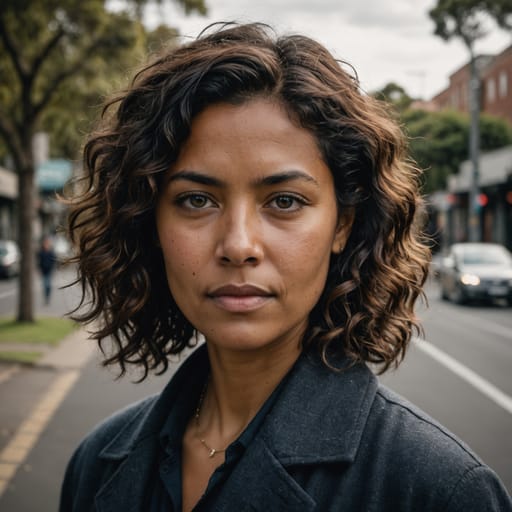
Wurundjeri
same region (Australia / New Zealand)
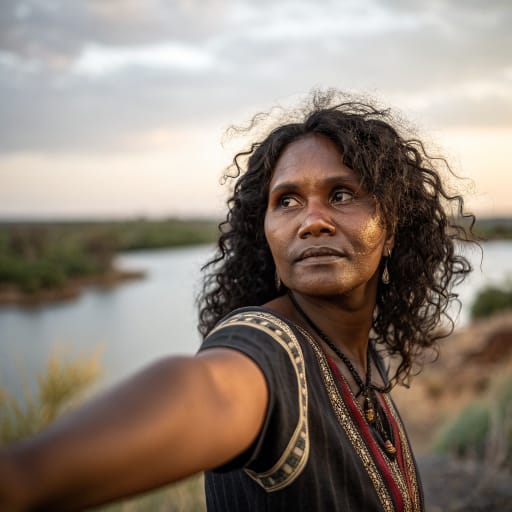
Alyawarre
same region (Australia / New Zealand)
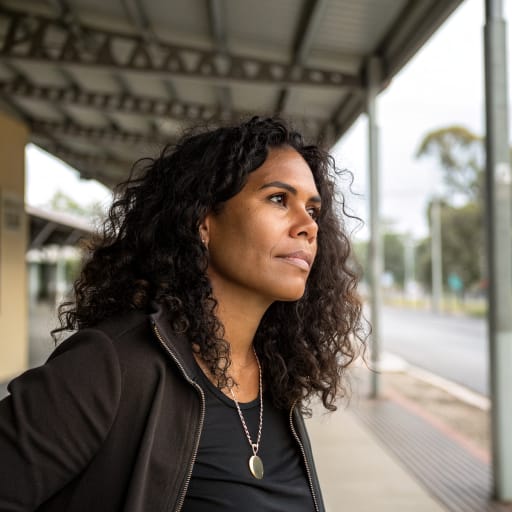
Jagera
same region (Australia / New Zealand)
Anmatyerre
same region (Australia / New Zealand)
Typical Bundjalung Phenotypes
Reference for AI generation: hair, eyes, skin, facial structure, build
Bundjalung Body & Anatomy Reference
Anatomy by feature, Aboriginal Australian phenotype
Bundjalung Boobs & Breasts
Bundjalung tits and boobs run small-to-medium cup, modest-to-moderate projection, the classic Aboriginal Australian bust profile. Bundjalung nipples and areolas show deep-brown to near-black areolar pigmentation against the deep-brown skin tone, with areolar diameter typically in the 28-42mm range and forward-set positioning rather than the fuller Polynesian or West African bust. Bundjalung breasts trend modest projection, firm, a function of the ectomorph-to-mesomorph, lean elongated frame adapted to arid environment body habitus and the mean adult female BMI 23-26. For anatomically accurate AI-generated Bundjalung nudes the render preserves the small-to-medium cup, modest-to-moderate projection shape, 28-42mm areolas with deep-brown to near-black pigmentation, and the torso proportions of the Aboriginal Australian phenotype.
Bundjalung Ass & Hips
Bundjalung hips and butt usually read as small-to-medium, modest projection, narrower hip profile. The skeletal base is narrow-to-medium iliac crests, longer torso and limb proportions, the Aboriginal Australian pattern. Set against the very full Polynesian gluteal projection, the difference is easy to see, and the hip-to-waist ratio is often what identifies Bundjalung women in photos.
Bundjalung Vagina & Pussy
Expect deep-brown labial pigmentation on Bundjalung women, in keeping with Aboriginal Australian ancestry. The pubic hair is wavy-to-coiled coarse texture. Coloring should run evenly from the deep-brown skin of the thighs to the labia, and Bundjalung nude imagery should keep the hair's wavy-to-coiled coarse texture.
Bundjalung Dicks & Penis
Bundjalung dick and penile anatomy in adult AI generation should anchor on the regional reference data: regional mean ~13cm erect, moderate girth, and deep-brown shaft pigmentation. The Bundjalung cock profile reflects the Aboriginal Australian population's anthropometric measurements. The shaft pigmentation should track the surrounding deep-brown skin tone, and the pubic hair should keep its wavy-to-coiled coarse texture in the typical inverted-V escutcheon.
Bundjalung Body, Curves & Build
Bundjalung body type: ectomorph-to-mesomorph, lean elongated frame adapted to arid environment, with mean adult female BMI 23-26. This is the typical Aboriginal Australian build. Height range, shoulder-to-hip ratio and fat distribution all follow from it, which is what an accurate Bundjalung nude body should show.
Bundjalung Skin Tone & Hair Texture
Bundjalung skin tone falls in the deep-brown (Fitzpatrick V-VI) band, the surface signal most often miscalibrated by generic AI nude generators. Bundjalung hair texture is typically wavy-to-curly 2C-3B, dark-brown to black; the distinctive blond-haired Aboriginal sub-population in Central Australia is documented and pigmentation-independent, characteristic of the Aboriginal Australian phenotype. In Bundjalung nude renders the skin should hold that band consistently across the body.
Explore phenotype categories
Structured taxonomy with peer-reviewed scales · 22 anatomical categories
Erotic Poses & Sex Positions
From the pose catalog: 219 named positions with reference skeletons
Frequently asked questions about Bundjalung people
Where is the Bundjalung homeland?
The Bundjalung homeland is Northern Rivers region of northeastern New South Wales, from the Clarence valley north through the Richmond and Tweed valleys to the border ranges, extending into southeastern Queensland, Australia in Australia / New Zealand.
What language do Bundjalung people speak?
Bundjalung people primarily speak Bundjalung, a dialect chain closely related to Yugambeh (Bandjalangic, Pama-Nyungan); English is now the everyday language.
What religion do Bundjalung people practice?
The predominant religion among Bundjalung people is Christianity, introduced through missions and reserves, alongside Aboriginal law and sacred sites such as Wollumbin.






Make your own Bundjalung images
Five a day, free, no credits to buy. The studio starts from this group's phenotype data, so you can set body type, pose and style and keep the traits accurate.
Start with Bundjalung