Help us get this right
Does this portrait look right for Bora?
Nobody has judged this one yet. You would be the first.
Bora Erotic
Northwest Amazon between the Putumayo and Caquetá rivers: the Ampiyacu and Yaguasyacu basins near Pebas in Loreto, Peru, with related Miraña communities in Amazonas, Colombia.
Bora, including the Miraña dialect (Boran family, often grouped with Witotoan as Bora-Witoto); Spanish is now dominant in most communities.
Traditional cosmology organized around tobacco and coca, overlaid by Catholic and evangelical Christianity.
The Miraña of Colombia speak a dialect of Bora; part of the regional People of the Center bloc alongside the Witoto (Murui-Muina), Ocaina, Muinane, Andoke, Nonuya and Resígaro.
About Bora People
The Bora are known first by sound. A pair of hollowed hardwood drums, the manguaré, stands in or beside the communal house, one cut to a higher pitch and one to a lower, and a man who knows how to strike them can push a message miles through the forest: come to the dance, bring fish, someone has died. It works because Bora is a tonal language, so the drum carries actual phrases rather than a code agreed on beforehand. Radio and cell signal have not retired the manguaré. It still opens a gathering.
Their country is the northwest Amazon, the low forest between the Putumayo and Caquetá rivers where Colombia and Peru meet. Most Bora now live on the Peruvian side, in villages along the Ampiyacu and Yaguasyacu near Pebas in Loreto, with a smaller cluster on the Momón outside Iquitos. The Miraña, who speak what is effectively the same language, stayed north in Colombia. That map is not ancestral. It was drawn by rubber. From the turn of the twentieth century the Casa Arana ran the Putumayo as a private labor colony, and the Bora, with the Ocaina, Andoke and Murui, were worked, starved and killed at a scale that Roger Casement's 1912 investigation laid in front of the British public. When the border war with Colombia broke out in 1932, the survivors were marched south into Peru. A people once counted in the thousands came out of that period numbering a few hundred.
What survived the march was the ritual core. The maloca, the big communal house, is still the building that matters, and at its edge is the mambeadero, where men sit at night with mambe, coca leaf toasted and pounded fine with the ash of cecropia, and ambil, a dark tobacco paste. Talk there is not casual. The Bora and their neighbors call themselves collectively the People of the Center, and this is what centers them: disputes, genealogy, healing and plans get worked through in what they call the word of tobacco and coca before anyone acts. Descent runs through the father, and clans carry the names of animals and plants.
The language is a landmark in its own right, carrying several hundred noun classifiers, one of the largest such systems documented anywhere. It is also losing ground. Fluency is strongest among older speakers, Spanish is the language of school and market, and the painted llanchama bark cloth of the dances now comes out for visitors about as often as for the clan.
Related ethnic groups
Groups that share Bora's homeland, region, language, or religious tradition. These are likely candidates for comparative phenotype reference.
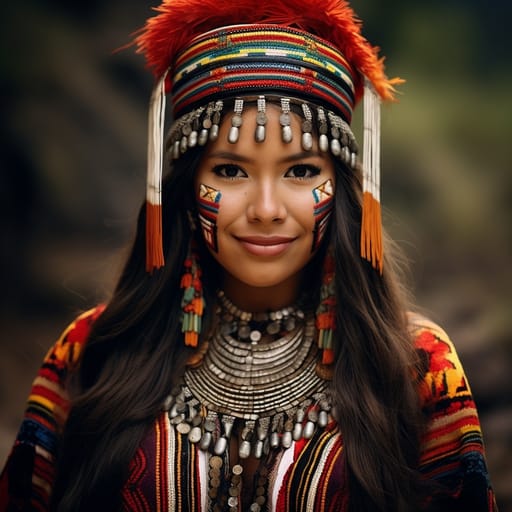
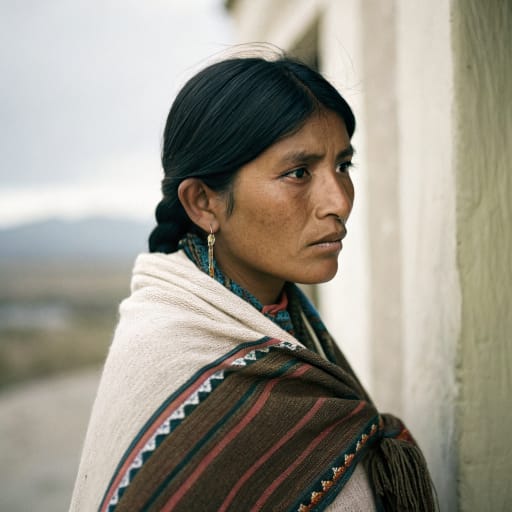
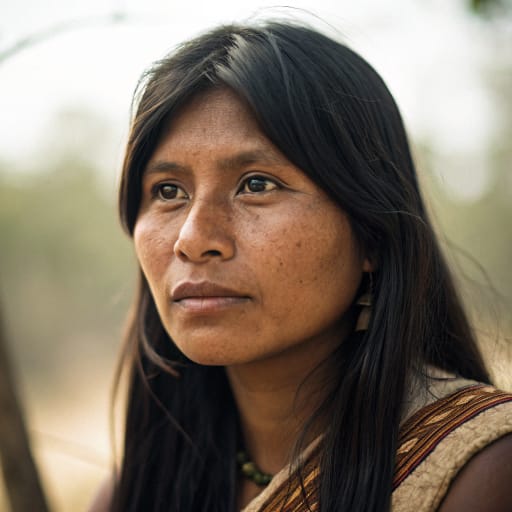
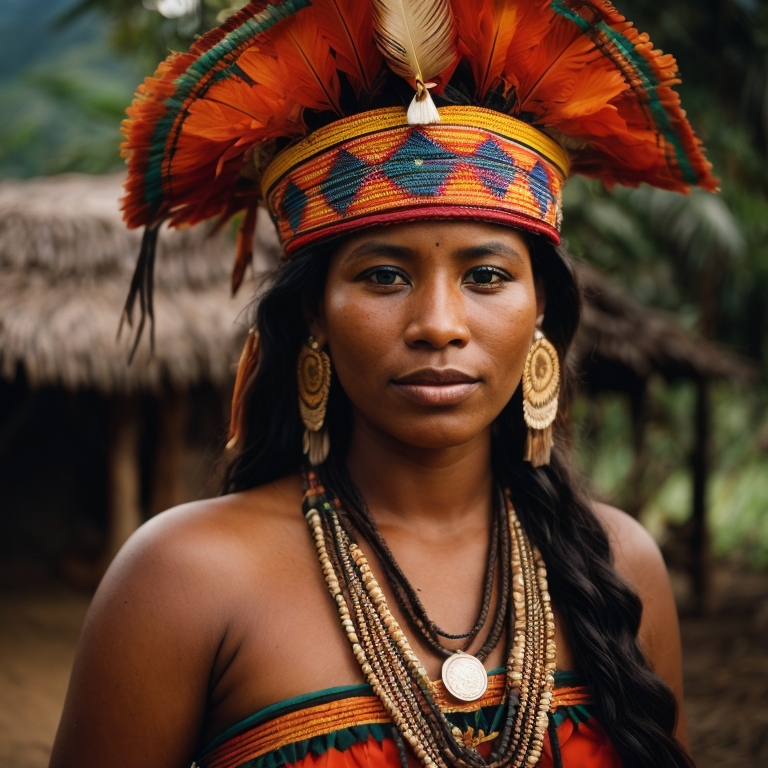
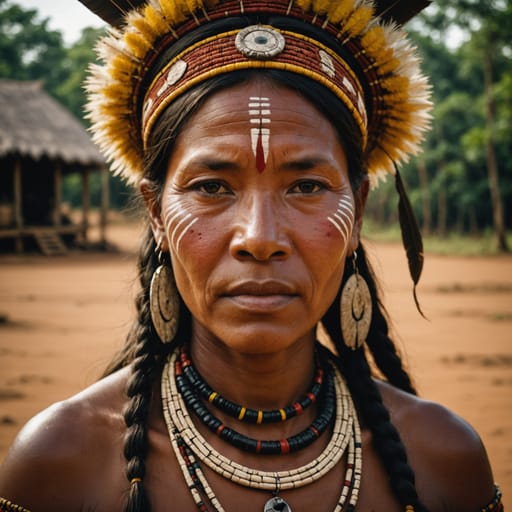
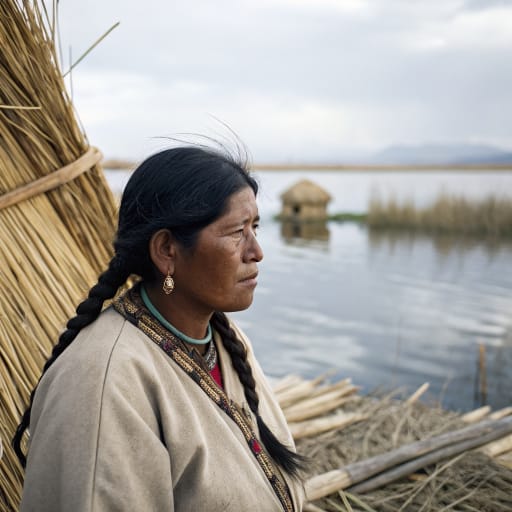
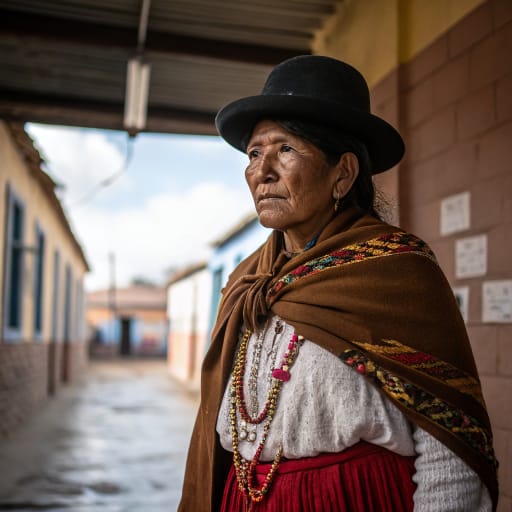
Typical Bora Phenotypes
Reference for AI generation: hair, eyes, skin, facial structure, build
Bora Body & Anatomy Reference
Anatomy by feature, South American Indigenous / European-Mestizo / Afro-Latino mix phenotype
Bora Boobs & Breasts
Bora tits and boobs run medium-to-large cup, full, high projection, the classic South American Indigenous / European-Mestizo / Afro-Latino mix bust profile. Bora nipples and areolas show medium-brown to dark-brown areolar pigmentation against the tan-to-deep-brown skin tone, with areolar diameter typically in the 32-46mm range and forward-set positioning rather than the smaller bust profile of Andean Indigenous sub-populations. Bora breasts trend the classic Brazilian / Latina curvy bust profile in lowland populations; smaller and shorter-set in Andean Indigenous populations, a function of the endomorph-to-mesomorph with high gluteal-femoral deposition body habitus and the mean adult female BMI 25-28. For anatomically accurate AI-generated Bora nudes the render preserves the medium-to-large cup, full, high projection shape, 32-46mm areolas with medium-brown to dark-brown pigmentation, and the torso proportions of the South American Indigenous / European-Mestizo / Afro-Latino mix phenotype.
Bora Ass & Hips
Bora hips and butt usually read as full, high projection, the famous Brazilian / Latina bunda profile. The skeletal base is wide iliac crests, very full gluteal-femoral fat deposition (the hallmark Brazilian / Latina hip-to-waist ratio), the South American Indigenous / European-Mestizo / Afro-Latino mix pattern. Set against the slim narrow-hip East Asian profile, the difference is easy to see, and the hip-to-waist ratio is often what identifies Bora women in photos.
Bora Vagina & Pussy
Expect medium-brown to dark-brown labial pigmentation, fuller labia minora on Bora women, in keeping with South American Indigenous / European-Mestizo / Afro-Latino mix ancestry. The pubic hair is wavy-to-curly coarse dark texture, dense distribution. Coloring should run evenly from the tan to deep-brown skin of the thighs to the labia, and Bora nude imagery should keep the hair's wavy-to-curly coarse dark texture.
Bora Dicks & Penis
Bora dick and penile anatomy in adult AI generation should anchor on the regional reference data: regional mean ~13cm erect, moderate-to-above-average girth, and medium-brown shaft pigmentation. The Bora cock profile reflects the South American Indigenous / European-Mestizo / Afro-Latino mix population's anthropometric measurements. The shaft pigmentation should track the surrounding tan to deep-brown skin tone, and the pubic hair should keep its wavy-to-curly coarse dark texture in the typical inverted-V escutcheon.
Bora Body, Curves & Build
Bora body type: endomorph-to-mesomorph with high gluteal-femoral deposition, with mean adult female BMI 25-28. This is the typical South American Indigenous / European-Mestizo / Afro-Latino mix build. Height range, shoulder-to-hip ratio and fat distribution all follow from it, which is what an accurate Bora nude body should show.
Bora Skin Tone & Hair Texture
Bora skin tone falls in the tan to deep-brown (Fitzpatrick III-VI) band, the surface signal most often miscalibrated by generic AI nude generators. Bora hair texture is typically straight-to-curly 1A-3C, varies widely by ancestral composition, characteristic of the South American Indigenous / European-Mestizo / Afro-Latino mix phenotype. In Bora nude renders the skin should hold that band consistently across the body.
Explore phenotype categories
Structured taxonomy with peer-reviewed scales · 22 anatomical categories
Erotic Poses & Sex Positions
From the pose catalog: 219 named positions with reference skeletons
Frequently asked questions about Bora people
Where is the Bora homeland?
The Bora homeland is Northwest Amazon between the Putumayo and Caquetá rivers: the Ampiyacu and Yaguasyacu basins near Pebas in Loreto, Peru, with related Miraña communities in Amazonas, Colombia. in South America.
What language do Bora people speak?
Bora people primarily speak Bora, including the Miraña dialect (Boran family, often grouped with Witotoan as Bora-Witoto); Spanish is now dominant in most communities..
What religion do Bora people practice?
The predominant religion among Bora people is Traditional cosmology organized around tobacco and coca, overlaid by Catholic and evangelical Christianity..






Make your own Bora images
Five a day, free, no credits to buy. The studio starts from this group's phenotype data, so you can set body type, pose and style and keep the traits accurate.
Start with Bora