Help us get this right
Does this portrait look right for Bimanese?
Nobody has judged this one yet. You would be the first.
Bimanese Erotic
Eastern Sumbawa, West Nusa Tenggara, Indonesia: Bima city, Bima Regency and Dompu Regency
Bima, or Nggahi Mbojo (Austronesian, Central Malayo-Polynesian, Bima-Sumba branch); Indonesian
Sunni Islam; pre-Islamic practices lasted longest in the Donggo highlands
Donggo highland communities (Dou Donggo) and the Bima-speaking population of Dompu; part of the wider Austronesian peoples of the Lesser Sunda Islands
About Bimanese People
The Bimanese call themselves Dou Mbojo, the people of Mbojo, and for about three centuries that name described a sultanate as much as a population. They live on the eastern end of Sumbawa in Indonesia's West Nusa Tenggara province, mainly in the port city of Bima and the regencies of Bima and Dompu. At close to a million people, they are the province's second largest group after the Sasak of Lombok. Sumbawa is split down the middle by language. The west speaks Samawa, a close relative of Sasak and Balinese. The Bima language, Nggahi Mbojo, looks east instead: its nearest relatives are spoken on Sumba and Flores. Islam came to Bima from Makassar. In the first half of the seventeenth century, Bima's ruler converted under the influence of the Gowa kingdom in South Sulawesi. The court then turned itself into a sultanate, which lasted until Bima became part of the Indonesian republic in the 1950s. Today the Bimanese are overwhelmingly Sunni Muslim, and the faith sets the rhythm of public life. Older beliefs lasted longest in the Donggo highlands, where people converted generations after the coast did. The sultan's palace, the Asi Mbojo, still stands in Bima as a museum. The court chronicle Bo Sangaji Kai is one of the key written sources for eastern Indonesia's past.
The other great break came in 1815, when Mount Tambora, on the peninsula northwest of Bima, produced the largest eruption in recorded history. It buried the small kingdoms of Tambora and Pekat, killed tens of thousands across the island through ash and famine, and wiped out the Tambora language. The custom outsiders now recognize most readily is the rimpu. A woman wraps herself in two lengths of handwoven tembe nggoli cloth, one around the body and one drawn over the head. Traditionally, unmarried women left only their eyes uncovered, while married women showed the whole face. Rimpu is less common as daily wear than it once was, but it has become a badge of local pride, brought out for parades and festivals. Bima is also known for small, tough horses. Its races ridden by child jockeys are defended as heritage and criticized by child-protection advocates. The lowland economy runs on rice and shallots, and Bima shallots are sold in markets across the country.
Related ethnic groups
Groups that share Bimanese's homeland, region, language, or religious tradition. These are likely candidates for comparative phenotype reference.
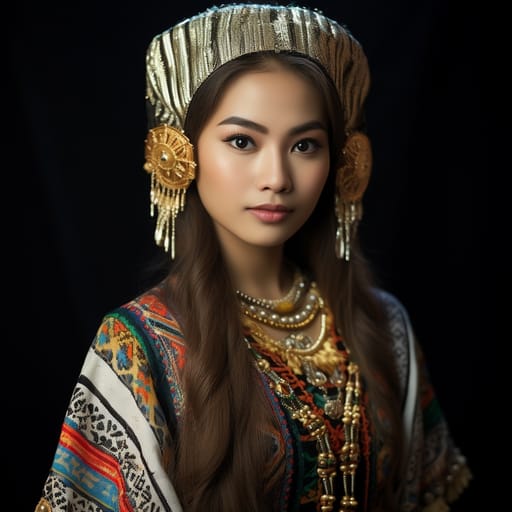
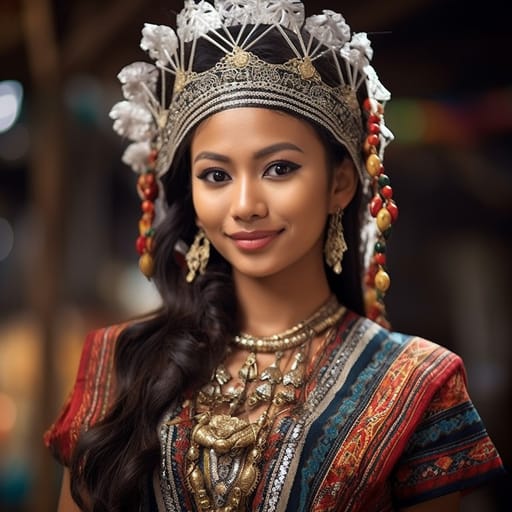
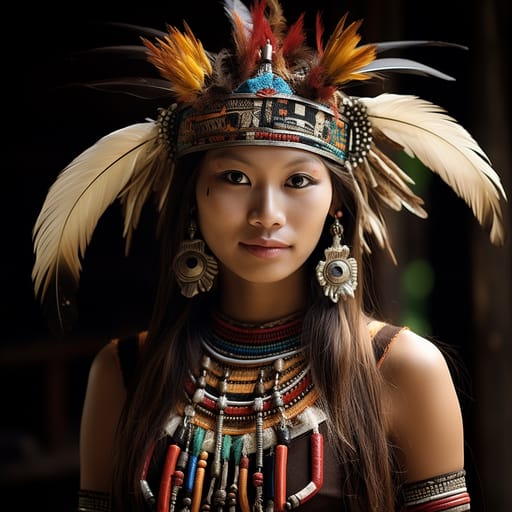
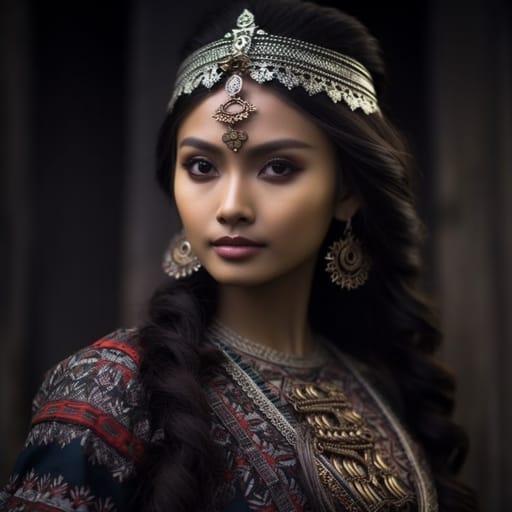
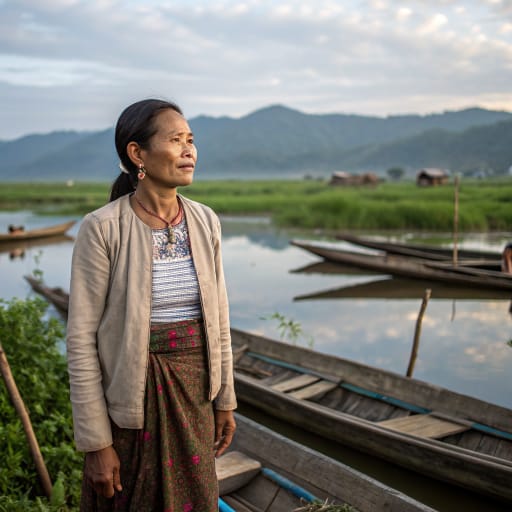
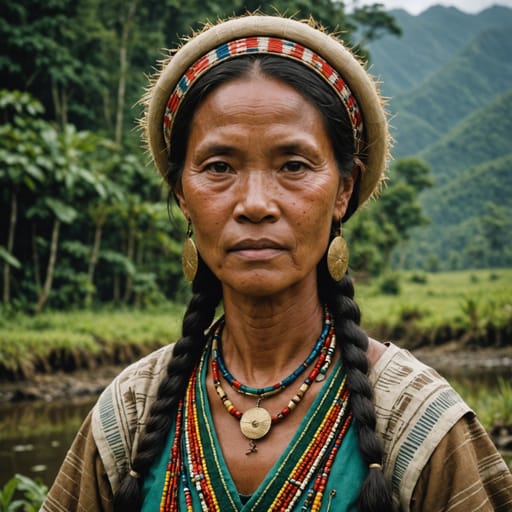
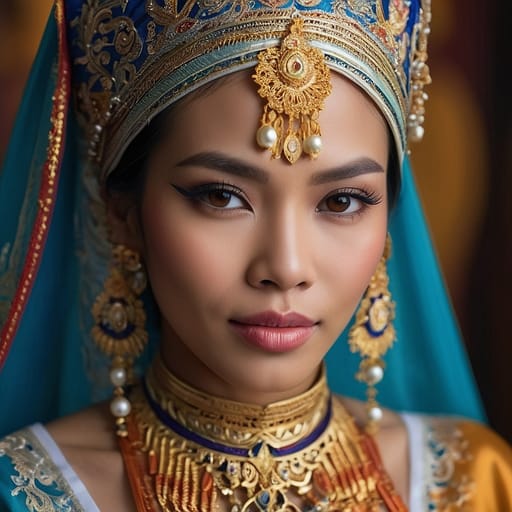
Typical Bimanese Phenotypes
Reference for AI generation: hair, eyes, skin, facial structure, build
Bimanese Body & Anatomy Reference
Per-feature anatomical profile for AI nude generation: Southeast Asian Austronesian / Austroasiatic phenotype
Bimanese Boobs & Breasts
Bimanese tits and boobs run small-to-medium cup, modest projection, the classic Southeast Asian Austronesian / Austroasiatic bust profile. Bimanese nipples and areolas show medium-brown to dark-brown areolar pigmentation against the tan-to-medium-brown skin tone, with areolar diameter typically in the 26-38mm range and forward-set positioning rather than the fuller South Asian or Polynesian bust. Bimanese breasts trend firm, modest projection, a function of the ectomorph, petite frame body habitus and the mean adult female BMI 20-23. For anatomically accurate AI-generated Bimanese nudes the render preserves the small-to-medium cup, modest projection shape, 26-38mm areolas with medium-brown to dark-brown pigmentation, and the torso proportions of the Southeast Asian Austronesian / Austroasiatic phenotype.
Bimanese Ass & Hips
Bimanese hips and butt usually read as small-to-medium, modest projection, narrower hip profile. The skeletal base is narrow-to-medium iliac crests, the Southeast Asian Austronesian / Austroasiatic pattern. Set against the fuller glutes of the Pacific Islander phenotype, the difference is easy to see, and the hip-to-waist ratio is often what identifies Bimanese women in photos.
Bimanese Vagina & Pussy
Expect medium-brown to dark-brown labial pigmentation on Bimanese women, in keeping with Southeast Asian Austronesian / Austroasiatic ancestry. The pubic hair is straight-to-wavy fine-to-medium texture. Coloring should run evenly from the tan to medium-brown skin of the thighs to the labia, and Bimanese nude imagery should keep the hair's straight-to-wavy fine-to-medium texture.
Bimanese Dicks & Penis
Bimanese dick and penile anatomy in adult AI generation should anchor on the regional reference data: regional mean ~11cm erect, moderate girth, and medium-brown shaft pigmentation. The Bimanese cock profile reflects the Southeast Asian Austronesian / Austroasiatic population's anthropometric measurements. The shaft pigmentation should track the surrounding tan to medium-brown skin tone, and the pubic hair should keep its straight-to-wavy fine-to-medium texture in the typical inverted-V escutcheon.
Bimanese Body, Curves & Build
Bimanese body type: ectomorph, petite frame, with mean adult female BMI 20-23. This is the typical Southeast Asian Austronesian / Austroasiatic build. Height range, shoulder-to-hip ratio and fat distribution all follow from it, which is what an accurate Bimanese nude body should show.
Bimanese Skin Tone & Hair Texture
Bimanese skin tone falls in the tan to medium-brown (Fitzpatrick III-V) band, the surface signal most often miscalibrated by generic AI nude generators. Bimanese hair texture is typically straight-to-wavy 1A-2A, dark-brown to black, characteristic of the Southeast Asian Austronesian / Austroasiatic phenotype. In Bimanese nude renders the skin should hold that band consistently across the body.
Explore phenotype categories
Structured taxonomy with peer-reviewed scales · 22 anatomical categories
Erotic Poses & Sex Positions
From the pose catalog: 219 named positions with reference skeletons
Frequently asked questions about Bimanese people
Where is the Bimanese homeland?
The Bimanese homeland is Eastern Sumbawa, West Nusa Tenggara, Indonesia: Bima city, Bima Regency and Dompu Regency in Southeast Asia.
What language do Bimanese people speak?
Bimanese people primarily speak Bima, or Nggahi Mbojo (Austronesian, Central Malayo-Polynesian, Bima-Sumba branch); Indonesian.
What religion do Bimanese people practice?
The predominant religion among Bimanese people is Sunni Islam; pre-Islamic practices lasted longest in the Donggo highlands.






Make your own Bimanese images
Five a day, free, no credits to buy. The studio starts from this group's phenotype data, so you can set body type, pose and style and keep the traits accurate.
Start with Bimanese