Help us get this right
Does this portrait look right for Bakhtiari?
Nobody has judged this one yet. You would be the first.
Bakhtiari Erotic
Central Zagros mountains of southwestern Iran: Chaharmahal and Bakhtiari province, eastern Khuzestan, and adjoining parts of Lorestan and Isfahan provinces
Bakhtiari dialect of Luri (Southwestern Iranian, Indo-European); Persian widely spoken
Twelver Shia Islam
A Lur people; divided into the Haft Lang and Chahar Lang moieties, each made up of tribes, sub-tribes and clans (Duraki, Babadi, Bakhtiarvand and Dinaruni under Haft Lang; Mamivand, Kianersi and Zalaki under Chahar Lang, among others)
About Bakhtiari People
The Bakhtiari are the largest of the Lur tribal confederations of Iran, and for most of their history they have been defined by movement. Their country is the central Zagros, a belt of ridges and river gorges running from the highlands of Chaharmahal and Bakhtiari province down to the hot plains of Khuzestan. The classic Bakhtiari year followed the grass: winter in the lowlands, then a spring migration on foot over snowbound passes and across the Karun River to summer pastures on the high plateau, and back again in autumn. The 1925 documentary Grass filmed one of these crossings. Most Bakhtiari are now settled in towns such as Shahr-e Kord, Masjed Soleyman and Izeh, or in Isfahan and Ahvaz, but some families still make the migration each year, often with trucks beside the flocks. Their language is Bakhtiari, a dialect of Luri that sits on the same Southwestern Iranian branch as Persian, far closer to it than Kurdish is, and it gives way to Persian easily in the cities. Nearly all are Twelver Shia Muslims, and the faith is lived through Muharram mourning and shrine pilgrimage rather than worn as something that sets them apart from other Iranians. Society is a genealogy of nested units: two great moieties, the Haft Lang and the Chahar Lang, whose names are usually traced to old livestock tax assessments, and beneath them tribes, sub-tribes and clans that once decided where a family camped, whom its children married and which khan spoke for it.
The khans mattered far beyond the mountains. In 1909 Bakhtiari horsemen under Sardar Asad marched on Tehran and helped restore the constitution against Mohammad Ali Shah. A year earlier oil had been struck at Masjed Soleyman in the tribe's winter lands, and the Anglo-Persian Oil Company paid the khans to guard its wells. Armed independence on strategic ground made the Bakhtiari a target for Reza Shah, who in the 1930s executed or imprisoned leading khans, disarmed the tribe and pushed nomads toward settlement. The same khan families later gave Iran a queen, Soraya Esfandiary-Bakhtiari, and its last prime minister before the 1979 revolution, Shapour Bakhtiar. Bakhtiari cemeteries hold carved stone lions over the graves of men remembered as fighters or leaders. Men's traditional dress is the chogha, a knee-length wool coat in black and white vertical stripes, worn with wide black trousers and a round felt cap. Women wear long layered skirts in strong colors under a tied headscarf. Bakhtiari rugs, especially the compartment garden design, are among Iran's most recognizable, and the line dance at Bakhtiari weddings is still a living part of the calendar.
Related ethnic groups
Groups that share Bakhtiari's homeland, region, language, or religious tradition. These are likely candidates for comparative phenotype reference.
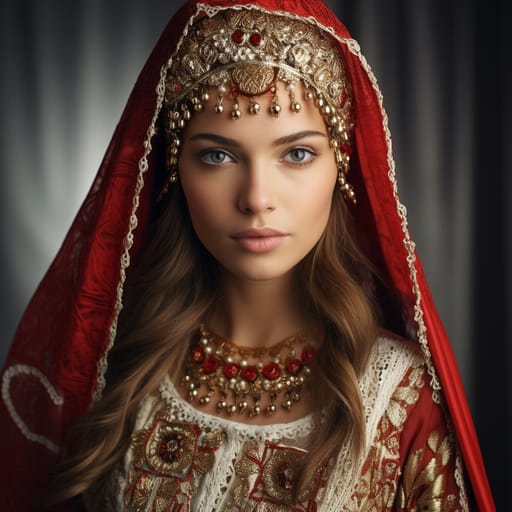
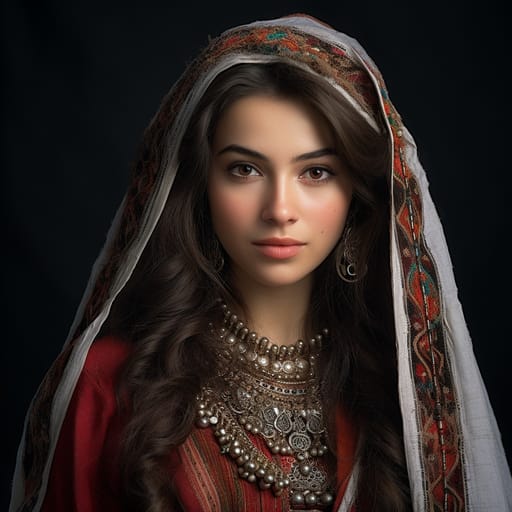
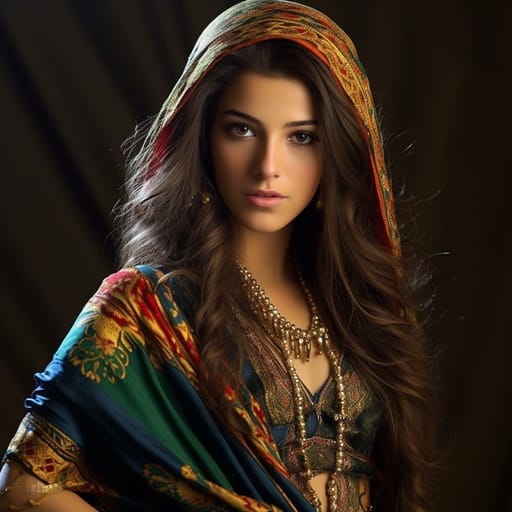
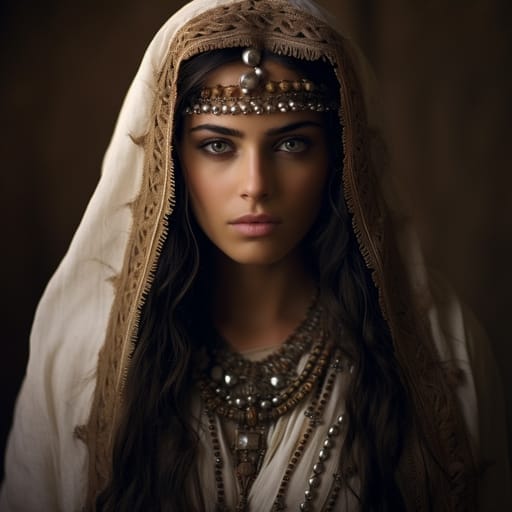
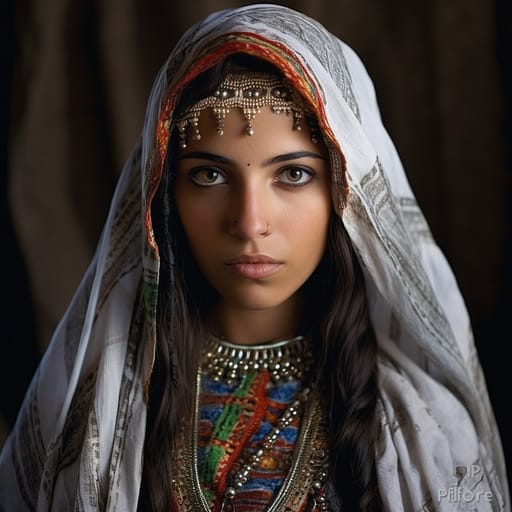
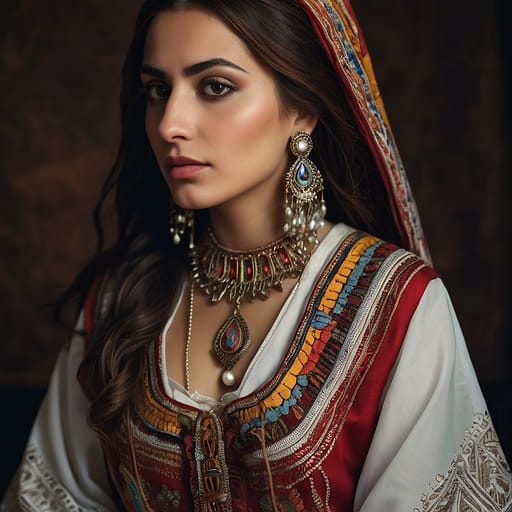
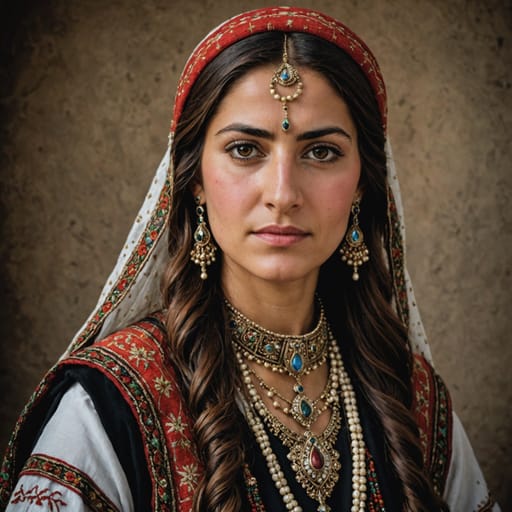
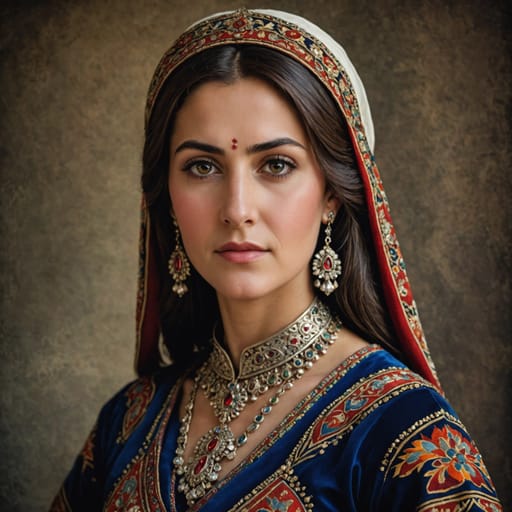
Typical Bakhtiari Phenotypes
Reference for AI generation: hair, eyes, skin, facial structure, build
Bakhtiari Body & Anatomy Reference
Per-feature anatomical profile for AI nude generation: Levantine / Mediterranean Middle Eastern phenotype
Bakhtiari Boobs & Breasts
The typical Bakhtiari bust is medium-to-large cup, full, moderate-to-high projection, in line with the wider Levantine / Mediterranean Middle Eastern pattern. Areolas usually fall in the 32-46mm range, with medium-brown to dark-brown areolar pigmentation against the olive-to-light-brown skin tone. Compared with the smaller East Asian bust profile, Bakhtiari breasts sit forward and are generally full and soft, fuller projection than the North-African Berber norm. A faithful AI render of Bakhtiari tits keeps that shape and areola size.
Bakhtiari Ass & Hips
Butt shape among Bakhtiari women: medium-to-full, moderate projection, broader hip profile, over medium-to-wide iliac crests, fuller gluteal-femoral deposition. This follows Levantine / Mediterranean Middle Eastern ancestry and looks quite unlike the slim East Asian narrow-hip profile. An accurate Bakhtiari ass in adult AI imagery keeps both the silhouette and the overall build (mesomorph with fuller hip-and-bust deposition) instead of a generic average.
Bakhtiari Vagina & Pussy
Vulvar anatomy among Bakhtiari women: medium-brown to dark-brown labial pigmentation, fuller labia minora. Pubic hair tends to be wavy-to-coiled medium-coarse dark texture, dense distribution, in the usual inverted-triangle pattern. Both follow Levantine / Mediterranean Middle Eastern pigmentation, which is why Bakhtiari pussy renders should not fall back on a pale, sparse Western template.
Bakhtiari Dicks & Penis
The Bakhtiari cock profile, from Levantine / Mediterranean Middle Eastern anthropometric data: regional mean ~14cm erect; moderate-to-above-average girth; medium-brown shaft pigmentation. Pubic hair has a wavy-to-coiled medium-coarse dark texture and forms the usual inverted-V pattern. Whether Bakhtiari men are circumcised follows religious and cultural practice rather than phenotype.
Bakhtiari Body, Curves & Build
Build and curves among Bakhtiari women follow the Levantine / Mediterranean Middle Eastern pattern: mesomorph with fuller hip-and-bust deposition, mean adult female BMI 25-28. Proportions matter as much as skin tone, so Bakhtiari figures should keep their regional height and limb ratios.
Bakhtiari Skin Tone & Hair Texture
The Bakhtiari skin range is olive to medium-brown (Fitzpatrick III-V), and hair tends to be wavy-to-curly 2B-3B, predominantly dark-brown to black. That combination marks the Levantine / Mediterranean Middle Eastern phenotype, and skin tone is the trait AI generators most often get wrong for Bakhtiari women.
Explore phenotype categories
Structured taxonomy with peer-reviewed scales · 22 anatomical categories
Erotic Poses & Sex Positions
From the pose catalog: 219 named positions with reference skeletons
Frequently asked questions about Bakhtiari people
Where is the Bakhtiari homeland?
The Bakhtiari homeland is Central Zagros mountains of southwestern Iran: Chaharmahal and Bakhtiari province, eastern Khuzestan, and adjoining parts of Lorestan and Isfahan provinces in Western Asia.
What language do Bakhtiari people speak?
Bakhtiari people primarily speak Bakhtiari dialect of Luri (Southwestern Iranian, Indo-European); Persian widely spoken.
What religion do Bakhtiari people practice?
The predominant religion among Bakhtiari people is Twelver Shia Islam.






Make your own Bakhtiari images
Five a day, free, no credits to buy. The studio starts from this group's phenotype data, so you can set body type, pose and style and keep the traits accurate.
Start with Bakhtiari