Help us get this right
Does this portrait look right for Walloons?
Nobody has judged this one yet. You would be the first.
Walloons Erotic
Also known as: Walloon
Wallonia (Belgium)
Christianity / Catholicism
About Walloons People
The Walloons are the French-speaking population of southern Belgium, occupying the rolling country south of the linguistic frontier that cuts the country roughly in half between Brussels and the Ardennes. Their identity is bound up with that border — a line that has, since the late nineteenth century, hardened from a quiet bilingual gradient into one of the most consequential internal divides in Western Europe. To be Walloon is, in part, to live on the southern side of that line and to speak the language of the south.
That language is, in everyday use, French — but underneath sits Walloon proper, a Romance tongue that developed alongside French rather than from it, retaining vocabulary and sound shifts from Latin that French lost. Walloon is closer kin to Picard and to the Norman speech of the Channel coast than to the standardized Parisian French taught in schools. It survives mostly among older speakers, in songs, in cabaret theatre, and in the occasional municipal sign, and there is a slow effort to keep it from disappearing entirely. Most Walloons today grow up monolingual in French and read Walloon, if at all, as a heritage curiosity.
The region itself is industrial in a way that tourists tend to miss. Wallonia powered nineteenth-century Belgium — Liège steel, Borinage coal, Charleroi glass — and was, for a stretch, one of the wealthiest corners of the continent. The collapse of those industries in the second half of the twentieth century left a landscape of brick terraces, dormant mine headframes, and slag heaps reclaimed by birch forest. Economic gravity shifted north to Flemish Belgium, and a great deal of contemporary Walloon politics is downstream of that reversal. The Ardennes plateau in the southeast — forested, sparsely populated, cut by the Meuse and its tributaries — gives the region its other face: small stone villages, river-valley towns, and the battlefields of 1914 and 1944.
Catholicism shaped Wallonia deeply but lightly governs daily life now. Practice has thinned, as elsewhere in Western Europe, while the cultural scaffolding remains: parish festivals, carnival traditions like the Gilles of Binche with their wax masks and ostrich-feather hats, processions in towns like Mons where the dragon is paraded and beaten down each summer. These are not folkloric performances staged for visitors so much as inherited civic obligations, taken seriously by the people who keep them up. The Walloon temperament that emerges in writing about the region — wry, anti-clerical despite the Catholic substrate, fond of plain food and long arguments — is best read as a regional self-image rather than a verified trait, but it persists for a reason.
Related ethnic groups
Groups that share Walloons's homeland, region, language, or religious tradition. These are likely candidates for comparative phenotype reference.
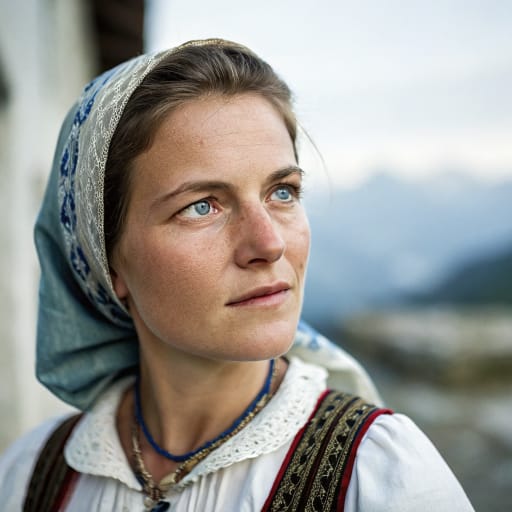
Austrians
same region (Western Europe)
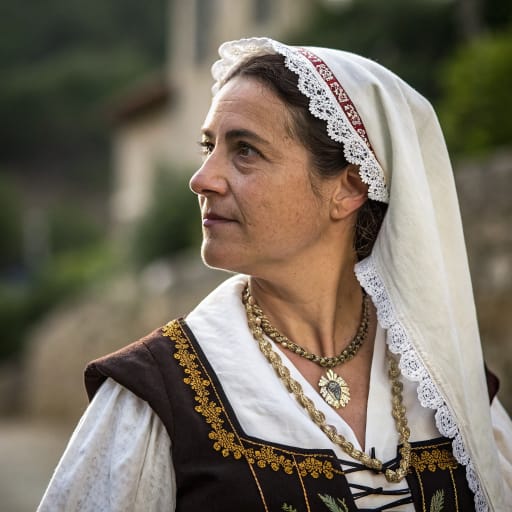
Corsicans
same region (Western Europe)
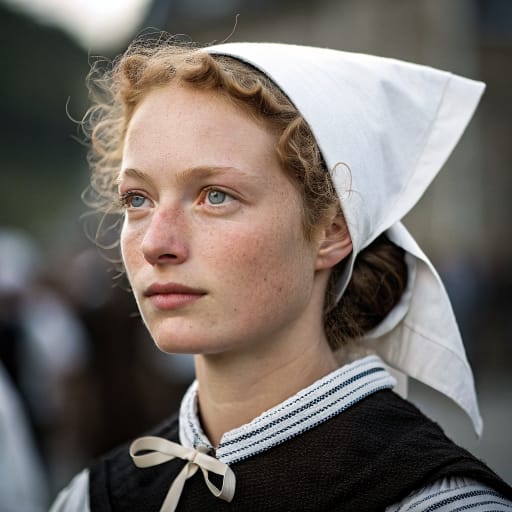
Bretons
same region (Western Europe)
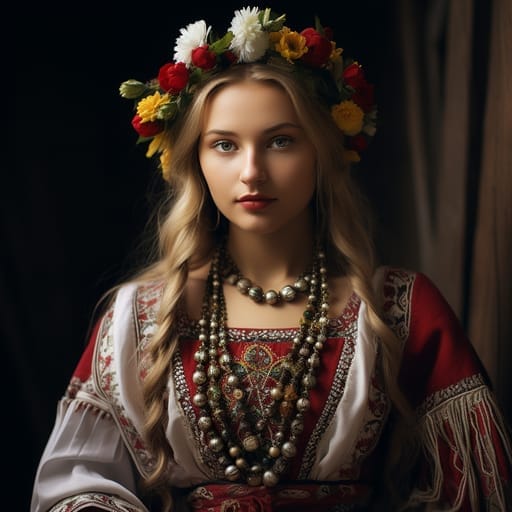
Lithuanians
same region (Western Europe)
Sardinians
same region (Western Europe)
Luxembourgers
same region (Western Europe)
Flemings
same region (Western Europe)
Estonians
same region (Western Europe)
Typical Walloons Phenotypes
Reference for AI generation: hair, eyes, skin, facial structure, build
Walloons are the French-speaking population of southern Belgium, and their phenotype sits at the crossroads of northern French, Rhineland German, and Dutch-Flemish stock — closer to the heavy-featured northern French of Picardy and the Ardennes than to the taller, fairer Flemings to their north. The dominant impression is mid-toned: brown hair, hazel or mixed eyes, and skin that tans rather than burns, with genuinely blond or genuinely dark phenotypes both in the minority.
Hair runs predominantly medium to dark brown, often with a warm chestnut or ash undertone; true black is uncommon, and natural blond appears in maybe 15–20% of the population, usually darkening to dark-blond by adulthood. Texture is overwhelmingly straight to loosely wavy, fine to medium in density. Red and auburn show up as a recessive minority, often paired with the freckling common across the Ardennes.
Eyes split roughly evenly between brown, hazel, and the green-grey-blue mixed range, with pure blue less common than among the Flemish. Eyelids are flat European with no epicanthic fold; the eye shape tends to be slightly deeper-set than in southern French populations, with a heavier brow ridge in men.
Skin is typically Fitzpatrick II to III — fair with neutral to slightly olive undertones, freckling common in the lighter end, tanning to a warm beige in summer. The very pale pink-toned Celtic skin found in parts of Wallonia's Ardennes border zones is a noted minority variant.
Facial structure leans heavy and architectural rather than delicate: a straight or slightly convex nose with a medium-to-broad bridge and moderate alar width, lips of average fullness, and a strong jaw with prominent chin in men. Cheekbones are moderate, not high-set. The signature is a square, slightly long face with a robust lower jaw — a feature that distinguishes Walloons visually from the rounder-faced French to their southwest.
Build runs solid and medium-tall, with men averaging around 178 cm and women 165 cm. Body composition tends toward sturdy mesomorph with a tendency to thicken in middle age, reflecting the region's industrial-agricultural heritage rather than the leaner build of Mediterranean France.
Walloons Body & Anatomy Reference
Per-feature anatomical profile for AI nude generation: Western European / Celtic-Germanic phenotype
Walloons Boobs & Breasts
Bust reference for Walloons women: medium-to-large cup, full, moderate-to-high projection, which is typical of Western European / Celtic-Germanic ancestry. Areolas measure about 30-46mm across, with light-pink to medium-pink pigmentation. Body type (ectomorph-to-mesomorph) shapes the bust as well, so Walloons tits are usually full and projecting. In AI imagery, keep the forward-set shape rather than drifting toward the smaller East Asian bust.
Walloons Ass & Hips
The Walloons ass is typically medium, moderate projection, which sets it apart from the broader hip profile of Mediterranean phenotypes. Underneath, the pelvis shows medium iliac crests, part of the Western European / Celtic-Germanic skeletal pattern. For Walloons butt pics and AI renders, match that silhouette and the overall build (ectomorph-to-mesomorph).
Walloons Vagina & Pussy
Walloons pussy and vulvar anatomy presents light-pink labial pigmentation, varied labia minora, consistent with the Western European / Celtic-Germanic phenotype's pigmentation pattern. Walloons pubic hair is typically wavy fine-to-medium texture, blond to dark-brown, in the inverted-triangle pattern. For anatomically accurate Walloons pussy renders the labial coloration should match the surrounding fair to light skin tone with a continuous gradient, and the hair should keep its wavy fine-to-medium texture.
Walloons Dicks & Penis
Walloons dicks follow the Western European / Celtic-Germanic reference data: regional mean ~13-14cm erect; moderate girth; light-pink to light-brown shaft pigmentation. Shaft color should track the fair to light skin tone with a smooth change toward the glans, and Walloons pubic hair keeps its wavy fine-to-medium texture.
Walloons Body, Curves & Build
Walloons body type and overall build presents as ectomorph-to-mesomorph, with mean adult female BMI 24-27: the characteristic Western European / Celtic-Germanic habitus. Walloons curves and proportions should keep the regional skeletal frame (height, shoulder-to-hip ratio, limb proportions) rather than a generic mesomorph default.
Walloons Skin Tone & Hair Texture
Walloons skin sits in the fair to light (Fitzpatrick I-III) band. Hair is typically straight-to-wavy 1A-2B, blond to dark-brown, in keeping with the Western European / Celtic-Germanic phenotype. In nude renders the skin should stay one even tone from face to body, and body, pubic and head hair should match.
Data depth
0/100Coverage of image-grounded phenotype observations · drives AI generation diversity
- Sample size
- 0/40· 0 images
- Image quality
- 0/30· 0% high
- Confidence
- 0/20
- Source diversity
- 0/10
- ·No image observations yet
Explore phenotype categories
Structured taxonomy with peer-reviewed scales · 22 anatomical categories
Erotic Poses & Sex Positions
From the pose catalog: 219 named positions with reference skeletons
Frequently asked questions about Walloons people
Where is the Walloons homeland?
The Walloons homeland is Wallonia (Belgium) in Western Europe.
What language do Walloons people speak?
Walloons people primarily speak Indo-European / Romance / French / Walloon.
What religion do Walloons people practice?
The predominant religion among Walloons people is Christianity / Catholicism.
What are other names for Walloons people?
Walloons people are also known as Walloon.






Make your own Walloons images
Five a day, free, no credits to buy. The studio starts from this group's phenotype data, so you can set body type, pose and style and keep the traits accurate.
Start with Walloons