Help us get this right
Does this portrait look right for Tlapanec?
Nobody has judged this one yet. You would be the first.
Tlapanec Erotic
Guerrero (Mexico)
Oto-Manguean / Tlapanec
Christianity / Catholicism
About Tlapanec People
The Tlapanec call themselves Mèꞌphàà, and the distinction matters: "Tlapanec" is a Nahuatl exonym carried over by the Spanish, and the people who use it for themselves are increasingly the ones outside the community. They live in the rugged eastern half of Guerrero, in the Sierra Madre del Sur and the dry tropical lowlands that fall away toward the Costa Chica. It is some of the steepest, most isolated country in southern Mexico, and that isolation has done a great deal to keep the language alive.
Mèꞌphàà sits inside the Oto-Manguean family — the same deep-rooted stock that produced Zapotec, Mixtec, and Otomí — but it is not mutually intelligible with any of its neighbors and is usually treated as its own small branch. It is a tonal language, with several tones doing real grammatical work, and it splinters into regional varieties (Malinaltepec, Acatepec, Tlacoapa, Azoyú and others) that differ enough that speakers sometimes default to Spanish when meeting from across the sierra. Linguists generally count it as one of the more endangered Oto-Manguean languages outside Oaxaca, though intergenerational transmission in the highland communities is still relatively strong.
Catholicism arrived in the sixteenth century and settled into the same uneasy coexistence found across indigenous Mexico: saints' days, processions, and parish life layered over an older ritual calendar tied to maize, rain, and the mountain itself. Petitions are still made at caves and springs; tlacololeros dance in some towns; healers work with copal, candles, and counted bundles of leaves. The civil-religious cargo system — rotating unpaid offices that bind a man to years of community service — remains the spine of village governance in much of the region.
The twentieth century was hard on the Tlapanec. Land disputes with mestizo ranchers, the long shadow of Guerrero's caciquismo, and the militarization that followed the dirty war and later the drug economy have all pressed on these communities. Out of that pressure came the CRAC-PC, the community police founded in 1995 in Mèꞌphàà and Na Savi towns, which still patrols a stretch of the Costa-Montaña region under indigenous customary law. Migration — to Sinaloa's fields, to Mexico City, to the United States — now shapes household economies as much as the milpa does, and remittances arrive in villages where the elders still address one another in a language Cortés never heard.
Related ethnic groups
Groups that share Tlapanec's homeland, region, language, or religious tradition. These are likely candidates for comparative phenotype reference.
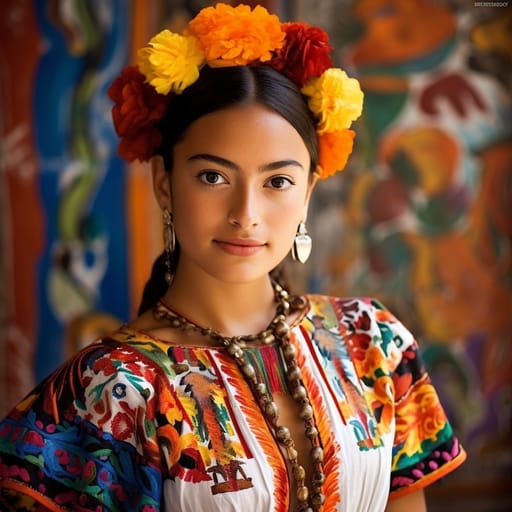

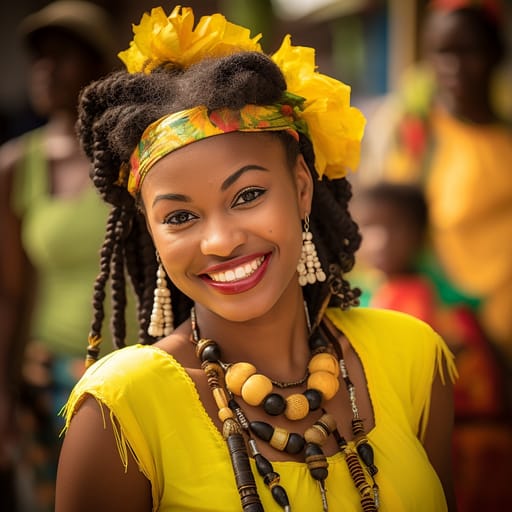
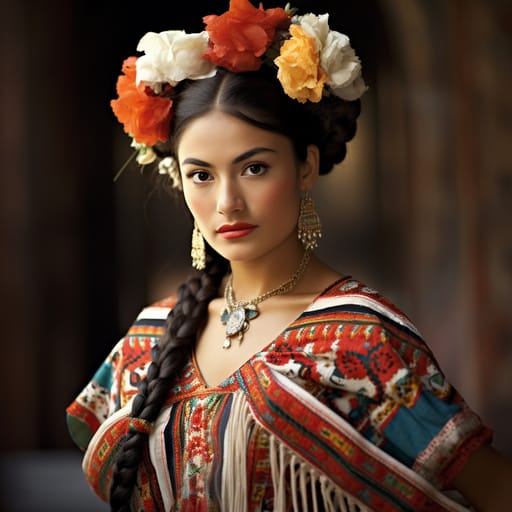
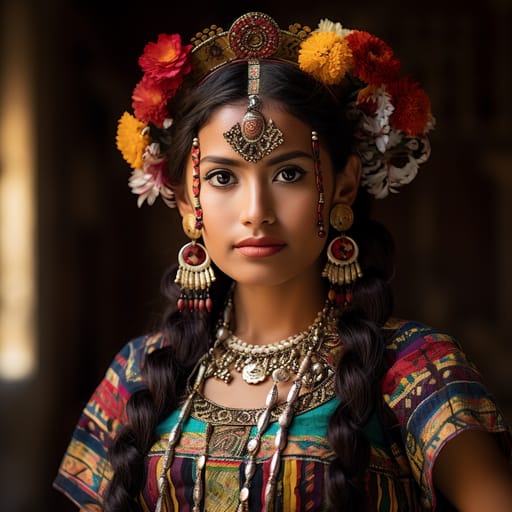
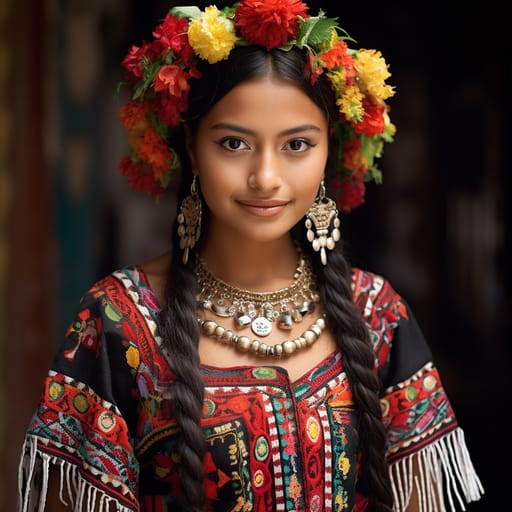
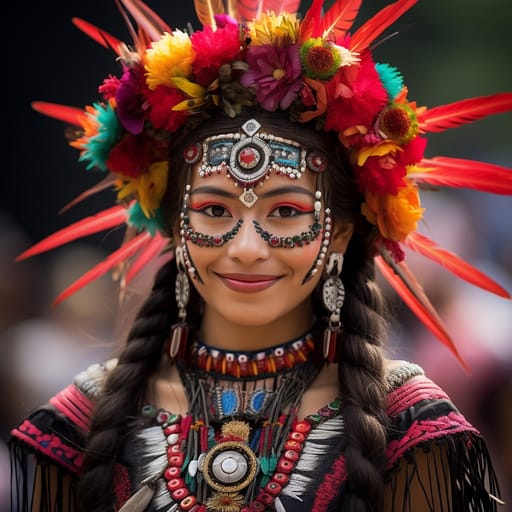
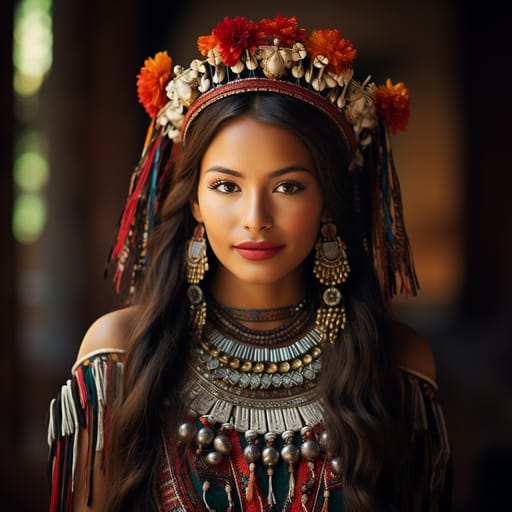
Typical Tlapanec Phenotypes
Reference for AI generation: hair, eyes, skin, facial structure, build
The Tlapanec (self-designated Me'phaa) of the Sierra Madre del Sur in eastern Guerrero present a clearly Mesoamerican Indigenous phenotype, distinct from both the Nahua to their north and the Mixtec to their west. Their isolation in the rugged La Montaña region — one of the most geographically and economically marginalized zones in Mexico — has kept admixture comparatively low, and the resulting look skews toward unmixed Amerindian features more strongly than in mestizo Guerrero coastal populations.
Hair is uniformly black to very dark brown, coarse, straight, and thick, with the cylindrical cross-section typical of East Asian and Native American populations. Premature graying is uncommon. Eyes are dark brown to near-black; a partial epicanthic fold is common, particularly an inner-canthal fold that softens the eye opening, though it is less pronounced than in East Asian populations. Eyelashes are short and straight. Skin tones cluster in Fitzpatrick IV, ranging into V among agricultural workers with chronic sun exposure, with warm coppery to reddish-brown undertones rather than the olive cast seen in some northern Mexican groups.
Facial structure shows the classic Mesoamerican highland pattern: broad zygomatic arches, a relatively flat midface, and a nose that is moderately broad at the alar base with a low-to-medium bridge — straighter and less convex than the aquiline profile associated with some Maya or Mixtec sub-groups. Lips are medium-full, with the lower lip slightly more prominent than the upper. Jaws are squared rather than tapered, and the chin is often modest in projection.
Build is short and compact. Adult men typically stand around 1.55–1.62 m and women around 1.45–1.52 m, among the shorter stature averages in Mexico, partly reflecting documented chronic undernutrition in the region. Bodies are stocky and broad-shouldered for their height, with short limbs relative to torso and a tendency toward muscular density rather than slimness. The four recognized Me'phaa variants — Malinaltepec, Acatepec, Azoyú, and Tlacoapa — show no consistent phenotypic divergence; differences are linguistic and cultural rather than visible.
Tlapanec Body & Anatomy Reference
Per-feature anatomical profile for AI nude generation: Mesoamerican Indigenous / Mestizo phenotype
Tlapanec Boobs & Breasts
Tlapanec tits and boobs run medium-to-large cup, full, moderate-to-high projection, the classic Mesoamerican Indigenous / Mestizo bust profile. Tlapanec nipples and areolas show medium-brown to dark-brown areolar pigmentation against the tan-to-medium-brown skin tone, with areolar diameter typically in the 32-46mm range and forward-set positioning rather than the smaller East Asian bust. Tlapanec breasts trend full and projecting, classic Latina curvy bust profile, a function of the endomorph-to-mesomorph with strong hip-and-bust deposition body habitus and the mean adult female BMI 26-29. For anatomically accurate AI-generated Tlapanec nudes the render preserves the medium-to-large cup, full, moderate-to-high projection shape, 32-46mm areolas with medium-brown to dark-brown pigmentation, and the torso proportions of the Mesoamerican Indigenous / Mestizo phenotype.
Tlapanec Ass & Hips
Tlapanec hips and butt usually read as medium-to-full, high projection, classic Latina curvy hip profile. The skeletal base is wide iliac crests, full gluteal-femoral fat deposition, the Mesoamerican Indigenous / Mestizo pattern. Set against the slim narrow-hip East Asian profile, the difference is easy to see, and the hip-to-waist ratio is often what identifies Tlapanec women in photos.
Tlapanec Vagina & Pussy
Expect medium-brown to dark-brown labial pigmentation, fuller labia minora on Tlapanec women, in keeping with Mesoamerican Indigenous / Mestizo ancestry. The pubic hair is straight-to-wavy coarse dark texture, dense distribution. Coloring should run evenly from the tan to medium-brown skin of the thighs to the labia, and Tlapanec nude imagery should keep the hair's straight-to-wavy coarse dark texture.
Tlapanec Dicks & Penis
Tlapanec dick and penile anatomy in adult AI generation should anchor on the regional reference data: regional mean ~13cm erect, moderate girth, and medium-brown shaft pigmentation. The Tlapanec cock profile reflects the Mesoamerican Indigenous / Mestizo population's anthropometric measurements. The shaft pigmentation should track the surrounding tan to medium-brown skin tone, and the pubic hair should keep its straight-to-wavy coarse dark texture in the typical inverted-V escutcheon.
Tlapanec Body, Curves & Build
Tlapanec body type: endomorph-to-mesomorph with strong hip-and-bust deposition, with mean adult female BMI 26-29. This is the typical Mesoamerican Indigenous / Mestizo build. Height range, shoulder-to-hip ratio and fat distribution all follow from it, which is what an accurate Tlapanec nude body should show.
Tlapanec Skin Tone & Hair Texture
Tlapanec skin tone falls in the tan to medium-brown (Fitzpatrick III-V) band, the surface signal most often miscalibrated by generic AI nude generators. Tlapanec hair texture is typically straight-to-wavy 1A-2B, dense dark-brown to black, characteristic of the Mesoamerican Indigenous / Mestizo phenotype. In Tlapanec nude renders the skin should hold that band consistently across the body.
Data depth
0/100Coverage of image-grounded phenotype observations · drives AI generation diversity
- Sample size
- 0/40· 0 images
- Image quality
- 0/30· 0% high
- Confidence
- 0/20
- Source diversity
- 0/10
- ·No image observations yet
Explore phenotype categories
Structured taxonomy with peer-reviewed scales · 22 anatomical categories
Erotic Poses & Sex Positions
From the pose catalog: 219 named positions with reference skeletons
Frequently asked questions about Tlapanec people
Where is the Tlapanec homeland?
The Tlapanec homeland is Guerrero (Mexico) in Central America.
What language do Tlapanec people speak?
Tlapanec people primarily speak Oto-Manguean / Tlapanec.
What religion do Tlapanec people practice?
The predominant religion among Tlapanec people is Christianity / Catholicism.






Make your own Tlapanec images
Five a day, free, no credits to buy. The studio starts from this group's phenotype data, so you can set body type, pose and style and keep the traits accurate.
Start with Tlapanec