No portrait yet
Sacaraucae Erotic
Steppe between the Syr Darya (Jaxartes) and Amu Darya (Oxus), in present-day Kazakhstan, Uzbekistan and Turkmenistan; later Bactria and the Parthian frontier in Afghanistan and Iran.
Saka, an Eastern Iranian language (Indo-European, Iranian branch); no texts of their own survive.
Iranian steppe polytheism of the Saka type; specifics for this tribe are unrecorded.
A tribe or confederation of the Saka (eastern Scythians); named by Strabo alongside the Asii, Pasiani and Tochari; linked by many scholars to the Sakas of Sakastan and the Indo-Scythians.
About Sacaraucae People
The Sacaraucae were a Saka nomad people of the Central Asian steppe, active in the second and first centuries BC between the Syr Darya and the Oxus, who helped end Greek rule in Bactria, meddled in the Parthian succession, and then disappeared as a named group, their survivors most likely absorbed into the Saka populations that settled Sistan and pushed on toward northwestern India. Nobody today claims descent from them by name. What survives is a handful of lines in Greek and Latin authors, and the consequences of what they did. The ancients knew them less by a territory than by a role. Strabo lists them, in the garbled form Sacarauli, with the Asii, Pasiani and Tochari as the nomads who came from beyond the Jaxartes and took Bactria from the Greeks around the 130s BC. The surviving summaries of Pompeius Trogus pair them with the Asiani as the conquerors of Bactra and Sogdiana. The push started further east: the Yuezhi, beaten by the Xiongnu, had moved west and knocked loose the Saka groups in their path. The Sacaraucae were one link in that chain reaction.
Parthia took the next blow. Two Parthian kings died fighting steppe invaders within a few years of each other, and although Mithridates II restored the frontier, the Sacaraucae remained strong enough that around 77 BC they put the aged exile Sinatruces on the Parthian throne. A text handed down under Lucian's name says he was eighty when they brought him home. After that the record goes quiet. Trogus notes, without detail, the destruction of the Saraucae, in the same breath as the Asiani becoming kings of the Tochari, which many historians read as the rise of the Kushans. They spoke a Saka language of the Eastern Iranian branch, kin to the Khotanese later written down in the Tarim Basin and, more distantly, to Pashto and Ossetian. They left no texts of their own, and even their name reaches us only in foreign spellings whose meaning is still argued over. Like other Sakas they were herders and mounted archers who moved with horses, flocks and wagons and buried their leaders under earthen mounds. Their legacy is on the map. Sistan, the borderland of Iran and Afghanistan, still carries the old name Sakastan, land of the Sakas, and the Indo-Scythian kings who struck coins in Gandhara and the Punjab came out of the same migration. Whether any particular dynasty was Sacaraucae by blood is beyond what the sources can tell us.
Related ethnic groups
Groups that share Sacaraucae's homeland, region, language, or religious tradition. These are likely candidates for comparative phenotype reference.
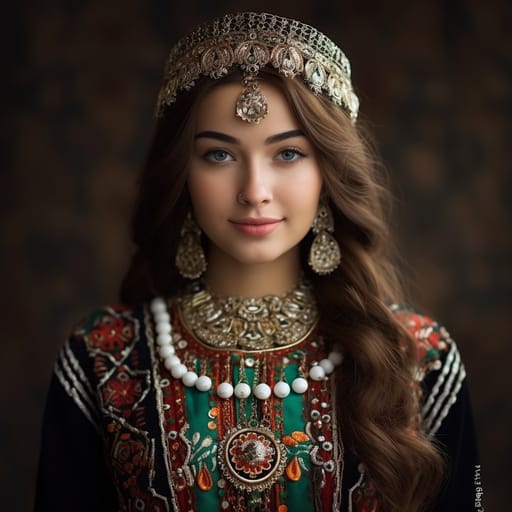
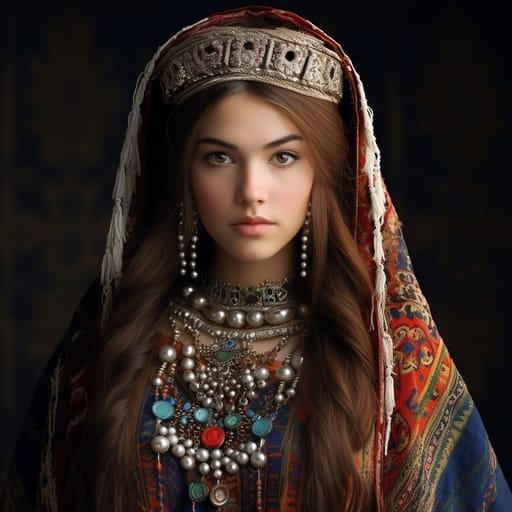
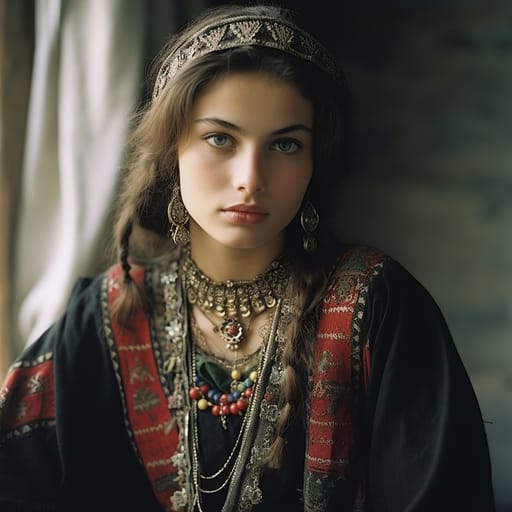
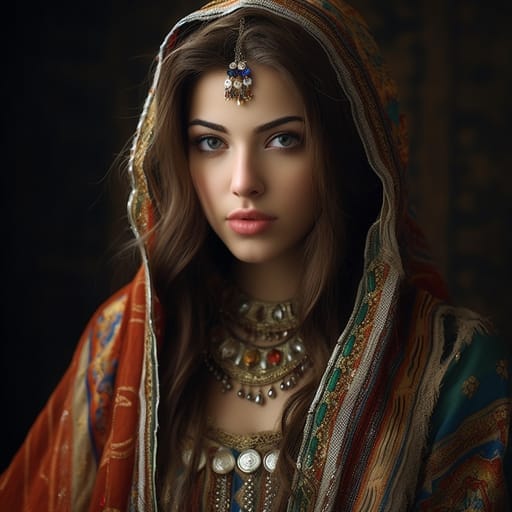
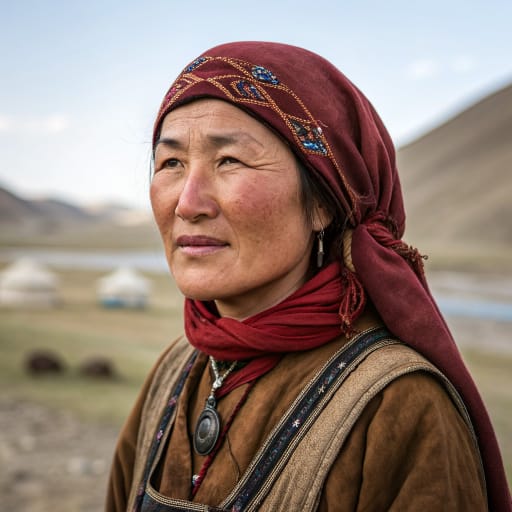
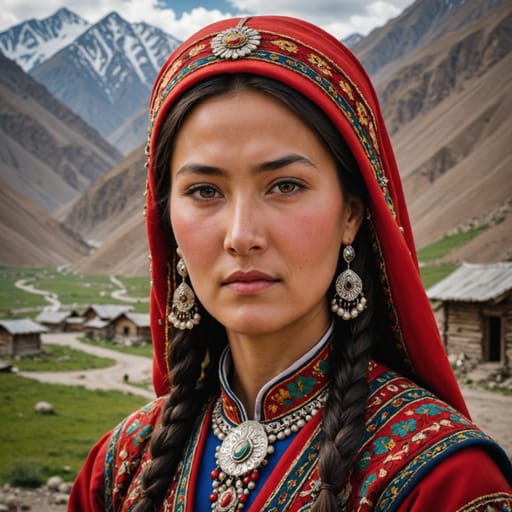
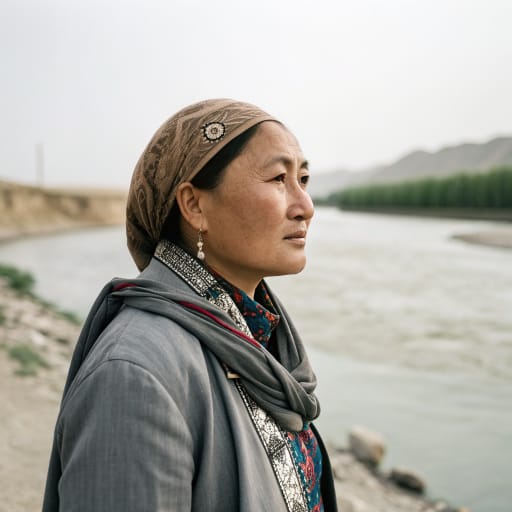
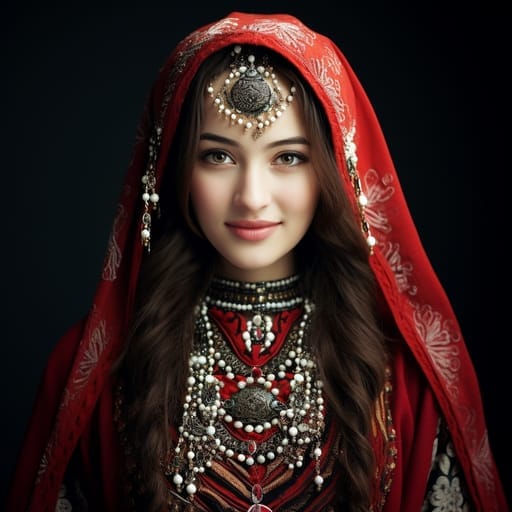
Typical Sacaraucae Phenotypes
Reference for AI generation: hair, eyes, skin, facial structure, build
Sacaraucae Body & Anatomy Reference
Central Asian Turkic-Mongolic phenotype: anatomy reference for AI nude generation
Sacaraucae Boobs & Breasts
The typical Sacaraucae bust is medium cup, moderate projection, in line with the wider Central Asian Turkic-Mongolic pattern. Areolas usually fall in the 30-42mm range, with medium-brown areolar pigmentation against the tan-to-light-brown skin tone. Compared with the smaller East Asian bust, Sacaraucae breasts sit forward and are generally full and modestly projecting. A faithful AI render of Sacaraucae tits keeps that shape and areola size.
Sacaraucae Ass & Hips
Butt shape among Sacaraucae women: medium, moderate projection, broader hip profile than the East Asian norm, over medium iliac crests, moderate gluteal-femoral fat deposition. This follows Central Asian Turkic-Mongolic ancestry and looks quite unlike the slim East Asian narrow-hip profile. An accurate Sacaraucae ass in adult AI imagery keeps both the silhouette and the overall build (mesomorph, broader frame than the East Asian norm) instead of a generic average.
Sacaraucae Vagina & Pussy
Vulvar anatomy among Sacaraucae women: medium-brown labial pigmentation. Pubic hair tends to be straight-to-wavy medium-coarse texture, in the usual inverted-triangle pattern. Both follow Central Asian Turkic-Mongolic pigmentation, which is why Sacaraucae pussy renders should not fall back on a pale, sparse Western template.
Sacaraucae Dicks & Penis
The Sacaraucae cock profile, from Central Asian Turkic-Mongolic anthropometric data: regional mean ~13cm erect; moderate girth; medium-brown shaft pigmentation. Pubic hair has a straight-to-wavy medium-coarse texture and forms the usual inverted-V pattern. Whether Sacaraucae men are circumcised follows religious and cultural practice rather than phenotype.
Sacaraucae Body, Curves & Build
Build and curves among Sacaraucae women follow the Central Asian Turkic-Mongolic pattern: mesomorph, broader frame than the East Asian norm, mean adult female BMI 23-26. Proportions matter as much as skin tone, so Sacaraucae figures should keep their regional height and limb ratios.
Sacaraucae Skin Tone & Hair Texture
The Sacaraucae skin range is tan to light-brown (Fitzpatrick III-IV), and hair tends to be straight 1A-1B, dark-brown to black. That combination marks the Central Asian Turkic-Mongolic phenotype, and skin tone is the trait AI generators most often get wrong for Sacaraucae women.
Explore phenotype categories
Structured taxonomy with peer-reviewed scales · 22 anatomical categories
Erotic Poses & Sex Positions
From the pose catalog: 219 named positions with reference skeletons
Frequently asked questions about Sacaraucae people
Where is the Sacaraucae homeland?
The Sacaraucae homeland is Steppe between the Syr Darya (Jaxartes) and Amu Darya (Oxus), in present-day Kazakhstan, Uzbekistan and Turkmenistan; later Bactria and the Parthian frontier in Afghanistan and Iran. in Central Asia.
What language do Sacaraucae people speak?
Sacaraucae people primarily speak Saka, an Eastern Iranian language (Indo-European, Iranian branch); no texts of their own survive..
What religion do Sacaraucae people practice?
The predominant religion among Sacaraucae people is Iranian steppe polytheism of the Saka type; specifics for this tribe are unrecorded..






Make your own Sacaraucae images
Five a day, free, no credits to buy. The studio starts from this group's phenotype data, so you can set body type, pose and style and keep the traits accurate.
Start with Sacaraucae