No portrait yet
Roman Africans Erotic
Roman North Africa, in the provinces of Africa Proconsularis, Numidia, Tripolitania and the Mauretanias: modern Tunisia, northern Algeria, northwestern Libya and northern Morocco.
Latin, including the regional African Romance vernacular (Italic, Indo-European); Punic (Semitic) and Berber languages (Afroasiatic) were also spoken alongside it.
Roman and Punic-derived polytheism, notably the cult of Saturn; later Latin Christianity, divided between Catholic and Donatist churches; gradual conversion to Islam after the Arab conquest.
Descended from Punic settlers, Romanized Berbers (Numidians and Mauri), and Italian colonists and veterans; called Afariqa by Arab writers; later absorbed into Berber and Arab Maghrebi populations.
About Roman Africans People
The Roman Africans were the Romanized, Latin-speaking population of North Africa from the fall of Carthage to Rome in 146 BC until several centuries after the Arab conquest, when their language and separate identity faded into the Berber and Arab Maghreb. They were never a single bloodline. The people who lived as Romans in Carthage, Hippo Regius or Leptis Magna descended from Punic townspeople, Berber farmers and chiefs, and Italian colonists and army veterans settled on African land. What made them a people was a way of living: Latin, Roman law and citizenship, bathhouses and amphitheaters, and a landowning class that shipped grain and olive oil across the sea to feed Rome.
Their provinces covered what is now Tunisia, northeastern Algeria, coastal western Libya and northern Morocco, with the densest settlement in the fertile north of Tunisia. Latin ran the towns and the courts, but it never had the field to itself. Punic was still spoken in the countryside around AD 400, and Berber languages held the mountains and the desert edge. The local Latin had its own sound. Augustine admitted that African ears could not tell long vowels from short ones, and that Italians found fault with his pronunciation.
Africa shaped Latin Christianity more than any other western region. Tertullian, Cyprian and Augustine all wrote there. The Donatist schism split African churches for more than a century over one question: could clergy who had collaborated during persecution still give valid sacraments? Earlier, many Africans worshiped Saturn, a Roman name laid over the Punic god Baal Hammon, and left great numbers of carved votive stelae. The region also gave Rome the emperor Septimius Severus and the novelist Apuleius.
The Vandals seized Carthage in 439, Byzantine forces retook it in 533, and Arab armies captured it for good in 698. The Roman Africans did not disappear with the city. Arab writers called them the Afariqa, separate from both the Berbers and the Byzantine Greeks. Latin Christian epitaphs from the Kairouan area run into the eleventh century, and in the twelfth the geographer al-Idrisi reported that the people of Gafsa still spoke an African Latin. Conversion, Arabization and emigration eventually ended the community. The legacy is quieter but real: Berber languages keep Latin loanwords, many of them for farming, and the old agricultural calendar of the Maghreb still names its months after Latin ones, starting with Yennayer for January.
Related ethnic groups
Groups that share Roman Africans's homeland, region, language, or religious tradition. These are likely candidates for comparative phenotype reference.
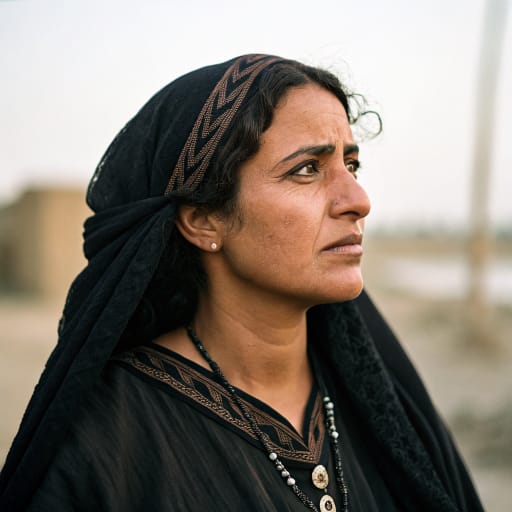
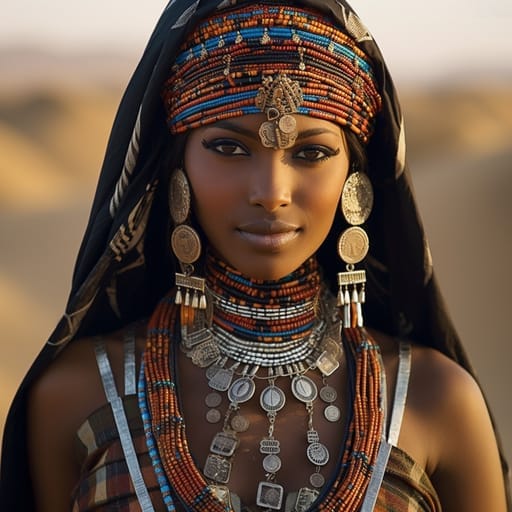
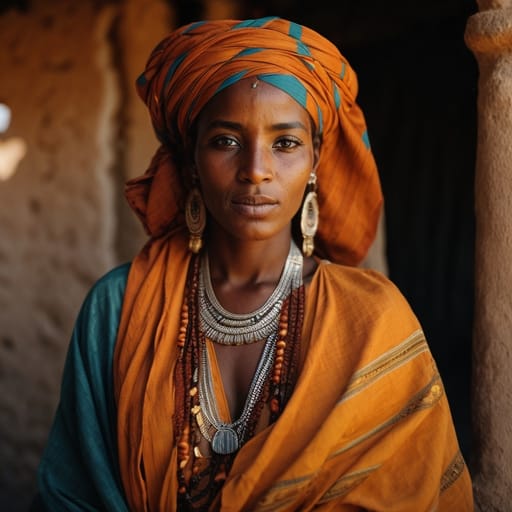
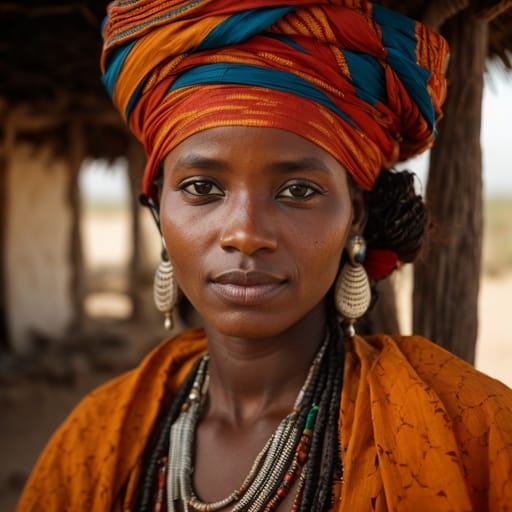
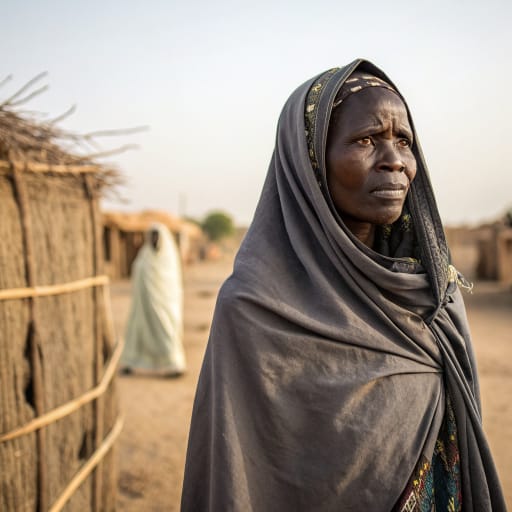
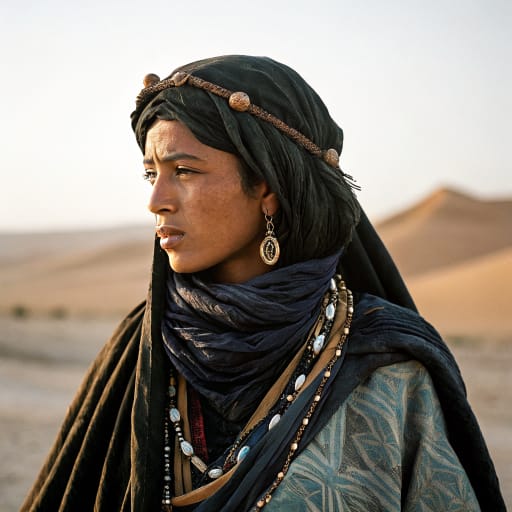
Typical Roman Africans Phenotypes
Reference for AI generation: hair, eyes, skin, facial structure, build
Roman Africans Body & Anatomy Reference
Berber / Mediterranean-Saharan phenotype: anatomy reference for AI nude generation
Roman Africans Boobs & Breasts
Roman Africans tits and boobs run medium-to-large cup, full, moderate projection, the classic Berber / Mediterranean-Saharan bust profile. Roman Africans nipples and areolas show medium-brown to dark-brown areolar pigmentation against the olive-to-light-brown skin tone, with areolar diameter typically in the 30-44mm range and forward-set positioning rather than the smaller East Asian bust profile. Roman Africans breasts trend fuller and softer than the Cushitic East African norm, a function of the mesomorph with fuller hip-and-bust deposition body habitus and the mean adult female BMI 24-28. For anatomically accurate AI-generated Roman Africans nudes the render preserves the medium-to-large cup, full, moderate projection shape, 30-44mm areolas with medium-brown to dark-brown pigmentation, and the torso proportions of the Berber / Mediterranean-Saharan phenotype.
Roman Africans Ass & Hips
Roman Africans hips and butt usually read as medium-to-full, moderate projection, broader hip profile. The skeletal base is medium-to-wide iliac crests, fuller gluteal-femoral fat distribution, the Berber / Mediterranean-Saharan pattern. Set against the slim narrow-hip Cushitic East African profile, the difference is easy to see, and the hip-to-waist ratio is often what identifies Roman Africans women in photos.
Roman Africans Vagina & Pussy
Expect medium-brown to dark-brown labial pigmentation, fuller labia minora on Roman Africans women, in keeping with Berber / Mediterranean-Saharan ancestry. The pubic hair is wavy-to-coiled medium-coarse texture, dense distribution. Coloring should run evenly from the olive to medium-brown skin of the thighs to the labia, and Roman Africans nude imagery should keep the hair's wavy-to-coiled medium-coarse texture.
Roman Africans Dicks & Penis
Roman Africans dick and penile anatomy in adult AI generation should anchor on the regional reference data: regional mean ~13-14cm erect, moderate girth, and medium-brown shaft pigmentation. The Roman Africans cock profile reflects the Berber / Mediterranean-Saharan population's anthropometric measurements. The shaft pigmentation should track the surrounding olive to medium-brown skin tone, and the pubic hair should keep its wavy-to-coiled medium-coarse texture in the typical inverted-V escutcheon.
Roman Africans Body, Curves & Build
Roman Africans body type: mesomorph with fuller hip-and-bust deposition, with mean adult female BMI 24-28. This is the typical Berber / Mediterranean-Saharan build. Height range, shoulder-to-hip ratio and fat distribution all follow from it, which is what an accurate Roman Africans nude body should show.
Roman Africans Skin Tone & Hair Texture
Roman Africans skin tone falls in the olive to medium-brown (Fitzpatrick III-V) band, the surface signal most often miscalibrated by generic AI nude generators. Roman Africans hair texture is typically wavy-to-curly 2B-3C, often dark-brown to black, characteristic of the Berber / Mediterranean-Saharan phenotype. In Roman Africans nude renders the skin should hold that band consistently across the body.
Explore phenotype categories
Structured taxonomy with peer-reviewed scales · 22 anatomical categories
Erotic Poses & Sex Positions
From the pose catalog: 219 named positions with reference skeletons
Frequently asked questions about Roman Africans people
Where is the Roman Africans homeland?
The Roman Africans homeland is Roman North Africa, in the provinces of Africa Proconsularis, Numidia, Tripolitania and the Mauretanias: modern Tunisia, northern Algeria, northwestern Libya and northern Morocco. in Northern Africa.
What language do Roman Africans people speak?
Roman Africans people primarily speak Latin, including the regional African Romance vernacular (Italic, Indo-European); Punic (Semitic) and Berber languages (Afroasiatic) were also spoken alongside it..
What religion do Roman Africans people practice?
The predominant religion among Roman Africans people is Roman and Punic-derived polytheism, notably the cult of Saturn; later Latin Christianity, divided between Catholic and Donatist churches; gradual conversion to Islam after the Arab conquest..






Make your own Roman Africans images
Five a day, free, no credits to buy. The studio starts from this group's phenotype data, so you can set body type, pose and style and keep the traits accurate.
Start with Roman Africans