Help us get this right
Does this portrait look right for Rajbongshi?
One tap. It takes a second and it is recorded.
3 say it looks right, 2 say it looks off.
Rajbongshi Erotic
About Rajbongshi People
The Rajbongshi are the people of the old Kamata–Koch country: the lowland belt where the Brahmaputra leaves the hills and spreads into the floodplains of northern Bengal, lower Assam, and northern Bangladesh. They take their name from a claim to royal lineage — raj-bongshi, "of the king's line" — anchored in the Koch dynasty that rose in the sixteenth century under Biswa Singha and his son Naranarayan, whose kingdom of Kamatapur once stretched across what are now Cooch Behar, Jalpaiguri, the Rangpur division, and the western districts of Assam. That kingdom is gone, but the identity it shaped is still the organizing fact of who the Rajbongshi understand themselves to be. They are not a tribal people in the administrative sense, nor wholly absorbed into mainstream Bengali or Assamese society; they sit in the seam between, and a long-running political movement insists that seam is its own thing.
Their language, Kamtapuri — also called Rajbanshi or, in parts of Assam, Goalpariya — is Indo-Aryan and close enough to Bengali and Assamese that outsiders often dismiss it as a dialect of one or the other, which Rajbongshi speakers tend to find irritating. It carries a substrate from the Tibeto-Burman languages of the Koch and Bodo neighbors, particularly in vocabulary tied to land, fishing, and agriculture, and it has its own oral literature: long narrative songs, the Bhawaiya tradition of melancholic love songs sung by cart drivers and elephant mahouts crossing the open grasslands, and a distinct repertoire of folk theatre. The push for recognition of Kamtapuri as a separate scheduled language, and for a separate Kamtapur state carved from the existing district map, has been a continuous undercurrent in regional politics for decades.
Religiously they are Hindu, but in the older syncretic register of the eastern frontier rather than the orthodox Sanskritic one. Household worship of Bishohori — a snake goddess shared with neighboring communities — village shrines to Thakur Panchanan, and the cult of Madan Kam tied to the Koch royal line all sit comfortably alongside more standard Vaishnava and Shakta observance. Society is organized around patrilineal clans, and marriage customs preserve forms — bride-price in some sub-groups, particular widow-remarriage practices — that distinguish Rajbongshi households from Bengali Hindu neighbors a few villages over. The community is internally varied: the Koch, Paliya, Deshi, and Sarania groupings each carry their own histories of how they came to claim, or be claimed by, the Rajbongshi name.
Related ethnic groups
Groups that share Rajbongshi's homeland, region, language, or religious tradition. These are likely candidates for comparative phenotype reference.
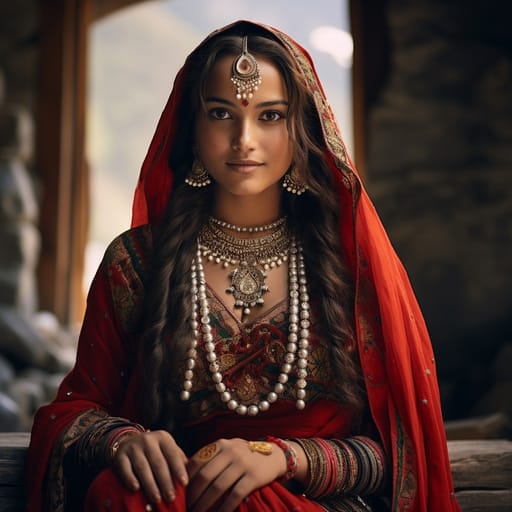
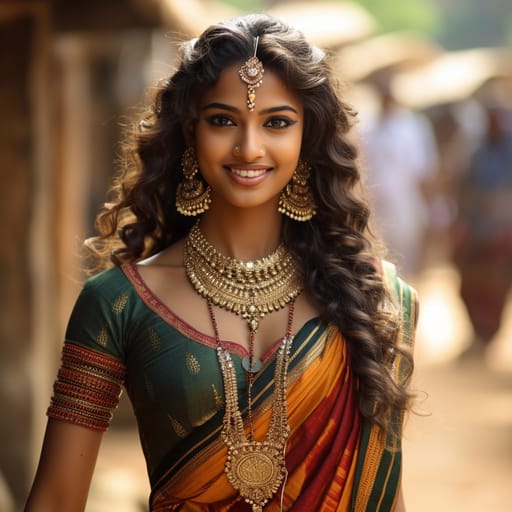
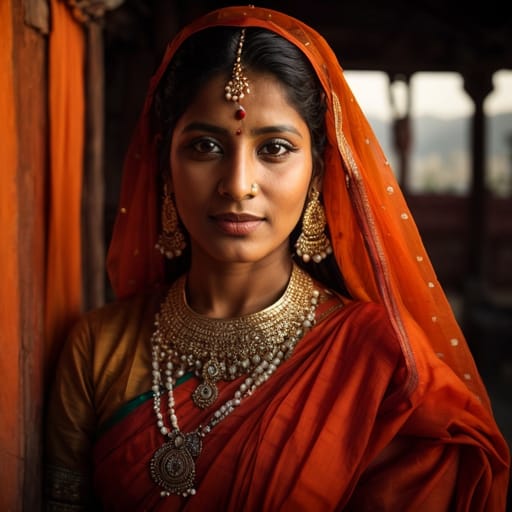
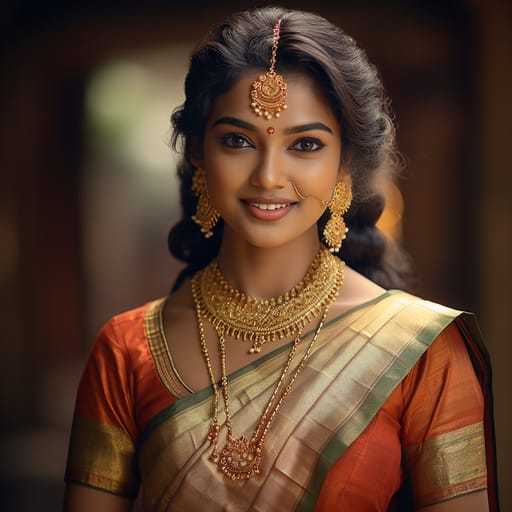
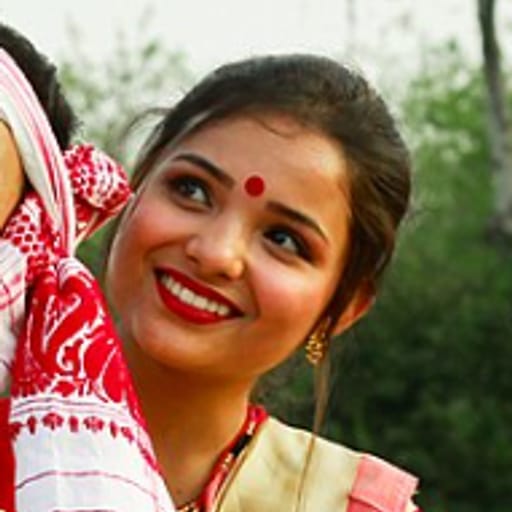
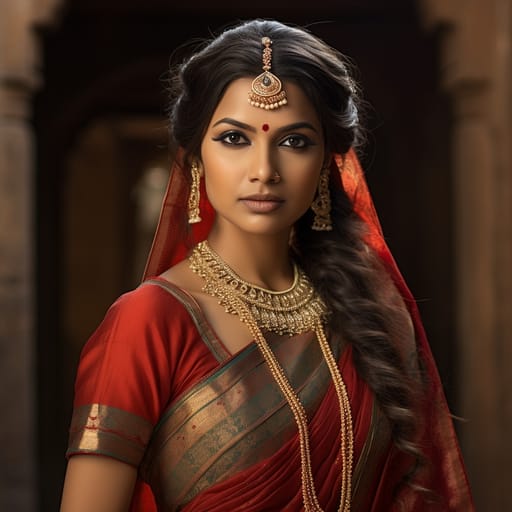
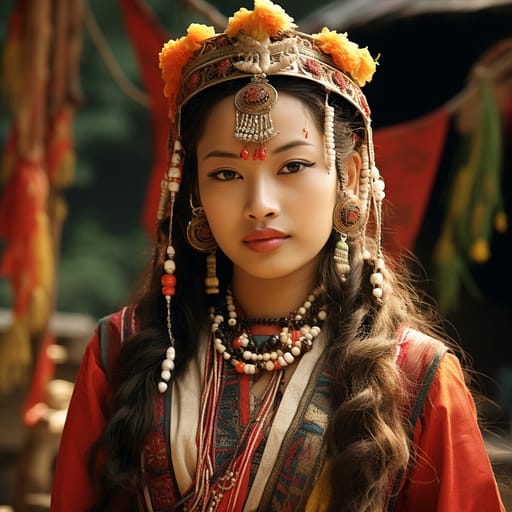
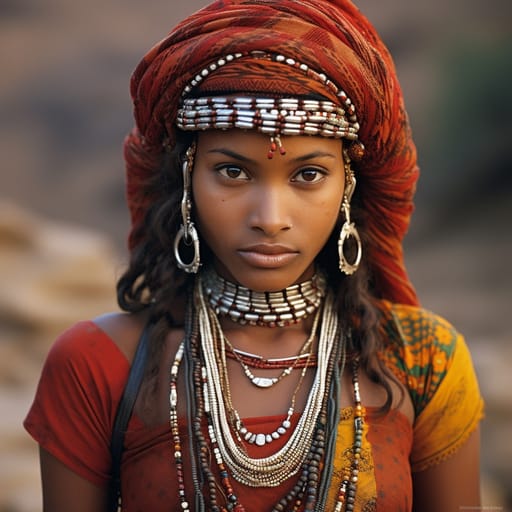
Typical Rajbongshi Phenotypes
Reference for AI generation: hair, eyes, skin, facial structure, build
The Rajbongshi (also Rajbanshi or Koch-Rajbongshi) sit on the visible seam between Indo-Aryan South Asian and Tibeto-Burman Northeast Indian phenotypes, and the population shows that mixing plainly. Hair is almost universally black to very dark brown, straight to gently wavy, with the heavy, glossy density typical of mainland South Asia; tight curl is rare. Coarse, poker-straight hair appears more often in northern Assam and submontane Bengal communities with deeper Tibeto-Burman ancestry, while looser wave is more common toward southern West Bengal and Bangladesh.
Eyes run dark brown to near-black. A partial or soft epicanthic fold is fairly common — not the full medial fold seen in East Asian populations, but enough to give many Rajbongshi a slightly hooded, almond-shaped eye with a less prominent supratarsal crease. Eye shape tends to be horizontally set rather than deeply socketed.
Skin tone spans roughly Fitzpatrick III to V, with warm olive and golden-brown undertones predominating; cooler, more neutral browns appear in the eastern Assam range. Outdoor agrarian life pushes much of the working population toward the deeper end of that range. Mouni Roy sits near the lighter, warm-olive end; rural cultivators commonly sit two to three shades darker.
Facial structure is the most diagnostic feature. Cheekbones are typically broad and high-set, the midface comparatively flat, and the jaw moderate rather than heavy. Noses tend toward small to medium length with a low-to-medium bridge and a moderately wide alar base — narrower and higher than Tibeto-Burman neighbors, broader and flatter than Indo-Aryan Punjabi or Bengali Brahmin norms. Lips are medium full, evenly proportioned, without strong eversion.
Build skews compact and wiry. Men commonly stand 5'4"–5'7", women 4'11"–5'3". Frames are small-boned with narrow shoulders and slim hips, lean musculature, and low typical body fat — the physique that produced heptathlete Swapna Barman is a recognizable Rajbongshi athletic build, not an outlier.
Rajbongshi Body & Anatomy Reference
Indo-Aryan / Dravidian South Asian phenotype: anatomy reference for AI nude generation
Rajbongshi Boobs & Breasts
Bust reference for Rajbongshi women: medium-to-large cup, moderate-to-full projection, which is typical of Indo-Aryan / Dravidian South Asian ancestry. Areolas measure about 32-46mm across, with medium-brown to dark-brown pigmentation. Body type (endomorph-to-mesomorph with fuller hip deposition) shapes the bust as well, so Rajbongshi tits are usually full and soft, generally fuller than the East Asian norm. In AI imagery, keep the forward-set shape rather than drifting toward the smaller East Asian bust profile.
Rajbongshi Ass & Hips
The Rajbongshi ass is typically medium-to-full, moderate-to-high projection, classic curvy hip profile, which sets it apart from the slim hip profile of East Asian women. Underneath, the pelvis shows medium-to-wide iliac crests, full gluteal-femoral fat distribution, part of the Indo-Aryan / Dravidian South Asian skeletal pattern. For Rajbongshi butt pics and AI renders, match that silhouette and the overall build (endomorph-to-mesomorph with fuller hip deposition).
Rajbongshi Vagina & Pussy
Rajbongshi pussy and vulvar anatomy presents medium-brown to dark-brown labial pigmentation, fuller labia minora projection, consistent with the Indo-Aryan / Dravidian South Asian phenotype's pigmentation pattern. Rajbongshi pubic hair is typically straight-to-wavy coarse texture, dense distribution, in the inverted-triangle pattern. For anatomically accurate Rajbongshi pussy renders the labial coloration should match the surrounding wheatish to brown skin tone with a continuous gradient, and the hair should keep its straight-to-wavy coarse texture.
Rajbongshi Dicks & Penis
Rajbongshi dicks follow the Indo-Aryan / Dravidian South Asian reference data: regional mean ~13cm erect; moderate girth; medium-brown shaft pigmentation. Shaft color should track the wheatish to brown skin tone with a smooth change toward the glans, and Rajbongshi pubic hair keeps its straight-to-wavy coarse texture.
Rajbongshi Body, Curves & Build
Rajbongshi body type and overall build presents as endomorph-to-mesomorph with fuller hip deposition, with mean adult female BMI 22-25: the characteristic Indo-Aryan / Dravidian South Asian habitus. Rajbongshi curves and proportions should keep the regional skeletal frame (height, shoulder-to-hip ratio, limb proportions) rather than a generic mesomorph default.
Rajbongshi Skin Tone & Hair Texture
Rajbongshi skin sits in the wheatish to brown (Fitzpatrick III-V) band. Hair is typically straight-to-wavy 1A-2B, dense, dark-brown to black, in keeping with the Indo-Aryan / Dravidian South Asian phenotype. In nude renders the skin should stay one even tone from face to body, and body, pubic and head hair should match.
Data depth
44/100Coverage of image-grounded phenotype observations · drives AI generation diversity
- Sample size
- 14/40· 6 images
- Image quality
- 25/30· 50% high
- Confidence
- 5/20· mean 0.54
- Source diversity
- 0/10· wikipedia
- ·Small sample (n<10)
- ·Low overall confidence
- ·Wikipedia-only source, not population-representative
Observed Distribution: Image Sample
Empirical observations from analyzed photographs · supplementary signal, not population truth
Sample: 6 images analyzed (6 wikipedia). Quality: 3 high, 1 medium, 2 low, 0 very_low. Avg analyzer confidence: 0.54.
Skin tone (Fitzpatrick): IV (33%), V (33%), unclear (33%)
Hair color: black (50%), gray/white (17%), unclear (33%)
Hair texture: straight (33%), wavy (17%), coily (17%), covered (17%), unclear (17%)
Eye color: dark brown (67%), unclear (33%)
Epicanthic fold: 0% present, 67% absent, 33% unclear
Caveats: Sample size 6 is small, so the observed distribution should be treated as suggestive, not definitive. Low average analyzer confidence: many photos partially obscured or historical. Sample is 100% Wikipedia notable people, which skews toward male, public-life, and modern figures, not population-representative.
Last aggregated: May 7, 2026
Explore phenotype categories
Structured taxonomy with peer-reviewed scales · 22 anatomical categories
Notable Rajbongshi People
11 reference figures, sourced from Wikipedia
- Panchanan Barma, 1866-1935) Indian social reformer of the Rajbanshi community from West Bengal.
- Upendranath Barman, 1 December 1899 to 7 February 1988) Indian politician from West Bengal.
- Pramathesh Chandra Barua, 24 October 1903 to 29 November 1951) was an Indian actor, director, and scree…
- Sarat Chandra Singha, 1 January 1914 to 25 December 2005) Former Chief Minister of Assam.
- Ambika Charan Choudhury, 16 August 1930 to 4 December 2011), popularly known as Kamataratna, from Borp…
- Pratima Barua Pandey, 3 October 1934 to 27 December 2002) was an Indian folk singer from the royal …
- Madhab Rajbangshi, 7 July 1954) Indian Politician from Assam.
- Mouni Roy, 28 September 1985) Indian actress from West Bengal.
- Swapna Barman, 29 October 1996) is an Indian heptathlete. She won the gold medal at 2018 Asi…
- Lalit Rajbanshi, 27 February 1999) Nepalese cricketer of Nepal National Cricket Team.
- Tuluram Rajbanshi, Nepalese politician associated with Nepal Communist Party.
Erotic Poses & Sex Positions
From the pose catalog: 219 named positions with reference skeletons
Frequently asked questions about Rajbongshi people
Where is the Rajbongshi homeland?
The Rajbongshi homeland is India (Assam, West Bengal), Bangladesh in Southern Asia.
What language do Rajbongshi people speak?
Rajbongshi people primarily speak Indo-European / Indo-Aryan / Kamtapuri.
What religion do Rajbongshi people practice?
The predominant religion among Rajbongshi people is Hinduism.
What does a typical Rajbongshi woman look like?
Rajbongshi women typically have black to very dark brown hair, straight to gently wavy, and dark brown eyes, often with a soft epicanthic fold that gives a slightly hooded, almond shape. Skin spans roughly Fitzpatrick III to V with warm olive and golden-brown undertones. Faces have broad, high cheekbones, a flatter midface and a small to medium nose, and women commonly stand 4'11" to 5'3" with a slim, small-boned frame.






Make your own Rajbongshi images
Five a day, free, no credits to buy. The studio starts from this group's phenotype data, so you can set body type, pose and style and keep the traits accurate.
Start with Rajbongshi