No portrait yet
Q'ero Erotic
Hatun Q'ero and neighboring hamlets on the eastern slopes of the Andes, Paucartambo province, Cusco region, Peru, below the peak of Ausangate.
Cusco Quechua, a Southern Quechua variety (Quechuan); Spanish as a second language for some.
Andean cosmology centered on Pachamama and the apus, with Catholic saints and feast days layered on top.
Quechua people; the Q'ero Nation comprises several communities including Hatun Q'ero, Q'ero Totorani, Marcachea, Quico, Hapu and Kallakancha.
About Q'ero People
The Q'ero are a small cluster of Quechua-speaking communities who live high on the eastern slopes of the Andes in Paucartambo province, Cusco region, Peru, within sight of the glaciated peak of Ausangate. Their name attaches to a handful of hamlets, Hatun Q'ero chief among them, that together call themselves the Q'ero Nation. What sets them apart is not remoteness alone but the way they organize life across altitude: the same family herds alpacas and llamas on the puna above 4,000 meters, grows potatoes and other tubers on the middle slopes, and keeps maize plots down in the cloud forest, walking between the three zones through the year. That vertical pattern is the old Andean template, and the Q'ero have kept it running as a working economy rather than a memory.
They speak Cusco Quechua, the southern variety that is also the language of the surrounding provinces, though outsiders often note a conservative cast to their vocabulary. Religion is Andean first and Catholic second. Pachamama, the earth, and the apus, the mountain lords, receive offerings called despachos, bundles of coca leaves, sweets, fat and other items that are burned or buried by ritual specialists known as paqos. Catholic saints and feast days sit on top of this without displacing it. The Inkarri myth, in which the beheaded Inca's body regrows underground until the day he returns, is told here with particular conviction, which is one reason the Q'ero were labeled the last Inca ayllu after a 1955 expedition from the university in Cusco brought them to national attention. Until the 1960s their lands belonged to a hacienda and families owed labor to it. A court fight won them title, and Peru declared the Q'ero communities part of the nation's cultural heritage in 2007.
Their weaving is the most visible marker. Women spin and weave alpaca and sheep wool into ponchos, shawls and belts in red, black and white, patterned with the inti, a diamond-shaped sun motif, and rows of small figures called ch'unchu that stand for the forest people below. Men wear knitted chullo caps with beaded ear flaps and a woven unku or poncho carrying the same motifs. Since the 1990s a stream of foreign seekers has come looking for paqos, and some Q'ero men now travel abroad to run ceremonies, a trade that brings income and also flattens a local practice into a global brand. Back home, most families still herd, plant and walk the slopes as before.
Related ethnic groups
Groups that share Q'ero's homeland, region, language, or religious tradition. These are likely candidates for comparative phenotype reference.
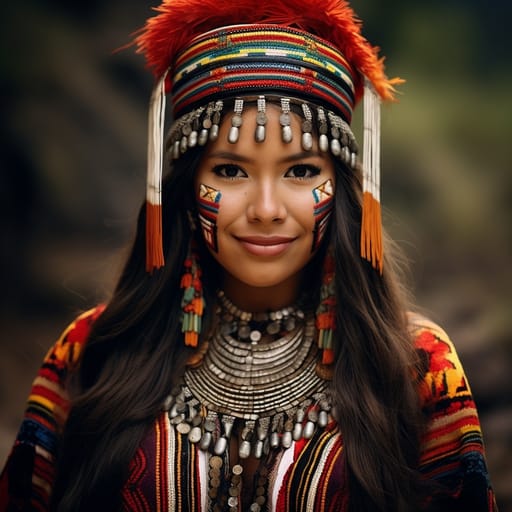
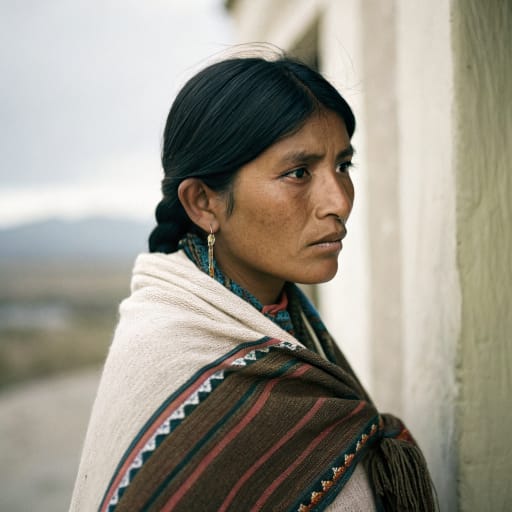
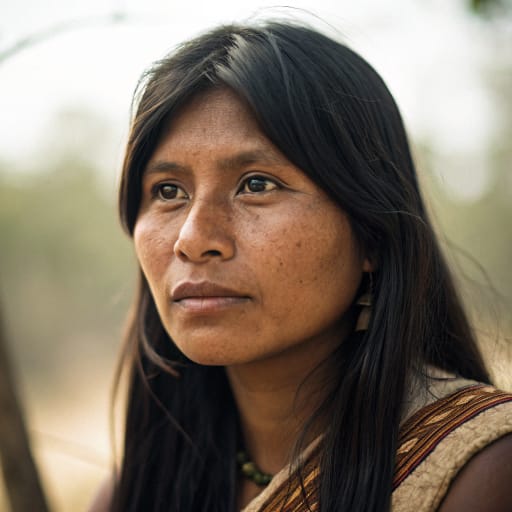
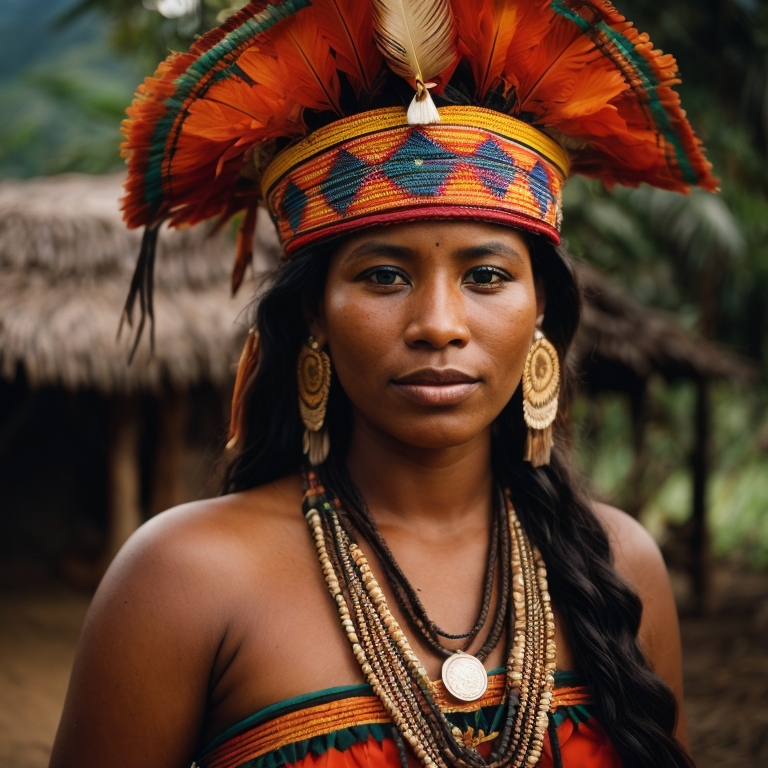
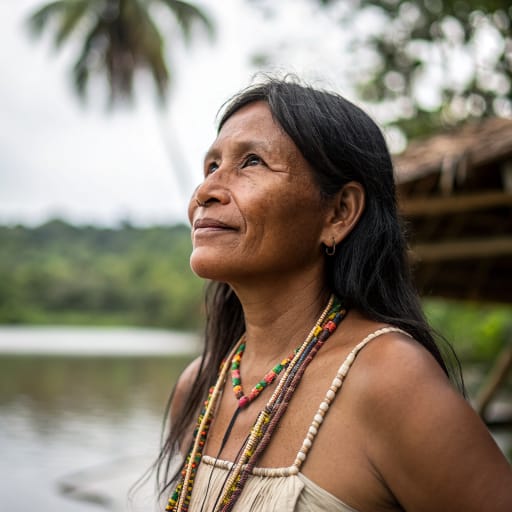
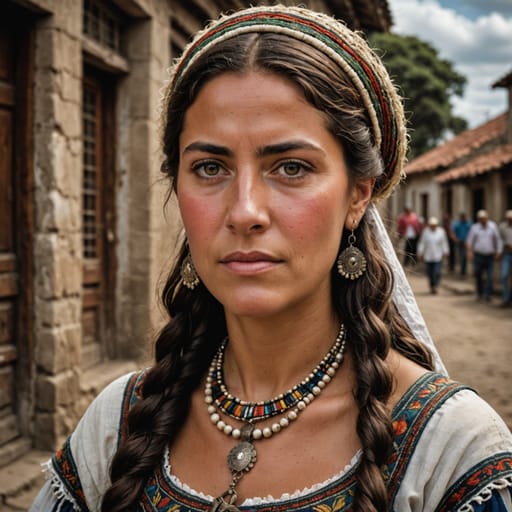
Typical Q'ero Phenotypes
Reference for AI generation: hair, eyes, skin, facial structure, build
Q'ero Body & Anatomy Reference
Per-feature anatomical profile for AI nude generation: South American Indigenous / European-Mestizo / Afro-Latino mix phenotype
Q'ero Boobs & Breasts
Q'ero tits and boobs run medium-to-large cup, full, high projection, the classic South American Indigenous / European-Mestizo / Afro-Latino mix bust profile. Q'ero nipples and areolas show medium-brown to dark-brown areolar pigmentation against the tan-to-deep-brown skin tone, with areolar diameter typically in the 32-46mm range and forward-set positioning rather than the smaller bust profile of Andean Indigenous sub-populations. Q'ero breasts trend the classic Brazilian / Latina curvy bust profile in lowland populations; smaller and shorter-set in Andean Indigenous populations, a function of the endomorph-to-mesomorph with high gluteal-femoral deposition body habitus and the mean adult female BMI 25-28. For anatomically accurate AI-generated Q'ero nudes the render preserves the medium-to-large cup, full, high projection shape, 32-46mm areolas with medium-brown to dark-brown pigmentation, and the torso proportions of the South American Indigenous / European-Mestizo / Afro-Latino mix phenotype.
Q'ero Ass & Hips
Q'ero hips and butt usually read as full, high projection, the famous Brazilian / Latina bunda profile. The skeletal base is wide iliac crests, very full gluteal-femoral fat deposition (the hallmark Brazilian / Latina hip-to-waist ratio), the South American Indigenous / European-Mestizo / Afro-Latino mix pattern. Set against the slim narrow-hip East Asian profile, the difference is easy to see, and the hip-to-waist ratio is often what identifies Q'ero women in photos.
Q'ero Vagina & Pussy
Expect medium-brown to dark-brown labial pigmentation, fuller labia minora on Q'ero women, in keeping with South American Indigenous / European-Mestizo / Afro-Latino mix ancestry. The pubic hair is wavy-to-curly coarse dark texture, dense distribution. Coloring should run evenly from the tan to deep-brown skin of the thighs to the labia, and Q'ero nude imagery should keep the hair's wavy-to-curly coarse dark texture.
Q'ero Dicks & Penis
Q'ero dick and penile anatomy in adult AI generation should anchor on the regional reference data: regional mean ~13cm erect, moderate-to-above-average girth, and medium-brown shaft pigmentation. The Q'ero cock profile reflects the South American Indigenous / European-Mestizo / Afro-Latino mix population's anthropometric measurements. The shaft pigmentation should track the surrounding tan to deep-brown skin tone, and the pubic hair should keep its wavy-to-curly coarse dark texture in the typical inverted-V escutcheon.
Q'ero Body, Curves & Build
Q'ero body type: endomorph-to-mesomorph with high gluteal-femoral deposition, with mean adult female BMI 25-28. This is the typical South American Indigenous / European-Mestizo / Afro-Latino mix build. Height range, shoulder-to-hip ratio and fat distribution all follow from it, which is what an accurate Q'ero nude body should show.
Q'ero Skin Tone & Hair Texture
Q'ero skin tone falls in the tan to deep-brown (Fitzpatrick III-VI) band, the surface signal most often miscalibrated by generic AI nude generators. Q'ero hair texture is typically straight-to-curly 1A-3C, varies widely by ancestral composition, characteristic of the South American Indigenous / European-Mestizo / Afro-Latino mix phenotype. In Q'ero nude renders the skin should hold that band consistently across the body.
Explore phenotype categories
Structured taxonomy with peer-reviewed scales · 22 anatomical categories
Erotic Poses & Sex Positions
From the pose catalog: 219 named positions with reference skeletons
Frequently asked questions about Q'ero people
Where is the Q'ero homeland?
The Q'ero homeland is Hatun Q'ero and neighboring hamlets on the eastern slopes of the Andes, Paucartambo province, Cusco region, Peru, below the peak of Ausangate. in South America.
What language do Q'ero people speak?
Q'ero people primarily speak Cusco Quechua, a Southern Quechua variety (Quechuan); Spanish as a second language for some..
What religion do Q'ero people practice?
The predominant religion among Q'ero people is Andean cosmology centered on Pachamama and the apus, with Catholic saints and feast days layered on top..






Make your own Q'ero images
Five a day, free, no credits to buy. The studio starts from this group's phenotype data, so you can set body type, pose and style and keep the traits accurate.
Start with Q'ero