No portrait yet
Pontic Greeks Erotic
Pontus, the Black Sea coast and Pontic Mountains of northeastern Turkey around Trabzon and Samsun; since the 1920s mostly northern Greece, with communities in Russia, Georgia, Kazakhstan and Western Europe
Pontic Greek, called Romeika by its speakers (Indo-European, Hellenic); also Standard Modern Greek, with Russian or Turkish in parts of the community
Eastern Orthodox Christianity; Sunni Islam in the Romeika-speaking villages that remained in Trabzon Province, Turkey
Part of the Greek people and the wider Anatolian Greeks; branches include Russian and Caucasus Pontians (Rossopontioi), Kars Greeks, and Muslim Romeika speakers around Of and Çaykara
About Pontic Greeks People
Pontic Greeks are Greeks whose ancestral home is not the Aegean but Pontus, the steep, rainy Black Sea coast of northeastern Turkey around Trabzon and Samsun. Most of their families left a century or more ago. What holds them together now is the memory of that coast, a dialect other Greeks often struggle to follow, and a music and dance tradition that still fills community halls from Thessaloniki to southern Russia. Greek colonists from Miletus and its daughter cities settled this shore in antiquity. The region later lent its name to the Kingdom of Pontus, whose king Mithridates VI spent decades at war with Rome. In the Middle Ages it was the seat of the Empire of Trebizond, which outlasted Constantinople by eight years before falling to the Ottomans in 1461. Under Ottoman rule most Pontians stayed Orthodox, though some villages converted to Islam and some families kept their Christianity hidden for generations. In the nineteenth century many moved into the Russian Empire, settling in the Caucasus and along the Black Sea. The break came with the First World War and the years after it, when deportations, labor battalions and massacres emptied much of Pontus. The 1923 population exchange sent the surviving Orthodox Pontians to Greece, largely to Macedonia. Greece now marks May 19 as a day of remembrance for what it officially recognizes as genocide. The Soviet branch went through its own ordeal: Stalin deported thousands to Kazakhstan and Central Asia, and many reached Greece only after the Soviet Union fell.
Their language, Pontic Greek, is called Romeika by the people who speak it. Long isolation let it keep features that standard Greek dropped centuries ago, while it borrowed freely from Turkish. In its homeland it survives mainly among older speakers in Muslim villages of Trabzon Province, around Of and Çaykara. For the Christian majority the faith is Orthodox, and its emotional center is Panagia Soumela, a monastery set into a cliff face in the Pontic Mountains. Monks buried its revered icon when they left. It was later recovered and now rests in a new monastery on Mount Vermio in northern Greece, where the August 15 feast of the Dormition draws thousands of pilgrims. Much of community life, in Greece and abroad, centers on Pontian associations that teach the dances to children and perform them in costume. The best known is the serra, a fast dance traditionally performed by men and marked by a sharp trembling of the shoulders. It is usually driven by the Pontic lyra, a slim three-stringed fiddle played upright. Pontian cooking leans on corn, butter and Black Sea anchovies, the food of a narrow coast with little flat farmland.
Related ethnic groups
Groups that share Pontic Greeks's homeland, region, language, or religious tradition. These are likely candidates for comparative phenotype reference.
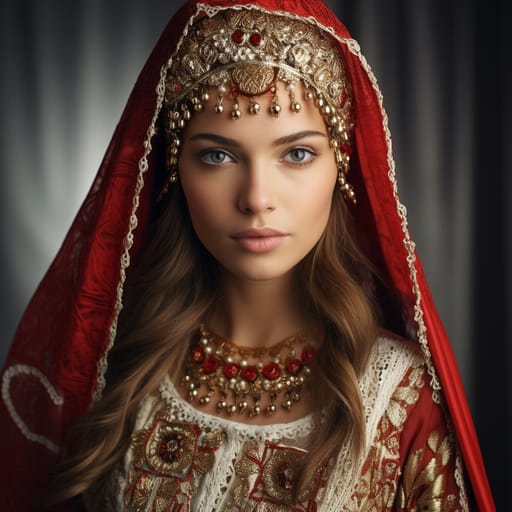
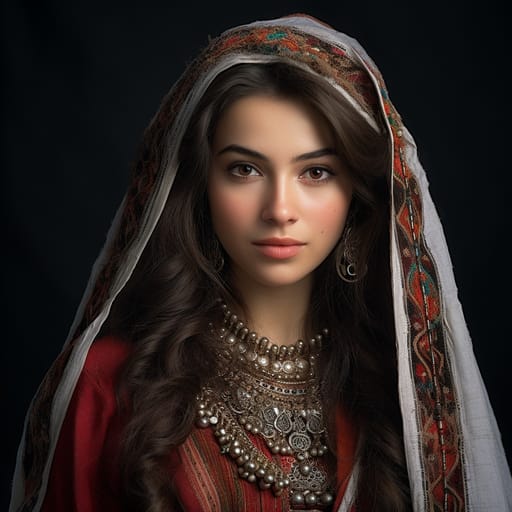
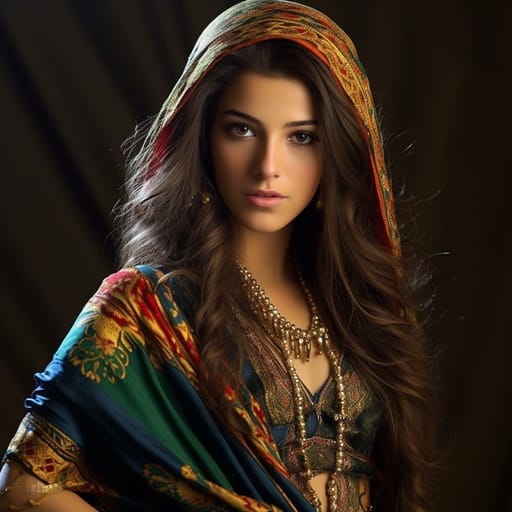
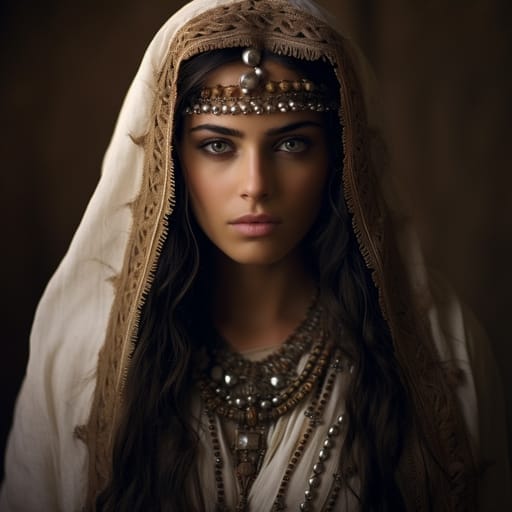
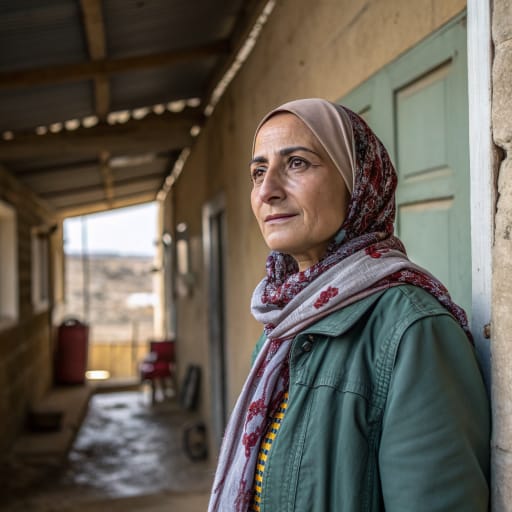
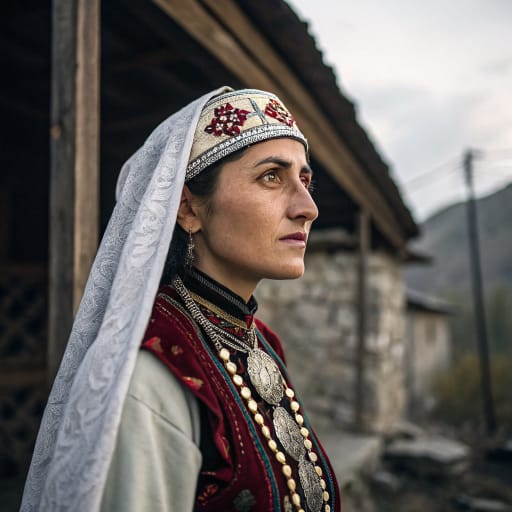
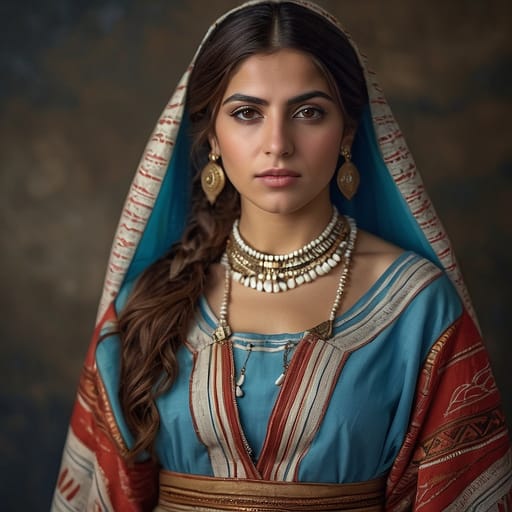
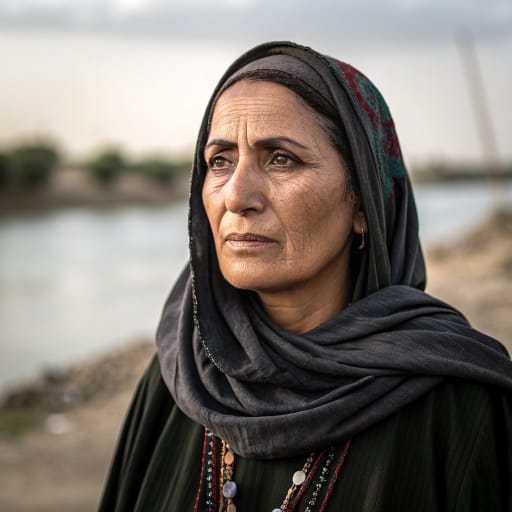
Typical Pontic Greeks Phenotypes
Reference for AI generation: hair, eyes, skin, facial structure, build
Pontic Greeks Body & Anatomy Reference
Per-feature anatomical profile for AI nude generation: Levantine / Mediterranean Middle Eastern phenotype
Pontic Greeks Boobs & Breasts
Pontic Greeks tits and boobs run medium-to-large cup, full, moderate-to-high projection, the classic Levantine / Mediterranean Middle Eastern bust profile. Pontic Greeks nipples and areolas show medium-brown to dark-brown areolar pigmentation against the olive-to-light-brown skin tone, with areolar diameter typically in the 32-46mm range and forward-set positioning rather than the smaller East Asian bust profile. Pontic Greeks breasts trend full and soft, fuller projection than the North-African Berber norm, a function of the mesomorph with fuller hip-and-bust deposition body habitus and the mean adult female BMI 25-28. For anatomically accurate AI-generated Pontic Greeks nudes the render preserves the medium-to-large cup, full, moderate-to-high projection shape, 32-46mm areolas with medium-brown to dark-brown pigmentation, and the torso proportions of the Levantine / Mediterranean Middle Eastern phenotype.
Pontic Greeks Ass & Hips
Pontic Greeks hips and butt usually read as medium-to-full, moderate projection, broader hip profile. The skeletal base is medium-to-wide iliac crests, fuller gluteal-femoral deposition, the Levantine / Mediterranean Middle Eastern pattern. Set against the slim East Asian narrow-hip profile, the difference is easy to see, and the hip-to-waist ratio is often what identifies Pontic Greeks women in photos.
Pontic Greeks Vagina & Pussy
Expect medium-brown to dark-brown labial pigmentation, fuller labia minora on Pontic Greeks women, in keeping with Levantine / Mediterranean Middle Eastern ancestry. The pubic hair is wavy-to-coiled medium-coarse dark texture, dense distribution. Coloring should run evenly from the olive to medium-brown skin of the thighs to the labia, and Pontic Greeks nude imagery should keep the hair's wavy-to-coiled medium-coarse dark texture.
Pontic Greeks Dicks & Penis
Pontic Greeks dick and penile anatomy in adult AI generation should anchor on the regional reference data: regional mean ~14cm erect, moderate-to-above-average girth, and medium-brown shaft pigmentation. The Pontic Greeks cock profile reflects the Levantine / Mediterranean Middle Eastern population's anthropometric measurements. The shaft pigmentation should track the surrounding olive to medium-brown skin tone, and the pubic hair should keep its wavy-to-coiled medium-coarse dark texture in the typical inverted-V escutcheon.
Pontic Greeks Body, Curves & Build
Pontic Greeks body type: mesomorph with fuller hip-and-bust deposition, with mean adult female BMI 25-28. This is the typical Levantine / Mediterranean Middle Eastern build. Height range, shoulder-to-hip ratio and fat distribution all follow from it, which is what an accurate Pontic Greeks nude body should show.
Pontic Greeks Skin Tone & Hair Texture
Pontic Greeks skin tone falls in the olive to medium-brown (Fitzpatrick III-V) band, the surface signal most often miscalibrated by generic AI nude generators. Pontic Greeks hair texture is typically wavy-to-curly 2B-3B, predominantly dark-brown to black, characteristic of the Levantine / Mediterranean Middle Eastern phenotype. In Pontic Greeks nude renders the skin should hold that band consistently across the body.
Explore phenotype categories
Structured taxonomy with peer-reviewed scales · 22 anatomical categories
Erotic Poses & Sex Positions
From the pose catalog: 219 named positions with reference skeletons
Frequently asked questions about Pontic Greeks people
Where is the Pontic Greeks homeland?
The Pontic Greeks homeland is Pontus, the Black Sea coast and Pontic Mountains of northeastern Turkey around Trabzon and Samsun; since the 1920s mostly northern Greece, with communities in Russia, Georgia, Kazakhstan and Western Europe in Western Asia.
What language do Pontic Greeks people speak?
Pontic Greeks people primarily speak Pontic Greek, called Romeika by its speakers (Indo-European, Hellenic); also Standard Modern Greek, with Russian or Turkish in parts of the community.
What religion do Pontic Greeks people practice?
The predominant religion among Pontic Greeks people is Eastern Orthodox Christianity; Sunni Islam in the Romeika-speaking villages that remained in Trabzon Province, Turkey.






Make your own Pontic Greeks images
Five a day, free, no credits to buy. The studio starts from this group's phenotype data, so you can set body type, pose and style and keep the traits accurate.
Start with Pontic Greeks