Help us get this right
Does this portrait look right for Nubians?
One tap. It takes a second and it is recorded.
4 say it looks right, 0 say it looks off.
Nubians Erotic
Also known as: Nubian
Nubia (Egypt, Sudan)
Islam
Nobiin, Mattokki, Dongolawi, Midob, Hill Nubians (including Dilling, Debri, Ghulfan, Kadaru, Karko, and Wali), Birgid, Ja'alin (including Bedaria), Shaigiya
About Nubians People
The Nubians are a Nile people whose homeland straddles what is now southern Egypt and northern Sudan, the long ribbon of river country between the First and Sixth Cataracts. They are among the oldest continuously documented populations on the African continent — the kingdoms of Kerma, Napata, and Meroë rose along this stretch of the Nile, and for a brief but consequential period in the 8th century BCE, Nubian rulers of the 25th Dynasty governed Egypt itself. That deep history is not a museum piece for Nubians; it sits beneath the surface of contemporary identity, especially since the 1960s, when the construction of the Aswan High Dam flooded ancestral villages and dispersed tens of thousands of people from the heart of historical Nubia. The displacement is the modern inflection point — older Nubians still distinguish between life before the water rose and life after.
The Nubian languages belong to a small branch within the broader Nilo-Saharan family, distinct from the Arabic spoken around them and from the Cushitic and Semitic languages further east. Nobiin, spoken nearest the Egyptian border, and Mattokki and Dongolawi, spoken further south, are the principal Nile Nubian tongues; the Hill Nubian varieties — Dilling, Debri, Ghulfan, Kadaru, Karko, Wali — survive in the Nuba Mountains of Kordofan, geographically separated from the river for centuries. Midob, spoken in Darfur, is a further outlier. Some communities historically counted as Nubian, including the Ja'alin and Shaigiya, are now Arabic-speaking and have absorbed the genealogical conventions of Arab kinship, though their Nubian substrate remains visible in custom and self-understanding.
Nubians are overwhelmingly Muslim today, having converted gradually after the collapse of the Christian kingdoms of Makuria and Alodia between the 14th and 16th centuries — a slow Islamization rather than a single conquest event. The earlier Christian period left its mark: church ruins still stand in the desert north of Dongola, and certain saints' shrines retain a pre-Islamic shape. Day-to-day Nubian life carries strong matrilineal currents that distinguish it from the surrounding Arab Sudanese norm — property, household authority, and kin reckoning often run through the mother's line, and the wedding traditions of Nubian villages are notably elaborate, with multi-day rituals that predate Islamic forms and have been quietly preserved alongside them. The brightly painted houses of villages like Gharb Soheil, with their relief work around doorways, are a recognizable Nubian visual signature, though that aesthetic is itself partly a post-displacement assertion of identity.
Related ethnic groups
Groups that share Nubians's homeland, region, language, or religious tradition. These are likely candidates for comparative phenotype reference.
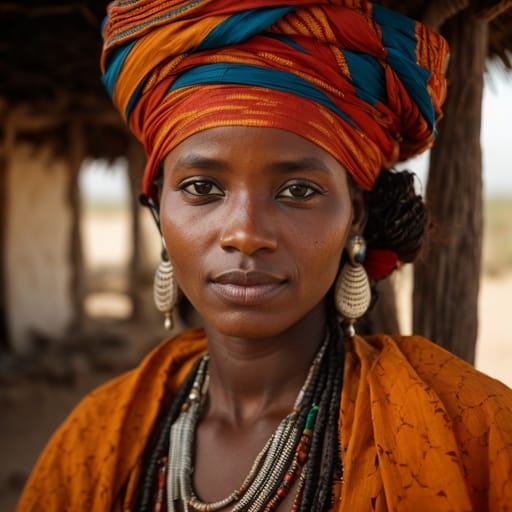
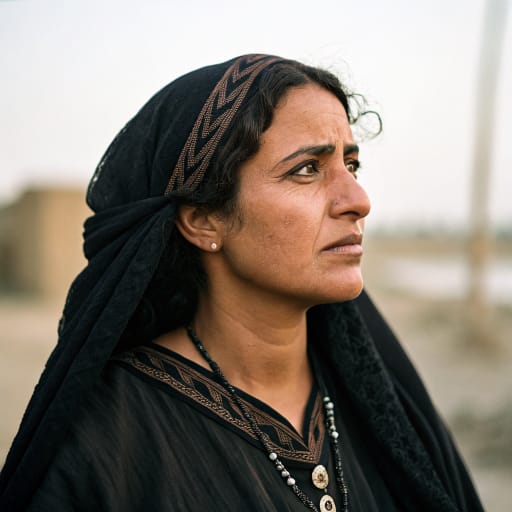
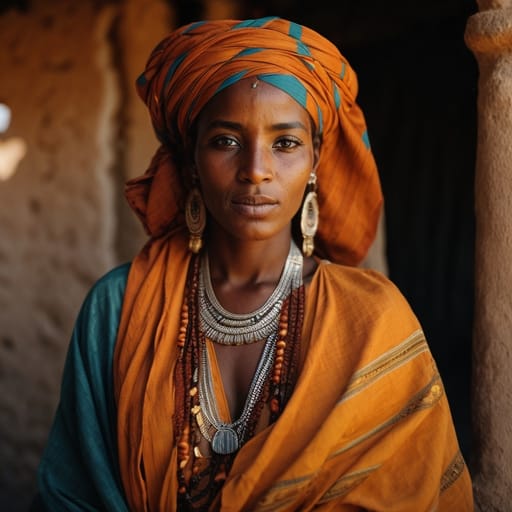
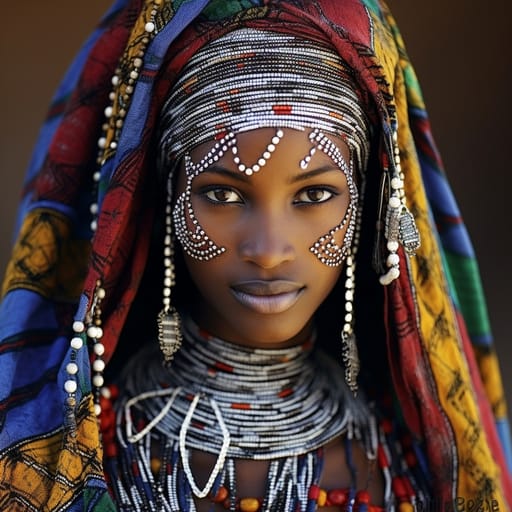
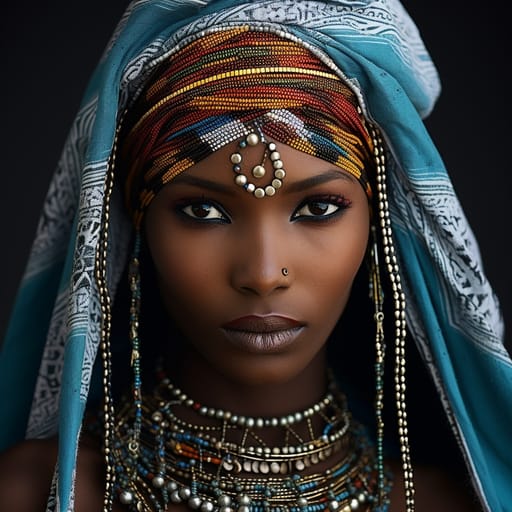
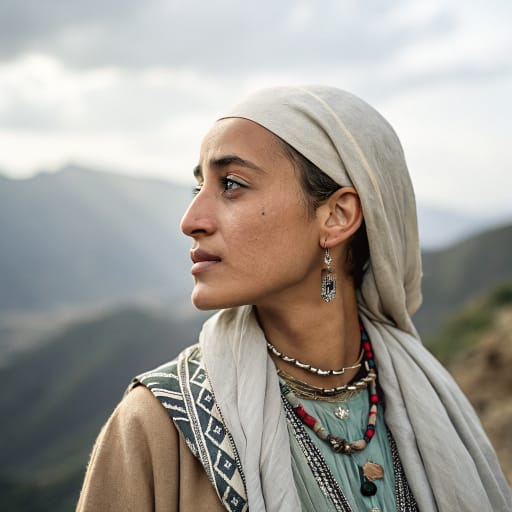
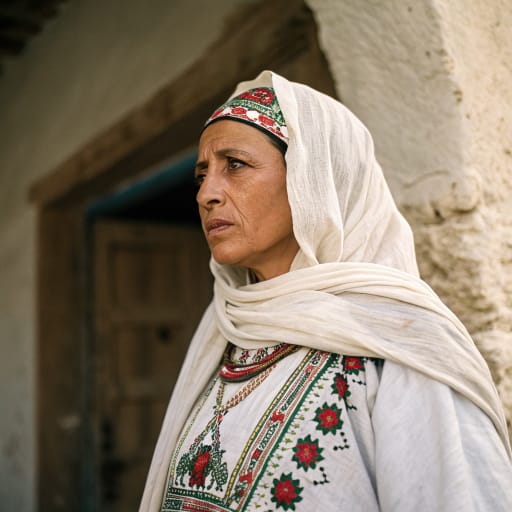
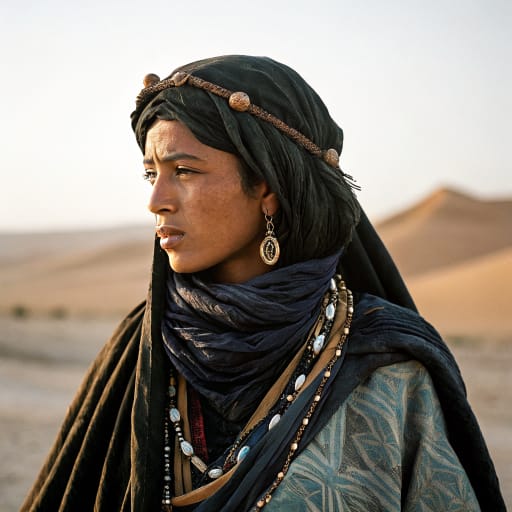
Typical Nubians Phenotypes
Reference for AI generation: hair, eyes, skin, facial structure, build
Nubians sit at the visual hinge between Saharan and Sub-Saharan Africa, and the phenotype reflects that hinge directly rather than splitting the difference. Skin tone runs deep — Fitzpatrick V to VI dominates, with rich brown to nearly blue-black tones common among riverine Nobiin and Mattokki of the Nile valley, and warmer red-brown undertones more typical of Ja'alin and Shaigiya groups further north. Hair is almost universally Type 4, tightly coiled to kinky, with the densest, most compact curl patterns among Hill Nubians and looser, more defined coils among lowland Nile groups. Natural color is uniformly black or near-black; reddish casts from sun bleaching are common on uncovered hair.
Eyes are dark — deep brown to near-black — with no epicanthic fold and an almond-to-rounded shape. Whites of the eye often appear strikingly bright against the surrounding skin, a feature visible in performers like Mohamed Mounir and Mohammed Wardi. Brows are dark, full, and well-defined.
Facial structure is the most distinctive marker. Nubians tend toward narrow, elongated faces with high foreheads, high cheekbones, and a long jawline — closer to the Northeast African / Nilotic template than to West African phenotype. Noses are typically straight to slightly aquiline with a narrow bridge and moderate alar width, less broad than in equatorial Sub-Saharan groups. Lips are full but usually less everted than West African averages.
Build skews tall and lean. Men commonly fall in the 175–185 cm range with long limbs, narrow hips, and low body fat carried high; women run slim and long-limbed with the same elongated proportions. Hill Nubians of the Nuba Mountains tend to be shorter and more compactly muscled than the riverine groups, while Ja'alin and Shaigiya populations show somewhat broader features and occasional lighter brown skin tones reflecting longer Arab admixture. The combination of very dark skin with sharp, narrow facial geometry is the signature — not softened African features, not Arab features, but a distinct Nile-corridor phenotype.
Data depth
42/100Coverage of image-grounded phenotype observations · drives AI generation diversity
- Sample size
- 24/40· 16 images
- Image quality
- 13/30· 25% high
- Confidence
- 5/20· mean 0.46
- Source diversity
- 0/10· wikipedia
- ·Modest sample (n<25)
- ·Low overall confidence
- ·Mostly low-quality source images
- ·Wikipedia-only source, not population-representative
Observed Distribution: Image Sample
Empirical observations from analyzed photographs · supplementary signal, not population truth
Sample: 16 images analyzed (16 wikipedia). Quality: 4 high, 8 medium, 2 low, 2 very_low. Avg analyzer confidence: 0.46.
Skin tone (Fitzpatrick): IV (19%), V (38%), VI (6%), unclear (38%)
Hair color: black (31%), gray/white (31%), unclear (38%)
Hair texture: straight (6%), wavy (6%), coily (31%), covered (38%), unclear (19%)
Eye color: dark brown (63%), unclear (38%)
Epicanthic fold: 0% present, 69% absent, 31% unclear
Caveats: Sample size 16 is modest, so secondary patterns may not be reliable. Quality skews toward older or low-resolution photos; phenotype detail may be lossy. Low average analyzer confidence: many photos partially obscured or historical. Sample is 100% Wikipedia notable people, which skews toward male, public-life, and modern figures, not population-representative.
Last aggregated: May 7, 2026
Explore phenotype categories
Structured taxonomy with peer-reviewed scales · 22 anatomical categories
Notable Nubians People
31 reference figures, sourced from Wikipedia
- Luqman, ancient wise man in Islamic tradition
- Mentuhotep II, possibly), sixth ruler of the Eleventh Dynasty; united Egypt and established …
- Amenemhat I, founder of the Twelfth Dynasty
- Alara of Kush, founder of the Twenty-fifth Dynasty of Egypt
- Taharqa, Pharaoh of the Twenty-fifth Dynasty
- Amanitore, Kandake of the Kingdom of Kush centered on Meroë
- Silko, 6th-century king of the Noubades and all of the Ethiopians
- Qalidurut, 7th-century king of Makuria
- Merkourios, 8th-century king of Dotawo
- Kyriakos of Makuria, 8th-century king of Makuria
- Abu al-Misk Kafur, vizier of Ikhshidid Egypt
- Rafael of Makuria, 10th-century Nubian king of Makuria
- al-Mustansir Billah, caliph of the Fatimid Caliphate
- Salomo of Makuria, 11th-century king of Dotawo
- Georgios I of Makuria, king of Makuria
- Moses Georgios of Makuria, 12th-century king
- Muhammad Ahmad, 19th-century Sufi sheikh and revolutionary leader
- Abdallah Khalil, ex-Sudanese prime minister
- Jaafar Nimeiry, former Sudanese president
- Jamal Mohammed Ahmed, writer, historian, and diplomat
- Khalil Farah, 20th-century Sudanese Nubian musician
- Hamza El Din, singer and musicologist
- Mohammed Wardi, Sudanese Nubian singer
- Mohamed Mounir, Egyptian Nubian singer
- Khalil Kalfat, literary critic, political and economic thinker, and writer
- Mohamed Hussein Tantawi Soliman, Egyptian field marshal and statesman
- Mo Ibrahim, Sudanese-British entrepreneur and billionaire
- Osama Abdul Latif, Sudanese businessman
- Idris Ali, Egyptian novelist and short story writer
- Mohamed Homos, footballer
- Taha Abdelmagid, Paralympic powerlifter
Erotic Poses & Sex Positions
From the pose catalog: 219 named positions with reference skeletons
Frequently asked questions about Nubians people
Where is the Nubians homeland?
The Nubians homeland is Nubia (Egypt, Sudan) in Northern Africa.
What language do Nubians people speak?
Nubians people primarily speak Nilo-Saharan / Nubian.
What religion do Nubians people practice?
The predominant religion among Nubians people is Islam.
What does a typical Nubians woman look like?
Nubian women typically have very dark skin, Fitzpatrick V to VI, and tightly coiled black hair, with dark almond-to-round eyes and full, well-defined brows. Faces tend to be narrow and elongated, with high foreheads, high cheekbones, a narrow straight to slightly aquiline nose and full lips. Women are slim and long-limbed.
What are other names for Nubians people?
Nubians people are also known as Nubian.






Make your own Nubians images
Five a day, free, no credits to buy. The studio starts from this group's phenotype data, so you can set body type, pose and style and keep the traits accurate.
Start with Nubians