No portrait yet
Mushki Erotic
Eastern group in the upper Euphrates and Arsanias (Murat) valleys of eastern Turkey; western group in Cappadocia and Cilicia, central and southern Turkey.
Unrecorded; the western Mushki are equated with the Phrygians and so probably spoke Phrygian (Indo-European), while the eastern group has been argued to be Phrygian, early Armenian (Indo-European), or Kartvelian.
Unrecorded for the eastern group; if the western Mushki were Phrygians, they worshipped the mother goddess Matar (Cybele) at rock-cut shrines.
Eastern Mushki (12th to 9th centuries BC, upper Euphrates) and Western Mushki (8th to 7th centuries BC, Cappadocia and Cilicia); associated with the Phrygians, the Moschoi of Greek writers, biblical Meshech, and the Georgian Meskhi.
About Mushki People
The Mushki were an Iron Age people of Anatolia, known entirely through the records of their enemies: Assyrian kings wrote about them from the twelfth to the seventh century BC, Greek writers later attached a related name, the Moschoi, to a highland people on the edge of the Caucasus, and then the name faded from history. No Mushki text survives, no city is securely theirs, and whether the word was ever what they called themselves is unknown. Their legacy is a set of names, arguments, and one famous king.
Assyria first met them around 1115 BC, when Tiglath-Pileser I claimed to have crushed twenty thousand Mushki under five kings in Katmuhu on the upper Tigris. His scribes add that the Mushki had already held Alzi and Purulumzi, near where the Arsanias (Murat) meets the Euphrates, for fifty years, which drops their arrival squarely into the vacuum left by the Hittite collapse. This eastern group stays in the Assyrian record for three centuries as a stubborn highland presence, paying tribute in one reign and raiding in the next. Then, in the eighth century, the name jumps west. Sargon II's annals describe Mita of Mushki, a king who backed Carchemish and Tabal against Assyria before making peace in 709 BC, and Mita is widely identified with Midas of Gordion, the Phrygian king of legend. For the Assyrians, Mushki simply meant Phrygia. That leaves the hard question: were the eastern highlanders and the western kingdom one migrating people or two peoples sharing a name? Scholars have argued for Phrygian settlers from Thrace, for an early Armenian-speaking population, and for Kartvelian ancestors of the Georgian Meskhi, and none of the cases is closed.
Their afterlife runs through names rather than descendants. Herodotus counts the Moschoi in the Persian empire's nineteenth satrapy and has them march for Xerxes in wooden helmets with small shields and long-pointed spears, and the Georgian district of Meskheti still carries the word. The Bible's Meshech, paired with Tubal (Assyrian Tabal) in Genesis and Ezekiel, is almost certainly the same name, and Josephus placed it in Cappadocia. Urartian inscriptions of Rusa II list Mushki among the peoples deported to fill his new fortress towns, a sign that the eastern group was still there to be uprooted in the seventh century. Whatever they called themselves, the Mushki appear to have been absorbed into Phrygia in the west and into the Armenian and Georgian highlands in the east, leaving a name that outlived every fact about the people who owned it.
Related ethnic groups
Groups that share Mushki's homeland, region, language, or religious tradition. These are likely candidates for comparative phenotype reference.
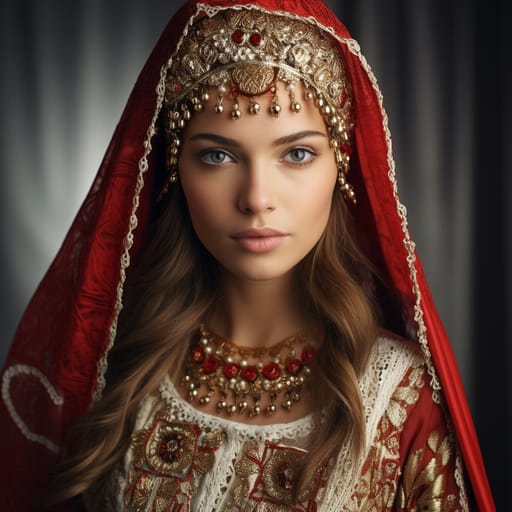
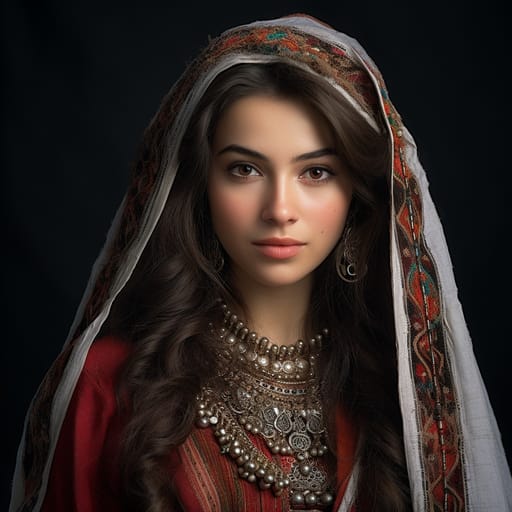
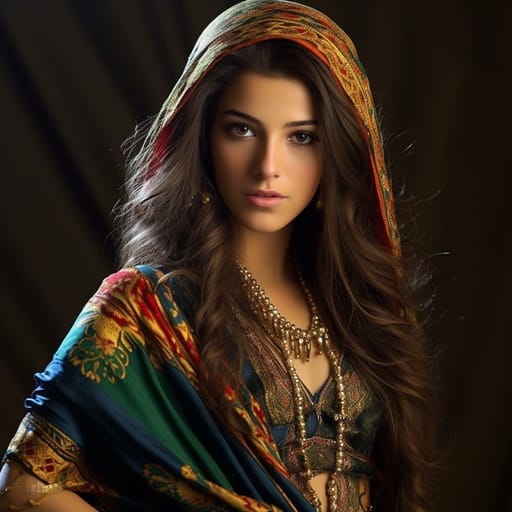
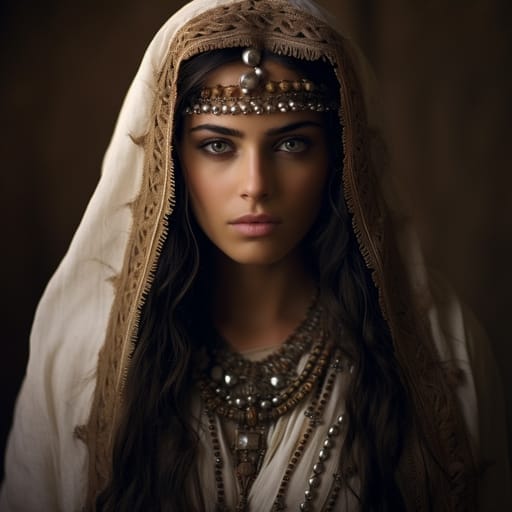
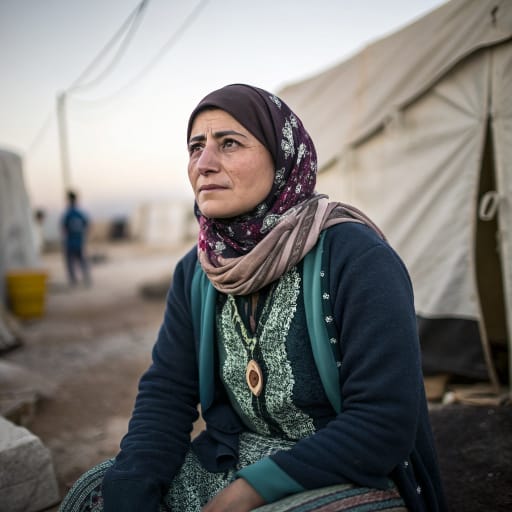
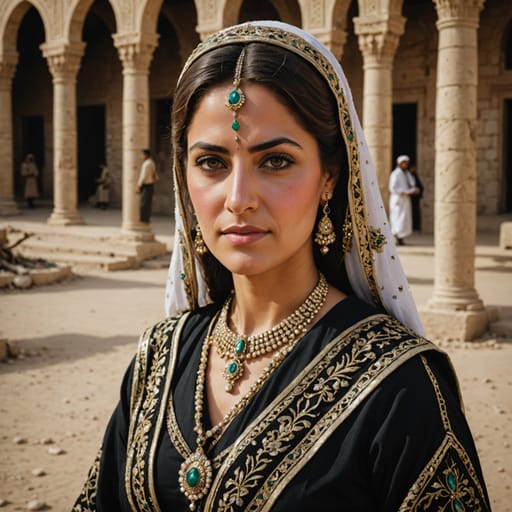
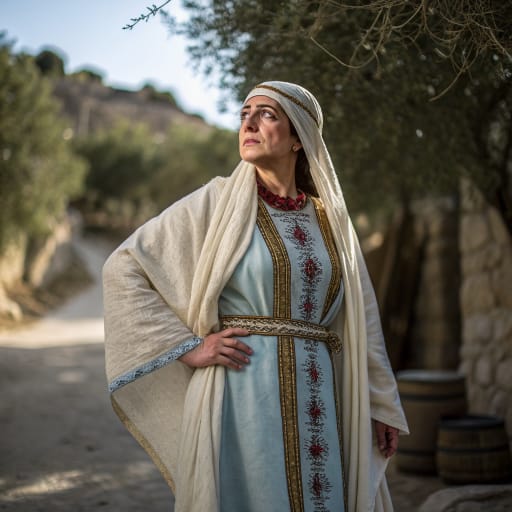
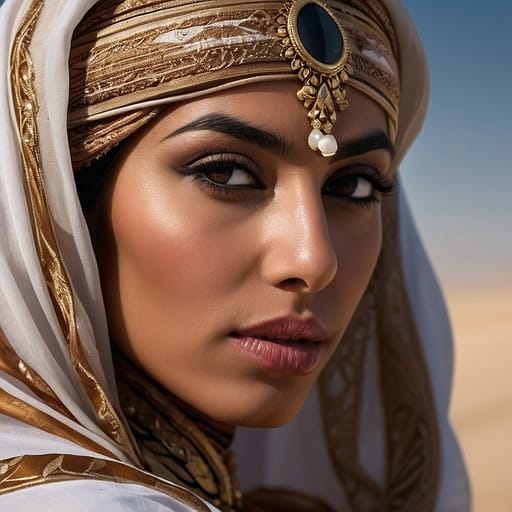
Typical Mushki Phenotypes
Reference for AI generation: hair, eyes, skin, facial structure, build
Mushki Body & Anatomy Reference
Per-feature anatomical profile for AI nude generation: Levantine / Mediterranean Middle Eastern phenotype
Mushki Boobs & Breasts
Bust reference for Mushki women: medium-to-large cup, full, moderate-to-high projection, which is typical of Levantine / Mediterranean Middle Eastern ancestry. Areolas measure about 32-46mm across, with medium-brown to dark-brown pigmentation. Body type (mesomorph with fuller hip-and-bust deposition) shapes the bust as well, so Mushki tits are usually full and soft, fuller projection than the North-African Berber norm. In AI imagery, keep the forward-set shape rather than drifting toward the smaller East Asian bust profile.
Mushki Ass & Hips
The Mushki ass is typically medium-to-full, moderate projection, broader hip profile, which sets it apart from the slim East Asian narrow-hip profile. Underneath, the pelvis shows medium-to-wide iliac crests, fuller gluteal-femoral deposition, part of the Levantine / Mediterranean Middle Eastern skeletal pattern. For Mushki butt pics and AI renders, match that silhouette and the overall build (mesomorph with fuller hip-and-bust deposition).
Mushki Vagina & Pussy
Mushki pussy and vulvar anatomy presents medium-brown to dark-brown labial pigmentation, fuller labia minora, consistent with the Levantine / Mediterranean Middle Eastern phenotype's pigmentation pattern. Mushki pubic hair is typically wavy-to-coiled medium-coarse dark texture, dense distribution, in the inverted-triangle pattern. For anatomically accurate Mushki pussy renders the labial coloration should match the surrounding olive to medium-brown skin tone with a continuous gradient, and the hair should keep its wavy-to-coiled medium-coarse dark texture.
Mushki Dicks & Penis
Mushki dicks follow the Levantine / Mediterranean Middle Eastern reference data: regional mean ~14cm erect; moderate-to-above-average girth; medium-brown shaft pigmentation. Shaft color should track the olive to medium-brown skin tone with a smooth change toward the glans, and Mushki pubic hair keeps its wavy-to-coiled medium-coarse dark texture.
Mushki Body, Curves & Build
Mushki body type and overall build presents as mesomorph with fuller hip-and-bust deposition, with mean adult female BMI 25-28: the characteristic Levantine / Mediterranean Middle Eastern habitus. Mushki curves and proportions should keep the regional skeletal frame (height, shoulder-to-hip ratio, limb proportions) rather than a generic mesomorph default.
Mushki Skin Tone & Hair Texture
Mushki skin sits in the olive to medium-brown (Fitzpatrick III-V) band. Hair is typically wavy-to-curly 2B-3B, predominantly dark-brown to black, in keeping with the Levantine / Mediterranean Middle Eastern phenotype. In nude renders the skin should stay one even tone from face to body, and body, pubic and head hair should match.
Explore phenotype categories
Structured taxonomy with peer-reviewed scales · 22 anatomical categories
Erotic Poses & Sex Positions
From the pose catalog: 219 named positions with reference skeletons
Frequently asked questions about Mushki people
Where is the Mushki homeland?
The Mushki homeland is Eastern group in the upper Euphrates and Arsanias (Murat) valleys of eastern Turkey; western group in Cappadocia and Cilicia, central and southern Turkey. in Western Asia.
What language do Mushki people speak?
Mushki people primarily speak Unrecorded; the western Mushki are equated with the Phrygians and so probably spoke Phrygian (Indo-European), while the eastern group has been argued to be Phrygian, early Armenian (Indo-European), or Kartvelian..
What religion do Mushki people practice?
The predominant religion among Mushki people is Unrecorded for the eastern group; if the western Mushki were Phrygians, they worshipped the mother goddess Matar (Cybele) at rock-cut shrines..






Make your own Mushki images
Five a day, free, no credits to buy. The studio starts from this group's phenotype data, so you can set body type, pose and style and keep the traits accurate.
Start with Mushki