Help us get this right
Does this portrait look right for Marquesans?
Nobody has judged this one yet. You would be the first.
Marquesans Erotic
Marquesas Islands (Te Henua Enana), French Polynesia: Nuku Hiva, Ua Pou, Ua Huka, Hiva Oa, Tahuata and Fatu Hiva; a large community also lives in Tahiti.
Marquesan, in North and South varieties (Austronesian, Eastern Polynesian); French is universal and Tahitian is widely understood.
Part of the Austronesian language family · Polynesian peoples
Predominantly Roman Catholic, with a Protestant minority; the older religion centered on tapu, deified ancestors and valley shrines (meae).
Polynesian. Northern group (Enana: Nuku Hiva, Ua Pou, Ua Huka) and southern group (Enata: Hiva Oa, Tahuata, Fatu Hiva), historically divided into valley tribes such as the Taipi and Teii of Nuku Hiva.
About Marquesans People
Marquesans call themselves Enana in the northern islands and Enata in the south. Both words simply mean people, and the archipelago is Te Henua Enana, the Land of Men. They are the Polynesians of the Marquesas, a chain of steep volcanic islands in French Polynesia about 1,400 kilometers northeast of Tahiti, and they do not think of themselves as Tahitians. Life happens in deep valleys walled off from each other by ridges, with little reef or coastal plain, and for centuries each valley was its own tribe, often at war with the next one over. Power stayed mostly local, without the large kingdoms that formed in Tahiti or Hawaii.
The language, Marquesan, comes in northern and southern varieties and belongs to the Eastern Polynesian branch, where it is usually grouped with Hawaiian and Mangarevan rather than Tahitian. The islands were settled early, and voyagers likely pushed on from here to other corners of the Polynesian triangle. Nearly everyone also speaks French, and Tahitian presses in through media and administration, but Marquesan remains a home language and a point of pride.
The 19th century nearly ended the Marquesans. Mendaña's Spanish expedition had shot its way through in 1595, but the real damage came later: whalers, sandalwood traders, firearms, alcohol, opium and wave after wave of epidemic disease, then French annexation in 1842. A population usually estimated in the tens of thousands fell to about 2,000 by the 1920s. Missionaries and colonial decrees banned tattooing, dance and chant along the way. Most Marquesans today are Roman Catholic, a contrast with largely Protestant Tahiti, and the Church eventually reversed course: Bishop Hervé-Marie Le Cléac'h translated scripture into Marquesan and brought local carving into the churches.
The recovery is the modern story. Roughly 9,000 people live in the islands now, with thousands more in Tahiti. The Motu Haka association, founded in 1978, and the Matavaa arts festival, first held on Ua Pou in 1987, brought back the haka, drumming and above all patutiki, the dense geometric tattooing that once covered bodies head to foot and was rebuilt partly from drawings made by visiting ethnographers. Marquesan carvers in wood, bone and stone are known across French Polynesia, and Fatu Hiva still beats bark cloth. Breadfruit remains the staple, once fermented in pits as insurance against drought. The stone platforms, plazas and tiki that fill the valleys helped win UNESCO World Heritage listing in 2024. Marquesan mayors have more than once asked Paris for a status apart from Papeete, and the islands already keep their own clock, half an hour ahead of Tahiti.
Related ethnic groups
Groups that share Marquesans's homeland, region, language, or religious tradition. These are likely candidates for comparative phenotype reference.
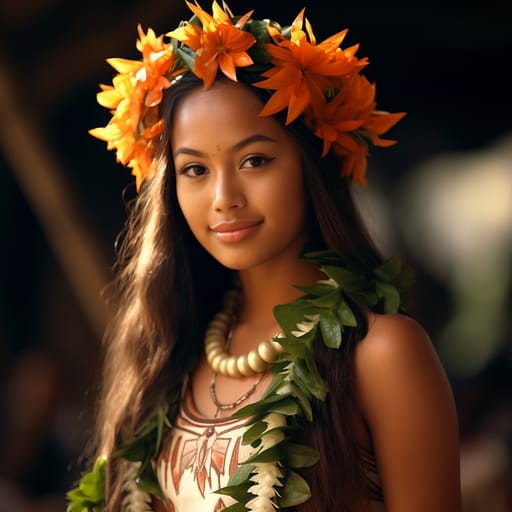
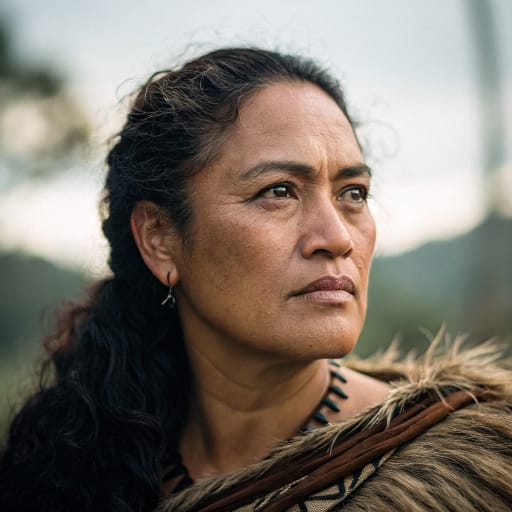
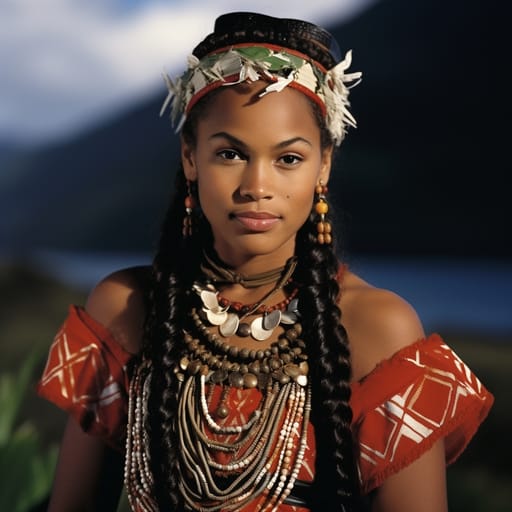
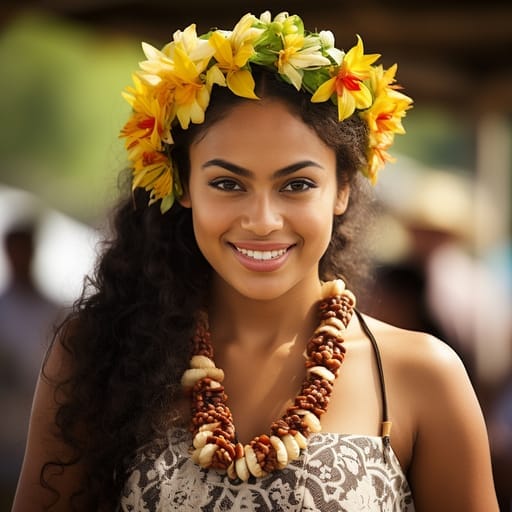
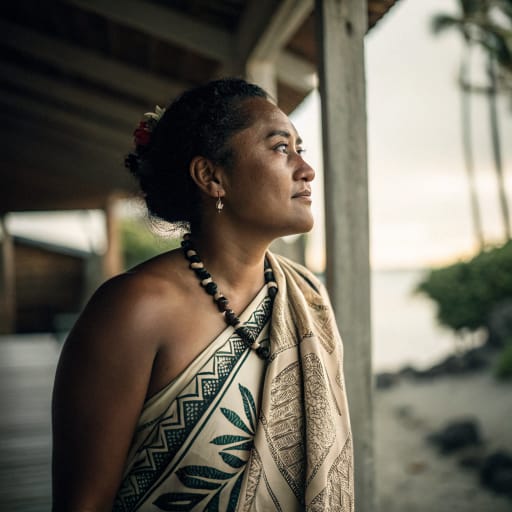
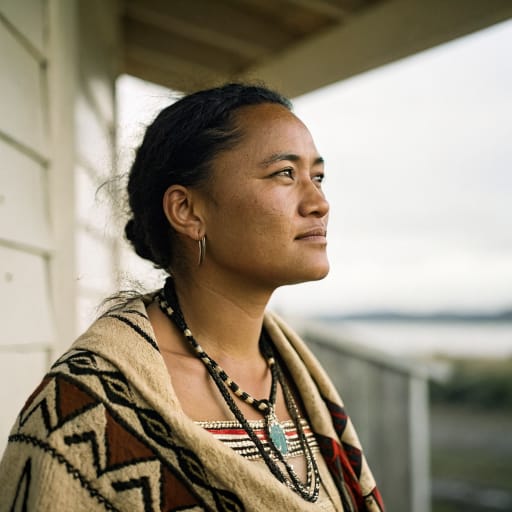
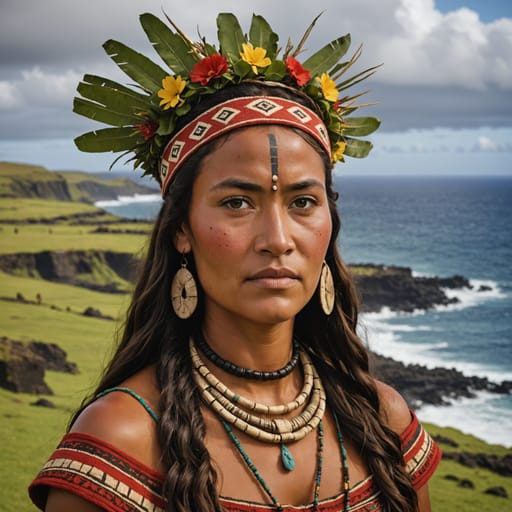
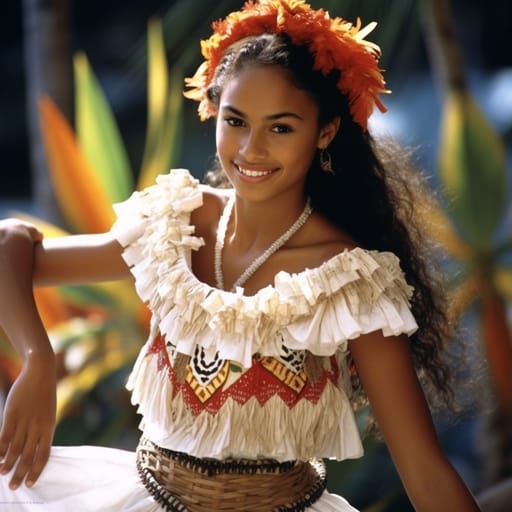
Typical Marquesans Phenotypes
Reference for AI generation: hair, eyes, skin, facial structure, build
Marquesans Body & Anatomy Reference
Per-feature anatomical profile for AI nude generation: Polynesian Pacific Islander phenotype
Marquesans Boobs & Breasts
Marquesans tits and boobs run medium-to-large cup, full, high projection, the classic Polynesian Pacific Islander bust profile. Marquesans nipples and areolas show medium-brown to dark-brown areolar pigmentation against the tan-to-medium-brown skin tone, with areolar diameter typically in the 34-50mm range and forward-set positioning rather than the smaller Southeast Asian bust. Marquesans breasts trend full and projecting, classic Polynesian build, a function of the endomorph-to-mesomorph with larger overall frame; the classic Polynesian taller-broader-build phenotype body habitus and the mean adult female BMI 28-32 (the highest regional mean globally; thrifty-gene phenotype documented). For anatomically accurate AI-generated Marquesans nudes the render preserves the medium-to-large cup, full, high projection shape, 34-50mm areolas with medium-brown to dark-brown pigmentation, and the torso proportions of the Polynesian Pacific Islander phenotype.
Marquesans Ass & Hips
Marquesans hips and butt usually read as very full, high projection, the famous Polynesian curvy hip profile. The skeletal base is wide iliac crests, very full gluteal-femoral fat deposition, the Polynesian Pacific Islander pattern. Set against the slim Southeast Asian narrow-hip profile, the difference is easy to see, and the hip-to-waist ratio is often what identifies Marquesans women in photos.
Marquesans Vagina & Pussy
Expect medium-brown to dark-brown labial pigmentation on Marquesans women, in keeping with Polynesian Pacific Islander ancestry. The pubic hair is wavy-to-curly medium-coarse texture. Coloring should run evenly from the tan to medium-brown skin of the thighs to the labia, and Marquesans nude imagery should keep the hair's wavy-to-curly medium-coarse texture.
Marquesans Dicks & Penis
Marquesans dick and penile anatomy in adult AI generation should anchor on the regional reference data: regional mean ~14cm erect, moderate-to-above-average girth, and medium-brown shaft pigmentation. The Marquesans cock profile reflects the Polynesian Pacific Islander population's anthropometric measurements. The shaft pigmentation should track the surrounding tan to medium-brown skin tone, and the pubic hair should keep its wavy-to-curly medium-coarse texture in the typical inverted-V escutcheon.
Marquesans Body, Curves & Build
Marquesans body type: endomorph-to-mesomorph with larger overall frame; the classic Polynesian taller-broader-build phenotype, with mean adult female BMI 28-32 (the highest regional mean globally; thrifty-gene phenotype documented). This is the typical Polynesian Pacific Islander build. Height range, shoulder-to-hip ratio and fat distribution all follow from it, which is what an accurate Marquesans nude body should show.
Marquesans Skin Tone & Hair Texture
Marquesans skin tone falls in the tan to medium-brown (Fitzpatrick IV-V) band, the surface signal most often miscalibrated by generic AI nude generators. Marquesans hair texture is typically wavy-to-curly 2B-3B, dark-brown to black, characteristic of the Polynesian Pacific Islander phenotype. In Marquesans nude renders the skin should hold that band consistently across the body.
Explore phenotype categories
Structured taxonomy with peer-reviewed scales · 22 anatomical categories
Erotic Poses & Sex Positions
From the pose catalog: 219 named positions with reference skeletons
Frequently asked questions about Marquesans people
Where is the Marquesans homeland?
The Marquesans homeland is Marquesas Islands (Te Henua Enana), French Polynesia: Nuku Hiva, Ua Pou, Ua Huka, Hiva Oa, Tahuata and Fatu Hiva; a large community also lives in Tahiti. in Polynesia.
What language do Marquesans people speak?
Marquesans people primarily speak Marquesan, in North and South varieties (Austronesian, Eastern Polynesian); French is universal and Tahitian is widely understood..
What religion do Marquesans people practice?
The predominant religion among Marquesans people is Predominantly Roman Catholic, with a Protestant minority; the older religion centered on tapu, deified ancestors and valley shrines (meae)..






Make your own Marquesans images
Five a day, free, no credits to buy. The studio starts from this group's phenotype data, so you can set body type, pose and style and keep the traits accurate.
Start with Marquesans