Help us get this right
Does this portrait look right for Pitcairn Islanders?
One tap. It takes a second and it is recorded.
1 says it looks right, 0 say it looks off.
Pitcairn Islanders Erotic
Pitcairn Island
Indo-European / Germanic / English / Pitkern
Part of the Indo-European language family · Polynesian peoples
Christianity / Protestantism
Significant population in Norfolk Island, along with a diaspora in Australia, and New Zealand[2]
About Pitcairn Islanders People
The Pitcairn Islanders are the descendants of nine Bounty mutineers and the Tahitian women and men who sailed with them in 1790, marooned by choice on a two-square-mile speck of volcanic rock in the South Pacific. Almost every Pitcairner alive today carries some combination of those founding surnames — Christian, Young, Adams, McCoy, Quintal — and the entire community has at various points fit inside a single church hall. The island sits closer to South America than to any inhabited Polynesian neighbor, and that isolation has done most of the cultural work: the Pitcairners are not quite British, not quite Polynesian, but a small, settled hybrid that has had more than two centuries to become its own thing.
Their language, Pitkern, is the audible record of the founding. It grew from the eighteenth-century English of the mutineers braided with Tahitian, and it remains a working creole rather than a heritage curiosity — neighbors still slip into it across the fence and back to English when an outsider walks up. A close sister dialect, Norf'k, is spoken on Norfolk Island, where the British relocated most of the population in 1856 after Pitcairn briefly outgrew its own water supply; some families later sailed back, and the two communities still trade visitors, surnames, and recipes.
Religion arrived as a second founding. In the 1880s the islanders converted en masse to Seventh-day Adventism after a missionary tract reached them by ship, and the denomination has shaped daily rhythm ever since: Saturday rather than Sunday is the day of rest, pork and shellfish are traditionally absent from the table, and the church doubles as the civic center of a polity that has no pub and no commercial district. Governance is unusual in scale — Pitcairn is a British Overseas Territory whose entire electorate can be seated around a long table — and the mayor is typically someone you've already shared a meal with.
The economy runs on what the sea brings and takes away: longboats meet passing freighters at an unsheltered landing called Bounty Bay, and households earn from honey, carved miro-wood curios, and commemorative postage stamps that circulate far more widely than the islanders themselves ever will. The population now hovers in the few dozens, and the central question Pitcairners discuss openly is whether the community will still exist in recognizable form a generation from now — a question they have, in fairness, been answering in the affirmative for more than two hundred years.
Related ethnic groups
Groups that share Pitcairn Islanders's homeland, region, language, or religious tradition. These are likely candidates for comparative phenotype reference.
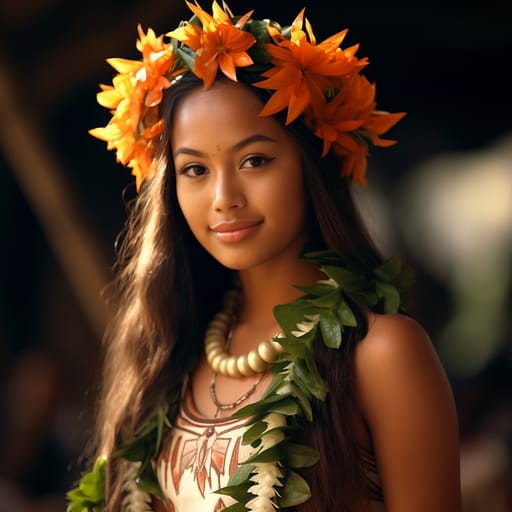
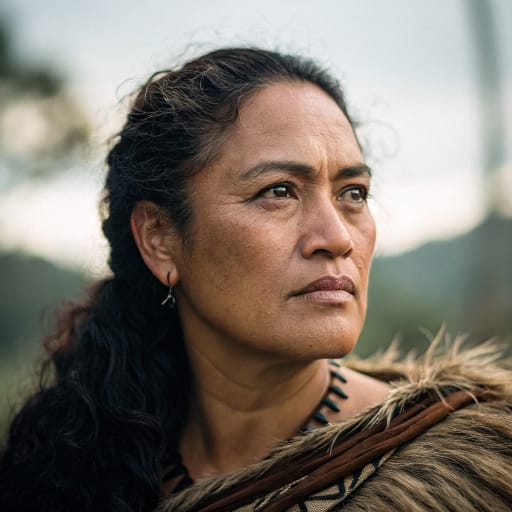
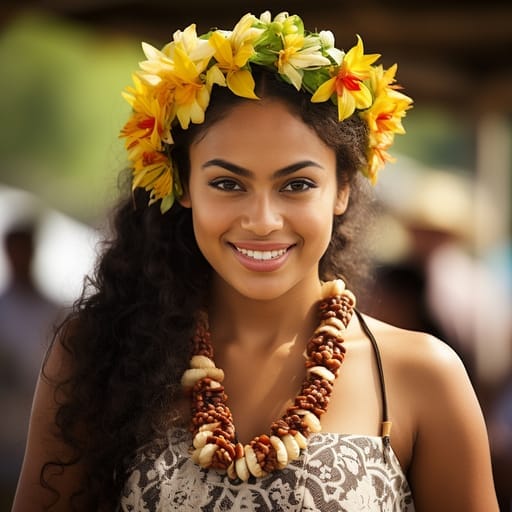
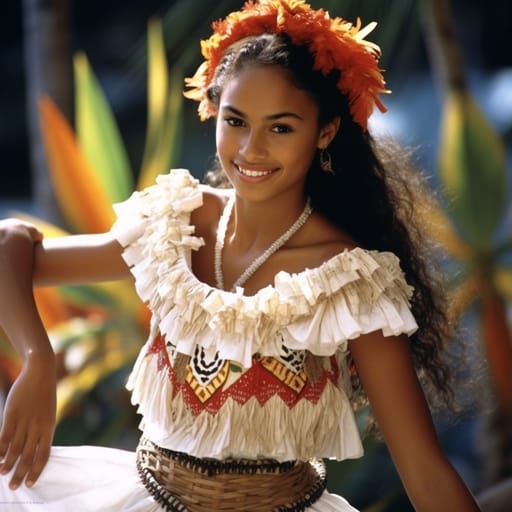
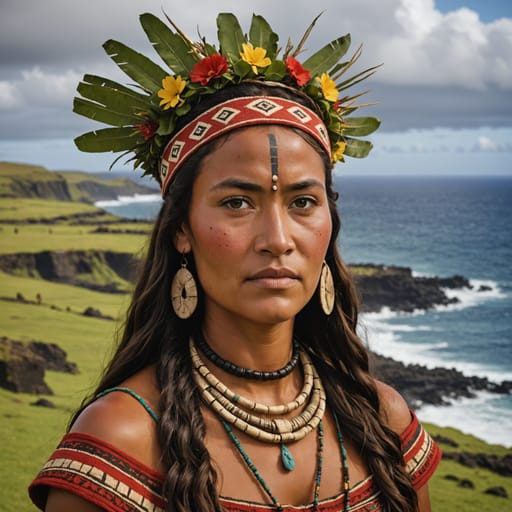
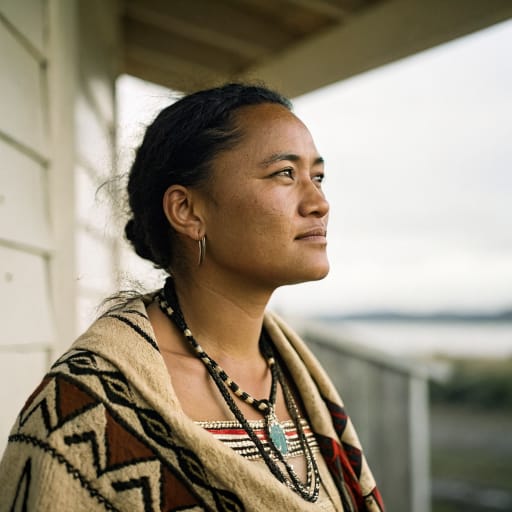
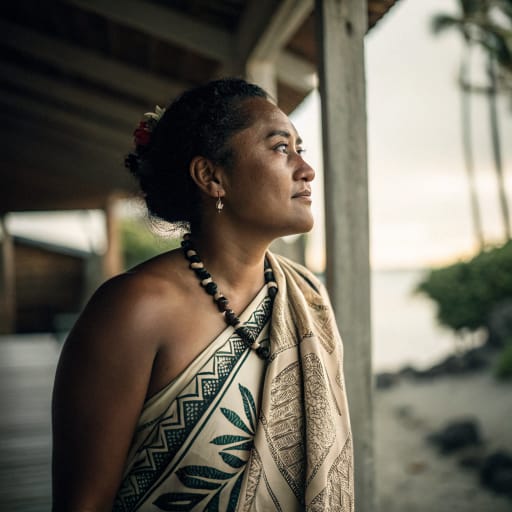
Typical Pitcairn Islanders Phenotypes
Reference for AI generation: hair, eyes, skin, facial structure, build
Pitcairn Islanders are one of the most genetically distinctive small populations on Earth — the descendants of nine British HMS Bounty mutineers and the Tahitian women they took to the island in 1790. Almost the entire community traces back to that founding pool, so the phenotype reads as a stable, recombined Polynesian–Northern European blend rather than a recent admixture in flux.
Hair is most often dark brown to near-black, thick, and ranges from straight to loose wave; tighter curl is uncommon. A minority carry lighter brown or sun-bleached chestnut tones, and full Polynesian-style straight black hair remains common, especially among descendants closer to the Tahitian maternal lines. Eyes skew brown — warm mid-brown to dark brown predominate — but green and hazel surface regularly thanks to the British paternal contribution, and clear blue eyes appear occasionally, often paired with otherwise Polynesian features. The epicanthic fold, when present, is usually partial rather than pronounced; eye shape tends toward almond with a slightly heavy upper lid.
Skin sits in the Fitzpatrick III–IV band: an even olive-tan to medium brown with golden or warm-bronze undertones, tanning readily and rarely burning. Sun exposure on the island reinforces a settled, weather-worn tone in adults.
Facial structure shows the clearest hybridity. Noses are typically broader than Northern European norms — a moderate, slightly flared alar base over a medium-height bridge — but narrower than fully Polynesian noses. Lips are full to medium-full, cheekbones broad and high, and jaws tend to be square and strong. Faces read as wide and open rather than long.
Build is robust. Both sexes trend toward the heavy-framed, broad-shouldered Polynesian template — taller-than-average stature, thick wrists and ankles, dense musculature, and a tendency toward solid mass with age. The signature look is a Polynesian face and frame carrying scattered European features — green eyes, a sharper nose, a lighter streak in the hair — within a single person. Norfolk Island descendants share the same baseline, with somewhat more visible European drift after generations of outside marriage.
Pitcairn Islanders Body & Anatomy Reference
Anatomy by feature, Polynesian Pacific Islander phenotype
Pitcairn Islanders Boobs & Breasts
The typical Pitcairn Islanders bust is medium-to-large cup, full, high projection, in line with the wider Polynesian Pacific Islander pattern. Areolas usually fall in the 34-50mm range, with medium-brown to dark-brown areolar pigmentation against the tan-to-medium-brown skin tone. Compared with the smaller Southeast Asian bust, Pitcairn Islanders breasts sit forward and are generally full and projecting, classic Polynesian build. A faithful AI render of Pitcairn Islanders tits keeps that shape and areola size.
Pitcairn Islanders Ass & Hips
Butt shape among Pitcairn Islanders women: very full, high projection, the famous Polynesian curvy hip profile, over wide iliac crests, very full gluteal-femoral fat deposition. This follows Polynesian Pacific Islander ancestry and looks quite unlike the slim Southeast Asian narrow-hip profile. An accurate Pitcairn Islanders ass in adult AI imagery keeps both the silhouette and the overall build (endomorph-to-mesomorph with larger overall frame; the classic Polynesian taller-broader-build phenotype) instead of a generic average.
Pitcairn Islanders Vagina & Pussy
Vulvar anatomy among Pitcairn Islanders women: medium-brown to dark-brown labial pigmentation. Pubic hair tends to be wavy-to-curly medium-coarse texture, in the usual inverted-triangle pattern. Both follow Polynesian Pacific Islander pigmentation, which is why Pitcairn Islanders pussy renders should not fall back on a pale, sparse Western template.
Pitcairn Islanders Dicks & Penis
The Pitcairn Islanders cock profile, from Polynesian Pacific Islander anthropometric data: regional mean ~14cm erect; moderate-to-above-average girth; medium-brown shaft pigmentation. Pubic hair has a wavy-to-curly medium-coarse texture and forms the usual inverted-V pattern. Whether Pitcairn Islanders men are circumcised follows religious and cultural practice rather than phenotype.
Pitcairn Islanders Body, Curves & Build
Build and curves among Pitcairn Islanders women follow the Polynesian Pacific Islander pattern: endomorph-to-mesomorph with larger overall frame; the classic Polynesian taller-broader-build phenotype, mean adult female BMI 28-32 (the highest regional mean globally; thrifty-gene phenotype documented). Proportions matter as much as skin tone, so Pitcairn Islanders figures should keep their regional height and limb ratios.
Pitcairn Islanders Skin Tone & Hair Texture
The Pitcairn Islanders skin range is tan to medium-brown (Fitzpatrick IV-V), and hair tends to be wavy-to-curly 2B-3B, dark-brown to black. That combination marks the Polynesian Pacific Islander phenotype, and skin tone is the trait AI generators most often get wrong for Pitcairn Islanders women.
Data depth
0/100Coverage of image-grounded phenotype observations · drives AI generation diversity
- Sample size
- 0/40· 0 images
- Image quality
- 0/30· 0% high
- Confidence
- 0/20
- Source diversity
- 0/10
- ·No image observations yet
Explore phenotype categories
Structured taxonomy with peer-reviewed scales · 22 anatomical categories
Erotic Poses & Sex Positions
From the pose catalog: 219 named positions with reference skeletons
Frequently asked questions about Pitcairn Islanders people
Where is the Pitcairn Islanders homeland?
The Pitcairn Islanders homeland is Pitcairn Island in Polynesia.
What language do Pitcairn Islanders people speak?
Pitcairn Islanders people primarily speak Indo-European / Germanic / English / Pitkern.
What religion do Pitcairn Islanders people practice?
The predominant religion among Pitcairn Islanders people is Christianity / Protestantism.






Make your own Pitcairn Islanders images
Five a day, free, no credits to buy. The studio starts from this group's phenotype data, so you can set body type, pose and style and keep the traits accurate.
Start with Pitcairn Islanders