Help us get this right
Does this portrait look right for Mapuche?
Nobody has judged this one yet. You would be the first.
Mapuche Erotic
Araucanía (Chile, Argentina)
Mapudungun
Christianity
Huilliche, along with Mestizos such as Chileans
About Mapuche People
The Mapuche are the people who never quite lost. Spanish conquistadors who flattened the Inca within a generation spent the better part of three centuries failing to subdue them, and the frontier they held — roughly the Biobío River in what is now south-central Chile — was acknowledged as a hard border by the Spanish Crown itself in the 1641 Treaty of Quillín. That fact shapes almost everything about how the Mapuche see themselves today: as a nation that negotiated, not a nation that was conquered. The full incorporation of their territory into Chile and Argentina did not happen until the late nineteenth century, through military campaigns both states still soft-pedal in their school curricula.
Their homeland, the Araucanía, runs through temperate rainforest, volcanic foothills, and the lake country straddling the Andes. The Huilliche — "people of the south" — are the southern branch, historically extending down into Chiloé and the wet, windbeaten coast beyond. Centuries of intermarriage and displacement have also produced a large mestizo population in Chile and Argentina who carry Mapuche ancestry without claiming the identity, a quieter form of continuity than the explicit revival movements of recent decades.
Mapudungun, their language, is a linguistic isolate — it has no demonstrated relative, which is unusual in a continent where most surviving indigenous languages slot into recognizable families. It has held on better than many comparable tongues, but it is under pressure, and the urban Mapuche communities around Santiago and Temuco are where the bilingual revival is most visible. Naming conventions still carry weight: a person's name often references a natural feature, an ancestor, or an animal, and the older custom of taking a new name at significant life stages has not entirely disappeared.
Religion is mostly Christianity now, layered atop an older cosmology that has not been tidily displaced. The machi, a ritual specialist who is usually but not always a woman, still operates in many rural communities, and the nguillatún — a multi-day ceremony of prayer, dance, and offering held in a cleared circular ground — is something families travel home for. Politically, the Mapuche question is live and unresolved: land claims, forestry conflicts in the Araucanía, and the legal status of Mapuche autonomy are ongoing flashpoints in Chilean public life, not historical footnotes. To write about the Mapuche only in the past tense is to miss the point entirely.
Related ethnic groups
Groups that share Mapuche's homeland, region, language, or religious tradition. These are likely candidates for comparative phenotype reference.
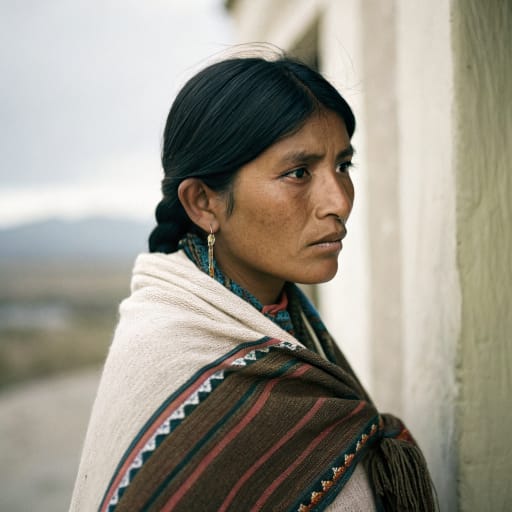
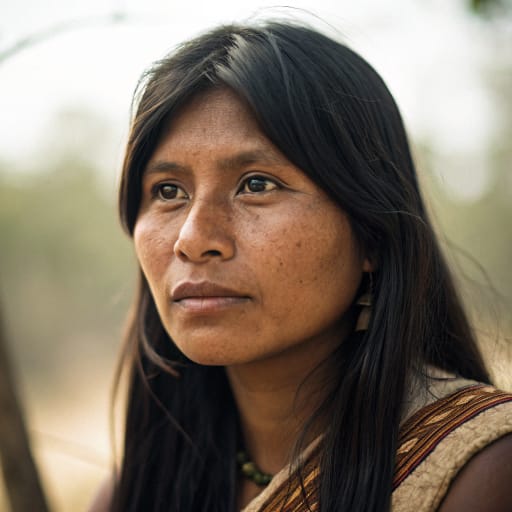
Geographic Distribution: Mapuche populations across 2 countries
Each row is ranked by the group's share of that country's population, with the source citation drawn from published census and demographic surveys. Click through for the full per-country phenotype profile.
| Country | Share | Source |
|---|---|---|
| Chile | 11.4% | INE 2017 Census, self-identified Mapuche (~11.4%, ~1.74M); concentrated in the Araucanía Region (Temuco, Cautín, Malleco), Los Ríos, Los Lagos, Biobío, and substantial urban Mapuche population in Santiago |
| Argentina | 0.5% | INDEC 2010 Census, Mapuche population in Argentina (~205,000, the largest single Indigenous group; concentrated in Patagonia: Neuquén, Río Negro, Chubut). Cross-border population shared with Chile. |
Typical Mapuche Phenotypes
Reference for AI generation: hair, eyes, skin, facial structure, build
The Mapuche phenotype is shaped by long isolation in the temperate forests and coastal valleys south of the Bío-Bío river, producing one of the more morphologically consistent Indigenous populations of the Southern Cone. Hair is uniformly black to very dark brown, coarse in texture, and almost always straight — wave or curl is essentially absent in unmixed individuals and reads as evidence of European admixture when it appears. Body hair is sparse; facial hair on men grows thinly and late, often confined to the chin and upper lip.
Eyes are dark brown to near-black, set under a moderate epicanthic fold that is less pronounced than in East Asian populations but clearly present, giving the eye an almond shape with a slightly downturned outer corner. Skin tones cluster in Fitzpatrick III–IV, a warm coppery brown with red-bronze undertones rather than the olive cast common in Andean groups further north; cheeks often carry a natural rose flush from the cold, wet Araucanian climate.
Facial structure is the group's most recognizable feature. The face is broad and squared, with prominent malar bones, a flat-bridged nose with moderately wide alae, and a strong horizontal jaw. Lips are medium-full with a defined cupid's bow. Foreheads are typically low and wide. Build is short and compact — men average around 162–165 cm, women around 150–153 cm — with thick torsos, short limbs relative to trunk length, and dense musculature historically tied to a horse-and-warrior culture that resisted Spanish conquest for three centuries.
Sub-group variation is modest. The Huilliche of the southern lakes and Chiloé tend slightly taller and a shade lighter, with somewhat narrower noses, reflecting older contact with coastal populations. Mestizo Chileans of Mapuche descent show the broadest range — lighter skin in Fitzpatrick II–III, hazel or green eyes in a minority, wavier hair — but the broad face, dark eyes, and compact build persist as the dominant inherited signature.
Mapuche Body & Anatomy Reference
Per-feature anatomical profile for AI nude generation: South American Indigenous / European-Mestizo / Afro-Latino mix phenotype
Mapuche Boobs & Breasts
The typical Mapuche bust is medium-to-large cup, full, high projection, in line with the wider South American Indigenous / European-Mestizo / Afro-Latino mix pattern. Areolas usually fall in the 32-46mm range, with medium-brown to dark-brown areolar pigmentation against the tan-to-deep-brown skin tone. Compared with the smaller bust profile of Andean Indigenous sub-populations, Mapuche breasts sit forward and are generally the classic Brazilian / Latina curvy bust profile in lowland populations; smaller and shorter-set in Andean Indigenous populations. A faithful AI render of Mapuche tits keeps that shape and areola size.
Mapuche Ass & Hips
Butt shape among Mapuche women: full, high projection, the famous Brazilian / Latina bunda profile, over wide iliac crests, very full gluteal-femoral fat deposition (the hallmark Brazilian / Latina hip-to-waist ratio). This follows South American Indigenous / European-Mestizo / Afro-Latino mix ancestry and looks quite unlike the slim narrow-hip East Asian profile. An accurate Mapuche ass in adult AI imagery keeps both the silhouette and the overall build (endomorph-to-mesomorph with high gluteal-femoral deposition) instead of a generic average.
Mapuche Vagina & Pussy
Vulvar anatomy among Mapuche women: medium-brown to dark-brown labial pigmentation, fuller labia minora. Pubic hair tends to be wavy-to-curly coarse dark texture, dense distribution, in the usual inverted-triangle pattern. Both follow South American Indigenous / European-Mestizo / Afro-Latino mix pigmentation, which is why Mapuche pussy renders should not fall back on a pale, sparse Western template.
Mapuche Dicks & Penis
The Mapuche cock profile, from South American Indigenous / European-Mestizo / Afro-Latino mix anthropometric data: regional mean ~13cm erect; moderate-to-above-average girth; medium-brown shaft pigmentation. Pubic hair has a wavy-to-curly coarse dark texture and forms the usual inverted-V pattern. Whether Mapuche men are circumcised follows religious and cultural practice rather than phenotype.
Mapuche Body, Curves & Build
Build and curves among Mapuche women follow the South American Indigenous / European-Mestizo / Afro-Latino mix pattern: endomorph-to-mesomorph with high gluteal-femoral deposition, mean adult female BMI 25-28. Proportions matter as much as skin tone, so Mapuche figures should keep their regional height and limb ratios.
Mapuche Skin Tone & Hair Texture
The Mapuche skin range is tan to deep-brown (Fitzpatrick III-VI), and hair tends to be straight-to-curly 1A-3C, varies widely by ancestral composition. That combination marks the South American Indigenous / European-Mestizo / Afro-Latino mix phenotype, and skin tone is the trait AI generators most often get wrong for Mapuche women.
Data depth
0/100Coverage of image-grounded phenotype observations · drives AI generation diversity
- Sample size
- 0/40· 0 images
- Image quality
- 0/30· 0% high
- Confidence
- 0/20
- Source diversity
- 0/10
- ·No image observations yet
Explore phenotype categories
Structured taxonomy with peer-reviewed scales · 22 anatomical categories
Erotic Poses & Sex Positions
From the pose catalog: 219 named positions with reference skeletons
Frequently asked questions about Mapuche people
Where is the Mapuche homeland?
The Mapuche homeland is Araucanía (Chile, Argentina) in South America.
What countries do Mapuche people live in?
Mapuche populations are documented across 2 countries: Chile, Argentina.
What language do Mapuche people speak?
Mapuche people primarily speak Mapudungun.
What religion do Mapuche people practice?
The predominant religion among Mapuche people is Christianity.






Make your own Mapuche images
Five a day, free, no credits to buy. The studio starts from this group's phenotype data, so you can set body type, pose and style and keep the traits accurate.
Start with Mapuche