Help us get this right
Does this portrait look right for Kumandins?
Nobody has judged this one yet. You would be the first.
Kumandins Erotic
Biya River basin in the northern Altai foothills: Altai Krai (including the city of Biysk) and the northern Altai Republic, Russia
Kumandin, a Northern Altai language (Turkic); Russian now dominant in daily use
Russian Orthodox Christianity, alongside surviving shamanist beliefs
One of the Northern Altai peoples, with Tubalars and Chelkans; traditionally organized into clans that pass through the father's line (seoks)
About Kumandins People
The Kumandins are a small Turkic people of the northern Altai foothills, where the open country of southwestern Siberia gives way to dense fir and Siberian pine forest along the Biya River. They call themselves Kumandy or Kuvandy. For most of the Soviet period, census takers counted them simply as Altaians. Only in 2000 did Russia list them among its recognized Indigenous small-numbered peoples. Today they number a few thousand and live in villages of Altai Krai and the northern Altai Republic, and in towns such as Biysk. Their language belongs to the Northern Altai group. It is close to the speech of their Tubalar and Chelkan neighbors and different enough from Southern Altai that the two are usually treated as separate languages. The Turkic language covers older roots: scholars trace part of Kumandin ancestry to Samoyedic, Yeniseian and Ugric forest peoples who switched to Turkic over many centuries. Some connect the name itself to the medieval Cumans, but that idea has not been proven. The language is now endangered. Most fluent speakers are older, and nearly everyone uses Russian day to day.
Russian power reached the Biya early. The fort that grew into Biysk was built in 1709, and in the generations that followed, Kumandin hunters paid tribute in furs to the Russian state. In the nineteenth century, Orthodox missionaries of the Altai Spiritual Mission baptized most of the community, but the new faith was added to older belief rather than replacing it. Belief in the spirits of mountains, water and forest, and in the shamans who dealt with them, lived on beside church ritual. Traditional life followed the taiga. Men hunted and trapped, and families fished and gathered Siberian pine nuts. Small plots worked by hoe produced barley and hemp, which women spun and wove into cloth. Society was built on clans that passed through the father's line, called seoks. Marrying within your own seok was forbidden, so every marriage tied two clans together. Wage work and town life have mostly replaced that old way of living. What makes someone Kumandin today is less about how they earn a living and more about family descent, clan memory and a long tie to the Biya valley.
Related ethnic groups
Groups that share Kumandins's homeland, region, language, or religious tradition. These are likely candidates for comparative phenotype reference.
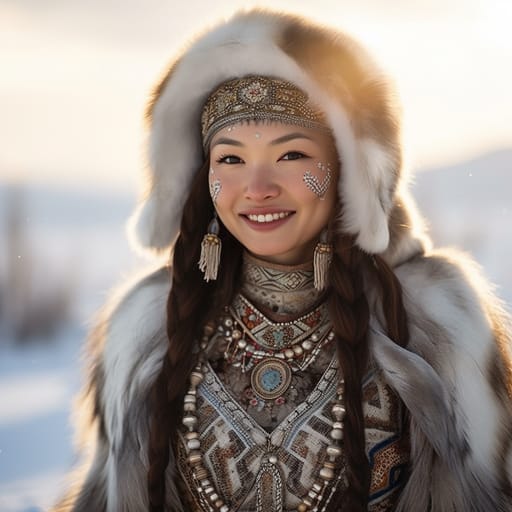
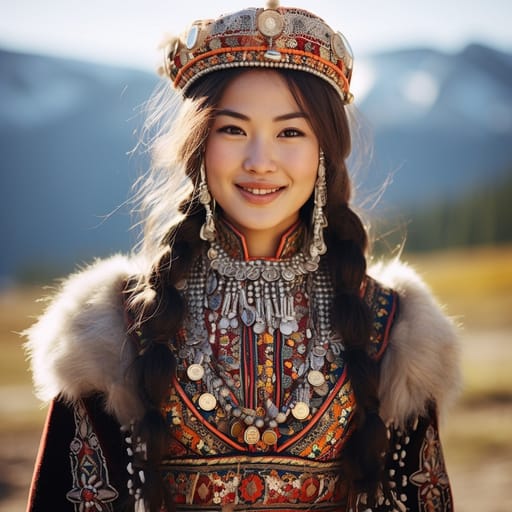
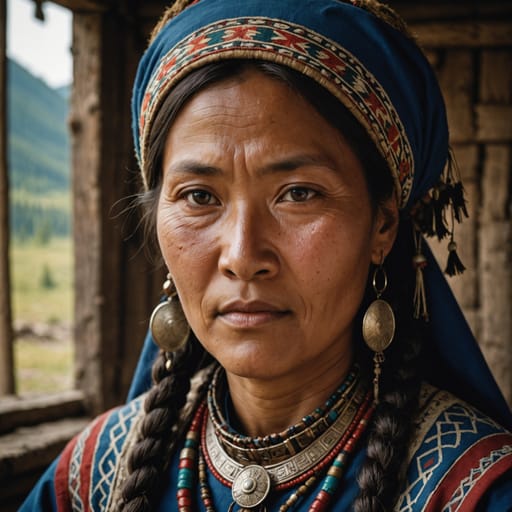
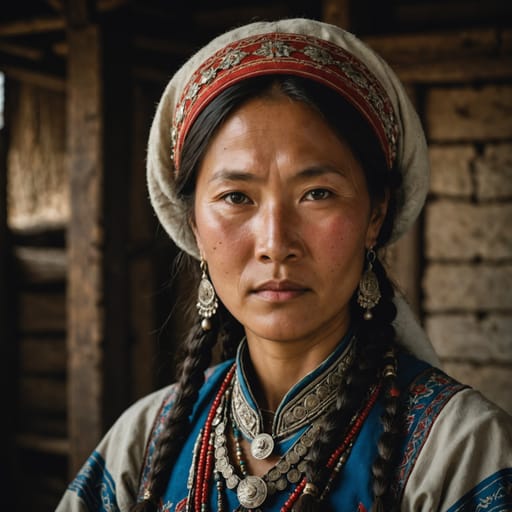
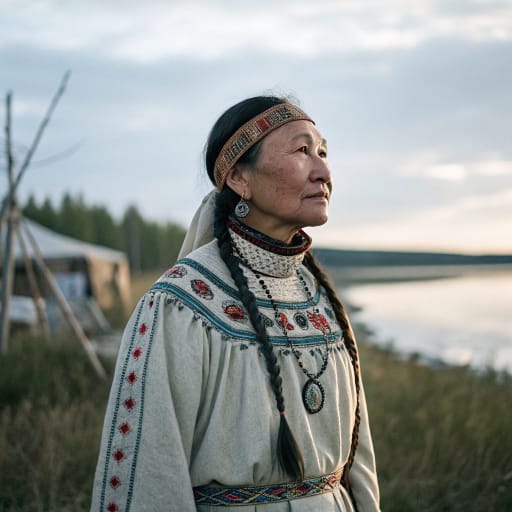
Typical Kumandins Phenotypes
Reference for AI generation: hair, eyes, skin, facial structure, build
Kumandins Body & Anatomy Reference
Anatomy by feature, Siberian Indigenous / Tungusic phenotype
Kumandins Boobs & Breasts
Kumandins tits and boobs run small-to-medium cup, modest projection, the classic Siberian Indigenous / Tungusic bust profile. Kumandins nipples and areolas show medium-brown areolar pigmentation against the light-to-medium skin tone, with areolar diameter typically in the 26-38mm range and forward-set positioning rather than the fuller Central Asian or East Asian bust. Kumandins breasts trend firm, modest projection, a function of the mesomorph, broader stocky frame adapted to cold climate body habitus and the mean adult female BMI 22-25. For anatomically accurate AI-generated Kumandins nudes the render preserves the small-to-medium cup, modest projection shape, 26-38mm areolas with medium-brown pigmentation, and the torso proportions of the Siberian Indigenous / Tungusic phenotype.
Kumandins Ass & Hips
Kumandins hips and butt usually read as small-to-medium, modest projection. The skeletal base is narrow-to-medium iliac crests, the Siberian Indigenous / Tungusic pattern. Set against the broader Central Asian hip profile, the difference is easy to see, and the hip-to-waist ratio is often what identifies Kumandins women in photos.
Kumandins Vagina & Pussy
Expect medium-brown labial pigmentation on Kumandins women, in keeping with Siberian Indigenous / Tungusic ancestry. The pubic hair is straight fine-to-medium texture, sparser distribution. Coloring should run evenly from the light to medium skin of the thighs to the labia, and Kumandins nude imagery should keep the hair's straight fine-to-medium texture.
Kumandins Dicks & Penis
Kumandins dick and penile anatomy in adult AI generation should anchor on the regional reference data: regional mean ~12cm erect, moderate girth, and medium-brown shaft pigmentation. The Kumandins cock profile reflects the Siberian Indigenous / Tungusic population's anthropometric measurements. The shaft pigmentation should track the surrounding light to medium skin tone, and the pubic hair should keep its straight fine-to-medium texture in the typical inverted-V escutcheon.
Kumandins Body, Curves & Build
Kumandins body type: mesomorph, broader stocky frame adapted to cold climate, with mean adult female BMI 22-25. This is the typical Siberian Indigenous / Tungusic build. Height range, shoulder-to-hip ratio and fat distribution all follow from it, which is what an accurate Kumandins nude body should show.
Kumandins Skin Tone & Hair Texture
Kumandins skin tone falls in the light to medium (Fitzpatrick II-IV) band, the surface signal most often miscalibrated by generic AI nude generators. Kumandins hair texture is typically straight 1A, dark-brown to black, characteristic of the Siberian Indigenous / Tungusic phenotype. In Kumandins nude renders the skin should hold that band consistently across the body.
Explore phenotype categories
Structured taxonomy with peer-reviewed scales · 22 anatomical categories
Erotic Poses & Sex Positions
From the pose catalog: 219 named positions with reference skeletons
Frequently asked questions about Kumandins people
Where is the Kumandins homeland?
The Kumandins homeland is Biya River basin in the northern Altai foothills: Altai Krai (including the city of Biysk) and the northern Altai Republic, Russia in Northern Asia.
What language do Kumandins people speak?
Kumandins people primarily speak Kumandin, a Northern Altai language (Turkic); Russian now dominant in daily use.
What religion do Kumandins people practice?
The predominant religion among Kumandins people is Russian Orthodox Christianity, alongside surviving shamanist beliefs.






Make your own Kumandins images
Five a day, free, no credits to buy. The studio starts from this group's phenotype data, so you can set body type, pose and style and keep the traits accurate.
Start with Kumandins