No portrait yet
Kabyle Erotic
Kabylia, the Djurdjura and Babor mountains of northern Algeria east of Algiers (Tizi Ouzou, Béjaïa, Bouira and neighboring provinces); large diaspora in France.
Kabyle / Taqbaylit (Afroasiatic, Berber, Northern Berber); Algerian Arabic and French widely spoken as second languages.
Sunni Islam (Maliki), with a strong secular current and a small evangelical Christian minority.
Berber (Amazigh); divided into Greater Kabylia (Djurdjura) and Lesser Kabylia (Soummam valley, Babors); historic confederations include the Igawawen (Zwawa), Ath Yiraten, Ath Yenni, Ath Waghlis and Iflisen.
About Kabyle People
The Kabyle are the mountain people of Algeria's Djurdjura, the Berber (Amazigh) group whose villages crowd the ridge crests of Kabylia, roughly a hundred miles east of Algiers. What marks them out is less a single trait than a whole habit of self-government. A Kabyle village, the taddart, runs on an assembly of household heads called the tajmaat, which historically wrote its own customary code, the qanun, fixed fines, settled feuds, and organized collective labor. The French conquered the region late, in 1857, and only after fighting village by village, and independent Algeria has found the same stubbornness waiting for it. The Berber Spring of 1980, set off when the state banned a lecture on ancient Kabyle poetry, and the Black Spring of 2001, when security forces killed more than a hundred protesters, are the two dates every Kabyle knows. The language they fought for, Taqbaylit, belongs to the Northern Berber branch of the Afroasiatic family, sits alongside Chaoui, Shilha and Rifian as a sister rather than a dialect, and is written today mostly in Latin letters using a notation the novelist Mouloud Mammeri standardized. Tamazight became a national language of Algeria in 2002 and an official one in 2016, both late and grudging by Kabyle reckoning.
Almost all Kabyles are Sunni Muslims of the Maliki school, but religious life here has long been mediated by local saints' lineages, the marabouts, and by the village rather than by any central religious authority, which is part of why Kabylia became the seedbed of Algerian secularism and, since the 1990s, of a small but noticed evangelical Christian minority. The land itself is olive and fig country: terraced hillsides, dry-stone houses with tiled roofs, oil pressed in winter, couscous rolled by hand. Ath Yenni silversmiths produce the enamel-and-coral jewelry that older women still wear in heavy sets, and the potters of Maatkas and Ath Kheir paint bowls with the same geometric motifs found on women's traditional dresses. The word Zouave entered European armies from the Igawawen confederation of Greater Kabylia, whose men the French recruited first. Emigration to France began early in the twentieth century, and today Paris and Marseille hold Kabyle communities large enough that the diaspora shapes the homeland's politics, music and money. Singers like Idir, Lounès Matoub and Aït Menguellet turned that migrant longing and political anger into a body of song that functions, for many Kabyles, as the real national literature.
Related ethnic groups
Groups that share Kabyle's homeland, region, language, or religious tradition. These are likely candidates for comparative phenotype reference.
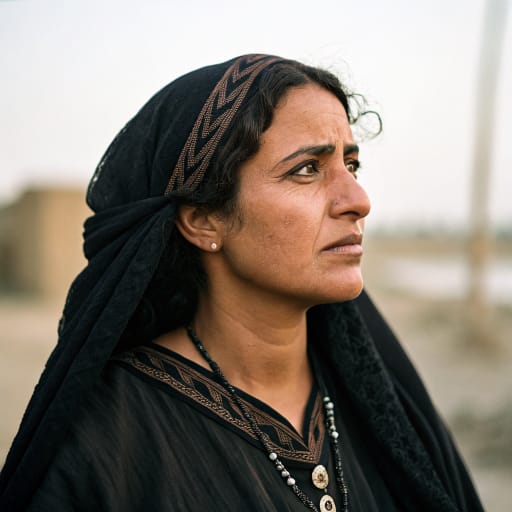
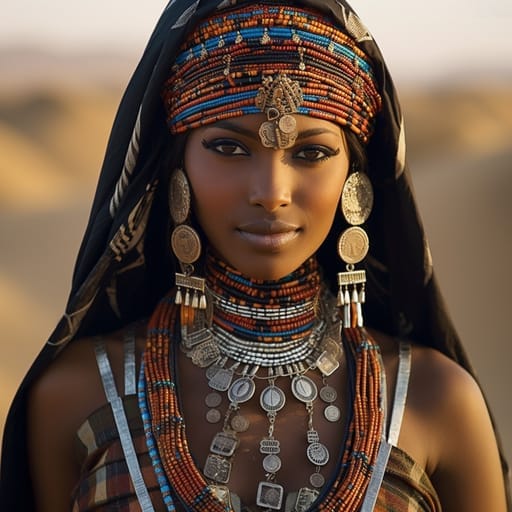
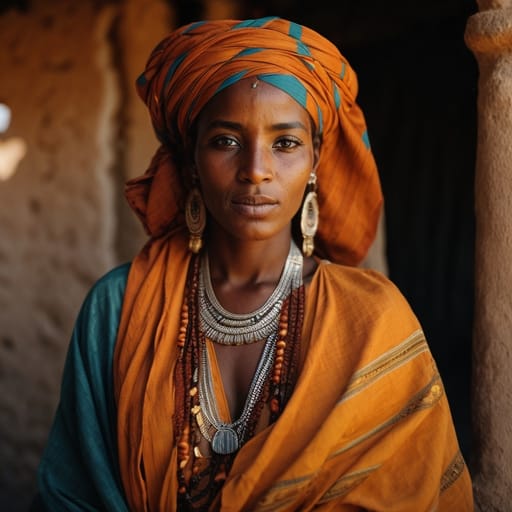
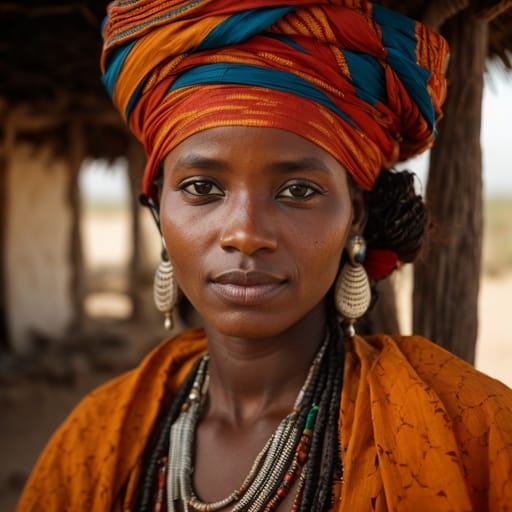
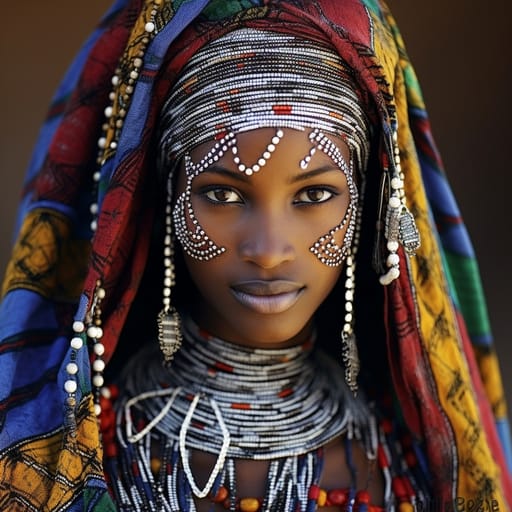
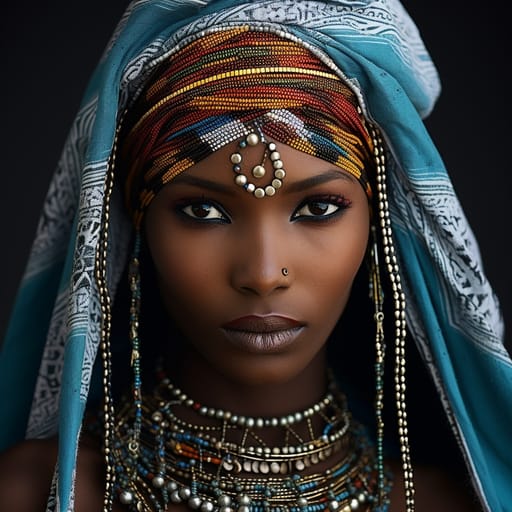
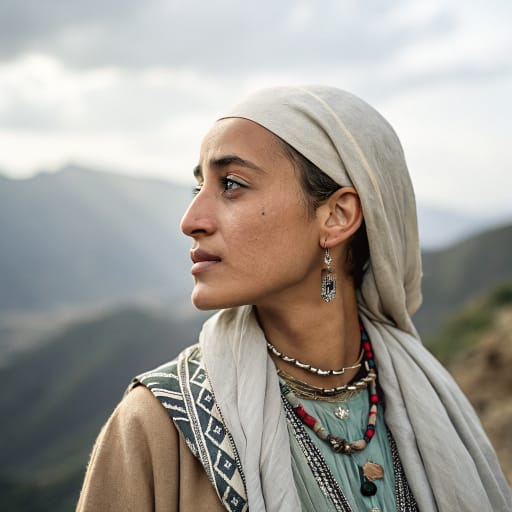
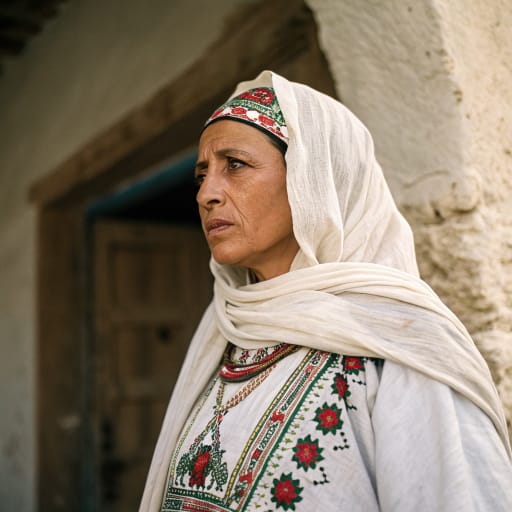
Typical Kabyle Phenotypes
Reference for AI generation: hair, eyes, skin, facial structure, build
Kabyle Body & Anatomy Reference
Berber / Mediterranean-Saharan phenotype: anatomy reference for AI nude generation
Kabyle Boobs & Breasts
Kabyle tits and boobs run medium-to-large cup, full, moderate projection, the classic Berber / Mediterranean-Saharan bust profile. Kabyle nipples and areolas show medium-brown to dark-brown areolar pigmentation against the olive-to-light-brown skin tone, with areolar diameter typically in the 30-44mm range and forward-set positioning rather than the smaller East Asian bust profile. Kabyle breasts trend fuller and softer than the Cushitic East African norm, a function of the mesomorph with fuller hip-and-bust deposition body habitus and the mean adult female BMI 24-28. For anatomically accurate AI-generated Kabyle nudes the render preserves the medium-to-large cup, full, moderate projection shape, 30-44mm areolas with medium-brown to dark-brown pigmentation, and the torso proportions of the Berber / Mediterranean-Saharan phenotype.
Kabyle Ass & Hips
Kabyle hips and butt usually read as medium-to-full, moderate projection, broader hip profile. The skeletal base is medium-to-wide iliac crests, fuller gluteal-femoral fat distribution, the Berber / Mediterranean-Saharan pattern. Set against the slim narrow-hip Cushitic East African profile, the difference is easy to see, and the hip-to-waist ratio is often what identifies Kabyle women in photos.
Kabyle Vagina & Pussy
Expect medium-brown to dark-brown labial pigmentation, fuller labia minora on Kabyle women, in keeping with Berber / Mediterranean-Saharan ancestry. The pubic hair is wavy-to-coiled medium-coarse texture, dense distribution. Coloring should run evenly from the olive to medium-brown skin of the thighs to the labia, and Kabyle nude imagery should keep the hair's wavy-to-coiled medium-coarse texture.
Kabyle Dicks & Penis
Kabyle dick and penile anatomy in adult AI generation should anchor on the regional reference data: regional mean ~13-14cm erect, moderate girth, and medium-brown shaft pigmentation. The Kabyle cock profile reflects the Berber / Mediterranean-Saharan population's anthropometric measurements. The shaft pigmentation should track the surrounding olive to medium-brown skin tone, and the pubic hair should keep its wavy-to-coiled medium-coarse texture in the typical inverted-V escutcheon.
Kabyle Body, Curves & Build
Kabyle body type: mesomorph with fuller hip-and-bust deposition, with mean adult female BMI 24-28. This is the typical Berber / Mediterranean-Saharan build. Height range, shoulder-to-hip ratio and fat distribution all follow from it, which is what an accurate Kabyle nude body should show.
Kabyle Skin Tone & Hair Texture
Kabyle skin tone falls in the olive to medium-brown (Fitzpatrick III-V) band, the surface signal most often miscalibrated by generic AI nude generators. Kabyle hair texture is typically wavy-to-curly 2B-3C, often dark-brown to black, characteristic of the Berber / Mediterranean-Saharan phenotype. In Kabyle nude renders the skin should hold that band consistently across the body.
Explore phenotype categories
Structured taxonomy with peer-reviewed scales · 22 anatomical categories
Erotic Poses & Sex Positions
From the pose catalog: 219 named positions with reference skeletons
Frequently asked questions about Kabyle people
Where is the Kabyle homeland?
The Kabyle homeland is Kabylia, the Djurdjura and Babor mountains of northern Algeria east of Algiers (Tizi Ouzou, Béjaïa, Bouira and neighboring provinces); large diaspora in France. in Northern Africa.
What language do Kabyle people speak?
Kabyle people primarily speak Kabyle / Taqbaylit (Afroasiatic, Berber, Northern Berber); Algerian Arabic and French widely spoken as second languages..
What religion do Kabyle people practice?
The predominant religion among Kabyle people is Sunni Islam (Maliki), with a strong secular current and a small evangelical Christian minority..






Make your own Kabyle images
Five a day, free, no credits to buy. The studio starts from this group's phenotype data, so you can set body type, pose and style and keep the traits accurate.
Start with Kabyle