Help us get this right
Does this portrait look right for Ghegs?
Nobody has judged this one yet. You would be the first.
Ghegs Erotic
Northern Albania north of the Shkumbin river, Kosovo, western North Macedonia, southern Montenegro and the Preševo Valley of Serbia
Gheg Albanian (Albanian, an independent branch of Indo-European); Standard Albanian, based on Tosk, is used in writing
Majority Sunni Muslim, with a substantial Roman Catholic minority concentrated in northwestern Albania (Shkodër, Mirdita, Malësia) and parts of Kosovo
Northern dialectal branch of the Albanians, alongside the Tosks. Sub-dialects: Northwestern (Shkodër), Northeastern (Kosovo), Central (Mat, Dibër, western Macedonia) and Southern Gheg (Durrës, Tirana, Elbasan). Highland clans include Kelmendi, Shala, Hoti
About Ghegs People
Ask an Albanian where Gheg country begins and they will point to the Shkumbin, the river that cuts Albania in half. North of it, and across the borders into Kosovo, western North Macedonia, southern Montenegro and Serbia's Preševo Valley, people speak Gheg: the northern dialect of Albanian, marked by nasal vowels, distinct long and short vowels, and an infinitive built with me that the southern Tosk dialect lacks. Albanian is a branch of Indo-European with no close relatives, so the Gheg and Tosk split is the main internal fault line of the whole language. The Ghegs are the larger of the two groups once Kosovo and North Macedonia are counted, yet the written standard adopted in 1972 was built on Tosk, which is why a Kosovar today writes one Albanian and speaks another. The oldest Albanian book, Gjon Buzuku's missal of 1555, was Gheg, and so was Gjergj Fishta's epic The Highland Lute, the closest thing the north has to a national poem. Krujë, Skanderbeg's fortress against the Ottomans, sits in Gheg country, as does Mat, the home district of King Zog.
Religion follows geography. Most Ghegs are Sunni Muslim, but the northwest, around Shkodër, Mirdita and the Malësia highlands, holds the core of Albania's Catholic community, and Franciscan and Jesuit clergy were the north's schoolteachers and folklorists into the twentieth century. Communist Albania outlawed all faith in 1967. Practice returned after 1991, mostly in a relaxed, family-centered form, and mixed Muslim and Catholic villages are not unusual. What binds the highlands more tightly than creed is the Kanun, the customary law attributed to the fifteenth-century lord Lekë Dukagjini and set down in writing by the Franciscan Shtjefën Gjeçovi. It governs hospitality, marriage, property and the blood feud, and it made besa, the sworn word, into the north's highest value. Old clan names, Kelmendi, Shala, Hoti, Kastrati, Berisha, Krasniqi, still work as surnames and as a map of who came from which valley. The same code produced the burrnesha, women who swear lifelong celibacy and take on a man's social role, dress and standing, a practice that survived in the mountains into the present century. The north is also home to the lahuta, a one-stringed bowed instrument used to chant the frontier-warrior epics of Muji and Halili, and to the white felt plis, a skullcap that older men in Kosovo and northern Albania still wear daily. Emigration from Kosovo and Macedonia since the 1960s has placed large Gheg communities in Switzerland, Germany, Austria and the United States, and a remittance economy runs back to the villages.
Related ethnic groups
Groups that share Ghegs's homeland, region, language, or religious tradition. These are likely candidates for comparative phenotype reference.
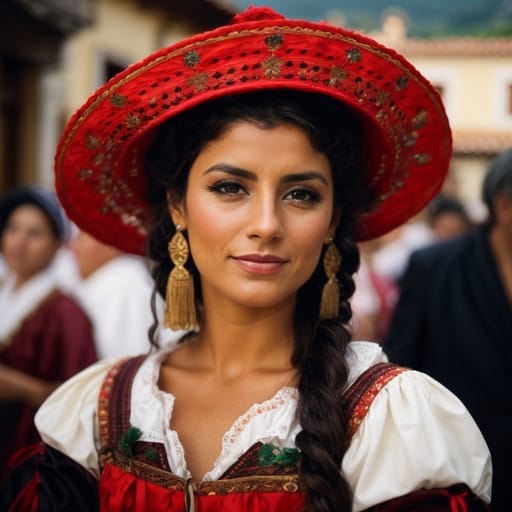
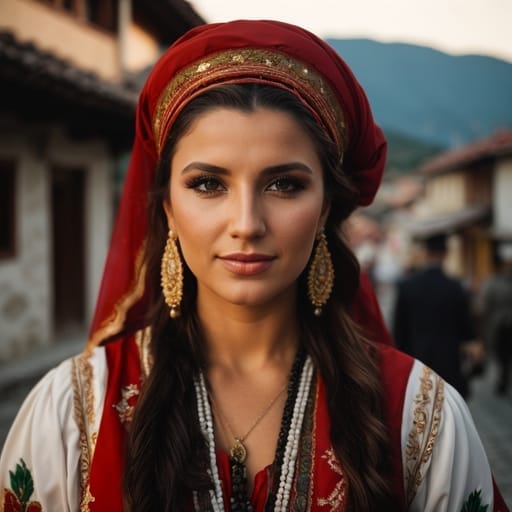
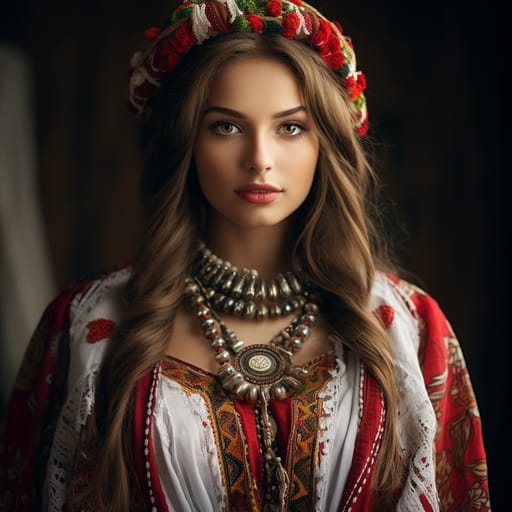
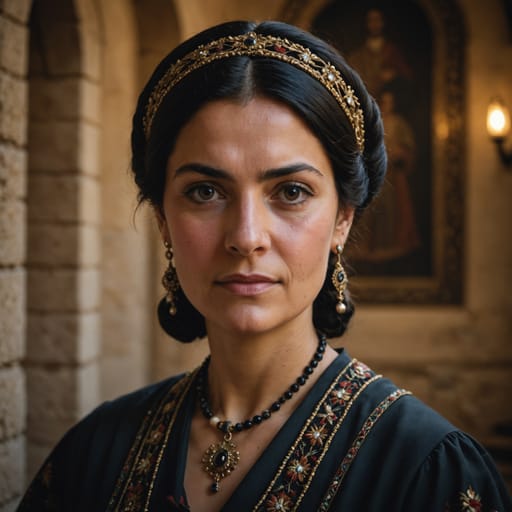
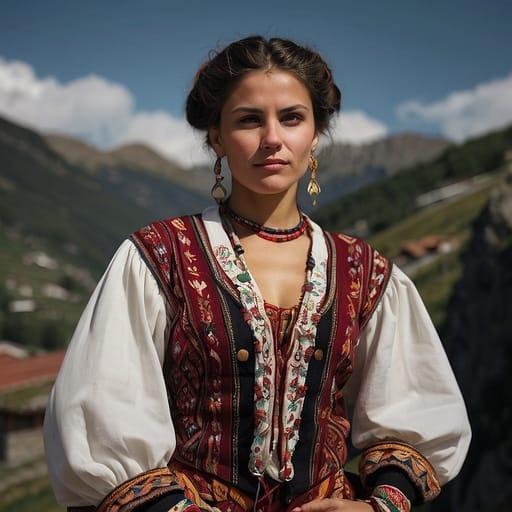
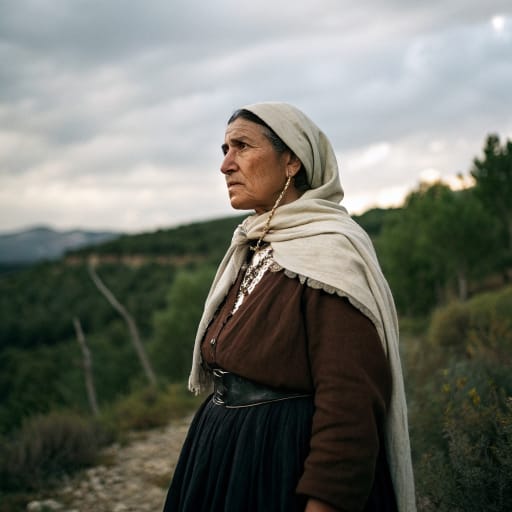
Typical Ghegs Phenotypes
Reference for AI generation: hair, eyes, skin, facial structure, build
Ghegs Body & Anatomy Reference
Per-feature anatomical profile for AI nude generation: Southern European / Mediterranean phenotype
Ghegs Boobs & Breasts
Ghegs tits and boobs run medium-to-large cup, full, moderate-to-high projection, the classic Southern European / Mediterranean bust profile. Ghegs nipples and areolas show medium-brown to dark-brown areolar pigmentation against the olive-to-light-brown skin tone, with areolar diameter typically in the 32-46mm range and forward-set positioning rather than the lighter pigmentation of the Northern European bust. Ghegs breasts trend full and projecting, generally the classic Mediterranean curvy bust profile, a function of the mesomorph with full hip-and-bust deposition body habitus and the mean adult female BMI 24-28. For anatomically accurate AI-generated Ghegs nudes the render preserves the medium-to-large cup, full, moderate-to-high projection shape, 32-46mm areolas with medium-brown to dark-brown pigmentation, and the torso proportions of the Southern European / Mediterranean phenotype.
Ghegs Ass & Hips
Ghegs hips and butt usually read as medium-to-full, moderate-to-high projection, broader hip profile. The skeletal base is medium-to-wide iliac crests, full gluteal-femoral fat distribution, the Southern European / Mediterranean pattern. Set against the slim Northern European narrow-hip pattern, the difference is easy to see, and the hip-to-waist ratio is often what identifies Ghegs women in photos.
Ghegs Vagina & Pussy
Expect medium-brown to dark-brown labial pigmentation, fuller labia minora on Ghegs women, in keeping with Southern European / Mediterranean ancestry. The pubic hair is wavy-to-curly medium-coarse dark texture, dense distribution. Coloring should run evenly from the olive to medium skin of the thighs to the labia, and Ghegs nude imagery should keep the hair's wavy-to-curly medium-coarse dark texture.
Ghegs Dicks & Penis
Ghegs dick and penile anatomy in adult AI generation should anchor on the regional reference data: regional mean ~13-14cm erect, moderate girth, and medium-brown shaft pigmentation. The Ghegs cock profile reflects the Southern European / Mediterranean population's anthropometric measurements. The shaft pigmentation should track the surrounding olive to medium skin tone, and the pubic hair should keep its wavy-to-curly medium-coarse dark texture in the typical inverted-V escutcheon.
Ghegs Body, Curves & Build
Ghegs body type: mesomorph with full hip-and-bust deposition, with mean adult female BMI 24-28. This is the typical Southern European / Mediterranean build. Height range, shoulder-to-hip ratio and fat distribution all follow from it, which is what an accurate Ghegs nude body should show.
Ghegs Skin Tone & Hair Texture
Ghegs skin tone falls in the olive to medium (Fitzpatrick III-IV) band, the surface signal most often miscalibrated by generic AI nude generators. Ghegs hair texture is typically wavy-to-curly 2B-3B, dark-brown to black, characteristic of the Southern European / Mediterranean phenotype. In Ghegs nude renders the skin should hold that band consistently across the body.
Explore phenotype categories
Structured taxonomy with peer-reviewed scales · 22 anatomical categories
Erotic Poses & Sex Positions
From the pose catalog: 219 named positions with reference skeletons
Frequently asked questions about Ghegs people
Where is the Ghegs homeland?
The Ghegs homeland is Northern Albania north of the Shkumbin river, Kosovo, western North Macedonia, southern Montenegro and the Preševo Valley of Serbia in Southern Europe.
What language do Ghegs people speak?
Ghegs people primarily speak Gheg Albanian (Albanian, an independent branch of Indo-European); Standard Albanian, based on Tosk, is used in writing.
What religion do Ghegs people practice?
The predominant religion among Ghegs people is Majority Sunni Muslim, with a substantial Roman Catholic minority concentrated in northwestern Albania (Shkodër, Mirdita, Malësia) and parts of Kosovo.






Make your own Ghegs images
Five a day, free, no credits to buy. The studio starts from this group's phenotype data, so you can set body type, pose and style and keep the traits accurate.
Start with Ghegs