Help us get this right
Does this portrait look right for Daju?
Nobody has judged this one yet. You would be the first.
Daju Erotic
Darfur in western Sudan, with scattered communities in the Nuba Mountains of South Kordofan, the Sila and Guéra regions of Chad, and along the Sopo river in South Sudan.
Daju languages, including Daju of Dar Fur (Beke), Dar Sila Daju, Dar Daju Daju, Logorik, Shatt and Njalgulgule (Eastern Sudanic, Nilo-Saharan). Sudanese and Chadian Arabic are widely used and dominant in some communities.
Predominantly Sunni Muslim, with pre-Islamic land and rain rites persisting in places. The Njalgulgule of South Sudan sit largely outside Islam.
Eastern Sudanic branch of Nilo-Saharan. Main communities: Daju of Dar Fur (Beke), Dar Sila Daju of Chad, Dar Daju Daju of the Guéra, Logorik (Liguri), Shatt (Caning) and Njalgulgule (Beli).
About Daju People
The Daju are one of the few peoples in Africa held together almost entirely by memory. There are seven or so Daju communities, spread across a thousand miles from the Nuba Mountains of Sudan to the Guéra massif in central Chad, and most of them can no longer talk to each other. Their languages, all descended from a single ancestor in the Eastern Sudanic branch of Nilo-Saharan, have drifted so far apart that a speaker from Dar Sila and a speaker from Lagowa reach for Arabic to get through a conversation. What survives in all of them is the claim: we came from Darfur, and we ruled it.
That claim is not folklore. Before the Fur sultans, and before the Tunjur who preceded them, Darfur was held by a Daju dynasty seated near the Jebel Marra highlands. Arab geographers writing in the thirteenth century knew them as the Tajuwa and put their king somewhere east of Kanem, which makes the Daju kingdom one of the earliest states in the region that outsiders bothered to record. Then they lost it. The Tunjur pushed them out, and the Daju scattered: west into Wadai, where a migrant line founded the sultanate of Dar Sila around Goz Beida and kept a sultan there through the colonial period; south into the Guéra; and east into the Nuba Mountains, where the Shatt and the Logorik settled as small hill communities among the Nuba. One group went furthest of all, to the Sopo river in what is now South Sudan, where the Njalgulgule live and where Islam never followed.
Everywhere else the Daju are Sunni Muslim, and the everyday texture of that is unremarkable Sahelian Islam: the mosque, the Quranic school, the faki consulted for a charm as readily as for a ruling. Underneath it, in places, sit older obligations to land and rain that the conversion did not cancel, still handled by the particular lineages that inherit the duty. They farm. Sorghum and millet on rain-fed land, goats and some cattle, which puts them on the cultivator side of the farmer and herder fault line that Darfur's war ran along after 2003, and that spilled west into Dar Sila in 2006 and 2007, emptying Daju villages into camps around Goz Beida. Plenty of those villages are still empty. Even the name is unstable in print: Dagu, Dadjo, Daaju, depending on whether the clerk writing it down worked in English, French or Arabic. It is a small record of how thoroughly this people got divided up.
Related ethnic groups
Groups that share Daju's homeland, region, language, or religious tradition. These are likely candidates for comparative phenotype reference.
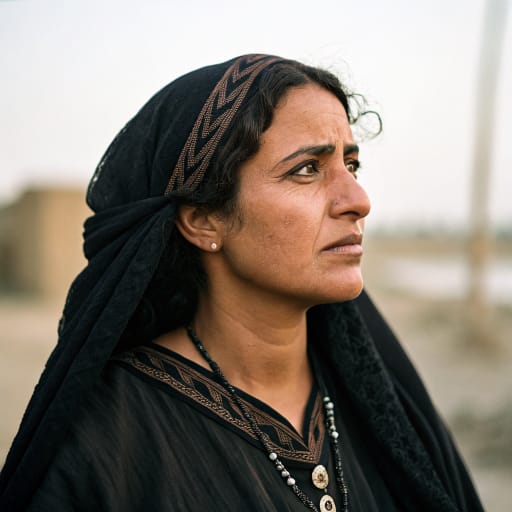
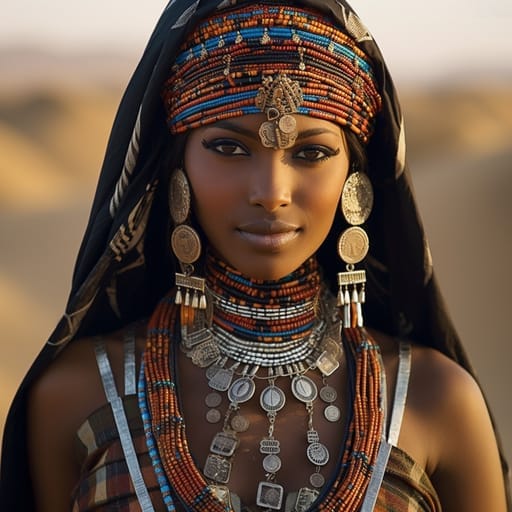
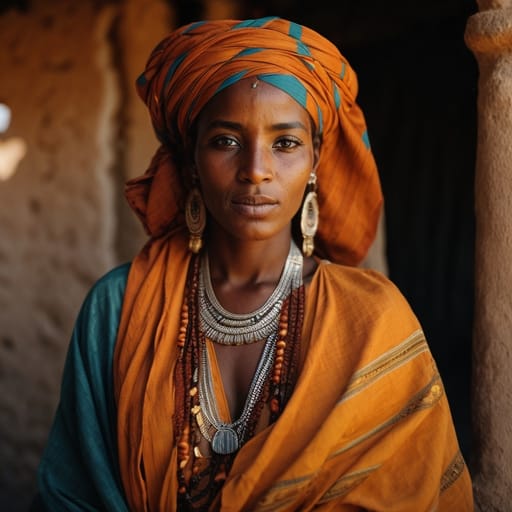
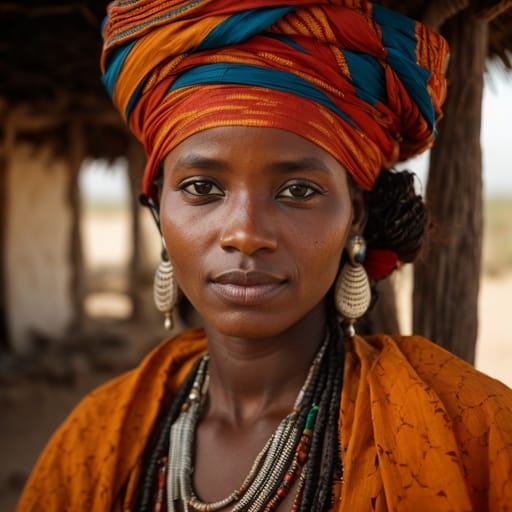
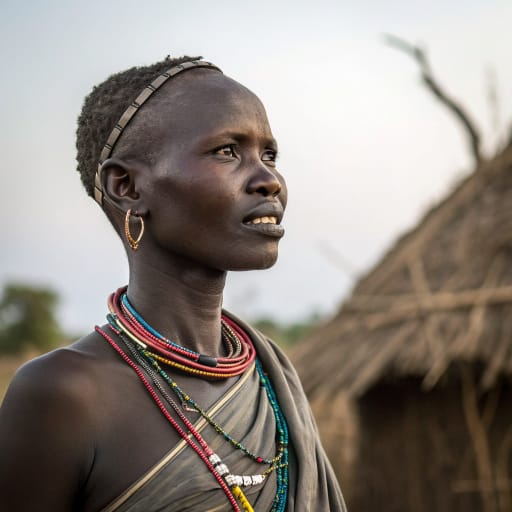
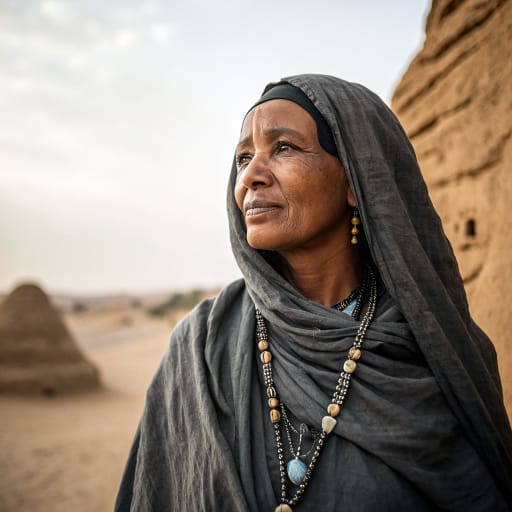
Typical Daju Phenotypes
Reference for AI generation: hair, eyes, skin, facial structure, build
Daju Body & Anatomy Reference
Per-feature anatomical profile for AI nude generation: Berber / Mediterranean-Saharan phenotype
Daju Boobs & Breasts
Daju tits and boobs run medium-to-large cup, full, moderate projection, the classic Berber / Mediterranean-Saharan bust profile. Daju nipples and areolas show medium-brown to dark-brown areolar pigmentation against the olive-to-light-brown skin tone, with areolar diameter typically in the 30-44mm range and forward-set positioning rather than the smaller East Asian bust profile. Daju breasts trend fuller and softer than the Cushitic East African norm, a function of the mesomorph with fuller hip-and-bust deposition body habitus and the mean adult female BMI 24-28. For anatomically accurate AI-generated Daju nudes the render preserves the medium-to-large cup, full, moderate projection shape, 30-44mm areolas with medium-brown to dark-brown pigmentation, and the torso proportions of the Berber / Mediterranean-Saharan phenotype.
Daju Ass & Hips
Daju hips and butt usually read as medium-to-full, moderate projection, broader hip profile. The skeletal base is medium-to-wide iliac crests, fuller gluteal-femoral fat distribution, the Berber / Mediterranean-Saharan pattern. Set against the slim narrow-hip Cushitic East African profile, the difference is easy to see, and the hip-to-waist ratio is often what identifies Daju women in photos.
Daju Vagina & Pussy
Expect medium-brown to dark-brown labial pigmentation, fuller labia minora on Daju women, in keeping with Berber / Mediterranean-Saharan ancestry. The pubic hair is wavy-to-coiled medium-coarse texture, dense distribution. Coloring should run evenly from the olive to medium-brown skin of the thighs to the labia, and Daju nude imagery should keep the hair's wavy-to-coiled medium-coarse texture.
Daju Dicks & Penis
Daju dick and penile anatomy in adult AI generation should anchor on the regional reference data: regional mean ~13-14cm erect, moderate girth, and medium-brown shaft pigmentation. The Daju cock profile reflects the Berber / Mediterranean-Saharan population's anthropometric measurements. The shaft pigmentation should track the surrounding olive to medium-brown skin tone, and the pubic hair should keep its wavy-to-coiled medium-coarse texture in the typical inverted-V escutcheon.
Daju Body, Curves & Build
Daju body type: mesomorph with fuller hip-and-bust deposition, with mean adult female BMI 24-28. This is the typical Berber / Mediterranean-Saharan build. Height range, shoulder-to-hip ratio and fat distribution all follow from it, which is what an accurate Daju nude body should show.
Daju Skin Tone & Hair Texture
Daju skin tone falls in the olive to medium-brown (Fitzpatrick III-V) band, the surface signal most often miscalibrated by generic AI nude generators. Daju hair texture is typically wavy-to-curly 2B-3C, often dark-brown to black, characteristic of the Berber / Mediterranean-Saharan phenotype. In Daju nude renders the skin should hold that band consistently across the body.
Explore phenotype categories
Structured taxonomy with peer-reviewed scales · 22 anatomical categories
Erotic Poses & Sex Positions
From the pose catalog: 219 named positions with reference skeletons
Frequently asked questions about Daju people
Where is the Daju homeland?
The Daju homeland is Darfur in western Sudan, with scattered communities in the Nuba Mountains of South Kordofan, the Sila and Guéra regions of Chad, and along the Sopo river in South Sudan. in Northern Africa.
What language do Daju people speak?
Daju people primarily speak Daju languages, including Daju of Dar Fur (Beke), Dar Sila Daju, Dar Daju Daju, Logorik, Shatt and Njalgulgule (Eastern Sudanic, Nilo-Saharan). Sudanese and Chadian Arabic are widely used and dominant in some communities..
What religion do Daju people practice?
The predominant religion among Daju people is Predominantly Sunni Muslim, with pre-Islamic land and rain rites persisting in places. The Njalgulgule of South Sudan sit largely outside Islam..






Make your own Daju images
Five a day, free, no credits to buy. The studio starts from this group's phenotype data, so you can set body type, pose and style and keep the traits accurate.
Start with Daju