Help us get this right
Does this portrait look right for Cueva?
Nobody has judged this one yet. You would be the first.
Cueva Erotic
The eastern Isthmus of Panama: the Darién, the coasts between the Chagres and the Atrato, and the Pearl Islands, in present-day Panama and adjacent Colombia.
Cueva (usually assigned to the Chibchan family, though it is extinct and known only from chroniclers' word lists)
Extinct pre-Christian isthmian religion: preserved chiefly ancestors, ritual specialists called tequina, and the spirit Tuira.
A cluster of related chiefdoms rather than one polity, including Careta, Comogre, Ponca, Chiapes and Tumaco, within the wider Isthmo-Colombian chiefdom world.
About Cueva People
The Cueva held the eastern end of the Isthmus of Panama when Spanish ships first coasted it in 1501, and they were finished as a people within about forty years, taken apart by slaving raids, war, and epidemic disease. Their country ran from the Caribbean shore across the low Serranía del Darién to the Pacific: mangrove, river, and rainforest between the Chagres and the Atrato, plus the Pearl Islands out in the Gulf of Panama. They lived as a set of chiefdoms rather than one nation, each under a quevi, with lesser lords called sacos beneath him and a rank of cabras made up of men promoted out of the commons for what they did in war. The names of those chiefs are what survive best, because Spanish notaries wrote them down: Careta, Comogre, Ponca, Chiapes, Tumaco. Cueva was never their own word for themselves. The Spanish took it from one district and stretched it over everyone who spoke the language, and the phrase that recurs in the documents is los de la lengua de Cueva, the people of the Cueva tongue. That language is known today from a few hundred words copied out by chroniclers, Gonzalo Fernández de Oviedo chief among them. It is usually filed with the Chibchan family, but the sample is too thin for certainty.
What the Spanish wanted was the gold. Cueva smiths worked it into pectorals, nose rings, and ear ornaments, and Balboa's 1513 crossing to the Pacific was made on Cueva information and with Cueva guides, after a chief's son told the newcomers there was another sea and more metal beyond it. The dead of high rank were dried slowly over fire, wrapped, and kept in the chief's house with their ornaments, so the ancestors stayed in the room. Ritual specialists called tequina handled dealings with Tuira, a spirit the chroniclers translated as the devil because they had no other category for him. The Tuira River in the Darién still carries the name. Pedrarias Dávila landed in 1514 and ran a decade of raids out of Santa María la Antigua, and the collapse that followed was fast and close to total. The Guna, who now hold the San Blas coast and much of the Darién, moved into emptied ground from the south and east; whether they absorbed Cueva survivors or simply inherited the territory is still argued. Nobody today calls themselves Cueva.
Related ethnic groups
Groups that share Cueva's homeland, region, language, or religious tradition. These are likely candidates for comparative phenotype reference.
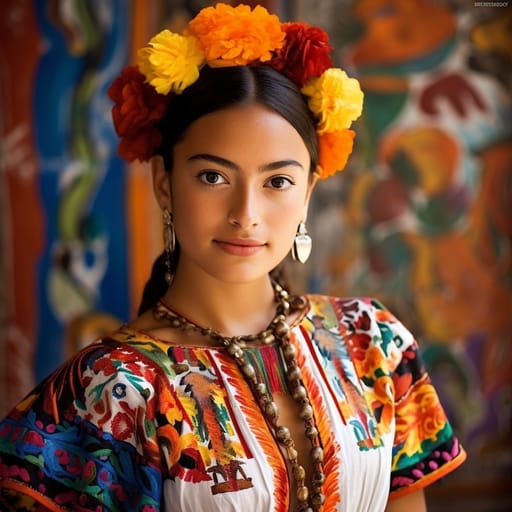
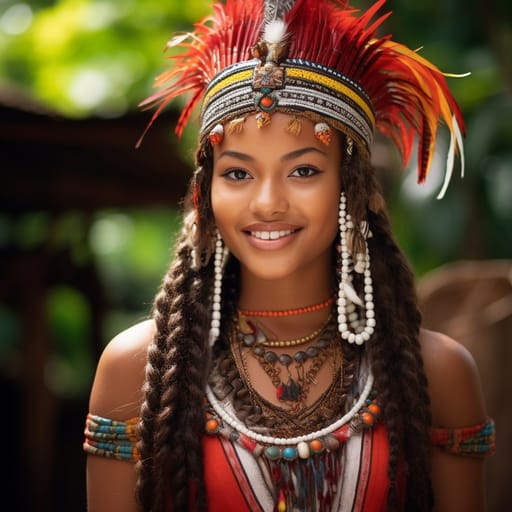
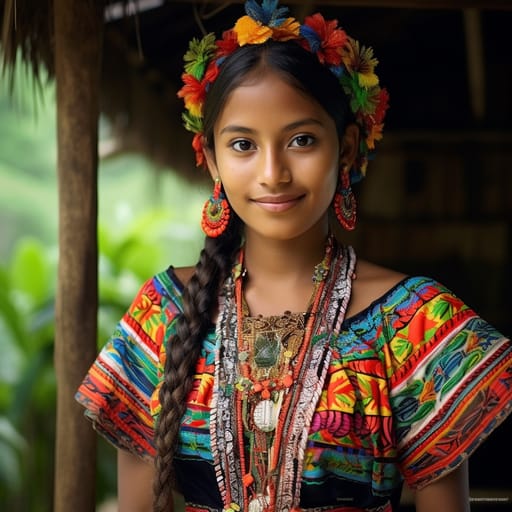
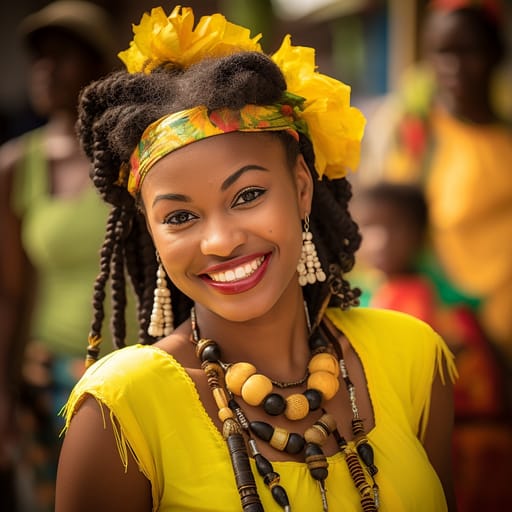
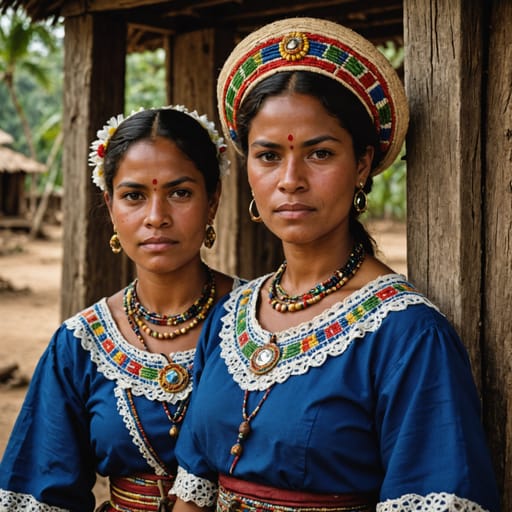
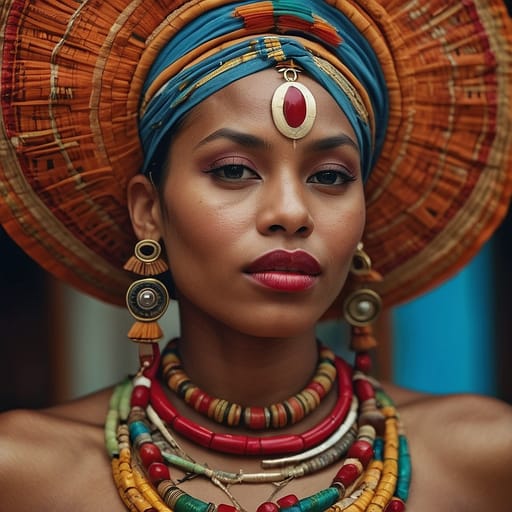
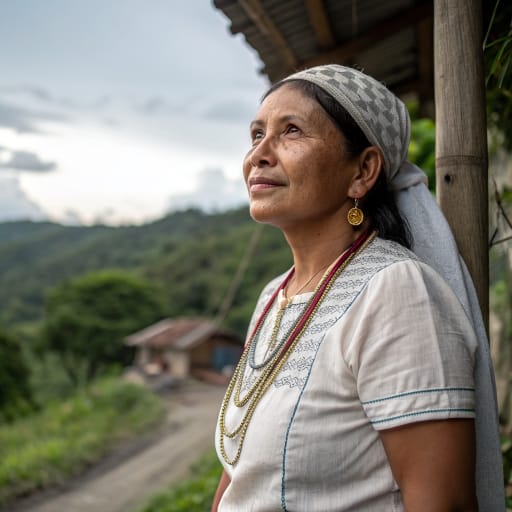
Typical Cueva Phenotypes
Reference for AI generation: hair, eyes, skin, facial structure, build
Cueva Body & Anatomy Reference
Anatomy by feature, Mesoamerican Indigenous / Mestizo phenotype
Cueva Boobs & Breasts
Cueva boobs follow the Mesoamerican Indigenous / Mestizo profile: medium-to-large cup, full, moderate-to-high projection. Areolar diameter is usually 32-46mm, and the coloring is medium-brown to dark-brown areolar pigmentation against the tan-to-medium-brown skin tone. Breast shape tracks body composition (endomorph-to-mesomorph with strong hip-and-bust deposition, mean adult female BMI 26-29), so Cueva breasts tend to be full and projecting, classic Latina curvy bust profile. Expect a forward-set shape, not the smaller East Asian bust.
Cueva Ass & Hips
Cueva ass and hip morphology presents as medium-to-full, high projection, classic Latina curvy hip profile, distinctly different from the slim narrow-hip East Asian profile. The Cueva pelvic profile shows wide iliac crests, full gluteal-femoral fat deposition, anchored in the Mesoamerican Indigenous / Mestizo skeletal pattern. Cueva butt shots in adult AI imagery should render the medium-to-full, high projection, classic Latina curvy hip profile silhouette with the overall build (endomorph-to-mesomorph with strong hip-and-bust deposition) and the fat distribution typical of the Mesoamerican Indigenous / Mestizo phenotype.
Cueva Vagina & Pussy
Cueva pussy anatomy typically shows medium-brown to dark-brown labial pigmentation, fuller labia minora. Pubic hair is usually straight-to-wavy coarse dark texture, dense distribution. In AI-generated Cueva nudes, labial color should blend into the tan to medium-brown skin with a gradual transition, and the hair should keep its straight-to-wavy coarse dark texture.
Cueva Dicks & Penis
Penis reference for Cueva men: regional mean ~13cm erect, moderate girth. Coloring: medium-brown shaft pigmentation. An accurate Cueva cock in AI imagery matches the surrounding tan to medium-brown skin rather than a generic porn default. Circumcision depends on religion and custom, not ancestry.
Cueva Body, Curves & Build
The Cueva figure is generally endomorph-to-mesomorph with strong hip-and-bust deposition, with mean adult female BMI 26-29, characteristic of Mesoamerican Indigenous / Mestizo ancestry. AI image tools tend to flatten regional body types into a few stock shapes; here the Cueva build is kept as its own reference.
Cueva Skin Tone & Hair Texture
Skin: tan to medium-brown (Fitzpatrick III-V). Hair: straight-to-wavy 1A-2B, dense dark-brown to black. Both are typical of Mesoamerican Indigenous / Mestizo ancestry. The most common mistake in AI nudes of Cueva women is a body rendered lighter than the face.
Explore phenotype categories
Structured taxonomy with peer-reviewed scales · 22 anatomical categories
Erotic Poses & Sex Positions
From the pose catalog: 219 named positions with reference skeletons
Frequently asked questions about Cueva people
Where is the Cueva homeland?
The Cueva homeland is The eastern Isthmus of Panama: the Darién, the coasts between the Chagres and the Atrato, and the Pearl Islands, in present-day Panama and adjacent Colombia. in Central America.
What language do Cueva people speak?
Cueva people primarily speak Cueva (usually assigned to the Chibchan family, though it is extinct and known only from chroniclers' word lists).
What religion do Cueva people practice?
The predominant religion among Cueva people is Extinct pre-Christian isthmian religion: preserved chiefly ancestors, ritual specialists called tequina, and the spirit Tuira..






Make your own Cueva images
Five a day, free, no credits to buy. The studio starts from this group's phenotype data, so you can set body type, pose and style and keep the traits accurate.
Start with Cueva