Help us get this right
Does this portrait look right for Boa?
Nobody has judged this one yet. You would be the first.
Boa Erotic
Bas-Uele (Democratic Republic of the Congo)
Christianity
About Boa People
The Boa live in the forested savanna of Bas-Uele, in the northeast of the Democratic Republic of the Congo, between the Uele and Aruwimi rivers. They are one of the more northerly Bantu-speaking peoples — a position that matters, because Bas-Uele is a linguistic seam where Bantu, Ubangian, and Central Sudanic languages meet. Their language, Boa (sometimes Bwa), sits inside the Bantu family but takes vocabulary and rhythm from neighbors who do not, and a Boa speaker on the frontier of the territory often reads the surrounding landscape in two grammars at once.
Identity among the Boa has long been organized around clans and chiefly lineages rather than a single centralized polity, and the people European travelers in the late nineteenth century lumped together as "Boa" or "Ababua" were really a constellation of related groups — Benge, Kango, Bati, and others — sharing language and custom but governing themselves locally. That looseness shaped how they experienced the colonial period. The Bas-Uele was deep inside the rubber-and-ivory zone of the Congo Free State, and Boa villages were among those subjected to the quota system and its violence; the memory of that period, and of the missions and Force Publique posts that followed, still inflects local oral history.
Christianity is the dominant affiliation today, the result of a century of Catholic and Protestant missionary work threading along the rivers, and it generally coexists with older ideas about ancestors, the bush, and the moral weight of the lineage. People are baptized, married in church, and buried with rites that draw on both registers without much sense of contradiction. Subsistence is agricultural — manioc, plantain, palm oil, hunting and fishing in the forest galleries — and craft traditions in iron and wood remain strong; Boa masks, especially the wide-eyed war and dance masks once associated with initiation societies, are among the better-known objects from the region in museum collections, though their original ceremonial context has thinned considerably.
Bas-Uele is one of the harder provinces to reach in a country where reach is already difficult, and that isolation cuts both ways. It has spared the Boa some of the upheavals further south and east, but it has also meant patchy schools, fragile roads, and an economy that runs largely on what the household and the forest produce. The Boa today are a rural, Christian, Bantu-speaking people quietly continuing a long presence in a corner of central Africa most outsiders never see.
Related ethnic groups
Groups that share Boa's homeland, region, language, or religious tradition. These are likely candidates for comparative phenotype reference.
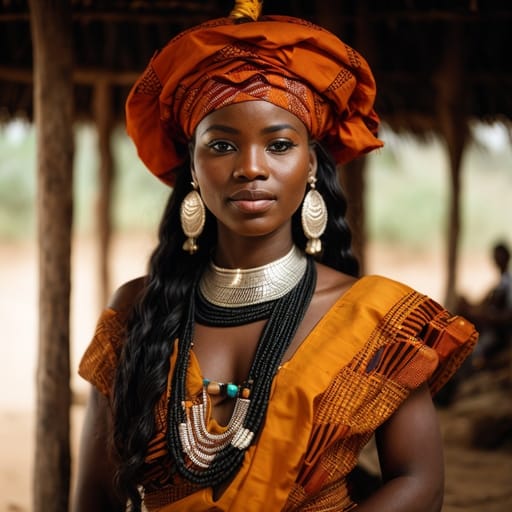
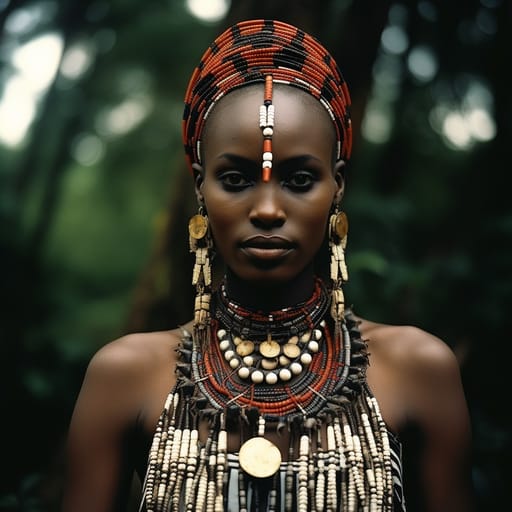
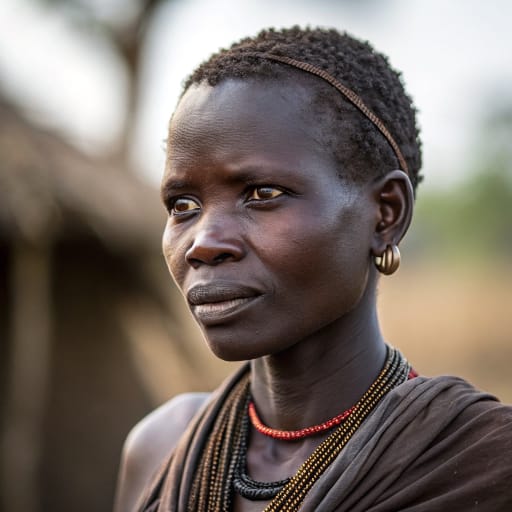
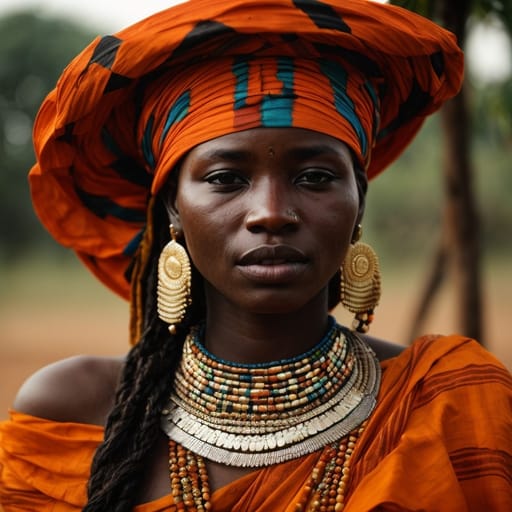
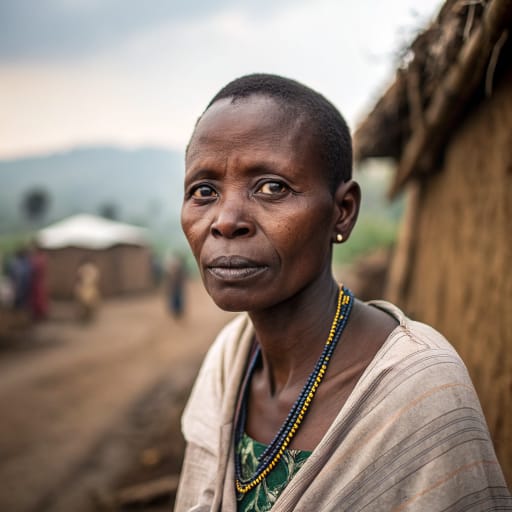
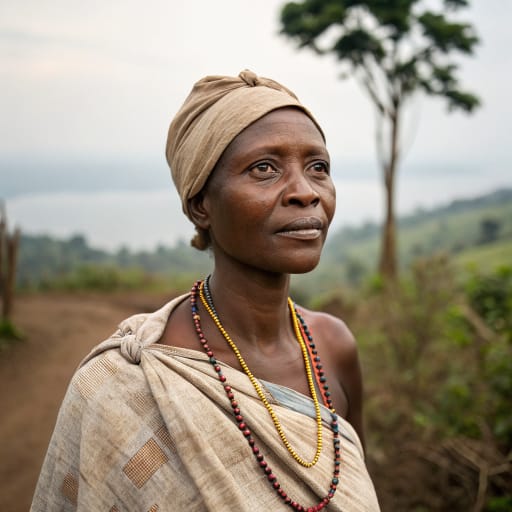
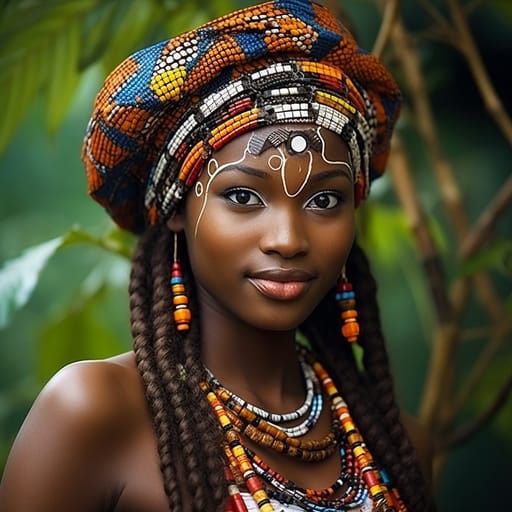
Typical Boa Phenotypes
Reference for AI generation: hair, eyes, skin, facial structure, build
The Boa are a Bantu-speaking population of the dense equatorial forest belt of Bas-Uele, in northern DRC, and their phenotype reflects long residence in that humid, low-light, year-round-warm environment. Skin tone clusters in the deeply pigmented end of Fitzpatrick VI — dark brown to near-black with cool, slightly blue-black undertones rather than the reddish or olive undertones seen in drier savanna populations to the north and east. Sun-induced variation is minimal; the baseline melanin density already saturates the visible range.
Hair is tightly coiled Type 4 (mostly 4B–4C), fine to medium in strand diameter, with the small, springy curl pattern typical of Central African forest peoples. Color is uniformly black-brown; significant graying is the only common pigment shift. Eyes are dark brown to near-black, set under a moderately heavy supraorbital ridge with full upper lids and no epicanthic fold. The brow line tends to be straight rather than arched, and lashes are dense.
Facial structure trends toward broad, low-bridged noses with wide alae and rounded tips — the platyrrhine pattern shared with neighboring Bantu and Ubangian forest groups. Lips are full on both upper and lower, with a defined vermilion border and a forward-set dental arch giving mild bimaxillary prominence. Cheekbones are moderately wide but not high or angular; the jaw is rounded rather than squared, and the chin is short.
Build is on the shorter side of Central African averages — adult men typically 165–172 cm, women 155–162 cm — with a mesomorphic frame: relatively short legs to torso, narrow hips, dense musculature, and low subcutaneous fat. Steatopygia, common in some southern African populations, is not characteristic here. The Boa share a closely overlapping phenotype with surrounding peoples of Bas-Uele and Orientale — the Mbudza, Bati, and Lika — and visible distinctions between these neighbors are subtle, more a matter of regional cline than discrete sub-group variation.
Boa Body & Anatomy Reference
Per-feature anatomical profile for AI nude generation: Bantu / Central African Niger-Congo phenotype
Boa Boobs & Breasts
Boa boobs follow the Bantu / Central African Niger-Congo profile: medium-to-large cup, full, projecting. Areolar diameter is usually 32-48mm, and the coloring is deep-brown areolar pigmentation against the deep-brown skin tone. Breast shape tracks body composition (mesomorph with strong gluteal-femoral fat deposition, mean adult female BMI 23-26), so Boa breasts tend to be fuller projection than East African; comparable to West African norm. Expect a forward-set shape, not the smaller East African conical profile.
Boa Ass & Hips
Boa ass and hip morphology presents as full, projected, wide-set glutes, distinctly different from the slim narrow-hip Cushitic East African profile. The Boa pelvic profile shows broad iliac crests, gynoid pelvic pattern, anchored in the Bantu / Central African Niger-Congo skeletal pattern. Boa butt shots in adult AI imagery should render the full, projected, wide-set glutes silhouette with the overall build (mesomorph with strong gluteal-femoral fat deposition) and the fat distribution typical of the Bantu / Central African Niger-Congo phenotype.
Boa Vagina & Pussy
Boa pussy anatomy typically shows deep-brown labial pigmentation, fuller labia minora. Pubic hair is usually tightly-coiled coarse texture, dense distribution. In AI-generated Boa nudes, labial color should blend into the deep-brown skin with a gradual transition, and the hair should keep its tightly-coiled coarse texture.
Boa Dicks & Penis
Penis reference for Boa men: regional mean ~14cm erect, above-average girth. Coloring: deep-brown shaft pigmentation. An accurate Boa cock in AI imagery matches the surrounding deep-brown skin rather than a generic porn default. Circumcision depends on religion and custom, not ancestry.
Boa Body, Curves & Build
The Boa figure is generally mesomorph with strong gluteal-femoral fat deposition, with mean adult female BMI 23-26, characteristic of Bantu / Central African Niger-Congo ancestry. AI image tools tend to flatten regional body types into a few stock shapes; here the Boa build is kept as its own reference.
Boa Skin Tone & Hair Texture
Skin: deep-brown (Fitzpatrick VI). Hair: tight 4A-4C coil. Both are typical of Bantu / Central African Niger-Congo ancestry. The most common mistake in AI nudes of Boa women is a body rendered lighter than the face.
Data depth
0/100Coverage of image-grounded phenotype observations · drives AI generation diversity
- Sample size
- 0/40· 0 images
- Image quality
- 0/30· 0% high
- Confidence
- 0/20
- Source diversity
- 0/10
- ·No image observations yet
Explore phenotype categories
Structured taxonomy with peer-reviewed scales · 22 anatomical categories
Erotic Poses & Sex Positions
From the pose catalog: 219 named positions with reference skeletons
Frequently asked questions about Boa people
Where is the Boa homeland?
The Boa homeland is Bas-Uele (Democratic Republic of the Congo) in Central Africa.
What language do Boa people speak?
Boa people primarily speak Niger-Congo / Bantu / Boa.
What religion do Boa people practice?
The predominant religion among Boa people is Christianity.






Make your own Boa images
Five a day, free, no credits to buy. The studio starts from this group's phenotype data, so you can set body type, pose and style and keep the traits accurate.
Start with Boa