No portrait yet
Tomun Erotic
Lamandau River basin in Lamandau and West Kotawaringin regencies, Central Kalimantan, Indonesia (Borneo)
Tomun (Austronesian, Malayic); Indonesian also widely spoken
Christianity and Islam, with Kaharingan (ancestral Dayak religion, officially classed under Hinduism) still practiced
Dayak; one of the Malayic-speaking Dayak communities of the Lamandau basin in Central Kalimantan
About Tomun People
The Tomun are a Dayak people of southwestern Central Kalimantan, in the Indonesian part of Borneo, and the easiest way to place them is by river. Their villages line the Lamandau and its feeder streams, inland country of farmland and forest that runs up to the West Kalimantan border. The name also appears as Tamuan. Outsiders usually put them under one broad Dayak label, but along these rivers people first place each other by village and watershed.
Language is the first surprise. Tomun speech belongs to the Malayic branch of Austronesian, the same branch as Malay and Indonesian. It is not one of the Barito languages spoken by many Dayak groups farther east, such as the Ngaju. That makes it a relative of the Malay spoken on the Kotawaringin coast, and it breaks the tidy idea that Dayak and Malay are opposites. History has blurred that line too. From the seventeenth century, the lower country answered to the Kotawaringin Sultanate, a Muslim court founded by a prince of Banjar, while upriver communities largely kept their own customary law. Across Borneo, becoming Muslim often meant being counted as Malay rather than Dayak. That is one reason ethnic lines here are less fixed than census forms suggest.
In 2002 the upriver districts split from West Kotawaringin to form Lamandau Regency, governed from Nanga Bulik. Since then, oil palm has remade much of the land around the villages, and village life now runs alongside plantation roads, schools and market towns.
Religious life has several layers. Christianity and Islam are both established, and people still practice Kaharingan, the ancestral Dayak faith that the Indonesian state registers as a form of Hinduism. Its best known expression among the Tomun is Babukung, a funeral rite. When someone dies, dancers called bukung come to the house of mourning with their faces hidden behind masks and their bodies covered in leaves or cloth. They dance to gongs and drums. Their presence is understood both to accompany the dead and to make sure the grieving household is not left alone with its loss. The regency now also stages Babukung as a public festival, but in the villages the dance still belongs to the dead.
Related ethnic groups
Groups that share Tomun's homeland, region, language, or religious tradition. These are likely candidates for comparative phenotype reference.
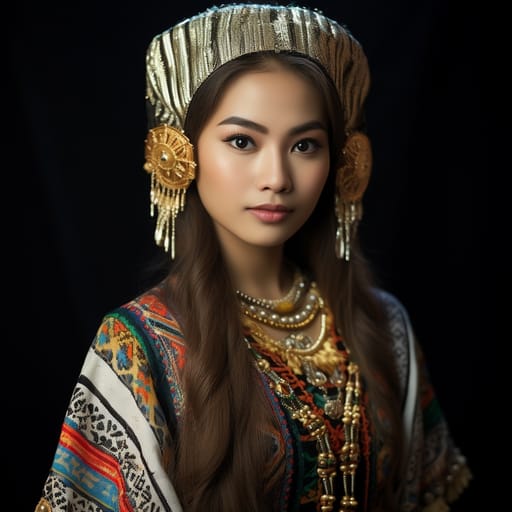
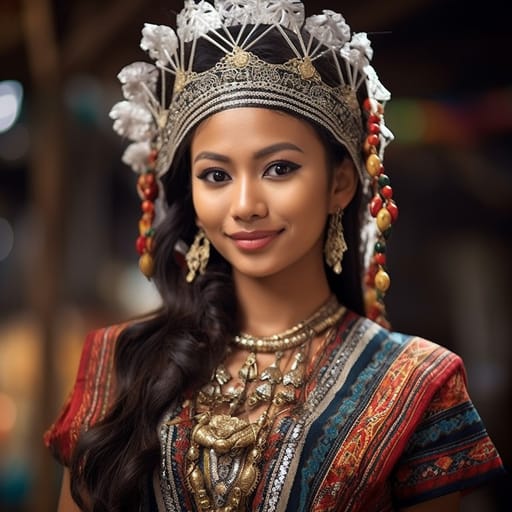
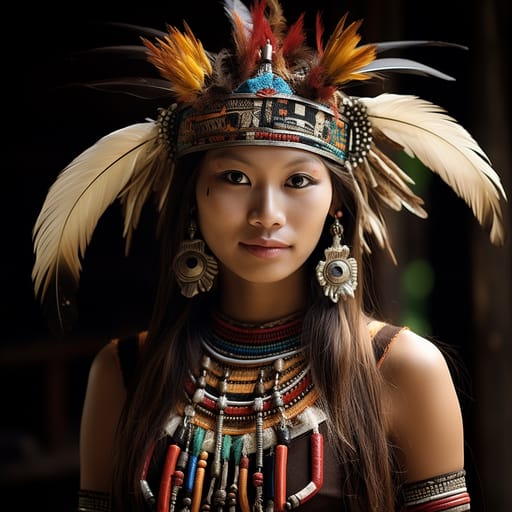
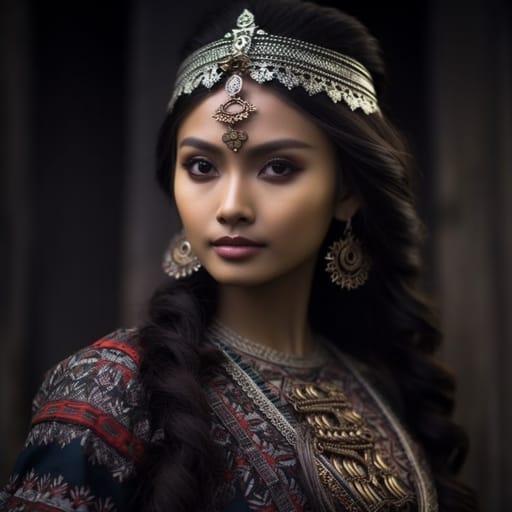
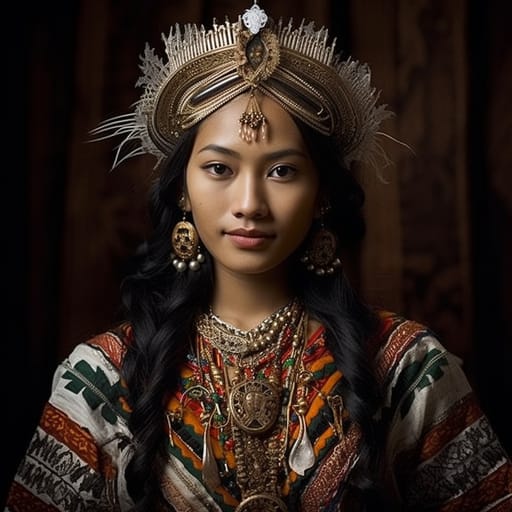
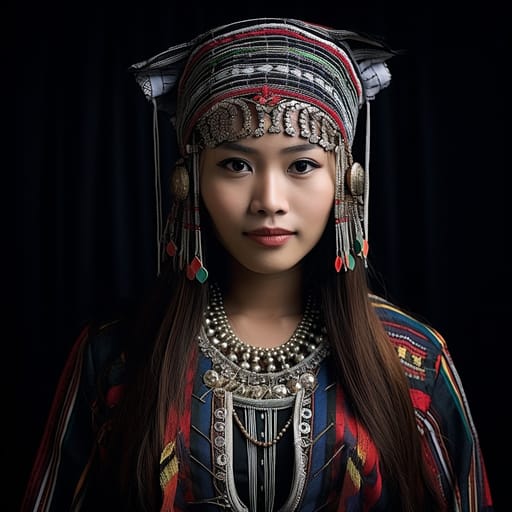
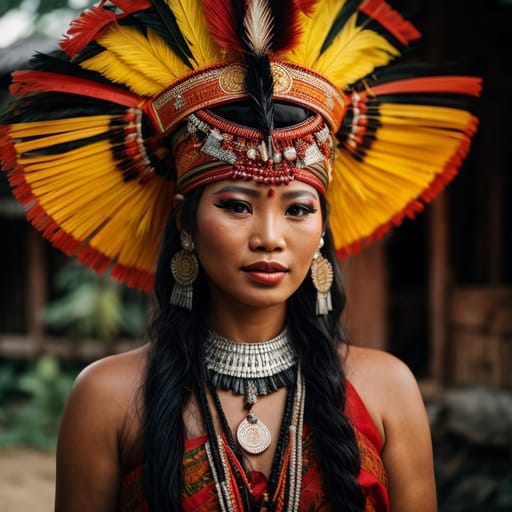
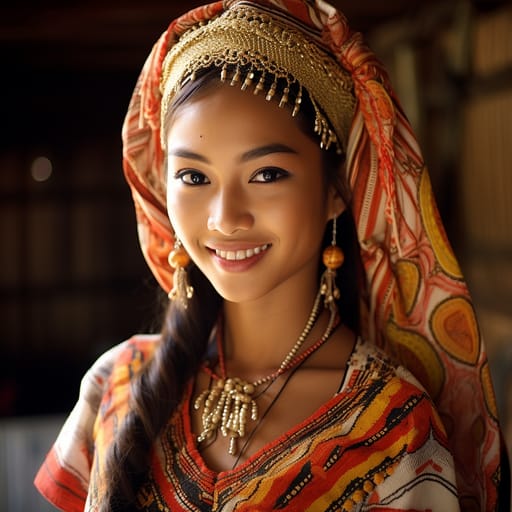
Typical Tomun Phenotypes
Reference for AI generation: hair, eyes, skin, facial structure, build
Tomun Body & Anatomy Reference
Anatomy by feature, Southeast Asian Austronesian / Austroasiatic phenotype
Tomun Boobs & Breasts
Bust reference for Tomun women: small-to-medium cup, modest projection, which is typical of Southeast Asian Austronesian / Austroasiatic ancestry. Areolas measure about 26-38mm across, with medium-brown to dark-brown pigmentation. Body type (ectomorph, petite frame) shapes the bust as well, so Tomun tits are usually firm, modest projection. In AI imagery, keep the forward-set shape rather than drifting toward the fuller South Asian or Polynesian bust.
Tomun Ass & Hips
The Tomun ass is typically small-to-medium, modest projection, narrower hip profile, which sets it apart from the fuller glutes of the Pacific Islander phenotype. Underneath, the pelvis shows narrow-to-medium iliac crests, part of the Southeast Asian Austronesian / Austroasiatic skeletal pattern. For Tomun butt pics and AI renders, match that silhouette and the overall build (ectomorph, petite frame).
Tomun Vagina & Pussy
Tomun pussy and vulvar anatomy presents medium-brown to dark-brown labial pigmentation, consistent with the Southeast Asian Austronesian / Austroasiatic phenotype's pigmentation pattern. Tomun pubic hair is typically straight-to-wavy fine-to-medium texture, in the inverted-triangle pattern. For anatomically accurate Tomun pussy renders the labial coloration should match the surrounding tan to medium-brown skin tone with a continuous gradient, and the hair should keep its straight-to-wavy fine-to-medium texture.
Tomun Dicks & Penis
Tomun dicks follow the Southeast Asian Austronesian / Austroasiatic reference data: regional mean ~11cm erect; moderate girth; medium-brown shaft pigmentation. Shaft color should track the tan to medium-brown skin tone with a smooth change toward the glans, and Tomun pubic hair keeps its straight-to-wavy fine-to-medium texture.
Tomun Body, Curves & Build
Tomun body type and overall build presents as ectomorph, petite frame, with mean adult female BMI 20-23: the characteristic Southeast Asian Austronesian / Austroasiatic habitus. Tomun curves and proportions should keep the regional skeletal frame (height, shoulder-to-hip ratio, limb proportions) rather than a generic mesomorph default.
Tomun Skin Tone & Hair Texture
Tomun skin sits in the tan to medium-brown (Fitzpatrick III-V) band. Hair is typically straight-to-wavy 1A-2A, dark-brown to black, in keeping with the Southeast Asian Austronesian / Austroasiatic phenotype. In nude renders the skin should stay one even tone from face to body, and body, pubic and head hair should match.
Explore phenotype categories
Structured taxonomy with peer-reviewed scales · 22 anatomical categories
Erotic Poses & Sex Positions
From the pose catalog: 219 named positions with reference skeletons
Frequently asked questions about Tomun people
Where is the Tomun homeland?
The Tomun homeland is Lamandau River basin in Lamandau and West Kotawaringin regencies, Central Kalimantan, Indonesia (Borneo) in Southeast Asia.
What language do Tomun people speak?
Tomun people primarily speak Tomun (Austronesian, Malayic); Indonesian also widely spoken.
What religion do Tomun people practice?
The predominant religion among Tomun people is Christianity and Islam, with Kaharingan (ancestral Dayak religion, officially classed under Hinduism) still practiced.






Make your own Tomun images
Five a day, free, no credits to buy. The studio starts from this group's phenotype data, so you can set body type, pose and style and keep the traits accurate.
Start with Tomun