Help us get this right
Does this portrait look right for Ovimbundu?
One tap. It takes a second and it is recorded.
0 say it looks right, 1 says it looks off.
Ovimbundu Erotic
Christianity
About Ovimbundu People
The Ovimbundu are the largest ethnic group in Angola, concentrated on the central highlands — the planalto — that rise behind the coastal lowlands and run south from Huambo through Bié and Benguela. They number somewhere over six million, depending on how one counts, and their language, Umbundu, gives them a name as much as their territory does: Ovimbundu means, roughly, the people of the mist-country, the cool elevated interior where maize and cassava grow and the rains come hard between October and April.
Linguistically they sit inside the broad Bantu family, alongside their Kimbundu-speaking neighbors to the north and the Chokwe and Ganguela peoples to the east — close enough that a careful ear can follow the drift between them, distinct enough that Umbundu has its own substantial body of proverbs, praise poetry, and trade vocabulary. That trade vocabulary is not incidental. From roughly the seventeenth century onward, the Ovimbundu built one of the great long-distance commercial networks of central Africa, sending caravans deep into what is now Zambia and the Democratic Republic of Congo and bringing back ivory, wax, rubber, and — through a darker chapter — captives bound for the Atlantic coast at Benguela. The caravan trade collapsed only when Portuguese colonial rule hardened in the early twentieth century and the railway took over the routes the porters had walked.
Christianity arrived through American Congregationalist and Canadian missionaries in the late 1800s, and it took root unusually deep — the mission stations at Bailundo, Chilesso, and Dôndi produced a literate Umbundu-speaking class that later supplied much of the leadership of UNITA during the long Angolan civil war. That war, fought largely on Ovimbundu soil between 1975 and 2002, scarred the highlands more than any other part of the country. Recovery has been slow and uneven; many villages still carry the mine-clearance signs.
Among themselves, the Ovimbundu are not one undifferentiated bloc but a federation of older kingdoms — Bailundo, Wambu, Bié, Ngalangi, and others — whose royal houses still hold ceremonial weight even where their political authority has thinned. Cattle matter, both economically and as a measure of standing, and bridewealth negotiations remain a serious business conducted between extended families. The ancestor cult, layered beneath formal Christian observance, has not gone anywhere; people pray to the saints and pour libations to the grandfathers without seeing a contradiction.
Related ethnic groups
Groups that share Ovimbundu's homeland, region, language, or religious tradition. These are likely candidates for comparative phenotype reference.
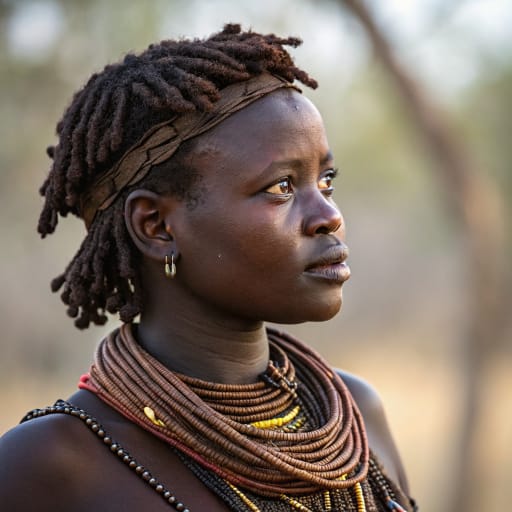
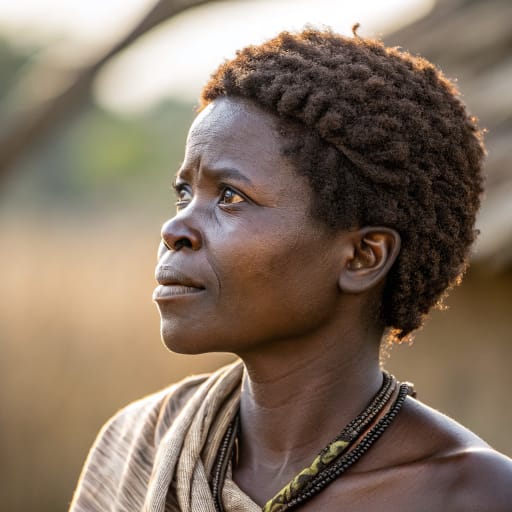
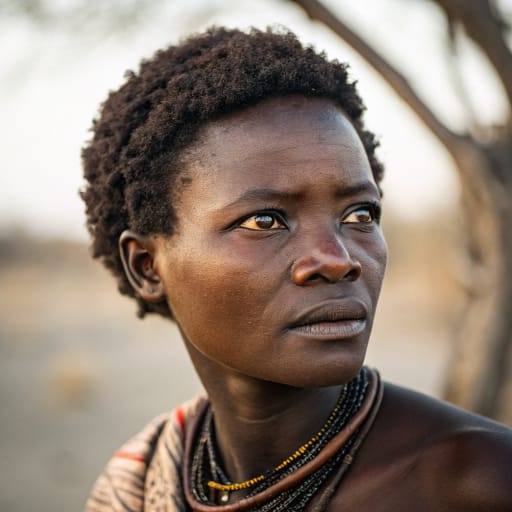
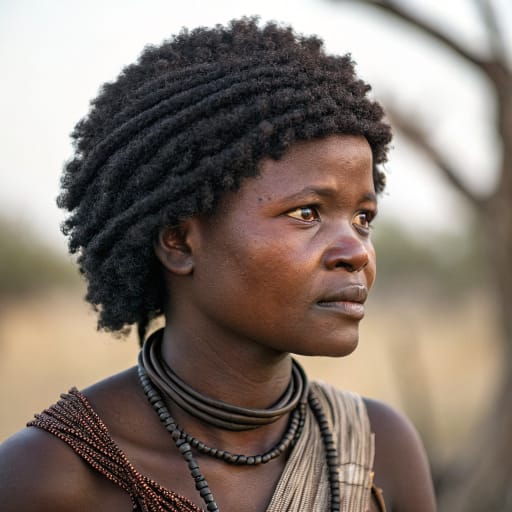
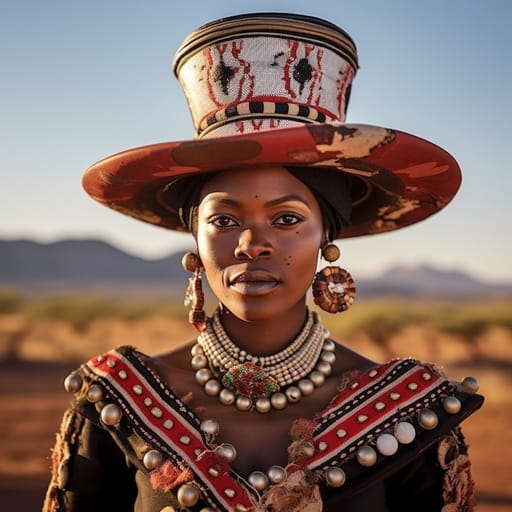
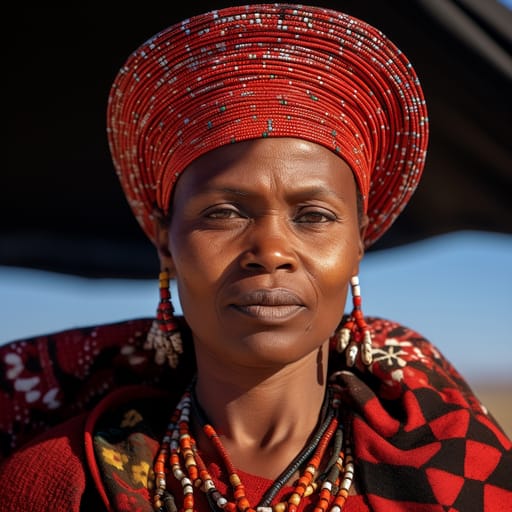

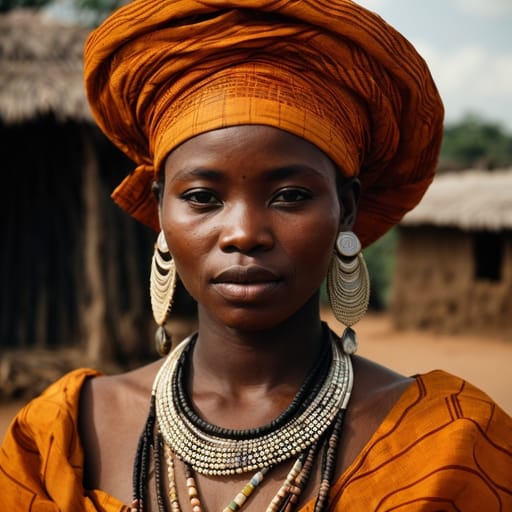
Geographic Distribution: Ovimbundu populations across 1 country
Each row is ranked by the group's share of that country's population, with the source citation drawn from published census and demographic surveys. Click through for the full per-country phenotype profile.
| Country | Share | Source |
|---|---|---|
| Angola | 37.0% | Estimated from international demographic sources; Angola's last comprehensive census was 2014. Ovimbundu (~37%, ~12M+); the largest ethnic group, concentrated in central Angola (Huambo, Bié, Benguela provinces). Bantu / Umbundu language |
Typical Ovimbundu Phenotypes
Reference for AI generation: hair, eyes, skin, facial structure, build
The Ovimbundu are a Bantu population of Angola's central highlands, and their phenotype reads as classically Southern-Bantu with the slim, slightly elongated build typical of plateau-dwelling agriculturalists rather than the more compact morphology of forest groups further north.
Hair is overwhelmingly Type 4 — tightly coiled, springy, with the dense Z-pattern coil common across Bantu Africa. Natural color is deep black-brown; sun-bleaching to a rust or copper cast is common in children and in adults who work outdoors on the Bié plateau. Hairlines tend to be moderate, with a higher incidence of temple recession in older men than in West African Bantu groups. Beards in men are typically sparse to moderate, rarely full.
Eyes are dark brown to near-black, almond-shaped, set under a brow ridge that is present but not heavy. The epicanthic fold is absent. Sclerae are often slightly warm-toned rather than bright white, a common Central-Southern African trait.
Skin sits in the Fitzpatrick V–VI range, leaning toward VI — a deep brown with neutral-to-cool undertones, generally darker than coastal Mbundu and lighter than the very dark skin of some Sudanic-belt populations. Tonal variation within a single family is normal.
Facial structure shows a moderately broad nose with a low-to-medium bridge and rounded tip, fuller alar wings than in Nilotic groups but narrower than in Congo Basin populations. Lips are full and well-defined, with a pronounced vermilion border. Cheekbones are high and laterally placed; jawlines in men are often square, in women softer and oval. Foreheads are typically broad and rounded.
Build is slender-to-athletic, with long limbs relative to torso — adult men commonly 170–180 cm, women 158–168 cm. Highland upbringing tends to produce wiry, durable physiques rather than the thicker mesomorphic builds seen in coastal Angolan populations. Hands and feet are proportionally long and narrow.
Ovimbundu Body & Anatomy Reference
Bantu / Khoisan Southern African phenotype: anatomy reference for AI nude generation
Ovimbundu Boobs & Breasts
Bust reference for Ovimbundu women: medium cup, full but moderate projection, which is typical of Bantu / Khoisan Southern African ancestry. Areolas measure about 30-44mm across, with medium-brown to deep-brown pigmentation. Body type (mesomorph; Khoisan-descended sub-populations show distinctive steatopygic fat deposition) shapes the bust as well, so Ovimbundu tits are usually moderately full; less projecting than West African norm. In AI imagery, keep the forward-set shape rather than drifting toward the heavier West African bust.
Ovimbundu Ass & Hips
The Ovimbundu ass is typically the distinctive Khoisan-influenced steatopygic profile in some sub-populations (San, Khoekhoe); broader gluteal projection in Bantu-speaking groups, which sets it apart from the slim Cushitic East African profile. Underneath, the pelvis shows wide iliac crests with notable lordosis in Khoisan-descended sub-populations, part of the Bantu / Khoisan Southern African skeletal pattern. For Ovimbundu butt pics and AI renders, match that silhouette and the overall build (mesomorph; Khoisan-descended sub-populations show distinctive steatopygic fat deposition).
Ovimbundu Vagina & Pussy
Ovimbundu pussy and vulvar anatomy presents deep-brown labial pigmentation; the elongated labia minora documented in some Khoisan-descended populations, consistent with the Bantu / Khoisan Southern African phenotype's pigmentation pattern. Ovimbundu pubic hair is typically tightly-coiled coarse texture, in the inverted-triangle pattern. For anatomically accurate Ovimbundu pussy renders the labial coloration should match the surrounding medium-brown to deep-brown skin tone with a continuous gradient, and the hair should keep its tightly-coiled coarse texture.
Ovimbundu Dicks & Penis
Ovimbundu dicks follow the Bantu / Khoisan Southern African reference data: regional mean ~14cm erect; moderate-to-above-average girth; deep-brown shaft pigmentation. Shaft color should track the medium-brown to deep-brown skin tone with a smooth change toward the glans, and Ovimbundu pubic hair keeps its tightly-coiled coarse texture.
Ovimbundu Body, Curves & Build
Ovimbundu body type and overall build presents as mesomorph; Khoisan-descended sub-populations show distinctive steatopygic fat deposition, with mean adult female BMI 24-28: the characteristic Bantu / Khoisan Southern African habitus. Ovimbundu curves and proportions should keep the regional skeletal frame (height, shoulder-to-hip ratio, limb proportions) rather than a generic mesomorph default.
Ovimbundu Skin Tone & Hair Texture
Ovimbundu skin sits in the medium-brown to deep-brown (Fitzpatrick V-VI); lighter in Khoisan-descended populations band. Hair is typically tightly-coiled 4A-4C; the distinctive 'peppercorn' tight-spiral texture in Khoisan-descended populations, in keeping with the Bantu / Khoisan Southern African phenotype. In nude renders the skin should stay one even tone from face to body, and body, pubic and head hair should match.
Data depth
0/100Coverage of image-grounded phenotype observations · drives AI generation diversity
- Sample size
- 0/40· 0 images
- Image quality
- 0/30· 0% high
- Confidence
- 0/20
- Source diversity
- 0/10
- ·No image observations yet
Explore phenotype categories
Structured taxonomy with peer-reviewed scales · 22 anatomical categories
Erotic Poses & Sex Positions
From the pose catalog: 219 named positions with reference skeletons
Frequently asked questions about Ovimbundu people
Where is the Ovimbundu homeland?
The Ovimbundu homeland is Angola in Southern Africa.
What countries do Ovimbundu people live in?
Ovimbundu populations are documented across 1 country: Angola.
What language do Ovimbundu people speak?
Ovimbundu people primarily speak Niger-Congo / Bantu / Umbundu.
What religion do Ovimbundu people practice?
The predominant religion among Ovimbundu people is Christianity.






Make your own Ovimbundu images
Five a day, free, no credits to buy. The studio starts from this group's phenotype data, so you can set body type, pose and style and keep the traits accurate.
Start with Ovimbundu