Help us get this right
Does this portrait look right for Nasa (Páez)?
Nobody has judged this one yet. You would be the first.
Nasa (Páez) Erotic
Cauca department, Andes of southwestern Colombia (Tierradentro)
Nasa Yuwe (Páezan)
Traditional Nasa cosmology blended with Catholicism; The'wala healers
About Nasa (Páez) People
Nasa, historically called Páez, are one of the largest Indigenous peoples of Colombia, living mainly in the rugged Andean highlands of Cauca department, especially the region of Tierradentro. They speak Nasa Yuwe, a language usually placed in the small Páezan grouping, and number several hundred thousand, with a strong record of political organization and land defense.
Society and subsistence
Nasa communities are organized into resguardos, communal Indigenous territories governed by elected cabildos whose authority is symbolized by wooden staffs of office. Some resguardos trace their communal titles to colonial era grants defended by legendary caciques such as Juan Tama. Farming on steep slopes yields maize, beans, potatoes, cassava, plantains and coffee, and households keep livestock and share reciprocal labor. Much of the movement's modern strength runs through the Regional Indigenous Council of Cauca, founded in 1971 and long at the forefront of land recovery in Colombia. In 1994 a powerful earthquake and avalanche struck Tierradentro, destroying villages and forcing many Nasa to relocate. Spiritual life blends Catholic practice with Nasa cosmology, and healers called The'wala read signs, cleanse and mediate with the spirit world, often using coca and ritual plants. The Nasa are also widely known for the Guardia Indígena, an unarmed community guard that protects territory and autonomy.
Appearance and adornment
Living at cold altitudes, the Nasa dress in warm layered clothing. Men commonly wear the ruana, a woolen poncho, with felt hats, while women wear gathered skirts, blouses, shawls and multiple strands of beads at the neck. A distinctive woven sash, the chumbe, is wound at the waist and, for infants, used for carrying and swaddling, its patterns carrying symbolic meaning. Everyday appearance today largely blends with rural mestizo dress, but the woolen ruana, beadwork and the ceremonial staffs of cabildo and guard remain strong markers of Nasa identity.
Related ethnic groups
Groups that share Nasa (Páez)'s homeland, region, language, or religious tradition. These are likely candidates for comparative phenotype reference.
Quechua
same region (South America)
Aymara
same region (South America)
Guaraní
same region (South America)
Emberá
same region (South America)
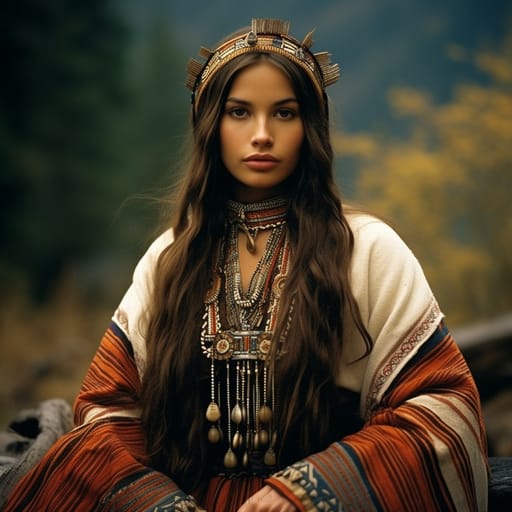
Mapuche
same region (South America)
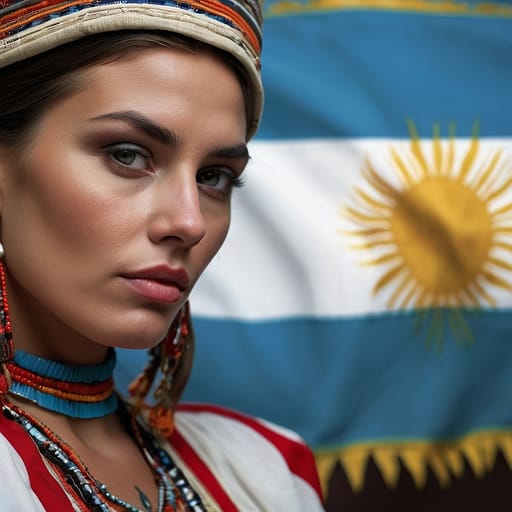
White Argentine
same region (South America)
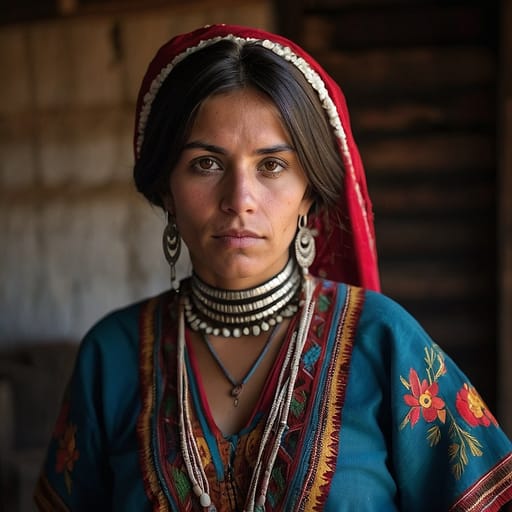
Mestizo Argentine
same region (South America)

Middle Eastern Argentine
same region (South America)
Typical Nasa (Páez) Phenotypes
Reference for AI generation: hair, eyes, skin, facial structure, build
Nasa (Páez) Body & Anatomy Reference
South American Indigenous / European-Mestizo / Afro-Latino mix phenotype: anatomy reference for AI nude generation
Nasa (Páez) Boobs & Breasts
Nasa (Páez) tits and boobs run medium-to-large cup, full, high projection, the classic South American Indigenous / European-Mestizo / Afro-Latino mix bust profile. Nasa (Páez) nipples and areolas show medium-brown to dark-brown areolar pigmentation against the tan-to-deep-brown skin tone, with areolar diameter typically in the 32-46mm range and forward-set positioning rather than the smaller bust profile of Andean Indigenous sub-populations. Nasa (Páez) breasts trend the classic Brazilian / Latina curvy bust profile in lowland populations; smaller and shorter-set in Andean Indigenous populations, a function of the endomorph-to-mesomorph with high gluteal-femoral deposition body habitus and the mean adult female BMI 25-28. For anatomically accurate AI-generated Nasa (Páez) nudes the render preserves the medium-to-large cup, full, high projection shape, 32-46mm areolas with medium-brown to dark-brown pigmentation, and the torso proportions of the South American Indigenous / European-Mestizo / Afro-Latino mix phenotype.
Nasa (Páez) Ass & Hips
Nasa (Páez) hips and butt usually read as full, high projection, the famous Brazilian / Latina bunda profile. The skeletal base is wide iliac crests, very full gluteal-femoral fat deposition (the hallmark Brazilian / Latina hip-to-waist ratio), the South American Indigenous / European-Mestizo / Afro-Latino mix pattern. Set against the slim narrow-hip East Asian profile, the difference is easy to see, and the hip-to-waist ratio is often what identifies Nasa (Páez) women in photos.
Nasa (Páez) Vagina & Pussy
Expect medium-brown to dark-brown labial pigmentation, fuller labia minora on Nasa (Páez) women, in keeping with South American Indigenous / European-Mestizo / Afro-Latino mix ancestry. The pubic hair is wavy-to-curly coarse dark texture, dense distribution. Coloring should run evenly from the tan to deep-brown skin of the thighs to the labia, and Nasa (Páez) nude imagery should keep the hair's wavy-to-curly coarse dark texture.
Nasa (Páez) Dicks & Penis
Nasa (Páez) dick and penile anatomy in adult AI generation should anchor on the regional reference data: regional mean ~13cm erect, moderate-to-above-average girth, and medium-brown shaft pigmentation. The Nasa (Páez) cock profile reflects the South American Indigenous / European-Mestizo / Afro-Latino mix population's anthropometric measurements. The shaft pigmentation should track the surrounding tan to deep-brown skin tone, and the pubic hair should keep its wavy-to-curly coarse dark texture in the typical inverted-V escutcheon.
Nasa (Páez) Body, Curves & Build
Nasa (Páez) body type: endomorph-to-mesomorph with high gluteal-femoral deposition, with mean adult female BMI 25-28. This is the typical South American Indigenous / European-Mestizo / Afro-Latino mix build. Height range, shoulder-to-hip ratio and fat distribution all follow from it, which is what an accurate Nasa (Páez) nude body should show.
Nasa (Páez) Skin Tone & Hair Texture
Nasa (Páez) skin tone falls in the tan to deep-brown (Fitzpatrick III-VI) band, the surface signal most often miscalibrated by generic AI nude generators. Nasa (Páez) hair texture is typically straight-to-curly 1A-3C, varies widely by ancestral composition, characteristic of the South American Indigenous / European-Mestizo / Afro-Latino mix phenotype. In Nasa (Páez) nude renders the skin should hold that band consistently across the body.
Explore phenotype categories
Structured taxonomy with peer-reviewed scales · 22 anatomical categories
Erotic Poses & Sex Positions
From the pose catalog: 219 named positions with reference skeletons
Frequently asked questions about Nasa (Páez) people
Where is the Nasa (Páez) homeland?
The Nasa (Páez) homeland is Cauca department, Andes of southwestern Colombia (Tierradentro) in South America.
What language do Nasa (Páez) people speak?
Nasa (Páez) people primarily speak Nasa Yuwe (Páezan).
What religion do Nasa (Páez) people practice?
The predominant religion among Nasa (Páez) people is Traditional Nasa cosmology blended with Catholicism; The'wala healers.






Make your own Nasa (Páez) images
Five a day, free, no credits to buy. The studio starts from this group's phenotype data, so you can set body type, pose and style and keep the traits accurate.
Start with Nasa (Páez)