Help us get this right
Does this portrait look right for Minahasan?
Nobody has judged this one yet. You would be the first.
Minahasan Erotic
Minahassa Peninsula (Indonesia)
Christianity / Protestantism
Tonsawang, Tontemboan, Tondano, Tombulu, Tonsea
About Minahasan People
The Minahasan are the dominant people of the northeastern arm of Sulawesi, the long peninsula that curls toward the Philippines across the Celebes Sea. That geography matters: culturally and linguistically, Minahasans sit closer to the southern Philippines than to most of the rest of Indonesia. Their languages — Tonsawang, Tontemboan, Tondano, Tombulu, Tonsea, and a few smaller varieties — form their own small Austronesian branch usually grouped with Philippine languages rather than with the Malay-aligned tongues spoken further south and west. The name "Minahasa" itself is not the name of an old kingdom; it comes from a word meaning roughly "to become one," referring to a confederation of these formerly distinct walak, or chiefdoms, that bound themselves together in the seventeenth and eighteenth centuries to deal with outside pressure, particularly from the sultanates of the south and from the Dutch.
The region's collision with the Dutch East India Company is the inflection point that still shapes Minahasan life. After a brief war in 1809, Minahasa came under direct colonial administration, and Protestant missions — first Dutch, later from elsewhere — moved in quickly. Conversion was thorough enough that today Minahasans are overwhelmingly Christian, mostly Protestant, in a country that is overwhelmingly Muslim. The Dutch also opened schools earlier and more widely here than in most of the archipelago, with the result that Minahasans were disproportionately represented in the colonial civil service and military, a legacy that fed directly into modern Indonesian political and intellectual life.
Day to day, the older sub-group identities — a Tombulu villager, a Tonsea speaker — remain meaningful for family lineage and dialect, but a shared Minahasan identity sits comfortably on top of them. Two practices outsiders tend to notice first are the food and the funerals. Minahasan cooking is famously hot and unsentimental about its ingredients, willing to use bush meat, dog, bat, and forest rat alongside more familiar fish and pork; the cuisine is one of the most distinctive regional kitchens in Indonesia and a point of pride. Burials traditionally used waruga, stone sarcophagi shaped like small houses in which the dead were placed seated, knees folded; old waruga fields still stand in several villages, moved together into rows after the Dutch banned above-ground burial on public-health grounds. Manado, the regional capital, is the cultural and economic anchor, and the Minahasan presence there is unmistakable in language, church life, and the pace of the market.
Related ethnic groups
Groups that share Minahasan's homeland, region, language, or religious tradition. These are likely candidates for comparative phenotype reference.
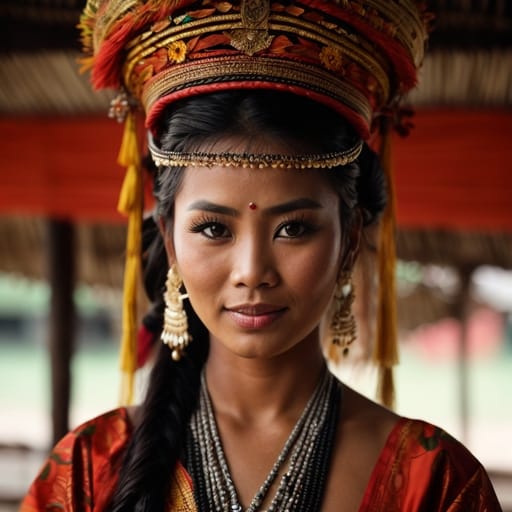
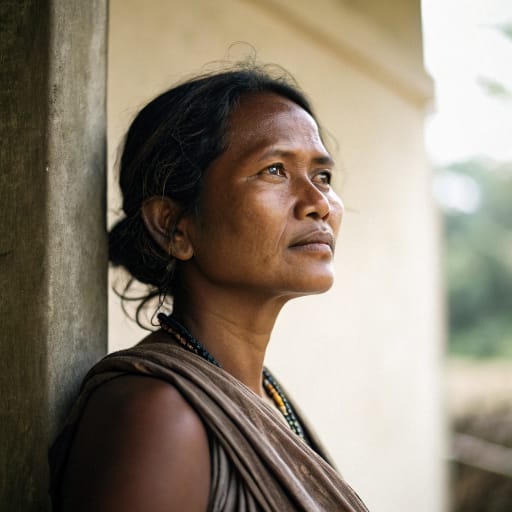
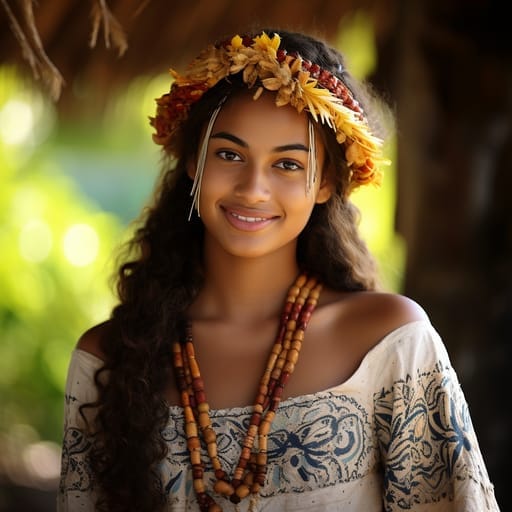
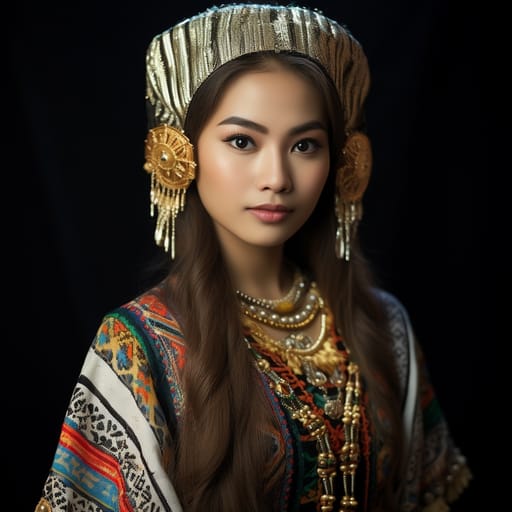
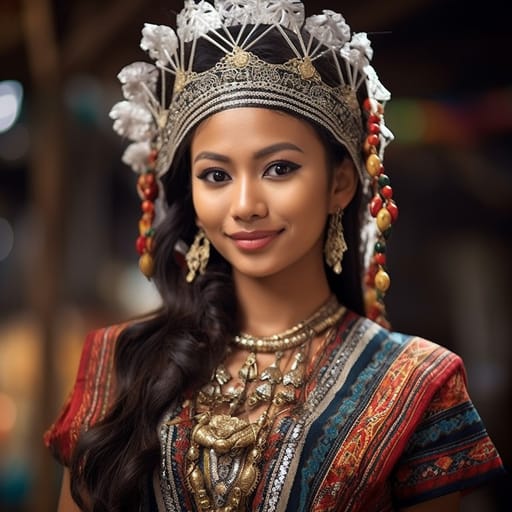
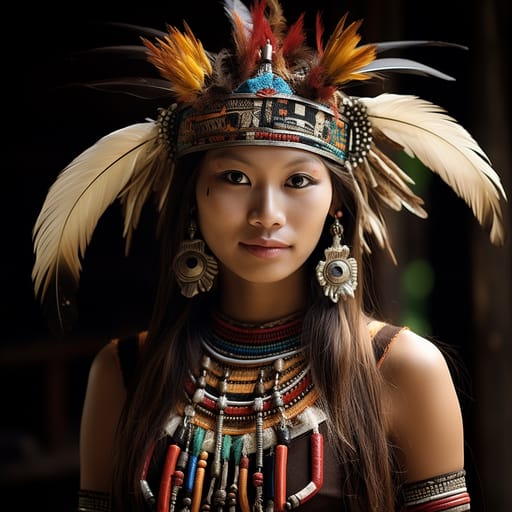
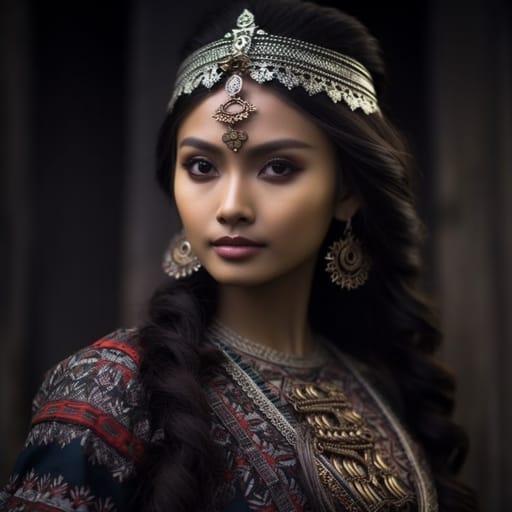
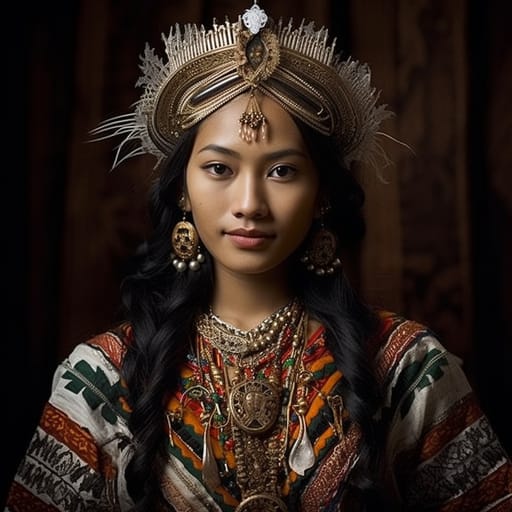
Typical Minahasan Phenotypes
Reference for AI generation: hair, eyes, skin, facial structure, build
The Minahasan are a Christianized highland Austronesian population from the northern tip of Sulawesi, and their phenotype sits noticeably apart from most of western Indonesia. Compared to Javanese or Sundanese neighbors, Minahasans skew lighter-skinned, sharper-featured, and visibly mixed with both Filipino and Dutch colonial ancestry — a result of three centuries of intermarriage with VOC settlers and missionaries.
Hair is typically straight to gently wavy, jet black to dark brown, with a fine to medium texture. True curls are uncommon. Greying patterns track Southeast Asian norms — late onset, often glossy salt-and-pepper rather than full white. Eyes range from dark brown to medium brown, with a noticeably softer epicanthic fold than Han Chinese or Javanese populations; the fold is often partial or absent entirely, and double eyelids are common, giving a rounder, more open eye shape than is typical further west in the archipelago. Hazel and lighter eyes appear in individuals with Indo-European admixture.
Skin tone runs Fitzpatrick III to IV — light olive to warm light brown, with golden or pinkish undertones rather than the cooler yellow cast common in mainland East Asian populations. Sun-exposed laborers tan deeply; the urban Manado professional class often reads strikingly fair. Noses are a defining feature: narrower, higher-bridged, and more projected than the broad-alar Malay average, frequently approaching Filipino-mestizo or Eurasian profiles. Lips are medium in fullness, jawlines tend to be defined, and cheekbones are present but less prominent than in northern East Asian phenotypes.
Build is compact and athletic. Stature averages around 162–168 cm for men and 152–158 cm for women — taller than the Indonesian mean. The group is heavily over-represented in Indonesian badminton, football, and tennis (Liliyana Natsir, Greysia Polii, Christopher Rungkat), reflecting wiry, fast-twitch builds with low body fat. Sub-group variation between Tonsea, Tombulu, Tondano, Tontemboan, and Tonsawang is largely linguistic; phenotypic differences are subtle, with coastal Tonsea showing slightly more Filipino influence and inland Tontemboan retaining a more uniformly Austronesian look.
Minahasan Body & Anatomy Reference
Southeast Asian Austronesian / Austroasiatic phenotype: anatomy reference for AI nude generation
Minahasan Boobs & Breasts
Minahasan boobs follow the Southeast Asian Austronesian / Austroasiatic profile: small-to-medium cup, modest projection. Areolar diameter is usually 26-38mm, and the coloring is medium-brown to dark-brown areolar pigmentation against the tan-to-medium-brown skin tone. Breast shape tracks body composition (ectomorph, petite frame, mean adult female BMI 20-23), so Minahasan breasts tend to be firm, modest projection. Expect a forward-set shape, not the fuller South Asian or Polynesian bust.
Minahasan Ass & Hips
Minahasan ass and hip morphology presents as small-to-medium, modest projection, narrower hip profile, distinctly different from the fuller glutes of the Pacific Islander phenotype. The Minahasan pelvic profile shows narrow-to-medium iliac crests, anchored in the Southeast Asian Austronesian / Austroasiatic skeletal pattern. Minahasan butt shots in adult AI imagery should render the small-to-medium, modest projection, narrower hip profile silhouette with the overall build (ectomorph, petite frame) and the fat distribution typical of the Southeast Asian Austronesian / Austroasiatic phenotype.
Minahasan Vagina & Pussy
Minahasan pussy anatomy typically shows medium-brown to dark-brown labial pigmentation. Pubic hair is usually straight-to-wavy fine-to-medium texture. In AI-generated Minahasan nudes, labial color should blend into the tan to medium-brown skin with a gradual transition, and the hair should keep its straight-to-wavy fine-to-medium texture.
Minahasan Dicks & Penis
Penis reference for Minahasan men: regional mean ~11cm erect, moderate girth. Coloring: medium-brown shaft pigmentation. An accurate Minahasan cock in AI imagery matches the surrounding tan to medium-brown skin rather than a generic porn default. Circumcision depends on religion and custom, not ancestry.
Minahasan Body, Curves & Build
The Minahasan figure is generally ectomorph, petite frame, with mean adult female BMI 20-23, characteristic of Southeast Asian Austronesian / Austroasiatic ancestry. AI image tools tend to flatten regional body types into a few stock shapes; here the Minahasan build is kept as its own reference.
Minahasan Skin Tone & Hair Texture
Skin: tan to medium-brown (Fitzpatrick III-V). Hair: straight-to-wavy 1A-2A, dark-brown to black. Both are typical of Southeast Asian Austronesian / Austroasiatic ancestry. The most common mistake in AI nudes of Minahasan women is a body rendered lighter than the face.
Data depth
0/100Coverage of image-grounded phenotype observations · drives AI generation diversity
- Sample size
- 0/40· 0 images
- Image quality
- 0/30· 0% high
- Confidence
- 0/20
- Source diversity
- 0/10
- ·No image observations yet
Explore phenotype categories
Structured taxonomy with peer-reviewed scales · 22 anatomical categories
Notable Minahasan People
100 reference figures, sourced from Wikipedia
- Arie Frederik Lasut, Indonesian national hero, co-founder of Indonesia's first Mining and Geologic…
- Frits Bernhard Mewengkang, academic and bureaucrat, dean of the University of Indonesia's engineering fa…
- Marie Thomas, first Indonesian female physician, first Indonesian specialist in obstetrics …
- W. A. F. J. Tumbelaka, physician, academician, and former acting rector of the University of Indones…
- Anna Adeline Warouw, second Indonesian female physician, specialist in otorhinolaryngology
- Rocky Gerung, political commentator, philosopher, academic and public intellectual
- Maria Walanda Maramis, Indonesian national hero, pioneer of women's rights in Indonesia
- Zus Ratulangi, psychiatrist, pediatrician, politician, and independence activist. Daughter o…
- Dora Marie Sigar, nurse, activist, and homemaker. Mother of Prabowo Subianto
- Johanna Tumbuan, pioneering figure in Indonesian independence, lecturer at the University of I…
- Benny Dollo, football coach
- Mees Hilgers, footballer
- Cisita Joity Jansen, badminton player
- Jones Ralfy Jansen, badminton player
- Lany Kaligis, tennis player
- Winny Oktavina Kandow, badminton player
- Mahadirga Lasut, footballer
- Flandy Limpele, badminton player, bronze medalist at the 2004 Summer Olympics in Athens, Greece
- Deyana Lomban, badminton player
- Fernando Lumain, sprinter
- Septi Mende, tennis player
- Erents Alberth Mangindaan, football manager
- Liliyana Natsir, badminton player, gold medalist at the 2016 Summer Olympics in Rio, Brazil
- Michael Orah, footballer
- Gianluca Pandeynuwu, footballer
- Jendri Pitoy, footballer
- Greysia Polii, badminton player, gold medalist at the 2020 Summer Olympics in Tokyo, Japan
- Natalia Christine Poluakan, badminton player
- Lius Pongoh, badminton player and coach
- Yeremia Rambitan, badminton player
- Fictor Gideon Roring, basketball coach
- Jessy Rompies, tennis player
- Ferry Rotinsulu, footballer
- Ikhsan Rumbay, badminton player
- Christopher Rungkat, tennis player
- Eksel Runtukahu, footballer
- Michael Soeoth, footballer
- Youbel Sondakh, basketball player
- Delton Stevano, footballer
- Zachariah Josiahno Sumanti, badminton player
- Ezra Walian, footballer
- Donald Wailan-Walalangi, tennis player
- Daniel Wenas, basketball player
- Max Arie Wotulo, chess player
- Sunaryati Hartono, attorney, lawyer, professor of law and government official
- Ani Abbas Manopo, first Indonesian female lawyer
- Jan Samuel Maringka, prosecutor
- F. D. J. Pangemanan, author of Tjerita Si Tjonat
- Hashim Djojohadikusumo, entrepreneur and politician
- Peter F. Gontha, Indonesian commercial television pioneer, founder of RCTI
- Reyn Altin Johannes Lumenta, former president and CEO of Garuda Indonesia
- Gita Wirjawan, entrepreneur, ex-investment banker, music and film producer, podcaster, and f…
- Kristania Virginia Besouw, Miss Indonesia 2006
- Adinda Cresheilla, Puteri Indonesia Pariwisata 2022, 3rd runner-up Miss Supranational 2022
- Anneth Delliecia (Kalengkongan), singer and songwriter
- Julie Estelle, actress and model
- Audy Item, pop and rock singer
- Davina Karamoy, actress and singer
- Angel Karamoy, pop singer and actress
- Monica Khonado, tv host and model
- Annie Landouw, singer and actress
- Marcellino Lefrandt, actor and lecturer
- Pinkan Mambo, pop and R&B singer
- Dougy Mandagi, singer, vocalist of The Temper Trap
- Mimi Mariani, actress, model, and singer
- Maria Menado, Malaysian actress
- Alice Norin, model and actress
- Vina Panduwinata, singer and actress
- Randy Pangalila, actor and singer
- Pance Pondaag, singer and songwriter
- Mona Ratuliu, actress and presenter
- Jolene Marie Rotinsulu, Puteri Indonesia Lingkungan 2019
- Safira Rumimper, model and beauty pageant titleholder
- Paula Rumokoy, actress, model, and dancer
- Januarisman Runtuwene, musician and singer-songwriter, Indonesian Idol (season 5) winner
- Ririn Setyarini, actress and politician
- Alyssa Soebandono, actress, model and singer
- James F. Sundah, songwriter
- Remy Sylado, author, actor, and musician
- Kezia Warouw, Puteri Indonesia 2016, Miss Universe 2016 top 13 semifinalist
- Stefan William, actor and singer (half-American)
- Brando Windah, YouTuber
- Rudy Wowor, dancer and actor
- Angga Dwimas Sasongko, film director
- Monty Tiwa, film director
- Sabrina Rochelle Kalangie, film director
- Wim Umboh, film director
- Alex Mendur, co-founder of the Indonesian Press Photo Service (IPPHOS), photographer of ic…
- Frans Mendur, co-founder of the Indonesian Press Photo Service (IPPHOS), photographer of Su…
- Alexander Evert Kawilarang, commander of the Siliwangi Division
- Willy Ghayus Alexander Lasut, governor of North Sulawesi
- Adolf Gustaaf Lembong, commander of 16th Division
- Jeanne Mandagi, first Indonesian woman to become a general in the Indonesian National Police
- Gustaf Hendrik Mantik, commander of Kodam IX/Mulawarman and Kodam Jaya, governor of North Sulawesi
- Elias Daniel (Daan) Mogot, first director of the Tangerang Military Academy
- Robert Wolter Mongisidi, Indonesian national hero
- Herman Nicolas Ventje Sumual, leader of Permesta movement
- Pierre Andries Tendean, Indonesian revolutionary hero
- Frits Johanes (Broer) Tumbelaka, first governor of North Sulawesi, brokered peace between the Indonesian gover…
- Jacob Frederick (Joop) Warouw, commander of TT-VII/Indonesia Timur, leader of Permesta movement
Erotic Poses & Sex Positions
From the pose catalog: 219 named positions with reference skeletons
Frequently asked questions about Minahasan people
Where is the Minahasan homeland?
The Minahasan homeland is Minahassa Peninsula (Indonesia) in Southeast Asia.
What language do Minahasan people speak?
Minahasan people primarily speak Austronesian / Philippine / Minahasan.
What religion do Minahasan people practice?
The predominant religion among Minahasan people is Christianity / Protestantism.






Make your own Minahasan images
Five a day, free, no credits to buy. The studio starts from this group's phenotype data, so you can set body type, pose and style and keep the traits accurate.
Start with Minahasan