Help us get this right
Does this portrait look right for Karagounides?
Nobody has judged this one yet. You would be the first.
Karagounides Erotic
The Thessalian plain in central Greece, above all the western plain around Karditsa and Trikala, extending toward Larissa
Greek, Thessalian variety of the Northern Greek dialects (Indo-European, Hellenic)
Greek Orthodox Christianity, with village life organized around saints' feasts and name days
A regional subgroup of the Greeks, historically set apart as settled farmers of the plain, unlike the Sarakatsani and Aromanian herders who shared Thessaly
About Karagounides People
The Karagounides are the plain people of Thessaly. They are Greek-speaking Orthodox farmers, and what makes them a group is the broad lowland at the center of the Greek mainland, not a separate language or faith. Their heartland is the western plain around Karditsa and Trikala, flat wheat and cotton country that runs right up to the foot of the Pindus. The name is usually explained as black cloak, from Turkish kara, black, and the dark wool outer garment the men once wore. People disagree about where the group came from before that, and the theories point in several directions. The Karagounides themselves have long seen themselves simply as Greeks with a strong regional identity.
Part of that identity came from contrast with their neighbors. Every winter, Sarakatsani and Aromanian shepherds drove their flocks down from the mountains onto the Thessalian lowland. The Karagounides were the ones who stayed put, tied to villages and fields. They speak Thessalian Greek, one of the northern dialects that drop unstressed vowels, so it sounds clipped to someone from Athens or the islands. The church calendar still shapes the year, with name days and the feast of each village's patron saint. At those feasts people dance the Karagouna, the circle dance named for them. It opens at a slow, steady pace and then breaks into quick, springing steps, and it is now danced at weddings all over Greece.
The defining chapter of their modern history is about land. Under Ottoman rule most Karagounides were sharecroppers on large estates called tsiflikia. When Thessaly passed to Greece in 1881, the estates were not broken up. Wealthy Greek buyers took them over, and the families who worked them stayed tenants. The anger came to a head in March 1910 at Kileler, near Larissa. Peasants on their way to a protest clashed with the authorities, and several were killed. Kileler is still commemorated, and over the following decades land redistribution finally turned sharecroppers into owners of small farms.
Today most Karagounides live as ordinary Greeks in villages, market towns and cities. The traditional costume lives on through dance groups and festivals. For women it means a white chemise with dense embroidery at the hem, a sleeveless wool overcoat, an apron, a headscarf and heavy silver jewelry. The plain still shapes their lives. When Storm Daniel flooded the Karditsa and Larissa lowlands in 2023, it struck the Karagouni heartland directly.
Related ethnic groups
Groups that share Karagounides's homeland, region, language, or religious tradition. These are likely candidates for comparative phenotype reference.
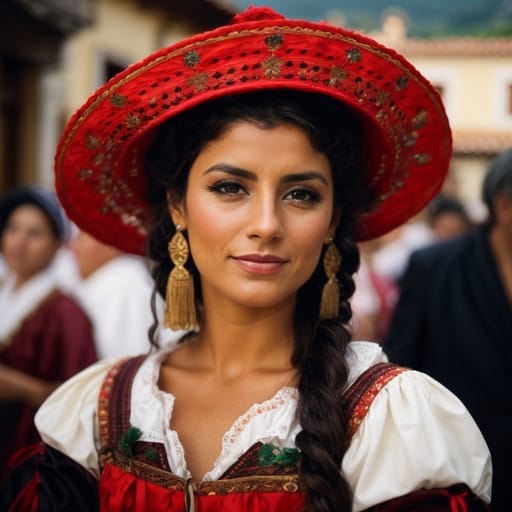
Basques
same region (Southern Europe)
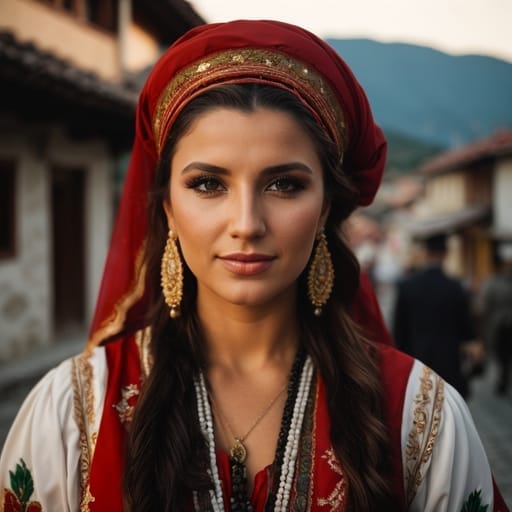
Bosniaks
same region (Southern Europe)
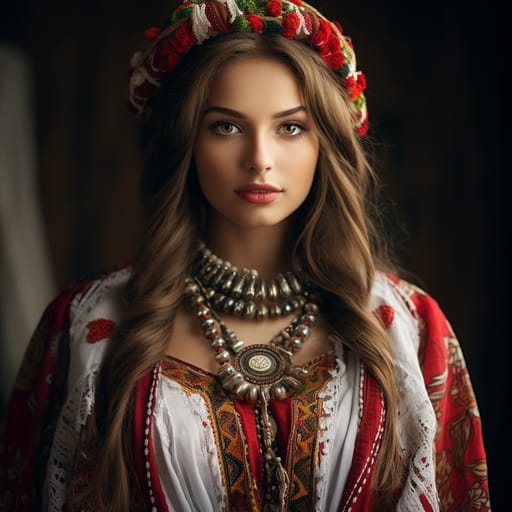
Moldovans
same region (Southern Europe)
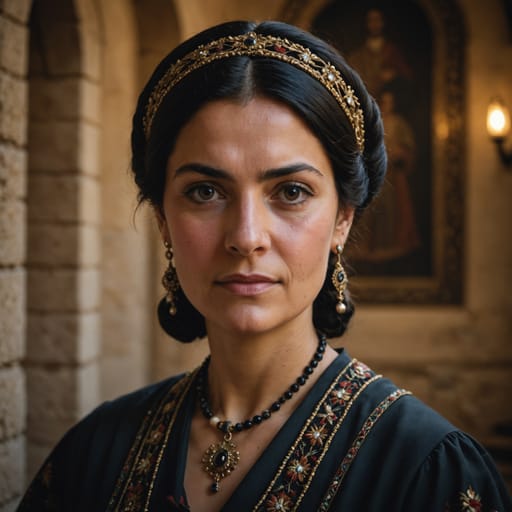
Maltese
same region (Southern Europe)
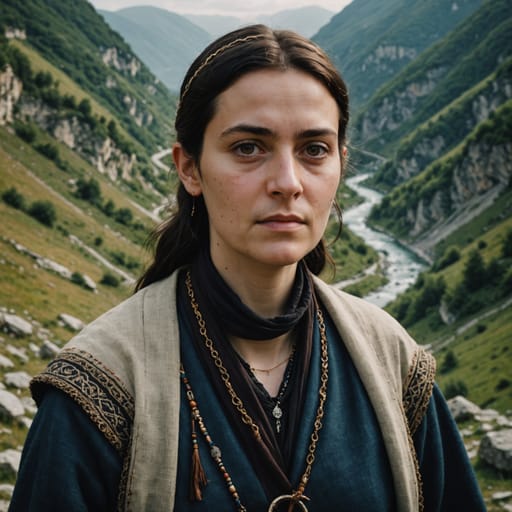
Shkreli
same region (Southern Europe)
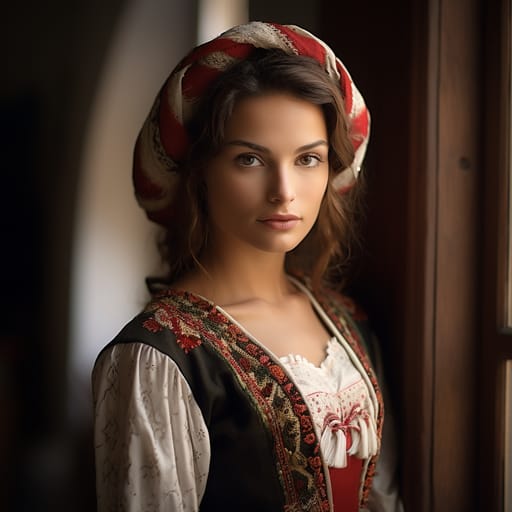
Friulians
same region (Southern Europe)
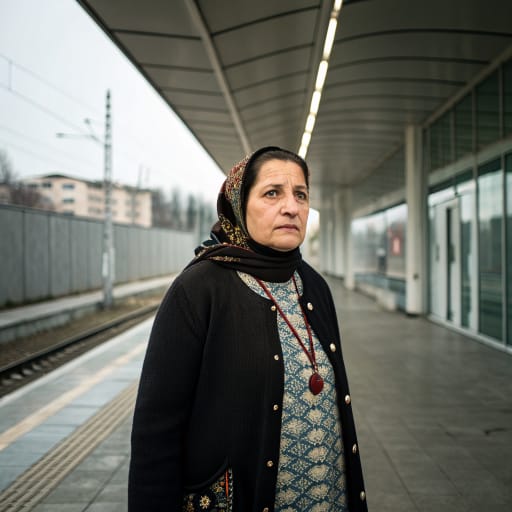
Megleno-Romanians
same region (Southern Europe)
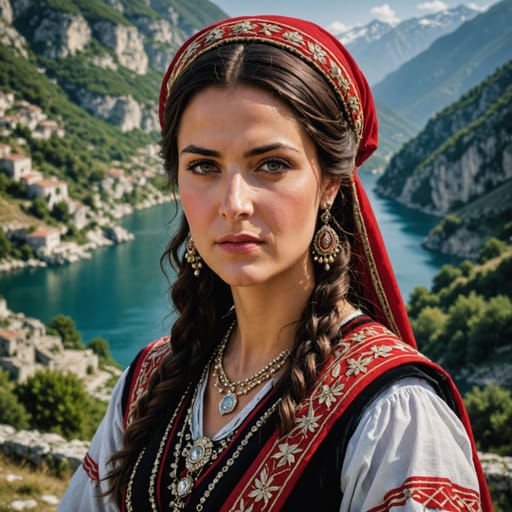
Albanian Greek
same region (Southern Europe)
Typical Karagounides Phenotypes
Reference for AI generation: hair, eyes, skin, facial structure, build
Karagounides Body & Anatomy Reference
Southern European / Mediterranean phenotype: anatomy reference for AI nude generation
Karagounides Boobs & Breasts
Bust reference for Karagounides women: medium-to-large cup, full, moderate-to-high projection, which is typical of Southern European / Mediterranean ancestry. Areolas measure about 32-46mm across, with medium-brown to dark-brown pigmentation. Body type (mesomorph with full hip-and-bust deposition) shapes the bust as well, so Karagounides tits are usually full and projecting, generally the classic Mediterranean curvy bust profile. In AI imagery, keep the forward-set shape rather than drifting toward the lighter pigmentation of the Northern European bust.
Karagounides Ass & Hips
The Karagounides ass is typically medium-to-full, moderate-to-high projection, broader hip profile, which sets it apart from the slim Northern European narrow-hip pattern. Underneath, the pelvis shows medium-to-wide iliac crests, full gluteal-femoral fat distribution, part of the Southern European / Mediterranean skeletal pattern. For Karagounides butt pics and AI renders, match that silhouette and the overall build (mesomorph with full hip-and-bust deposition).
Karagounides Vagina & Pussy
Karagounides pussy and vulvar anatomy presents medium-brown to dark-brown labial pigmentation, fuller labia minora, consistent with the Southern European / Mediterranean phenotype's pigmentation pattern. Karagounides pubic hair is typically wavy-to-curly medium-coarse dark texture, dense distribution, in the inverted-triangle pattern. For anatomically accurate Karagounides pussy renders the labial coloration should match the surrounding olive to medium skin tone with a continuous gradient, and the hair should keep its wavy-to-curly medium-coarse dark texture.
Karagounides Dicks & Penis
Karagounides dicks follow the Southern European / Mediterranean reference data: regional mean ~13-14cm erect; moderate girth; medium-brown shaft pigmentation. Shaft color should track the olive to medium skin tone with a smooth change toward the glans, and Karagounides pubic hair keeps its wavy-to-curly medium-coarse dark texture.
Karagounides Body, Curves & Build
Karagounides body type and overall build presents as mesomorph with full hip-and-bust deposition, with mean adult female BMI 24-28: the characteristic Southern European / Mediterranean habitus. Karagounides curves and proportions should keep the regional skeletal frame (height, shoulder-to-hip ratio, limb proportions) rather than a generic mesomorph default.
Karagounides Skin Tone & Hair Texture
Karagounides skin sits in the olive to medium (Fitzpatrick III-IV) band. Hair is typically wavy-to-curly 2B-3B, dark-brown to black, in keeping with the Southern European / Mediterranean phenotype. In nude renders the skin should stay one even tone from face to body, and body, pubic and head hair should match.
Explore phenotype categories
Structured taxonomy with peer-reviewed scales · 22 anatomical categories
Erotic Poses & Sex Positions
From the pose catalog: 219 named positions with reference skeletons
Frequently asked questions about Karagounides people
Where is the Karagounides homeland?
The Karagounides homeland is The Thessalian plain in central Greece, above all the western plain around Karditsa and Trikala, extending toward Larissa in Southern Europe.
What language do Karagounides people speak?
Karagounides people primarily speak Greek, Thessalian variety of the Northern Greek dialects (Indo-European, Hellenic).
What religion do Karagounides people practice?
The predominant religion among Karagounides people is Greek Orthodox Christianity, with village life organized around saints' feasts and name days.






Make your own Karagounides images
Five a day, free, no credits to buy. The studio starts from this group's phenotype data, so you can set body type, pose and style and keep the traits accurate.
Start with Karagounides