Help us get this right
Does this portrait look right for Inga?
Nobody has judged this one yet. You would be the first.
Inga Erotic
Southwestern Colombia: the Sibundoy Valley and lowlands of Putumayo, Aponte in Nariño, and parts of Caquetá, with urban communities in Bogotá and other cities.
Inga Kichwa, with highland and jungle varieties (Quechuan, Northern Quechua); Spanish (Indo-European) is widely spoken as a second language.
Roman Catholic, alongside Indigenous healing traditions centered on yagé (ayahuasca) and medicinal plants.
Highland Inga of the Sibundoy Valley and Aponte; lowland or jungle Inga of Putumayo and Caquetá; urban Inga communities. Part of the wider Quechua-speaking world of the northern Andes.
About Inga People
The Inga are the northernmost speakers of Quechua, the language family most associated with the Inca, and they live where few would expect to find it: in the mountains and foothills of southwestern Colombia. Their language, Inga Kichwa, is closely related to the Kichwa spoken across the border in Ecuador. It sets them apart from neighbors who speak Spanish or unrelated Indigenous languages. How Quechua got this far north is still debated. Some researchers link the Inga to settlers the Inca placed on their northern frontier. Others point to trade routes and colonial missions that used Quechua as a common tongue.
Their heartland is the Sibundoy Valley in Putumayo, a cool, high basin where the Andes start their descent toward the Amazon. The Inga share the valley with the Kamëntšá, whose language has no known relatives. The two peoples have lived side by side for generations, trading and intermarrying, and each keeps its own carnival before Lent. Other Inga communities hold land at Aponte in the mountains of Nariño. Still others live downslope in the rainforest of lowland Putumayo and Caquetá, where people speak a distinct jungle dialect. There are also sizable groups in Bogotá and other Colombian cities.
The twentieth century hit the valley hard. Capuchin missionaries arrived in the early 1900s, took control of much of the land and ran the schools in Spanish. Winning back territory has shaped Inga politics ever since. Today communities organize through resguardos and cabildos, the collective land titles and elected councils recognized under Colombian law.
Catholicism is the formal faith, but much of daily life runs through knowledge of plants. Inga taitas, the healers and ritual specialists, are among the best known practitioners of yagé. This is the ayahuasca brew taken in night ceremonies for healing and guidance, and Inga taitas have helped organize Indigenous healers across the Colombian Amazon. Inga herbalists have also long traveled far from home, selling roots, barks and remedies in city markets across Colombia and in neighboring countries. In Santiago, the festival of Atun Puncha, the Great Day, comes just before Lent, placing an Indigenous celebration inside the Catholic calendar.
Weaving has its own vocabulary. The chumbe is a long, narrow sash wound tightly around the waist. Its geometric motifs have names and meanings that weavers pass down through the generations. Layered strands of glass beads are still a familiar part of festival and ceremonial dress.
Related ethnic groups
Groups that share Inga's homeland, region, language, or religious tradition. These are likely candidates for comparative phenotype reference.
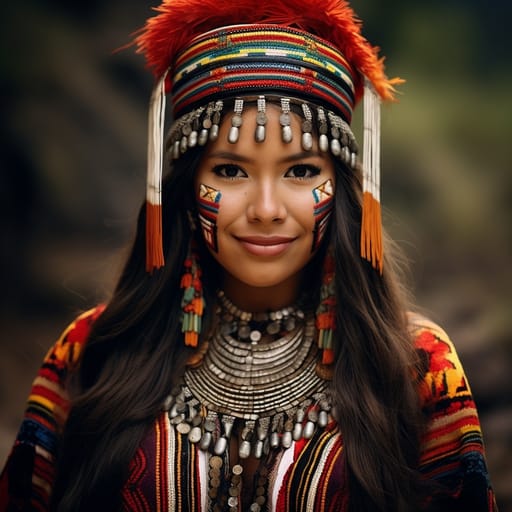
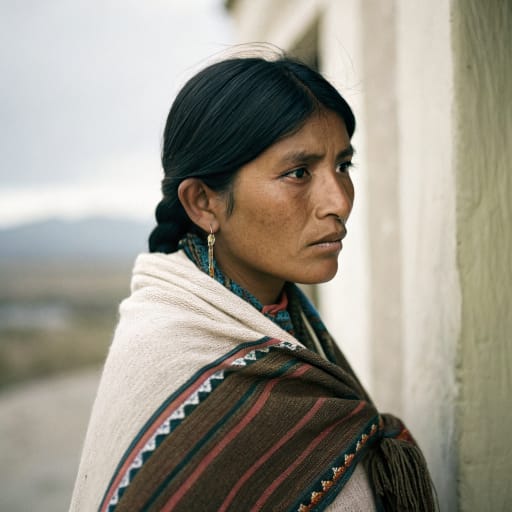
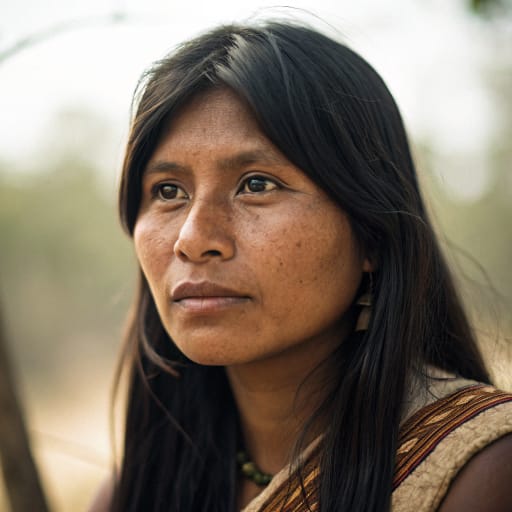
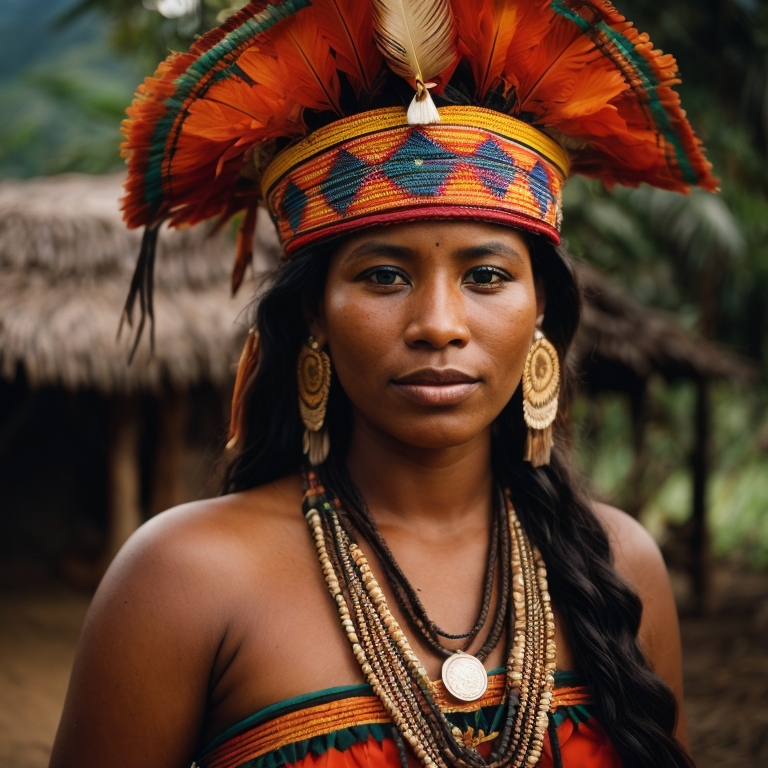
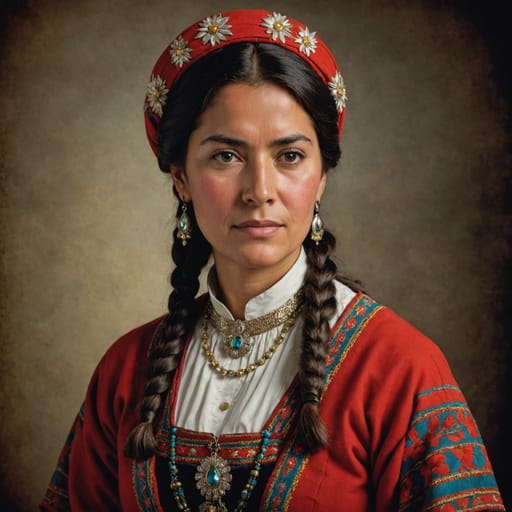
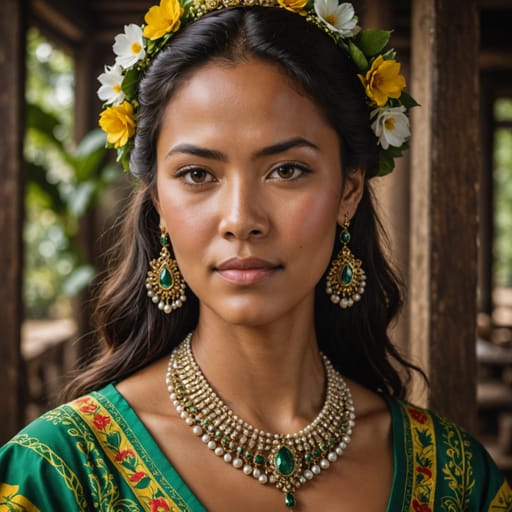
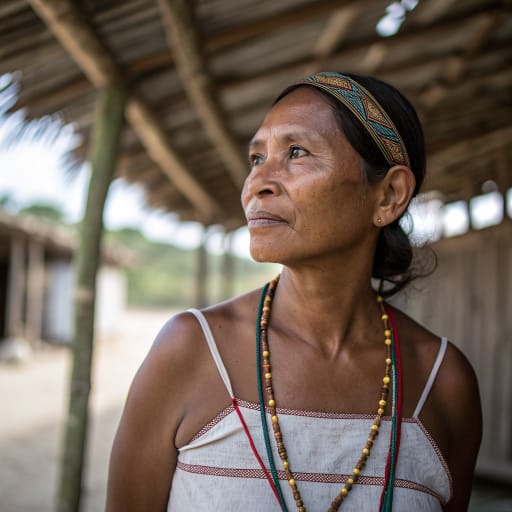
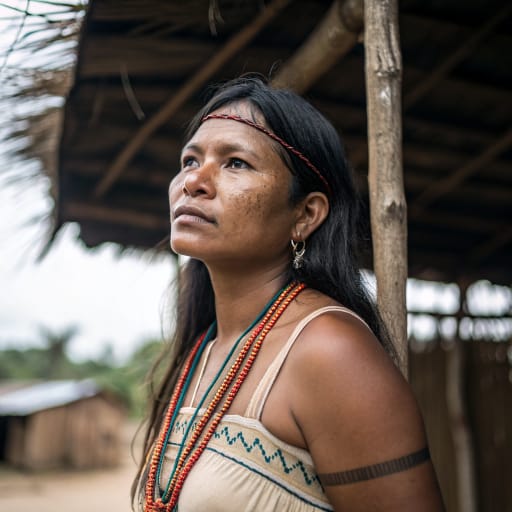
Typical Inga Phenotypes
Reference for AI generation: hair, eyes, skin, facial structure, build
Inga Body & Anatomy Reference
Per-feature anatomical profile for AI nude generation: South American Indigenous / European-Mestizo / Afro-Latino mix phenotype
Inga Boobs & Breasts
The typical Inga bust is medium-to-large cup, full, high projection, in line with the wider South American Indigenous / European-Mestizo / Afro-Latino mix pattern. Areolas usually fall in the 32-46mm range, with medium-brown to dark-brown areolar pigmentation against the tan-to-deep-brown skin tone. Compared with the smaller bust profile of Andean Indigenous sub-populations, Inga breasts sit forward and are generally the classic Brazilian / Latina curvy bust profile in lowland populations; smaller and shorter-set in Andean Indigenous populations. A faithful AI render of Inga tits keeps that shape and areola size.
Inga Ass & Hips
Butt shape among Inga women: full, high projection, the famous Brazilian / Latina bunda profile, over wide iliac crests, very full gluteal-femoral fat deposition (the hallmark Brazilian / Latina hip-to-waist ratio). This follows South American Indigenous / European-Mestizo / Afro-Latino mix ancestry and looks quite unlike the slim narrow-hip East Asian profile. An accurate Inga ass in adult AI imagery keeps both the silhouette and the overall build (endomorph-to-mesomorph with high gluteal-femoral deposition) instead of a generic average.
Inga Vagina & Pussy
Vulvar anatomy among Inga women: medium-brown to dark-brown labial pigmentation, fuller labia minora. Pubic hair tends to be wavy-to-curly coarse dark texture, dense distribution, in the usual inverted-triangle pattern. Both follow South American Indigenous / European-Mestizo / Afro-Latino mix pigmentation, which is why Inga pussy renders should not fall back on a pale, sparse Western template.
Inga Dicks & Penis
The Inga cock profile, from South American Indigenous / European-Mestizo / Afro-Latino mix anthropometric data: regional mean ~13cm erect; moderate-to-above-average girth; medium-brown shaft pigmentation. Pubic hair has a wavy-to-curly coarse dark texture and forms the usual inverted-V pattern. Whether Inga men are circumcised follows religious and cultural practice rather than phenotype.
Inga Body, Curves & Build
Build and curves among Inga women follow the South American Indigenous / European-Mestizo / Afro-Latino mix pattern: endomorph-to-mesomorph with high gluteal-femoral deposition, mean adult female BMI 25-28. Proportions matter as much as skin tone, so Inga figures should keep their regional height and limb ratios.
Inga Skin Tone & Hair Texture
The Inga skin range is tan to deep-brown (Fitzpatrick III-VI), and hair tends to be straight-to-curly 1A-3C, varies widely by ancestral composition. That combination marks the South American Indigenous / European-Mestizo / Afro-Latino mix phenotype, and skin tone is the trait AI generators most often get wrong for Inga women.
Explore phenotype categories
Structured taxonomy with peer-reviewed scales · 22 anatomical categories
Erotic Poses & Sex Positions
From the pose catalog: 219 named positions with reference skeletons
Frequently asked questions about Inga people
Where is the Inga homeland?
The Inga homeland is Southwestern Colombia: the Sibundoy Valley and lowlands of Putumayo, Aponte in Nariño, and parts of Caquetá, with urban communities in Bogotá and other cities. in South America.
What language do Inga people speak?
Inga people primarily speak Inga Kichwa, with highland and jungle varieties (Quechuan, Northern Quechua); Spanish (Indo-European) is widely spoken as a second language..
What religion do Inga people practice?
The predominant religion among Inga people is Roman Catholic, alongside Indigenous healing traditions centered on yagé (ayahuasca) and medicinal plants..






Make your own Inga images
Five a day, free, no credits to buy. The studio starts from this group's phenotype data, so you can set body type, pose and style and keep the traits accurate.
Start with Inga