Help us get this right
Does this portrait look right for Ekoi?
One tap. It takes a second and it is recorded.
1 says it looks right, 0 say it looks off.
Ekoi Erotic
Christianity
About Ekoi People
The Ekoi — known to themselves and their neighbors as the Ejagham — live along the forested border country between southeastern Nigeria's Cross River State and southwestern Cameroon. The land is hilly, drenched, riverine; it shapes a people who built villages around clearings and treated the surrounding forest as both larder and archive. Estimates put their numbers somewhere around 180,000 across the two countries, with Nigerian Ejagham concentrated around Ikom and Etung and Cameroonian communities scattered through the Manyu Division.
Their language, Ejagham, belongs to the Ekoid branch of the Bantoid sub-family within Niger–Congo, and sits at the linguistic seam where Bantu-speaking Africa shades into the older non-Bantu languages of the Cross River basin. Linguists treat Ekoid as a useful key to that transition — close enough to Bantu to illuminate it, distinct enough to predate it. Most Ejagham today are Christian, the result of long missionary contact through Calabar and Mamfe, though the older ritual world has not so much vanished as folded itself into the background of village life.
The Ekoi are best known to outsiders for two things, and both are worth mentioning because they sit at the center of how the group sees itself. The first is nsibidi, an indigenous system of ideographic signs developed before European contact and used to communicate ideas, mark social roles, record judgments, and inscribe ritual meaning. Nsibidi appears on calabashes, on textiles, on the body, on the walls of meeting houses; some signs are public, others restricted to initiates. It is one of the few sub-Saharan writing-adjacent systems whose origin lies entirely outside the Arabic and Latin orbits. The second is the skin-covered headdress and helmet mask, carved in wood and stretched with antelope hide, with such convincing realism that nineteenth-century European collectors initially refused to believe the faces were not human. These masks belong to the men's society Ekpe (or Mgbe, depending on dialect), a graded association that historically functioned as a governing and judicial body across the Cross River region and which still administers ceremonial life in many communities.
Ejagham social organization is patrilineal but layered with title societies open to both sexes, and the village council — rather than any chiefly figure — has traditionally held authority. The colonial border that cut their homeland in two has never quite cut the Ejagham in two; kinship, trade, and Ekpe lodges still move freely across it.
Related ethnic groups
Groups that share Ekoi's homeland, region, language, or religious tradition. These are likely candidates for comparative phenotype reference.
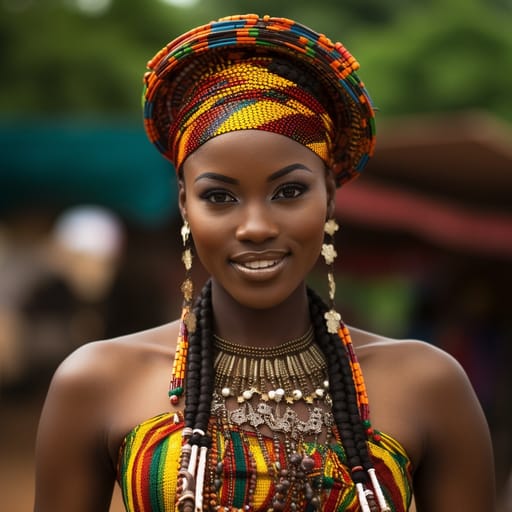
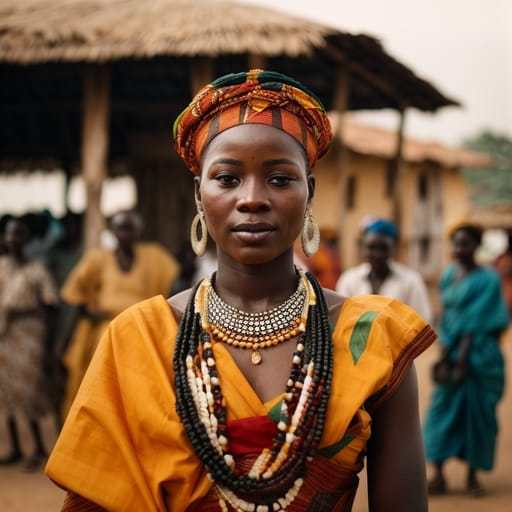
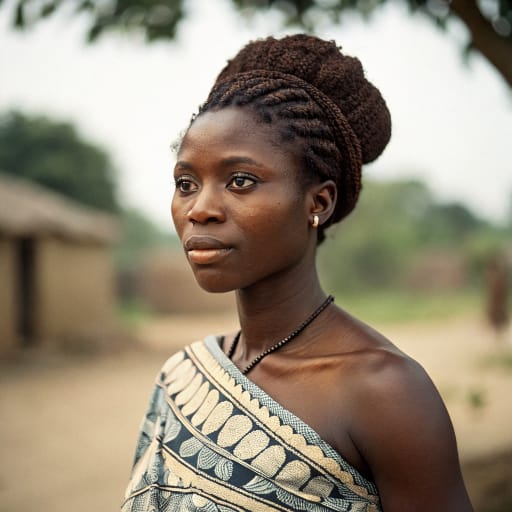
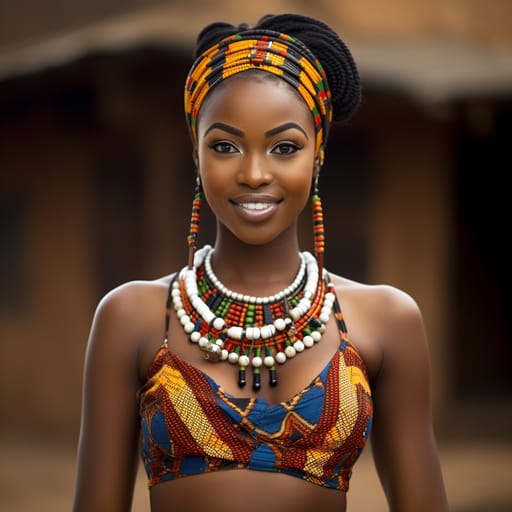
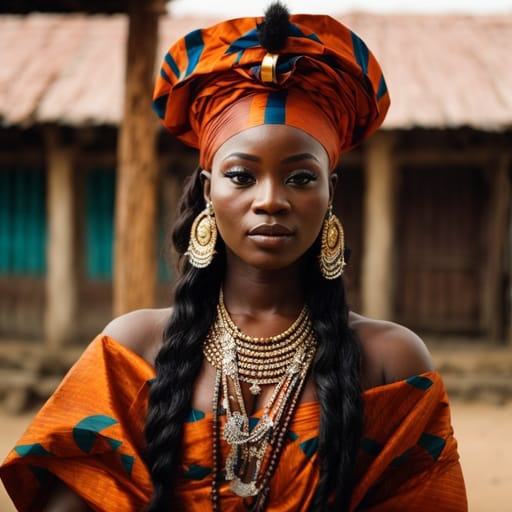

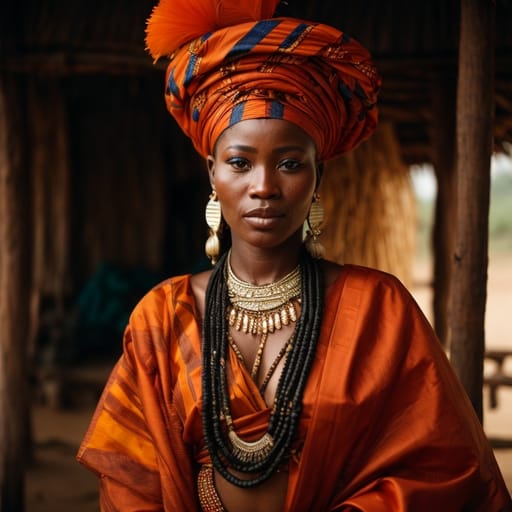
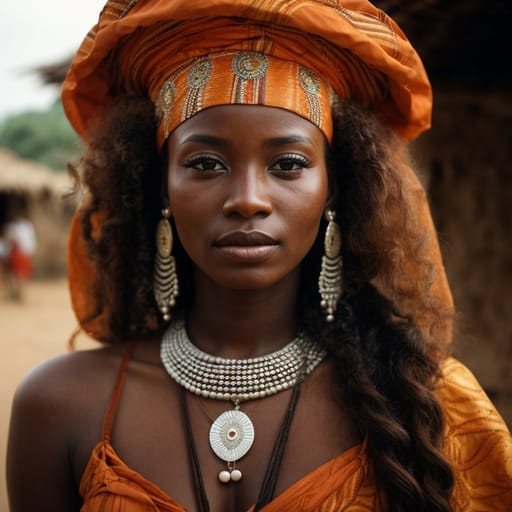
Typical Ekoi Phenotypes
Reference for AI generation: hair, eyes, skin, facial structure, build
The Ekoi (also Ejagham) inhabit the Cross River basin straddling southeastern Nigeria and southwestern Cameroon, and their phenotype reflects the broader Cross River cluster of West-Central African populations — distinct from the Yoruba-Igbo majority to their west and from the Bantu groups expanding from the south. The most structurally distinctive feature is a combination of strong midfacial projection with relatively narrow, well-defined facial proportions compared to neighboring forest groups, which is part of why Ekoi-carved skin-covered headdresses became famous for their unusually naturalistic human features.
Hair is uniformly Type 4 — tightly coiled, ranging from springy 4A to dense 4C — with jet-black pigmentation; graying tends to come late and concentrate at the temples. Eyes are dark brown to near-black, almond-shaped, with no epicanthic fold and a cleanly defined upper lid crease. Skin spans Fitzpatrick V to VI, sitting in the deep brown to dark brown range with warm red-brown or olive undertones rather than the bluish-black common further south; sustained equatorial sun exposure in farming and riverine work keeps tones at the darker end of an individual's natural range.
Noses tend toward medium to broad alar width with a low-to-medium bridge, though the tip is often more refined than in neighboring groups, and a defined philtrum is common. Lips are full top and bottom with clear vermilion borders, and the lower lip frequently carries more volume than the upper. Cheekbones are moderately broad and set high, and jawlines run from softly rounded in women to squared in men, with strong gonial angles.
Build is medium — adult men typically 168–175 cm, women 156–163 cm — leaner than the West African coastal average, with long limbs relative to torso, narrow hips in men, and a tendency toward mesomorph muscle distribution. Subgroup variation across the Ejagham, Keaka, Obang, and Etung clusters is mostly cultural; phenotype differences are subtle, with the Cameroonian-side communities sometimes showing slightly broader facial features from gene flow with neighboring Bantu populations.
Ekoi Body & Anatomy Reference
Anatomy by feature, West African Niger-Congo phenotype
Ekoi Boobs & Breasts
Ekoi boobs follow the West African Niger-Congo profile: medium-to-large cup, full, projecting. Areolar diameter is usually 35-50mm, and the coloring is deep-brown to near-black areolar pigmentation against the medium-to-deep-brown skin tone. Breast shape tracks body composition (mesomorph with strong gluteal-femoral fat distribution, mean adult female BMI 24-27), so Ekoi breasts tend to be fuller and more projecting than the East African norm. Expect a forward-set shape, not the smaller conical Cushitic East African profile.
Ekoi Ass & Hips
Ekoi ass and hip morphology presents as wide-set, full, heavily projected glutes, distinctly different from the slim narrow-hip Cushitic East African profile. The Ekoi pelvic profile shows wide iliac crests, broad gynoid pelvic pattern, high glute-to-waist ratio, anchored in the West African Niger-Congo skeletal pattern. Ekoi butt shots in adult AI imagery should render the wide-set, full, heavily projected glutes silhouette with the overall build (mesomorph with strong gluteal-femoral fat distribution) and the fat distribution typical of the West African Niger-Congo phenotype.
Ekoi Vagina & Pussy
Ekoi pussy anatomy typically shows deep-brown to near-black labial pigmentation, fuller labia minora. Pubic hair is usually tightly-coiled coarse texture, densely distributed. In AI-generated Ekoi nudes, labial color should blend into the medium-brown to deep-brown skin with a gradual transition, and the hair should keep its tightly-coiled coarse texture.
Ekoi Dicks & Penis
Penis reference for Ekoi men: regional mean ~14-15cm erect, above-average girth, ~13cm circumference. Coloring: deep-brown-to-near-black shaft pigmentation. An accurate Ekoi cock in AI imagery matches the surrounding medium-brown to deep-brown skin rather than a generic porn default. Circumcision depends on religion and custom, not ancestry.
Ekoi Body, Curves & Build
The Ekoi figure is generally mesomorph with strong gluteal-femoral fat distribution, with mean adult female BMI 24-27, characteristic of West African Niger-Congo ancestry. AI image tools tend to flatten regional body types into a few stock shapes; here the Ekoi build is kept as its own reference.
Ekoi Skin Tone & Hair Texture
Skin: medium-brown to deep-brown (Fitzpatrick V-VI). Hair: tight 4A-4C coil, often worn natural, braided, or relaxed. Both are typical of West African Niger-Congo ancestry. The most common mistake in AI nudes of Ekoi women is a body rendered lighter than the face.
Data depth
0/100Coverage of image-grounded phenotype observations · drives AI generation diversity
- Sample size
- 0/40· 0 images
- Image quality
- 0/30· 0% high
- Confidence
- 0/20
- Source diversity
- 0/10
- ·No image observations yet
Explore phenotype categories
Structured taxonomy with peer-reviewed scales · 22 anatomical categories
Erotic Poses & Sex Positions
From the pose catalog: 219 named positions with reference skeletons
Frequently asked questions about Ekoi people
Where is the Ekoi homeland?
The Ekoi homeland is Nigeria, Cameroon in Western Africa.
What language do Ekoi people speak?
Ekoi people primarily speak Niger-Congo / Ekoi.
What religion do Ekoi people practice?
The predominant religion among Ekoi people is Christianity.






Make your own Ekoi images
Five a day, free, no credits to buy. The studio starts from this group's phenotype data, so you can set body type, pose and style and keep the traits accurate.
Start with Ekoi