Diola Erotic
The Casamance region of southern Senegal, with communities in The Gambia and northwestern Guinea-Bissau.
Jola languages, including Fonyi, Kasa and Ejamat (Bak branch of the Atlantic group, Niger-Congo), with Wolof, French, Mandinka and English widely used as second languages.
Islam and Roman Catholicism, alongside the indigenous awasena practice centered on Emitai and shrine spirits. Many families hold more than one at once.
Fonyi, Kasa, Ejamat or Felupe, Karon, Kwatay and Bayot, among others. Part of the wider Bak-speaking cluster that also includes the Manjak and Balanta.
About Diola People
The Diola are the people of the mangrove rice paddy. Their homeland is the Casamance, the strip of southern Senegal below the Gambia, reaching into the Gambia itself and northwest Guinea-Bissau: flat, wet, cut by tidal creeks, and green in a way the rest of Senegal is not. Generations of Diola diked and drained saltwater flats into freshwater paddies, flushing out the salt over years, and they still work them with the kajendou, a long fulcrum shovel a man drives into the ridge and levers up with his whole body. Rice is the measure of a household, the substance of ceremony, and the thing a young man is judged on.
They organized themselves without kings. Authority sat with elders and with the ukin, shrines holding jurisdiction over rain, war, childbirth and disputes, each with its own priest and its own rules. The one figure who resembles a monarch, the king of Oussouye, holds a ritual office rather than a government: chosen by the shrine, dressed in red, hedged with prohibitions, answerable for rain and reconciliation rather than taxes. Religion runs on three tracks that often overlap inside a single family. Islam took hold in the north near Mandinka neighbors, Catholicism is dense around Ziguinchor, and awasena, the older practice centered on Emitai and the shrines, never went away; plenty of baptized Diola still pour palm wine at a boekin. Their languages belong to the Bak branch of the Atlantic family, cousins to Manjak and Balanta, and have drifted far enough apart that a Fonyi speaker and a Kasa speaker will often settle into Wolof or French instead.
Refusing outside authority is an old habit. Portuguese and then French administrators found no chief to co-opt and had to take the lower Casamance village by village, well into the twentieth century. In 1943 Aline Sitoé Diatta, a young woman from Kabrousse who spoke as a prophet, told her people to stop surrendering rice to colonial requisition; the French deported her to Timbuktu, where she died, and Senegal now names things after her. The separatist war that began in 1982 was fought largely in Diola country and cost it decades of mines, displacement and interrupted farming, with settlements only recently holding. The ritual calendar keeps its own time regardless: the bukut, the men's initiation in the sacred forest, may come once in twenty or thirty years, and Diola working in Dakar, Banjul, Paris and Madrid fly home for it. At festivals the Kumpo still appears, a spinning figure covered head to foot in palm fronds with a stake rising from its crown, and no one explains it to you.
Related ethnic groups
Groups that share Diola's homeland, region, language, or religious tradition — likely candidates for comparative phenotype reference.
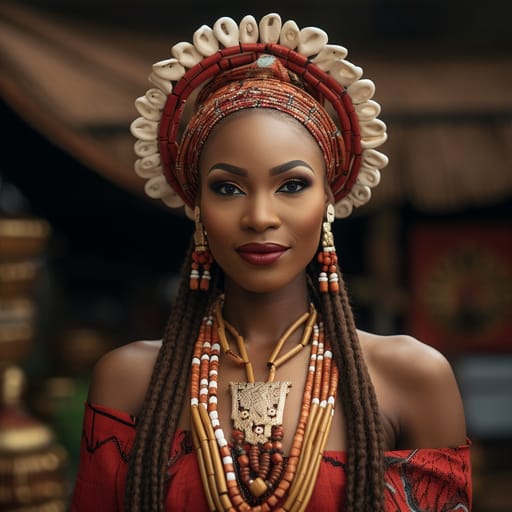
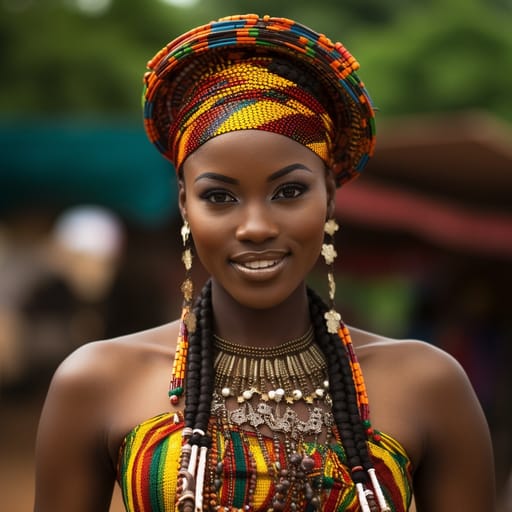
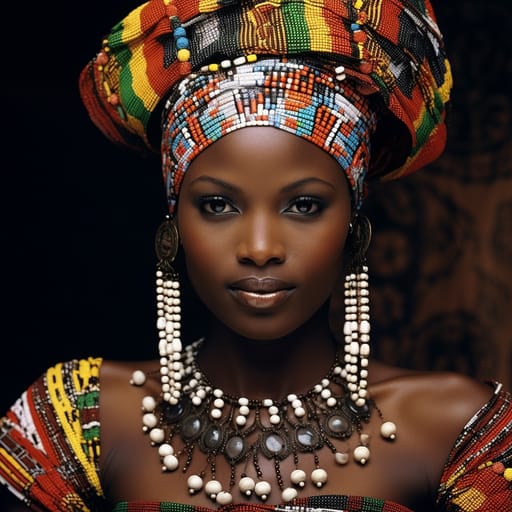
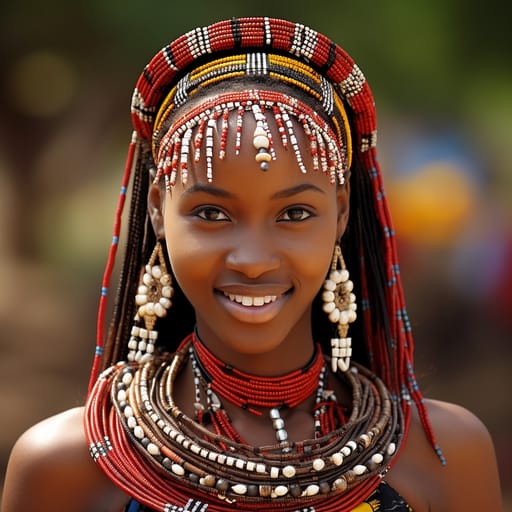
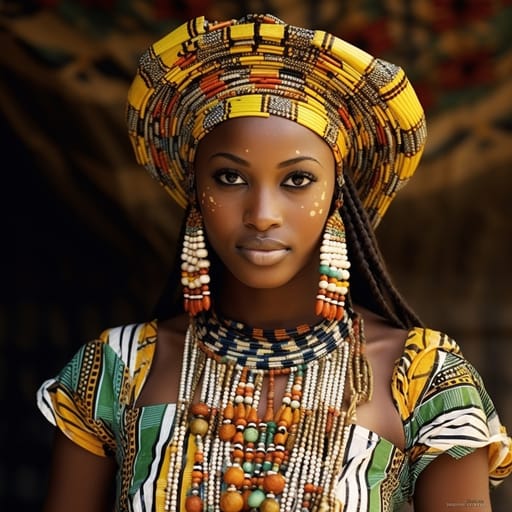
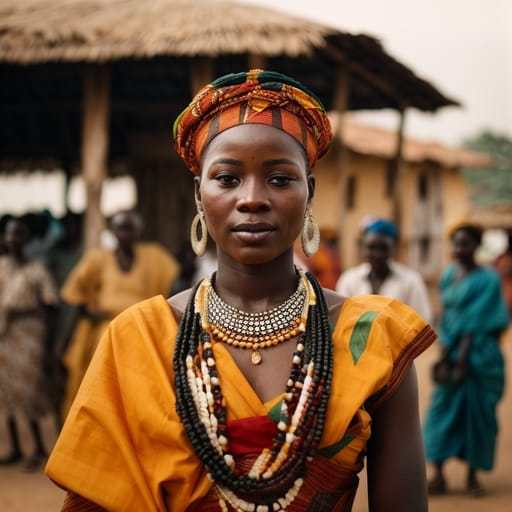
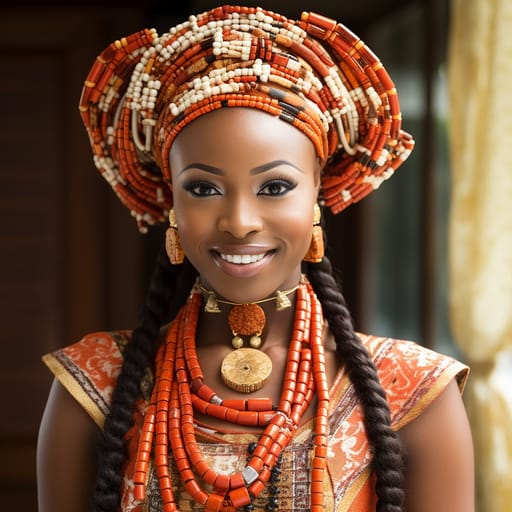
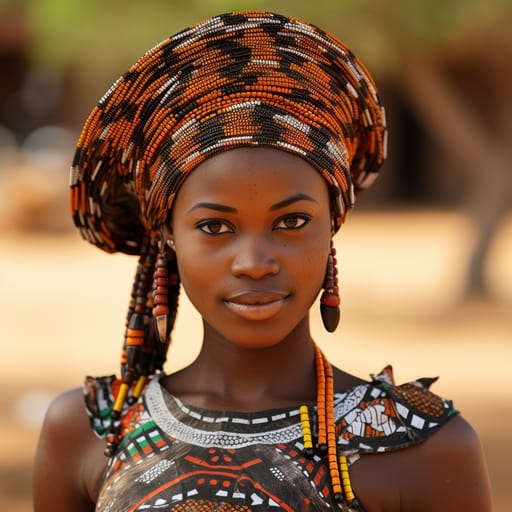
Typical Diola Phenotypes
Reference for AI generation — hair, eyes, skin, facial structure, build
Diola Body & Anatomy Reference
Per-feature anatomical profile for AI nude generation — West African Niger-Congo phenotype
Diola Boobs & Breasts
Diola tits and boobs run medium-to-large cup, full, projecting — the classic West African Niger-Congo bust profile. Diola nipples and areolas show deep-brown to near-black areolar pigmentation against the medium-to-deep-brown skin tone, with areolar diameter typically in the 35-50mm range and forward-set positioning rather than the smaller conical Cushitic East African profile. Diola breasts trend fuller and more projecting than the East African norm, a function of the mesomorph with strong gluteal-femoral fat distribution body habitus and the mean adult female BMI 24-27. For anatomically-accurate AI-generated Diola nudes the render preserves: medium-to-large cup, full, projecting shape, 35-50mm areolas with deep-brown to near-black pigmentation, and the torso proportions of the West African Niger-Congo phenotype.
Diola Ass & Hips
Diola ass and hip morphology presents as wide-set, full, heavily projected glutes — distinctly different from the slim narrow-hip Cushitic East African profile. The Diola pelvic profile shows wide iliac crests, broad gynoid pelvic pattern, high glute-to-waist ratio, anchored in the West African Niger-Congo skeletal pattern. Diola butt shots in adult AI imagery should render the wide-set, full, heavily projected glutes silhouette with the mesomorph with strong gluteal-femoral fat distribution build and the gluteal-femoral fat distribution typical of the West African Niger-Congo phenotype rather than defaulting to a globally-averaged "ethnic" butt that generic AI generators produce. The hip-to-waist ratio characteristic of Diola women is one of the identifying features of the West African Niger-Congo regional phenotype.
Diola Vagina & Pussy
Diola pussy and vulvar anatomy presents deep-brown to near-black labial pigmentation, fuller labia minora — consistent with the West African Niger-Congo phenotype's pigmentation pattern. Diola pubic hair is typically tightly-coiled coarse texture, densely distributed, distributed in the inverted-triangle pattern with regional-typical density. AI-generated Diola nude imagery should preserve the deep-brown to near-black labial pigmentation and the tightly-coiled coarse texture hair texture rather than defaulting to a Western-European pink-and-sparse template. For anatomically-accurate Diola pussy renders the labial pigmentation and coloration should match the surrounding medium-brown to deep-brown skin tone of the West African Niger-Congo phenotype, with continuous gradient rather than an abrupt color transition.
Diola Dicks & Penis
Diola dick and penile anatomy in adult AI generation should anchor on the regional reference data: regional mean ~14-15cm erect, above-average girth, ~13cm circumference, and deep-brown-to-near-black shaft pigmentation. The Diola cock profile reflects the West African Niger-Congo ancestral population's anthropometric measurements rather than a globally-averaged Western-pornography default. For anatomically-accurate Diola nude male imagery the shaft pigmentation should track the surrounding medium-brown to deep-brown skin tone, the glans-to-shaft pigmentation transition should be continuous, and the pubic hair pattern should match tightly-coiled coarse texture texture distributed in the typical inverted-V escutcheon. Circumcision status in Diola populations varies by religious-cultural tradition rather than ancestral phenotype.
Diola Body, Curves & Build
Diola body type and overall build presents as mesomorph with strong gluteal-femoral fat distribution, with mean adult female BMI 24-27 — the characteristic West African Niger-Congo habitus. Diola curves and proportions in adult AI imagery should preserve the regional skeletal frame (height, shoulder-to-hip ratio, limb proportions) rather than scaling to a Western-European mesomorph default. The Diola nude female form, when rendered with anatomical fidelity, shows the height range, frame width, and adipose distribution pattern typical of the West African Niger-Congo phenotype. Generic AI image generators tend to collapse regional body types into a few default shapes; the EthnicErotic phenotype-anchored approach preserves the Diola build as its own reference category.
Diola Skin Tone & Hair Texture
Diola skin tone falls in the medium-brown to deep-brown (Fitzpatrick V-VI) band — the surface signal most often miscalibrated by generic AI nude generators trained on Western-photographic datasets. Diola hair texture is typically tight 4A-4C coil, often worn natural, braided, or relaxed, characteristic of the West African Niger-Congo phenotype. For anatomically-accurate Diola nude renders the skin should hold the Fitzpatrick band consistently across body surface rather than showing the lighter-than-face body shading that AI generators default to. Diola hair pigmentation and texture on body, pubic, and head should match across the figure rather than mixing textures (a common AI artefact).
Explore phenotype categories
Structured taxonomy with peer-reviewed scales · 22 anatomical categories
Erotic Poses & Sex Positions
From the pose catalog — 219 named positions with reference skeletons
Frequently asked questions about Diola people
Where is the Diola homeland?
The Diola homeland is The Casamance region of southern Senegal, with communities in The Gambia and northwestern Guinea-Bissau. in Western Africa.
What language do Diola people speak?
Diola people primarily speak Jola languages, including Fonyi, Kasa and Ejamat (Bak branch of the Atlantic group, Niger-Congo), with Wolof, French, Mandinka and English widely used as second languages..
What religion do Diola people practice?
The predominant religion among Diola people is Islam and Roman Catholicism, alongside the indigenous awasena practice centered on Emitai and shrine spirits. Many families hold more than one at once..
What does a typical Diola woman look like?
Deep brown to very dark skin and tightly coiled hair, with a medium to tall build; men who farm the paddies with the kajendou tend to be solidly built through the shoulders and back. Everyday dress is ordinary West African: wax print wrappers and headties for women, shirts and trousers or a light boubou for men.






Make your own Diola images
Five a day, free, no credits to buy. The studio starts from this group's phenotype data, so you can set body type, pose and style and keep the traits accurate.
Start with Diola