Help us get this right
Does this portrait look right for Dagaaba?
Nobody has judged this one yet. You would be the first.
Dagaaba Erotic
Christianity
About Dagaaba People
The Dagaaba live in the savanna country that straddles northwestern Ghana and the southwestern corner of Burkina Faso, a stretch of land flatter and drier than the forest belt to the south. They are sometimes grouped with the Lobi and Birifor as part of a broader Lobi-Dagarti cultural cluster, and the boundaries between these populations have always been porous — clan ties, marriage, and shared ritual specialists matter more than any neat ethnic line drawn on a map. The name itself shifts depending on who is speaking: Dagaaba in the plural, Dagao in the singular, with Dagara used by speakers on the Burkinabè side and Dagaare more commonly by those in Ghana.
Dagaare belongs to the Gur branch of the Niger–Congo family, sitting alongside Mooré, Kusaal, and Frafra in a chain of related languages that runs across the inner West African savanna. It splits into a northern variety (sometimes called Dagara) and a southern one, with mutual intelligibility holding well enough across the dialect continuum that speakers on either side of the Black Volta can usually follow each other. The language is tonal and noun-class rich, and it has a substantial written tradition through Catholic mission work that dates back to the early twentieth century.
That mission history shapes the religious landscape today. Most Dagaaba identify as Christian, with Catholicism particularly strong in the Wa, Nandom, and Jirapa areas, but the older earth-shrine system has not been displaced so much as folded in. The tendaana, or earth-priest, remains the figure who mediates between a community and the land it farms, and funeral rites — long, structured, and central to social life — still draw on pre-Christian cosmology even when conducted within a Catholic frame. Bagre, the secret society whose recitations form one of the longest oral epics documented in West Africa, persists in pockets despite a century of pressure from missionaries and modernizing chiefs.
Dagaaba society is traditionally patrilineal and organized around dispersed compound houses rather than nucleated villages, which gives the landscape its distinctive look: fortified-looking flat-roofed homesteads scattered across the bush, each with its own granaries and ancestral shrines. Subsistence farming — millet, sorghum, yams, groundnuts — still anchors rural life, though labor migration south to the cocoa belt and to Kumasi and Accra has been a defining economic fact for generations.
Related ethnic groups
Groups that share Dagaaba's homeland, region, language, or religious tradition. These are likely candidates for comparative phenotype reference.
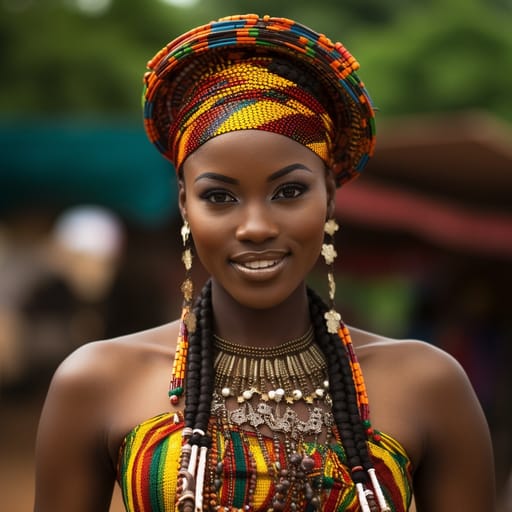
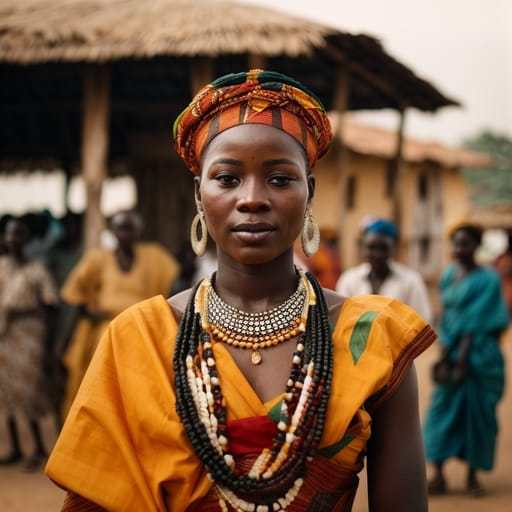
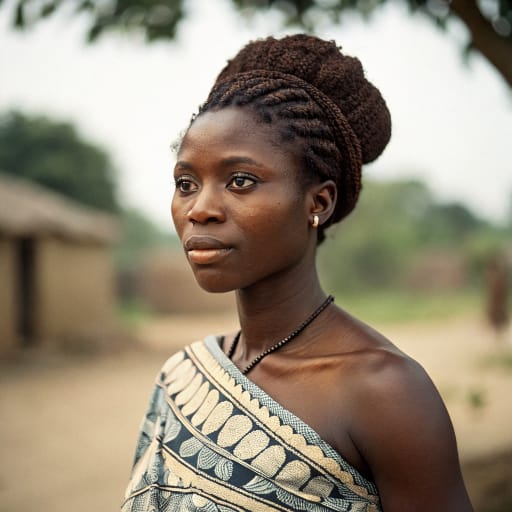
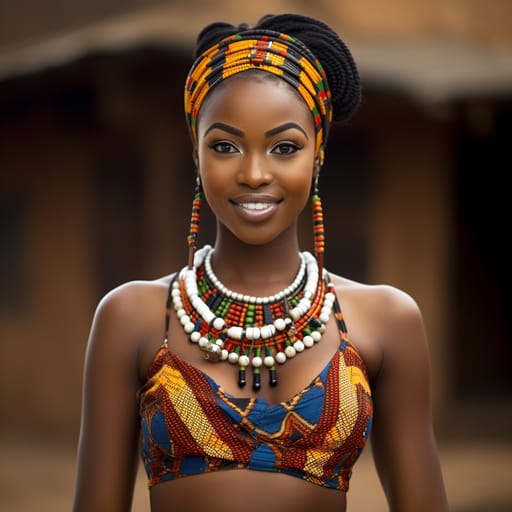
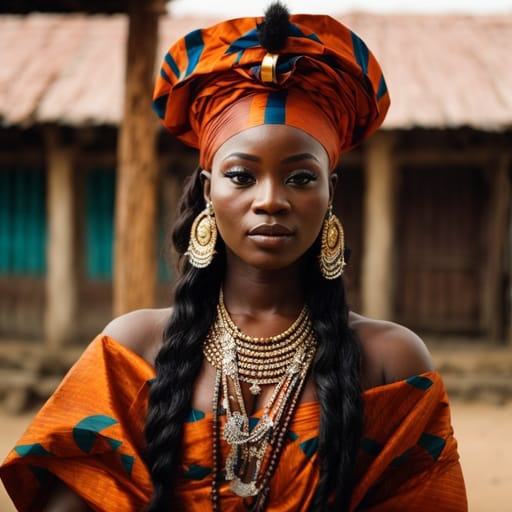

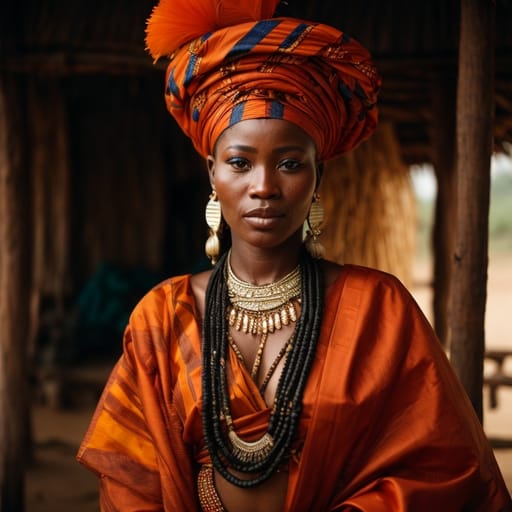
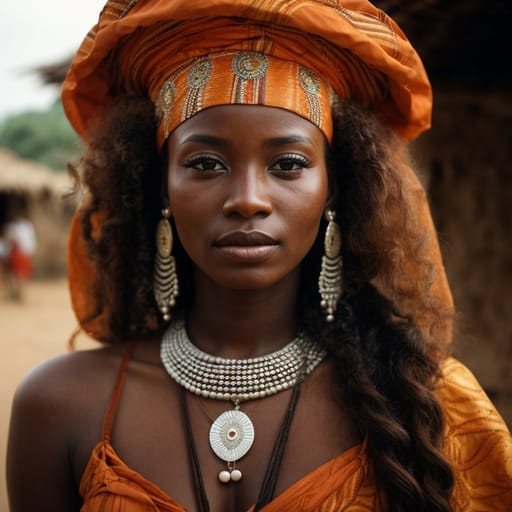
Typical Dagaaba Phenotypes
Reference for AI generation: hair, eyes, skin, facial structure, build
The Dagaaba are a Gur-speaking population of the Black Volta basin, straddling Ghana's Upper West region and southwestern Burkina Faso. Their phenotype sits within the broader West African Sudanic spectrum but trends toward the darker, leaner end typical of the savanna belt rather than the forest-zone Akan groups to the south.
Skin tone ranges across Fitzpatrick V to VI, with a strong concentration at the deeper end — rich brown to near-black with cool, slightly reddish-brown undertones rather than the warmer ochre cast common further south. The dry savanna environment and high UV exposure sustain consistently dark pigmentation; lightening through age or sun-shielded body areas is modest. Hair is uniformly Type 4 — tightly coiled, often Type 4B to 4C — densely textured, jet black, with the soft graying patterns typical of the region appearing relatively late.
Eyes are dark brown to near-black, set under straight or gently arched brows. The eye opening tends to be moderate in width with a clean monolid-free upper crease; epicanthic folds are absent. Faces show the structural traits common to Voltaic populations: a moderately broad nose with a low-to-medium bridge and rounded alar wings, full but well-defined lips with a clear vermilion border, and a tendency toward forward-projecting jaws. Cheekbones are typically high and laterally placed, giving the face a slightly angular, sculpted look in profile rather than the rounder facial frame seen in some coastal groups.
Build is the most distinctive feature. Dagaaba men and women trend tall and lean, with long limbs, narrow hips, and low subcutaneous fat — an ectomorphic frame shared with neighboring Sudanic farming peoples like the Lobi, Sisaala, and Gurunsi. Average male stature commonly reaches 175–180 cm; women are similarly long-limbed. Shoulder width is narrower and the torso longer than in stockier forest-zone West Africans, producing an elongated silhouette. Sub-group differences between Ghanaian and Burkinabé Dagaaba are minimal — chiefly dialectal rather than phenotypic.
Dagaaba Body & Anatomy Reference
Per-feature anatomical profile for AI nude generation: West African Niger-Congo phenotype
Dagaaba Boobs & Breasts
Bust reference for Dagaaba women: medium-to-large cup, full, projecting, which is typical of West African Niger-Congo ancestry. Areolas measure about 35-50mm across, with deep-brown to near-black pigmentation. Body type (mesomorph with strong gluteal-femoral fat distribution) shapes the bust as well, so Dagaaba tits are usually fuller and more projecting than the East African norm. In AI imagery, keep the forward-set shape rather than drifting toward the smaller conical Cushitic East African profile.
Dagaaba Ass & Hips
The Dagaaba ass is typically wide-set, full, heavily projected glutes, which sets it apart from the slim narrow-hip Cushitic East African profile. Underneath, the pelvis shows wide iliac crests, broad gynoid pelvic pattern, high glute-to-waist ratio, part of the West African Niger-Congo skeletal pattern. For Dagaaba butt pics and AI renders, match that silhouette and the overall build (mesomorph with strong gluteal-femoral fat distribution).
Dagaaba Vagina & Pussy
Dagaaba pussy and vulvar anatomy presents deep-brown to near-black labial pigmentation, fuller labia minora, consistent with the West African Niger-Congo phenotype's pigmentation pattern. Dagaaba pubic hair is typically tightly-coiled coarse texture, densely distributed, in the inverted-triangle pattern. For anatomically accurate Dagaaba pussy renders the labial coloration should match the surrounding medium-brown to deep-brown skin tone with a continuous gradient, and the hair should keep its tightly-coiled coarse texture.
Dagaaba Dicks & Penis
Dagaaba dicks follow the West African Niger-Congo reference data: regional mean ~14-15cm erect; above-average girth, ~13cm circumference; deep-brown-to-near-black shaft pigmentation. Shaft color should track the medium-brown to deep-brown skin tone with a smooth change toward the glans, and Dagaaba pubic hair keeps its tightly-coiled coarse texture.
Dagaaba Body, Curves & Build
Dagaaba body type and overall build presents as mesomorph with strong gluteal-femoral fat distribution, with mean adult female BMI 24-27: the characteristic West African Niger-Congo habitus. Dagaaba curves and proportions should keep the regional skeletal frame (height, shoulder-to-hip ratio, limb proportions) rather than a generic mesomorph default.
Dagaaba Skin Tone & Hair Texture
Dagaaba skin sits in the medium-brown to deep-brown (Fitzpatrick V-VI) band. Hair is typically tight 4A-4C coil, often worn natural, braided, or relaxed, in keeping with the West African Niger-Congo phenotype. In nude renders the skin should stay one even tone from face to body, and body, pubic and head hair should match.
Data depth
0/100Coverage of image-grounded phenotype observations · drives AI generation diversity
- Sample size
- 0/40· 0 images
- Image quality
- 0/30· 0% high
- Confidence
- 0/20
- Source diversity
- 0/10
- ·No image observations yet
Explore phenotype categories
Structured taxonomy with peer-reviewed scales · 22 anatomical categories
Erotic Poses & Sex Positions
From the pose catalog: 219 named positions with reference skeletons
Frequently asked questions about Dagaaba people
Where is the Dagaaba homeland?
The Dagaaba homeland is Ghana, Burkina Faso in Western Africa.
What language do Dagaaba people speak?
Dagaaba people primarily speak Niger-Congo / Gur / Dagaare.
What religion do Dagaaba people practice?
The predominant religion among Dagaaba people is Christianity.






Make your own Dagaaba images
Five a day, free, no credits to buy. The studio starts from this group's phenotype data, so you can set body type, pose and style and keep the traits accurate.
Start with Dagaaba