Help us get this right
Does this portrait look right for Calchaquí?
Nobody has judged this one yet. You would be the first.
Calchaquí Erotic
The Calchaquí Valleys of northwestern Argentina, across Salta, Tucumán and Catamarca provinces
Historically Kakán (extinct, unclassified); later Quechua (Quechuan); today Spanish (Indo-European)
Originally Andean religion centered on Pachamama; today mostly Roman Catholic, and Pachamama offerings are still common
A branch of the Diaguita; valley groups included the Quilmes, Tolombón, Colalao, Amaicha and Yocavil
About Calchaquí People
The Calchaquí take their name from the valleys they held, a long corridor of dry river country running north to south through the Andean foothills of Salta, Tucumán and Catamarca in northwestern Argentina. They were one branch of the wider Diaguita world. They farmed maize, beans, squash and quinoa on irrigated terraces, herded llamas on the slopes above, and lived in stone villages backed by pucarás, walled hilltop refuges built for bad times. The painted urns of the Santa María tradition, used to bury children, are among the best-known objects to come out of the region. Their own language, Kakán, survives only in place names and a scatter of words. Quechua had already pressed in after the Inca moved into the valleys in the late fifteenth century, and Spanish finished the job.
What sets the Calchaquí apart in the history of the Americas is how long they held off Spanish rule. The Calchaquí Wars ran, on and off, for more than a century. Juan Calchaquí, a leader from Tolombón, wiped out the first Spanish towns in the valleys in the 1560s. A second rising under Juan Chelemín shook the region in the 1630s. The last round turned on an unlikely figure: Pedro Bohórquez, an Andalusian adventurer who persuaded valley leaders he was an Inca heir and led them against the crown. Once the Spanish won, their answer was removal. Whole communities were broken up and resettled far from home. The Quilmes were marched more than a thousand kilometers to the shore of the Río de la Plata near Buenos Aires, where a city still carries their name.
That history left a long silence, but not an ending. Families who stayed or came back kept working the valley land. They mixed Catholic saints with offerings to Pachamama, the earth mother, who is still fed with food, chicha and coca when the ground is opened for her. Communities such as Amaicha del Valle and Quilmes now organize openly as Diaguita Calchaquí peoples, press land claims backed by colonial-era titles, and hold a Pachamama festival at Carnival that draws visitors from across Argentina. The stone walls of the old Quilmes settlement, climbing a hillside in Tucumán, remain the clearest sign of how hard these valleys were once defended.
Related ethnic groups
Groups that share Calchaquí's homeland, region, language, or religious tradition. These are likely candidates for comparative phenotype reference.
Quechua
same region (South America)
Aymara
same region (South America)
Guaraní
same region (South America)
Emberá
same region (South America)
Nahukuá
same region (South America)
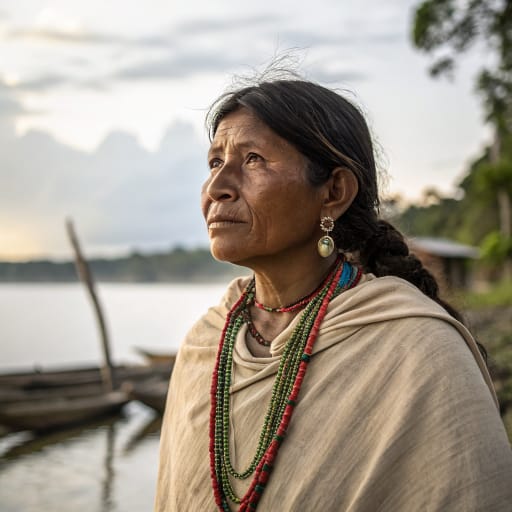
Achuar
same region (South America)
Taruma
same region (South America)
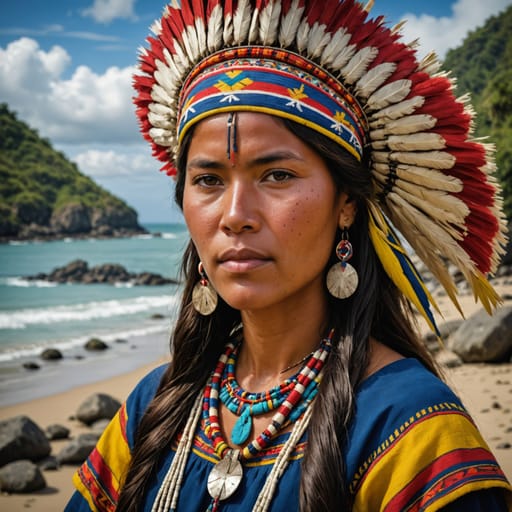
Tsáchila and Coastal Indigenous Ecuadorian
same region (South America)
Typical Calchaquí Phenotypes
Reference for AI generation: hair, eyes, skin, facial structure, build
Calchaquí Body & Anatomy Reference
South American Indigenous / European-Mestizo / Afro-Latino mix phenotype: anatomy reference for AI nude generation
Calchaquí Boobs & Breasts
Bust reference for Calchaquí women: medium-to-large cup, full, high projection, which is typical of South American Indigenous / European-Mestizo / Afro-Latino mix ancestry. Areolas measure about 32-46mm across, with medium-brown to dark-brown pigmentation. Body type (endomorph-to-mesomorph with high gluteal-femoral deposition) shapes the bust as well, so Calchaquí tits are usually the classic Brazilian / Latina curvy bust profile in lowland populations; smaller and shorter-set in Andean Indigenous populations. In AI imagery, keep the forward-set shape rather than drifting toward the smaller bust profile of Andean Indigenous sub-populations.
Calchaquí Ass & Hips
The Calchaquí ass is typically full, high projection, the famous Brazilian / Latina bunda profile, which sets it apart from the slim narrow-hip East Asian profile. Underneath, the pelvis shows wide iliac crests, very full gluteal-femoral fat deposition (the hallmark Brazilian / Latina hip-to-waist ratio), part of the South American Indigenous / European-Mestizo / Afro-Latino mix skeletal pattern. For Calchaquí butt pics and AI renders, match that silhouette and the overall build (endomorph-to-mesomorph with high gluteal-femoral deposition).
Calchaquí Vagina & Pussy
Calchaquí pussy and vulvar anatomy presents medium-brown to dark-brown labial pigmentation, fuller labia minora, consistent with the South American Indigenous / European-Mestizo / Afro-Latino mix phenotype's pigmentation pattern. Calchaquí pubic hair is typically wavy-to-curly coarse dark texture, dense distribution, in the inverted-triangle pattern. For anatomically accurate Calchaquí pussy renders the labial coloration should match the surrounding tan to deep-brown skin tone with a continuous gradient, and the hair should keep its wavy-to-curly coarse dark texture.
Calchaquí Dicks & Penis
Calchaquí dicks follow the South American Indigenous / European-Mestizo / Afro-Latino mix reference data: regional mean ~13cm erect; moderate-to-above-average girth; medium-brown shaft pigmentation. Shaft color should track the tan to deep-brown skin tone with a smooth change toward the glans, and Calchaquí pubic hair keeps its wavy-to-curly coarse dark texture.
Calchaquí Body, Curves & Build
Calchaquí body type and overall build presents as endomorph-to-mesomorph with high gluteal-femoral deposition, with mean adult female BMI 25-28: the characteristic South American Indigenous / European-Mestizo / Afro-Latino mix habitus. Calchaquí curves and proportions should keep the regional skeletal frame (height, shoulder-to-hip ratio, limb proportions) rather than a generic mesomorph default.
Calchaquí Skin Tone & Hair Texture
Calchaquí skin sits in the tan to deep-brown (Fitzpatrick III-VI) band. Hair is typically straight-to-curly 1A-3C, varies widely by ancestral composition, in keeping with the South American Indigenous / European-Mestizo / Afro-Latino mix phenotype. In nude renders the skin should stay one even tone from face to body, and body, pubic and head hair should match.
Explore phenotype categories
Structured taxonomy with peer-reviewed scales · 22 anatomical categories
Erotic Poses & Sex Positions
From the pose catalog: 219 named positions with reference skeletons
Frequently asked questions about Calchaquí people
Where is the Calchaquí homeland?
The Calchaquí homeland is The Calchaquí Valleys of northwestern Argentina, across Salta, Tucumán and Catamarca provinces in South America.
What language do Calchaquí people speak?
Calchaquí people primarily speak Historically Kakán (extinct, unclassified); later Quechua (Quechuan); today Spanish (Indo-European).
What religion do Calchaquí people practice?
The predominant religion among Calchaquí people is Originally Andean religion centered on Pachamama; today mostly Roman Catholic, and Pachamama offerings are still common.






Make your own Calchaquí images
Five a day, free, no credits to buy. The studio starts from this group's phenotype data, so you can set body type, pose and style and keep the traits accurate.
Start with Calchaquí