Help us get this right
Does this portrait look right for Basseri?
One tap. It takes a second and it is recorded.
1 says it looks right, 0 say it looks off.
Basseri Erotic
Fars province, southern Iran, moving between winter pastures in the lowlands south of Shiraz and summer pastures in the Kuh-e Bul highlands to the north
A local dialect of Persian (Indo-European, Iranian)
Shia Islam, with formal observance traditionally light in camp life
One of the five tribes of the Khamseh confederation of Fars, alongside the Arab, Ainalu, Baharlu and Nafar; internally divided into sections and descent groups
About Basseri People
The Basseri are defined by a road. Each year their households take down black goat-hair tents and move their flocks along a customary route through Fars province in southern Iran. They winter in the warmer lowlands south of Shiraz and push north in spring to summer grazing in the Kuh-e Bul highlands. The route and its schedule belong to the tribe as a recognized right. Steering that movement past villages, farmland and other tribes has long been the heart of a chief's authority. Being Basseri means sharing that road.
They speak a local dialect of Persian and are Shia Muslims, though observers have noted that formal religious practice sits lightly on camp life. Fredrik Barth, the Norwegian anthropologist who lived among them in the late 1950s, argued that the migration itself does much of the work that ritual does elsewhere, giving the year its shape and meaning. His book Nomads of South Persia made the Basseri one of the most closely studied pastoral peoples in anthropology. Much of what outsiders know about them still comes through his account.
They are one of five tribes in the Khamseh confederation, an alliance formed in the nineteenth century under the Qavam family of Shiraz to balance the powerful Qashqai. The name means five, and the alliance joined the Persian-speaking Basseri with Turkic-speaking and Arabic-speaking neighbors. Within the tribe, authority ran from the chief through section headmen down to the single tent. The tent, meaning a household with its own flock, is the unit that counts. Its head speaks for it to villagers, officials and strangers, and camps form and split as tents choose whom to travel with.
Sheep and goats carry the economy. Wool, butter, hides and young animals go to villages and bazaars in exchange for flour, tea, sugar and cloth. Herds are fragile wealth, and Barth showed how the tribe loses members at both ends: families that prosper buy land and settle as landlords, while those whose flocks collapse leave to work in villages. The twentieth century brought harsher pressure, from forced settlement under Reza Shah in the 1930s to state control of grazing land, and settlement has drawn many families off the road.
Related ethnic groups
Groups that share Basseri's homeland, region, language, or religious tradition. These are likely candidates for comparative phenotype reference.
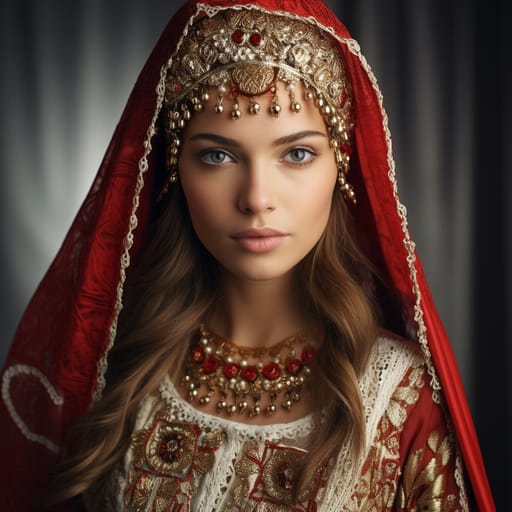
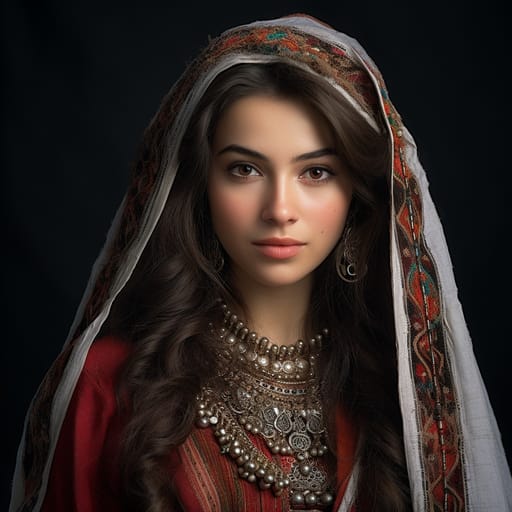
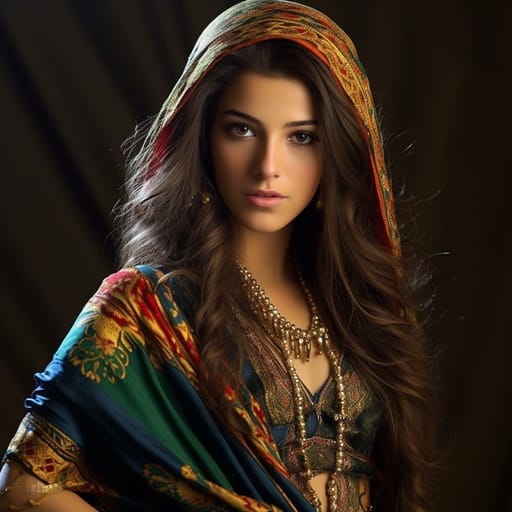
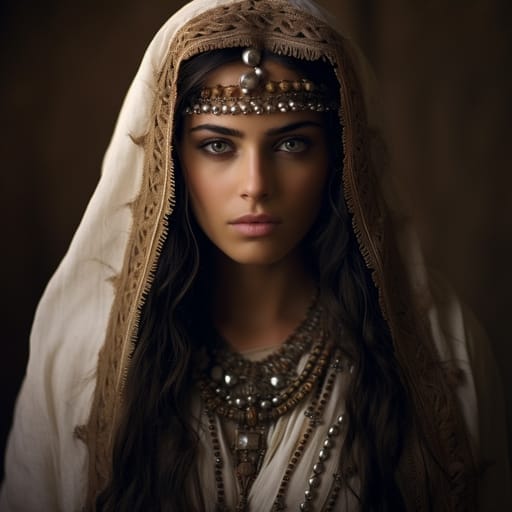
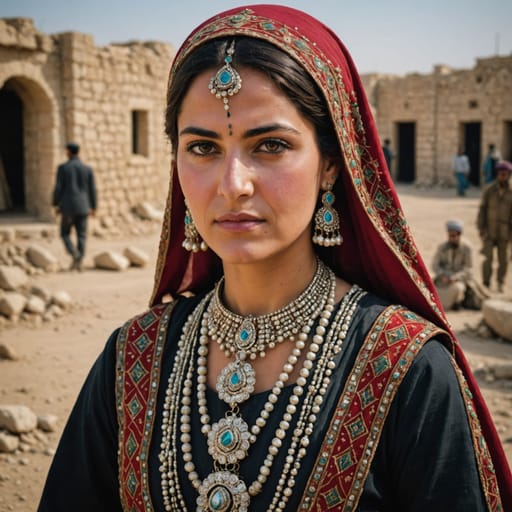
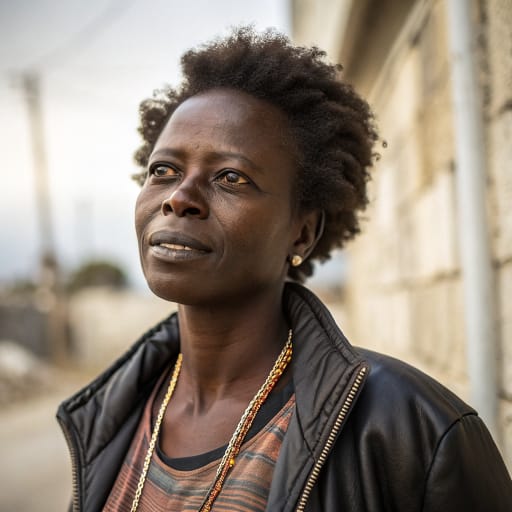
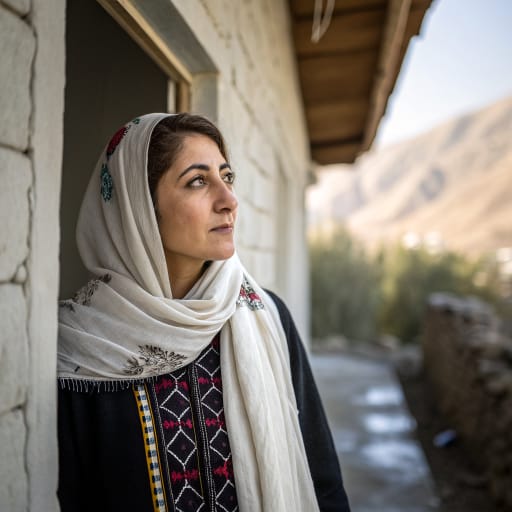
Typical Basseri Phenotypes
Reference for AI generation: hair, eyes, skin, facial structure, build
Basseri Body & Anatomy Reference
Per-feature anatomical profile for AI nude generation: Levantine / Mediterranean Middle Eastern phenotype
Basseri Boobs & Breasts
Bust reference for Basseri women: medium-to-large cup, full, moderate-to-high projection, which is typical of Levantine / Mediterranean Middle Eastern ancestry. Areolas measure about 32-46mm across, with medium-brown to dark-brown pigmentation. Body type (mesomorph with fuller hip-and-bust deposition) shapes the bust as well, so Basseri tits are usually full and soft, fuller projection than the North-African Berber norm. In AI imagery, keep the forward-set shape rather than drifting toward the smaller East Asian bust profile.
Basseri Ass & Hips
The Basseri ass is typically medium-to-full, moderate projection, broader hip profile, which sets it apart from the slim East Asian narrow-hip profile. Underneath, the pelvis shows medium-to-wide iliac crests, fuller gluteal-femoral deposition, part of the Levantine / Mediterranean Middle Eastern skeletal pattern. For Basseri butt pics and AI renders, match that silhouette and the overall build (mesomorph with fuller hip-and-bust deposition).
Basseri Vagina & Pussy
Basseri pussy and vulvar anatomy presents medium-brown to dark-brown labial pigmentation, fuller labia minora, consistent with the Levantine / Mediterranean Middle Eastern phenotype's pigmentation pattern. Basseri pubic hair is typically wavy-to-coiled medium-coarse dark texture, dense distribution, in the inverted-triangle pattern. For anatomically accurate Basseri pussy renders the labial coloration should match the surrounding olive to medium-brown skin tone with a continuous gradient, and the hair should keep its wavy-to-coiled medium-coarse dark texture.
Basseri Dicks & Penis
Basseri dicks follow the Levantine / Mediterranean Middle Eastern reference data: regional mean ~14cm erect; moderate-to-above-average girth; medium-brown shaft pigmentation. Shaft color should track the olive to medium-brown skin tone with a smooth change toward the glans, and Basseri pubic hair keeps its wavy-to-coiled medium-coarse dark texture.
Basseri Body, Curves & Build
Basseri body type and overall build presents as mesomorph with fuller hip-and-bust deposition, with mean adult female BMI 25-28: the characteristic Levantine / Mediterranean Middle Eastern habitus. Basseri curves and proportions should keep the regional skeletal frame (height, shoulder-to-hip ratio, limb proportions) rather than a generic mesomorph default.
Basseri Skin Tone & Hair Texture
Basseri skin sits in the olive to medium-brown (Fitzpatrick III-V) band. Hair is typically wavy-to-curly 2B-3B, predominantly dark-brown to black, in keeping with the Levantine / Mediterranean Middle Eastern phenotype. In nude renders the skin should stay one even tone from face to body, and body, pubic and head hair should match.
Explore phenotype categories
Structured taxonomy with peer-reviewed scales · 22 anatomical categories
Erotic Poses & Sex Positions
From the pose catalog: 219 named positions with reference skeletons
Frequently asked questions about Basseri people
Where is the Basseri homeland?
The Basseri homeland is Fars province, southern Iran, moving between winter pastures in the lowlands south of Shiraz and summer pastures in the Kuh-e Bul highlands to the north in Western Asia.
What language do Basseri people speak?
Basseri people primarily speak A local dialect of Persian (Indo-European, Iranian).
What religion do Basseri people practice?
The predominant religion among Basseri people is Shia Islam, with formal observance traditionally light in camp life.






Make your own Basseri images
Five a day, free, no credits to buy. The studio starts from this group's phenotype data, so you can set body type, pose and style and keep the traits accurate.
Start with Basseri