Body composition and somatotype: Heath-Carter, BMI, and what they don't capture
May 10, 2026
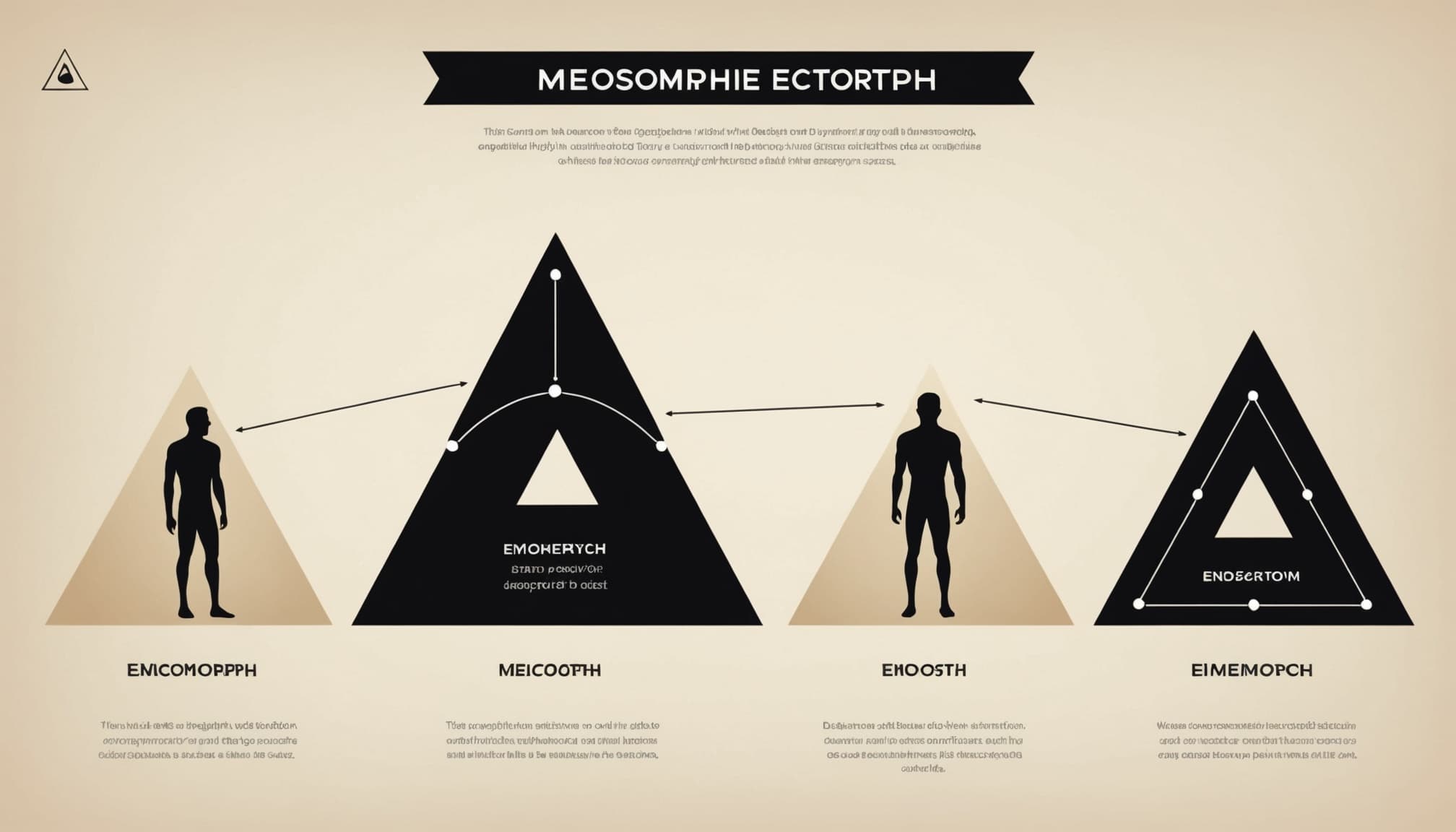
"Are X people thin or stocky?" is one of the more visible questions about human variation. The answer requires distinguishing between somatotype (the body-build framework — Heath-Carter is dominant), BMI (Body Mass Index, useful but flawed cross-population), and regional fat distribution (which BMI ignores entirely). Each measures something different.
Heath-Carter somatotype — the framework
The Heath-Carter system (Heath BH & Carter JEL, 1967, American Journal of Physical Anthropology 27:57-74; updated in Carter & Heath 1990, Somatotyping: development and applications) classifies adult body build along three independent dimensions, each rated 1-7:
- Endomorphy — relative fatness (low value = lean, high value = adipose)
- Mesomorphy — relative musculoskeletal robustness (low = gracile, high = robust/muscular frame)
- Ectomorphy — relative linearity (low = stocky, high = linear/slender)
A person's somatotype is expressed as three numbers, e.g., "2-4-3" (low endomorphy, mid mesomorphy, mid ectomorphy = lean and reasonably muscular without being either heavily-built or notably linear). The system is calculated from 10 anthropometric measurements (skinfold thickness at four sites, biepicondylar humeral and femoral diameters, biceps and calf girth, plus stature and weight).
Population modal somatotypes from peer-reviewed anthropometric studies:
| Population | Modal somatotype | Source |
|---|---|---|
| West African (Yoruba, Akan, Igbo) | 2-5-3 | Hiernaux 1968; Adetokunbo 2018 |
| East African Nilotic (Maasai, Dinka, Nuer) | 1-4-5 | Hiernaux 1968; Knip 1971 |
| Northern European (Dutch, Norwegian) | 3-5-3 | Drinkwater 2005 |
| East Asian (Japanese, Korean) | 3-4-4 | Choi 2009 |
| Polynesian (Samoan, Tongan) | 5-7-1 | Bindon 1994; McGarvey 2007 |
| Mesoamerican (Yucatec Maya, Mexican) | 3-5-2 | Malina 2007 |
| Mbuti / Aka Pygmy | 2-4-3 (gracile, low stature) | Hewlett 1991 |
Reading the table:
- Nilotic populations (Maasai, Dinka) are the canonical "ectomorphic" body type at population mean — tall, slim, gracile build. The 1-4-5 mode reflects low endomorphy, mid mesomorphy, high ectomorphy (linearity).
- Polynesian populations are the canonical opposite — high endomorphy + high mesomorphy + low ectomorphy. Documented in Bindon 1994 + McGarvey 2007 (cited below). Polynesian body composition has been studied extensively because it has documented metabolic implications (elevated diabetes / cardiovascular risk relative to BMI) — see "What BMI misses" below.
- East Asian populations are notably mid-range across all three dimensions, with high ectomorphy variability.
- Northern European populations sit in mid-range endomorphy + relatively high mesomorphy + mid ectomorphy. The modern "Dutch" stereotype of tall-and-lean is partly correct (tall, modal stature 184cm) but mesomorphy is mid-high — Dutch populations carry substantial musculoskeletal robustness alongside the height.
The phenotype atlas's Body Shape section documents Heath-Carter modal somatotype for each ethnic group page where peer-reviewed anthropometric studies exist.
BMI — the most-cited, most-misused metric
Body Mass Index (BMI) = weight (kg) / height² (m²). Adolphe Quetelet first proposed it in 1832 as a simple population-stratification tool. It became dominant in clinical medicine after Ancel Keys 1972 promoted it (Journal of Chronic Diseases 25:329-343).
Standard BMI categories (WHO 2000):
- < 18.5: Underweight
- 18.5-24.9: Normal weight
- 25.0-29.9: Overweight
- ≥ 30: Obese
BMI's key limitations for ethnographic / cross-population work:
- It doesn't distinguish muscle from fat. A muscular athlete with 8% body fat may have BMI 27 (categorized "overweight") while a sedentary individual with 30% body fat may have BMI 22 (categorized "normal").
- Cross-population validity is poor. Asian populations show elevated cardiometabolic risk at lower BMI than European populations. The WHO published Asia-Pacific BMI cutoffs in 2000 (WHO Asia-Pacific perspective: Redefining obesity and its treatment) lowering the overweight threshold to BMI ≥ 23 and obesity to BMI ≥ 25 for Asian populations. Polynesian populations show the opposite — at any BMI level, they have proportionally more lean mass than European populations, so European-derived cutoffs over-classify Polynesians as obese (Swinburn et al. 1996, American Journal of Clinical Nutrition 64:405-408).
- It collapses regional fat distribution. Visceral fat (intra-abdominal) is the metabolically-active fat that drives diabetes/cardiovascular risk. Subcutaneous fat (under-skin) is largely passive. BMI treats them identically.
The phenotype atlas notes BMI population modal value where measured data exists, but flags it as a partial descriptor — Heath-Carter somatotype + waist-hip ratio (WHR) data is preferred for descriptive accuracy.
Waist-hip ratio and regional fat distribution
Waist-hip ratio (WHR = waist circumference / hip circumference) is the most widely-used regional-fat-distribution metric. Population modal WHR varies:
- East Asian populations: female modal WHR 0.74-0.78, male modal 0.85-0.90
- European populations: female modal WHR 0.72-0.76, male modal 0.88-0.94
- West African populations: female modal WHR 0.75-0.80 (with characteristic gluteofemoral fat distribution producing low WHR despite higher hip circumference)
- South Asian populations: male modal WHR 0.88-0.95 (elevated visceral fat distribution at any BMI)
The phenotype atlas documents WHR modal values where peer-reviewed sampling exists.
What body composition actually tells you about a population
Three patterns documented in the literature:
1. Tall + slim is genetic + nutritional. Maasai 178cm men with low endomorphy reflects both Nilotic source-population genetics AND cattle-protein-rich nutrition. Dutch 184cm men reflects Northern European genetics AND post-WWII high-quality dairy/protein. Either alone produces less stature.
2. Polynesian body composition is partly post-colonial. McGarvey 2007 and follow-up papers documented that pre-Western-contact Polynesian populations had Heath-Carter somatotypes closer to 4-6-2 (still high mesomorphy, but less endomorphy). The shift to high-endomorphy modal reflects post-1900 Western dietary transition + continuing genetic predisposition. Genetics + environment compound.
3. East Asian populations have low population-mode BMI but elevated regional metabolic risk. Despite mean BMI ~23 in modern Japan / Korea / China cohorts, the populations show elevated diabetes risk relative to BMI. The WHO Asia-Pacific cutoffs reflect this. Visceral fat distribution + skeletal-muscle differences both contribute.
How the phenotype atlas applies body-composition data
The atlas's Body Shape category documents per ethnic group:
- Heath-Carter modal somatotype (where peer-reviewed studies exist)
- BMI modal value with confidence range
- WHR modal value where sampled
- Stature modal value with secular-trend notation
- Population-specific notes on regional fat distribution
Body composition is among the most environmentally-plastic phenotype dimensions. Population modal values shift with secular nutrition trends (most populations have gained 3-5 BMI units since 1960 due to dietary shifts). The atlas notes the era of the underlying anthropometric study so readers can interpret the data correctly.
Limitations of cross-population body-composition comparisons
A standing caveat: most cross-population body-composition data combines studies from different eras with different sampling designs. A 1968 Hiernaux Maasai sample is not directly comparable to a 2020 NHANES American sample — measurement protocols differ, samples differ, and secular trends mean the underlying populations have shifted. The atlas pages cite era + sample size + measurement protocol where the source paper documents them.
When in doubt, treat all "X population body type is Y" claims as descriptive of the studied cohort, not deterministic for individuals or for the broader population in different eras.
References
- Heath BH, Carter JEL. A modified somatotype method. American Journal of Physical Anthropology 27(1):57-74, 1967.
- Carter JEL, Heath BH. Somatotyping: development and applications. Cambridge University Press, 1990.
- Hiernaux J. La Diversité humaine en Afrique subsaharienne. Editions de l'Université de Bruxelles, 1968.
- Bindon JR, Knight A, Dressler WW, Crews DE. Social context and psychosocial influences on blood pressure among American Samoans. American Journal of Physical Anthropology 103(1):7-18, 1994.
- McGarvey ST. Population genetics of obesity, diabetes, and cardiovascular disease in the Pacific. In: Genomic Medicine and Cardiovascular Disease, 2007.
- WHO Expert Consultation. Appropriate body-mass index for Asian populations and its implications for policy and intervention strategies. The Lancet 363(9403):157-163, 2004.
- Swinburn BA, Ley SJ, Carmichael HE, Plank LD. Body size and composition in Polynesians. International Journal of Obesity 23(11):1178-1183, 1999.
- Choi JC, Park K. Anthropometry and somatotype of Korean adolescents. International Journal of Anthropology 24:39-48, 2009.
- Drinkwater DT, Mazza JC. Anthropometry and Somatotypes of Dutch Adults. In: International Body Composition Symposium proceedings, 2005.
- Malina RM. Body composition in athletes: assessment and ethnic differences. Clinical Sports Medicine 26(1):37-68, 2007.
Topics
More articles

The peer-reviewed classification scales we use, and why
May 10, 2026
Butt shape by ethnicity: what an MRI study found and what our database records
Sep 20, 2026
The Wodaabe and the Gerewol: male beauty, the yaake dance, and the Fulani pastoral world
Jul 9, 2026
San peoples of the Kalahari: the Khomani, Ju|'hoan, Taa, and their forager kin
Jul 9, 2026