The peer-reviewed classification scales we use, and why
May 10, 2026

Phenotype description without a controlled vocabulary becomes subjective ("she has medium-light skin"). Phenotype description with a controlled vocabulary becomes reproducible ("Fitzpatrick III, ITA° 35°, Halls warm undertone"). The phenotype catalog uses peer-reviewed classification scales for every trait it documents. This article lists each scale, when it was developed, and what it actually classifies.
Why use scales at all
Three reasons:
1. Reproducibility. When two researchers describe the same phenotype using the same scale, they should produce similar values. Without scales, descriptions drift — "olive skin" means different things in different decades and different cultural contexts.
2. Comparability. Population A's mean skin tone can be compared to Population B's mean skin tone only if both are described using the same scale. The catalog uses Fitzpatrick + ITA° everywhere so cross-population comparisons are meaningful.
3. Citation transparency. Each scale has a source paper, a defined methodology, and known limitations. When a phenotype profile says "Fitzpatrick V modal," any reader can look up Fitzpatrick 1988, see how he defined Type V, and audit whether the catalog applied the definition correctly.
The scales used
Skin: Fitzpatrick + ITA° + Halls
Fitzpatrick scale (Fitzpatrick TB, Archives of Dermatology 124:869, 1988): six-type classification (I-VI) based on UV-reactivity. Originally developed for phototherapy patient assessment. The catalog uses Fitzpatrick as the primary skin-depth descriptor because it's the most-cited and most-portable scale.
ITA° (Individual Typology Angle) (Del Bino S & Bernerd F, British Journal of Dermatology 169:33, 2013): colorimetric measure derived from CIELAB color space, computed from chromameter measurements. Continuous (in degrees) rather than categorical. Used in the catalog where peer-reviewed studies report ITA° values.
Halls system (Halls 2018): undertone classification (cool / neutral / warm) complementary to Fitzpatrick. Catures undertone (carotenoid vs hemoglobin contribution to skin color) which Fitzpatrick alone doesn't.
The atlas's Skin page covers all three.
Hair: Andre Walker (texture) + Sturm-style genetic classification (color)
Andre Walker scale (Walker 1997): four-tier hair texture classification (1 = straight, 2A-2C = wavy, 3A-3C = curly, 4A-4C = coily). Originally cosmetic-industry; adopted into clinical dermatology.
Color classification uses Sturm 2009 (Human Molecular Genetics 18:R9) categories: black, dark brown, light brown, blonde, red — with population-frequency for each. Underlying genetics: MC1R, TYRP1, OCA2, plus other variants.
The atlas's Head Hair page covers both.
Eyes: HERC2/OCA2 color + epicanthic-fold morphology
Iris color classification: brown, dark brown, hazel, green, blue, gray. Underlying genetics dominated by HERC2 rs12913832 variant per Eiberg et al. 2008.
Epicanthic fold presence: present / variable / absent at population modal level.
Palpebral fissure obliquity: measured in degrees.
The atlas's Eyes page covers all three.
Body composition: Heath-Carter + BMI + WHR
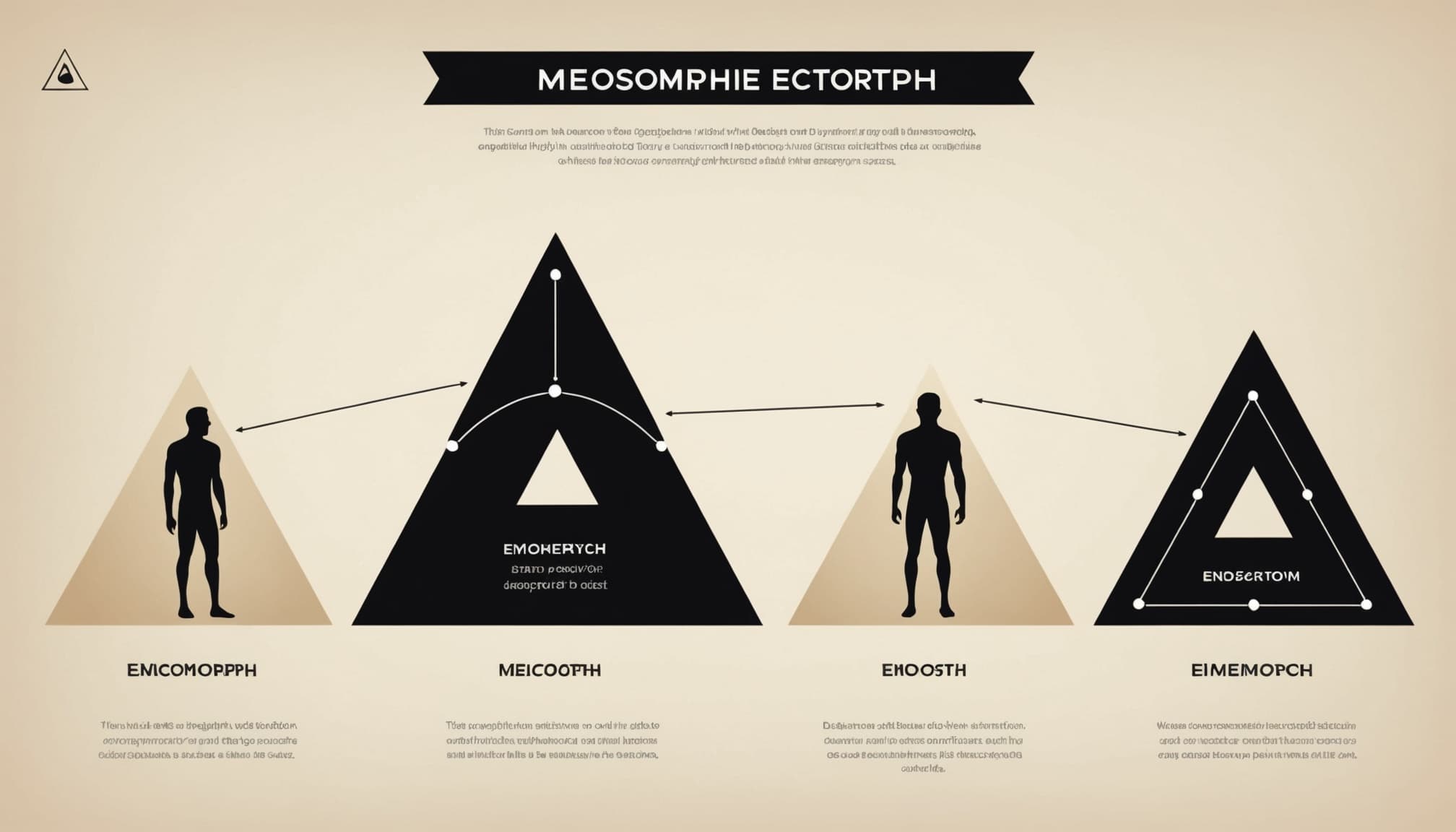
Heath-Carter somatotype (Heath BH & Carter JEL, American Journal of Physical Anthropology 27:57, 1967): three-dimensional classification (endomorphy / mesomorphy / ectomorphy each rated 1-7). The dominant somatotype framework in clinical and athletic anthropometry.
BMI (Body Mass Index, Quetelet 1832 / Keys 1972 Journal of Chronic Diseases 25:329): weight/height² with WHO categories. Used as a starting point but with documented cross-population validity issues — see the body-composition article.
WHR (Waist-Hip Ratio): regional fat-distribution descriptor that BMI ignores.
The atlas's Body Shape page covers all three.
Lips: Halls volume + Cupid's-bow morphology
Halls lip-volume classification (cosmetic-industry standard): thin / medium / full / very full. Used to describe lip projection and volume.
Cupid's-bow morphology: well-defined / shallow / absent. Documented per population modal value.
The atlas's Lips and Mouth page covers both.
Nose: Anthropometric ratio system
Nasal index (nasal width / nasal height × 100): the historic anthropometric measure dating to 19th-century anthropology, now expressed in modern cross-sectional studies (Farkas et al. 2005, Journal of Craniofacial Surgery 16:615-646). Categories: leptorrhine (long-narrow), mesorrhine (intermediate), platyrrhine (short-broad).
Bridge prominence (low / medium / high), tip projection (low / medium / high), and alar width (narrow / medium / wide) supplement the nasal-index measure.
The atlas's Nose page covers the full descriptor set.
Hands and digit ratios: Manning 2D:4D
Manning 2D:4D ratio (Manning et al. 1998, Human Reproduction 13:3000-3004): ratio of second-finger length to fourth-finger length. Documented variation by sex (males show lower ratio, ~0.95-0.97) and by population (modal ratio differs by ~0.01-0.02 across populations). Marker for prenatal androgen exposure.
Body hair: Halls volume + Tanner stages
Body-hair density (sparse / moderate / dense): classification by anatomical region. Modal values differ by population.
Tanner stages (Tanner JM 1962, 1969): five-stage developmental classification. Used in pediatric and adolescent contexts; less applicable to adult phenotype documentation.
Head shape and craniofacial: Cephalic index + Farkas anthropometry
Cephalic index (head width / head length × 100): historic anthropometric measure with three categories (dolichocephalic / mesocephalic / brachycephalic). Useful as a population modal but with limitations — see the methodology discussion.
Farkas Atlas of Craniofacial Anthropometry (Farkas LG, Anthropometry of the Head and Face, 2nd ed. 1994, ISBN 0-7817-0179-6): the canonical reference for face-anthropometry measurement protocols. The atlas applies Farkas standards where peer-reviewed studies use them.
Hamilton-Norwood baldness scale
Hamilton-Norwood scale (Hamilton 1951, Annals of the New York Academy of Sciences 53:708; refined Norwood 1975, Southern Medical Journal 68:1359): seven-stage male-pattern-baldness classification. Used to describe baldness frequency and pattern by population.
Ludwig scale (Ludwig 1977, British Journal of Dermatology 97:247): three-stage female-pattern-hair-loss classification. Complement to Hamilton-Norwood.
Skin moisture / sebum: ISL scale
Sebumeter readings (μg/cm² of skin surface lipid): population-modal sebum-production rates documented per anatomical region. East Asian populations document higher sebum-production rates than European populations (Yamaguchi et al. 2018).
Why not race-based or visual-only descriptors?
A standing question for anyone reading the catalog: "why not just describe what people look like in plain language?"
Plain-language descriptors fail on reproducibility — two researchers describing "olive skin" mean different things. The peer-reviewed scales solve that. They also avoid the historical baggage of race-based classification (which conflated phenotype, ancestry, and culture into a problematic single dimension).
The catalog's commitment is to use scales that:
- Have peer-reviewed source publications with cited methodology
- Are reproducible across observers
- Are descriptive of measurable traits rather than evaluative ("beautiful" / "harmonious" / etc. — these are aesthetic, not scientific)
- Acknowledge limitations — every scale has caveats, and the catalog flags them per-page
How the scales fit together
Most ethnic-group pages use 5-10 scales simultaneously. A typical Phenotype Profile might read:
"Maasai populations show Fitzpatrick V-VI skin tone modal V, characteristic copper-bronze undertone (Halls warm-cool variable), Andre Walker 4A-4C hair (modal 4B-4C), iris color modal dark brown, distinctive Nilotic-source nasal morphology (mesorrhine to platyrrhine, with characteristic high tip projection), Heath-Carter somatotype 1-4-5 (gracile and linear with low endomorphy and mid mesomorphy), adult male mean stature 178 cm in well-nourished cohorts."
Each phrase invokes a specific scale or measurement standard. A reader can audit any claim by looking up the scale's source paper and the population's underlying data.
Limitations standing across all scales
A standing caveat: every scale was developed in a specific historical and geographic context. Fitzpatrick was developed on European populations. Heath-Carter was developed in mid-20th-century North America. Andre Walker was developed in cosmetic-industry context. Cross-population application requires care — values may be calibrated differently across populations than within the source-population.
The catalog tries to flag these limitations at the per-page level, but readers should treat all values as descriptive of the cohort studied, not as universal truths.
Want to know more
- Methodology — how the catalog was built
- Glossary — every term in every scale defined
- Atlas — browse one trait across populations
References
(All scales referenced above are cited in their respective atlas-category articles. The glossary page links each defined term to its source publication.)
Topics
More articles
Body composition and somatotype: Heath-Carter, BMI, and what they don't capture
May 10, 2026
Butt shape by ethnicity: what an MRI study found and what our database records
Sep 20, 2026
The Wodaabe and the Gerewol: male beauty, the yaake dance, and the Fulani pastoral world
Jul 9, 2026
San peoples of the Kalahari: the Khomani, Ju|'hoan, Taa, and their forager kin
Jul 9, 2026