Hair texture, color, and density across world populations
May 10, 2026
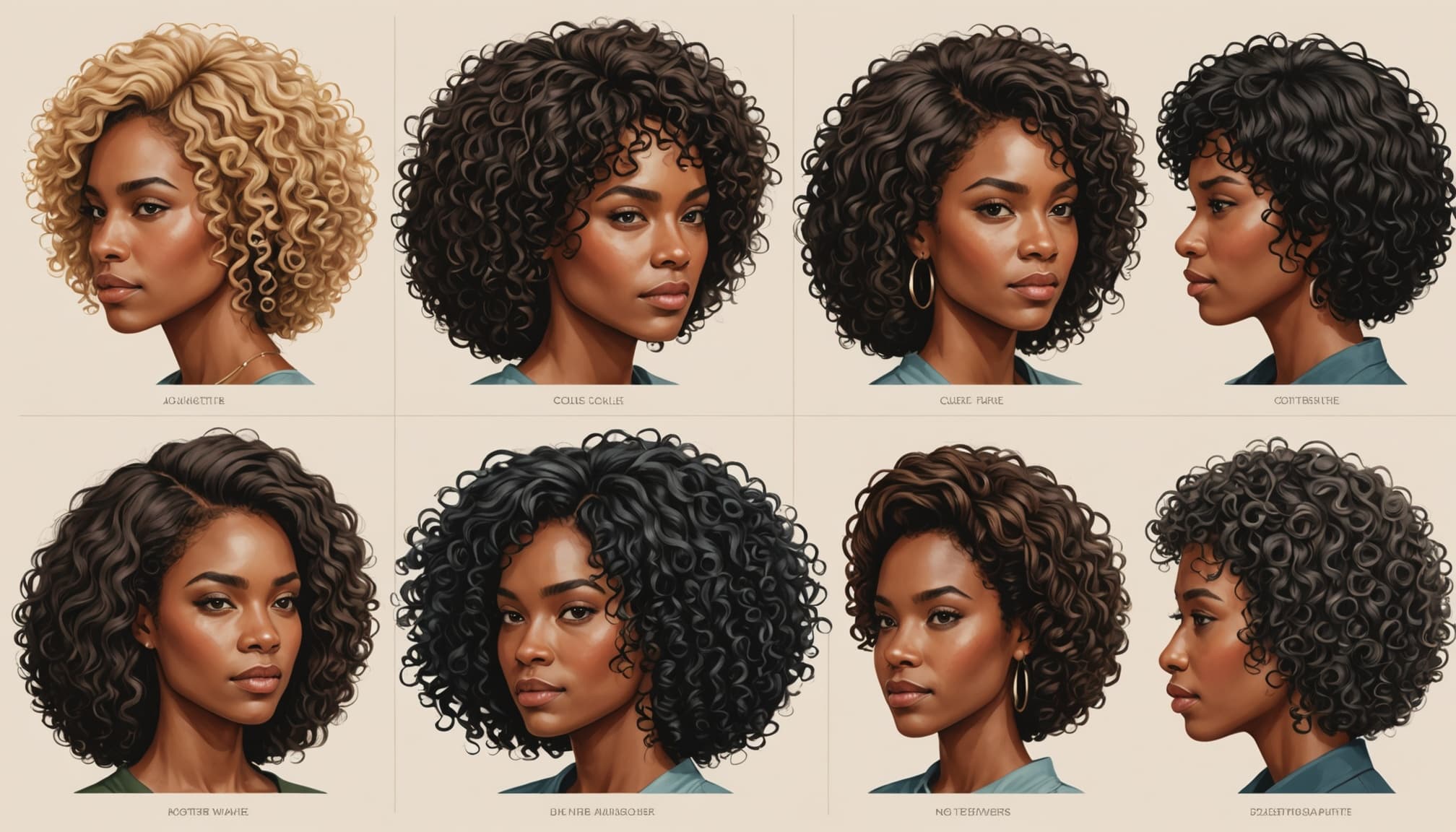
Hair phenotype varies more than almost any other visible trait: texture from straight to tightly coiled, color from white-blonde to black, density from 80,000 to 150,000 follicles, and notable mutations (red, naturally blonde-in-Melanesians, premature graying) that mark specific populations. This article describes what the peer-reviewed literature actually documents.
The Andre Walker hair-typing system
Andre Walker, longtime stylist for Oprah Winfrey, proposed a four-tier hair-texture system in his 1997 book Andre Talks Hair (ISBN 978-0-7432-0005-8). Despite originating outside academic dermatology, the Andre Walker scale has been adopted into clinical hair research as the canonical descriptor:
| Type | Description |
|---|---|
| 1 | Straight (no curl pattern) |
| 2A | Wavy, fine |
| 2B | Wavy, medium |
| 2C | Wavy, coarse |
| 3A | Loose curls |
| 3B | Tighter curls |
| 3C | Very tight corkscrew curls |
| 4A | Tightly coiled, S-pattern |
| 4B | Tightly coiled, Z-pattern |
| 4C | Tightly coiled, very tight Z-pattern, often "peppercorn" appearance |
Modern hair-research literature (Loussouarn et al. 2007, International Journal of Dermatology 46 Suppl 1:2-6) refines Andre Walker into eight curl-classification categories with measurable curl-diameter and curl-curvature parameters, but the Andre Walker 1-4 framework remains dominant in cosmetics, dermatology, and ethnographic literature.
Population modal distributions:
- Icelandic, Finnish, and broader Northern European populations cluster at Andre Walker 1-2A (modal 1)
- Japanese and broader East Asian populations cluster at Andre Walker 1 (very strongly straight) — driven in part by EDAR variant V370A, the East Asian thick-straight-hair adaptation
- Punjabi and broader South Asian populations cluster at Andre Walker 2A-3A
- Yoruba and broader West African populations cluster at Andre Walker 4A-4C (modal 4B-4C)
- Ethiopian populations cluster at Andre Walker 3B-4A — somewhat looser-curl East African pattern compared to West African
- Melanesian populations cluster at Andre Walker 4A-4C with notable natural blondism (see "Color" section below)
The phenotype atlas's Head Hair section documents Andre Walker modal value plus population range per ethnic group.
Hair color genetics — what determines it
Two pigments combine to determine human hair color:
- Eumelanin — produces brown/black pigment. Dominant in dark hair.
- Pheomelanin — produces red/yellow pigment. Dominant in red hair; subtle in blonde and lighter hair.
The principal gene controlling the eumelanin/pheomelanin ratio is MC1R (melanocortin-1 receptor). Loss-of-function MC1R variants reduce eumelanin synthesis and produce red hair when homozygous. Sturm 2009 (Human Molecular Genetics 18:R9–R17) is the canonical pigmentation-genetics review.
Red hair frequency across populations:
- Highest documented: Scotland (~13% of population per the Scottish Government 2014 census-style analysis), Ireland (~10%), Wales (~8%) — driven by elevated MC1R loss-of-function variant frequencies
- Moderate: Northern Europe broadly (~2-6%), some Berber populations (~2-4%)
- Low: Most populations globally, <1%
- Essentially absent: East Asian and most Indigenous American populations — MC1R loss-of-function variants haven't reached appreciable frequency
Red hair carries documented co-traits beyond color: anesthetic resistance (Liem et al. 2004, Anesthesiology 101:279-283 — redheads require ~20% more inhaled anesthetic than non-redheads), thermal-pain perception (Mogil et al. 2003, Journal of Medical Genetics 40:e50), and elevated melanoma risk (independent of UV exposure, per Pérez-Alfonso et al. 2014, Pigment Cell & Melanoma Research 27:686-705).
Blonde hair distribution shows a different genetic basis. Northern European blondism is associated with TYRP1 variants (Sturm 2009). Notably, Solomon Islands blondism is causally distinct — caused by TYRP1 variant rs387907171 fixed at high frequency in some Western Solomon Islands populations per Kenny et al. 2012 (Science 336:554). The mutation arose independently from European blondism. Solomon Islands and Vanuatu populations show natural blonde frequencies of 5-25% in some sub-populations despite Fitzpatrick V-VI skin tone — among the most striking genetic-cosmetic dissociations documented.
Examples:
- Icelandic populations: ~70% naturally blonde or light-brown hair, ~7% red — reflecting Northern European TYRP1 + MC1R variant distribution
- Finnish populations: similar Northern European blondism distribution
- Solomon Islands populations: naturally blonde frequencies of 5-25% in Western Solomon villages despite Fitzpatrick V-VI skin tone — distinct from European blondism
- Punjabi populations: predominantly black (~95%+) with ~5% naturally chestnut-brown variation
- Yoruba and broader West African populations: black hair, near 100% — selection on dark hair persists across the African continent
Hair density — follicle count
Average follicle density on the scalp varies by population:
| Population | Mean scalp follicles | Source |
|---|---|---|
| Northern European | ~120,000-150,000 | Loussouarn 2001, British Journal of Dermatology 145:294 |
| East Asian | ~100,000-130,000 | Loussouarn 2001 |
| West African | ~100,000-115,000 | Loussouarn 2001 |
| Mediterranean | ~110,000-135,000 | Loussouarn 2001 |
The differences are statistically meaningful but small in absolute terms. More striking is the variation in hair-shaft cross-section diameter — East Asian hair averages 100-120 μm, Northern European 70-90 μm, and West African 60-80 μm (with cross-section more elliptical, contributing to curl). This means an East Asian individual with "thinner-looking" hair density may actually have more follicles per cm² because each hair is thicker.
The phenotype atlas documents follicle-density modal values per ethnic group where peer-reviewed sampling exists.
Premature graying
Hair graying timing varies by population. The mean age at first 50% gray hair (per a 2012 multi-population review, Panhard et al., British Journal of Dermatology 167:865-873):
- European populations: ~50 years
- East Asian populations: ~55 years
- West African populations: ~57 years
- South Asian populations: ~50-52 years
Genetic premature graying (before age 30) is documented at <2% in most populations but with variants increasing frequency in some sub-populations.
How the phenotype atlas applies hair data
The atlas's Head Hair category documents per ethnic group:
- Andre Walker modal type (1, 2A-2C, 3A-3C, 4A-4C)
- Color modal frequency (typically: black, dark brown, brown, light brown, blonde, red — with population frequency for each)
- Density modal value with confidence range where peer-reviewed sampling exists
- Notable variants — natural blondism in Melanesians, MC1R red-hair frequency in Northern European groups, etc.
The classifications describe population modal values with documented within-population variation. Individual hair variation within an ethnic group is substantial — within-population variance typically exceeds between-population variance for hair density and shaft diameter (less so for color and curl pattern, where between-population variance dominates).
References
- Loussouarn G. African hair growth parameters. British Journal of Dermatology 145(2):294-297, 2001.
- Loussouarn G, Garcel AL, Lozano I, Collaudin C, Porter C, Panhard S, et al. Worldwide diversity of hair curliness: a new method of assessment. International Journal of Dermatology 46 Suppl 1:2-6, 2007.
- Sturm RA. Molecular genetics of human pigmentation diversity. Human Molecular Genetics 18(R1):R9-R17, 2009.
- Liem EB, Lin CM, Suleman MI, Doufas AG, Gregg RG, Veauthier JM, Loyd G, Sessler DI. Anesthetic requirement is increased in redheads. Anesthesiology 101(2):279-283, 2004.
- Mogil JS, Wilson SG, Chesler EJ, Rankin AL, Nemmani KV, et al. The melanocortin-1 receptor gene mediates female-specific mechanisms of analgesia in mice and humans. PNAS 100(8):4867-4872, 2003.
- Kenny EE, Timpson NJ, Sikora M, Yee MC, Moreno-Estrada A, et al. Melanesian blond hair is caused by an amino acid change in TYRP1. Science 336(6081):554, 2012.
- Panhard S, Lozano I, Loussouarn G. Greying of the human hair: a worldwide survey, revisiting the '50' rule of thumb. British Journal of Dermatology 167(4):865-873, 2012.
- Walker A. Andre Talks Hair. Simon & Schuster, 1997.
Topics
More articles
Butt shape by ethnicity: what an MRI study found and what our database records
Sep 20, 2026
The Wodaabe and the Gerewol: male beauty, the yaake dance, and the Fulani pastoral world
Jul 9, 2026
San peoples of the Kalahari: the Khomani, Ju|'hoan, Taa, and their forager kin
Jul 9, 2026
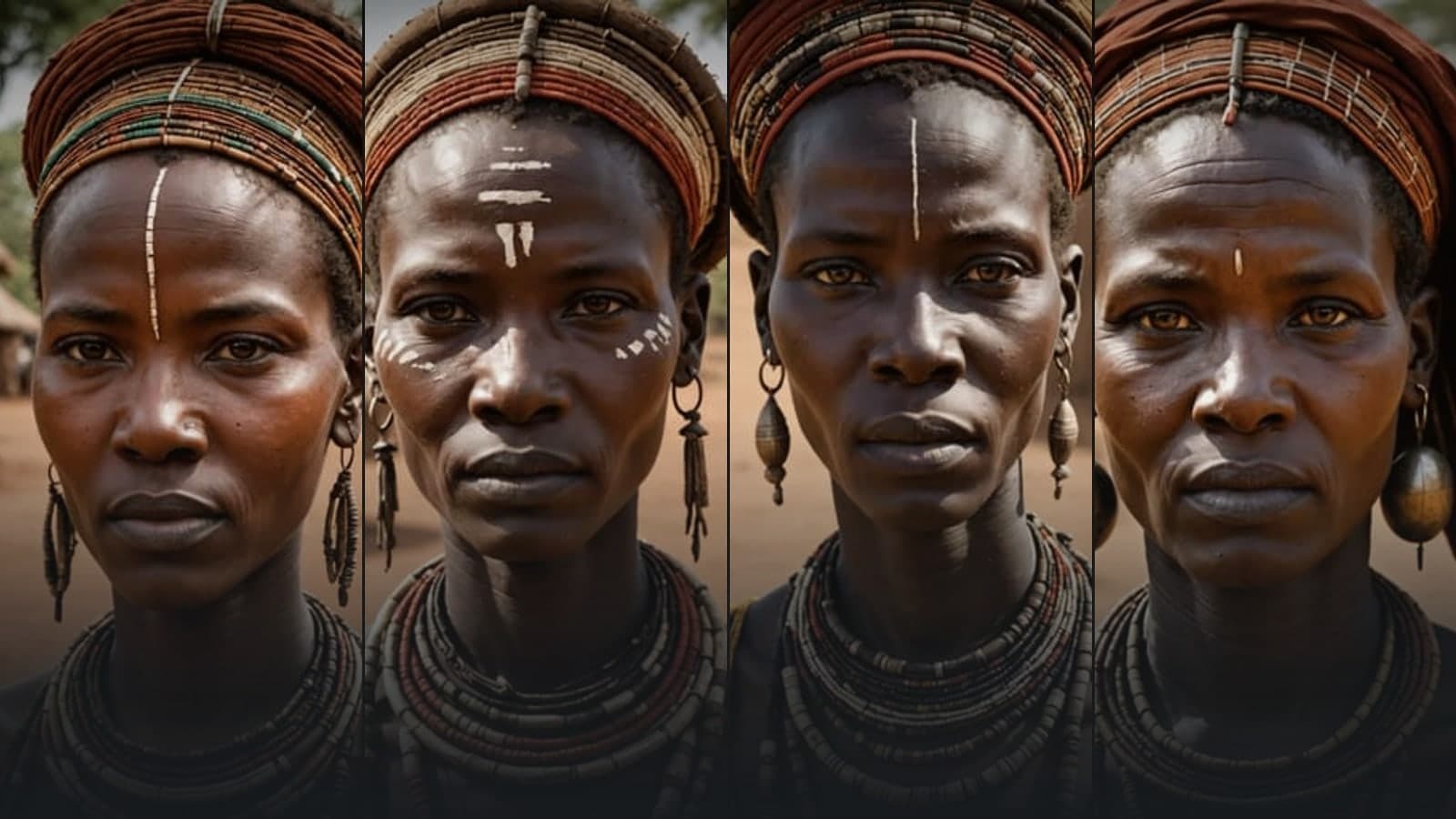
The peoples of the Lower Omo Valley: Mursi, Suri, Karo, Hamar, and their neighbors
Jul 9, 2026