Foot length and shoe size: anthropometry and the international sizing tangle
May 10, 2026
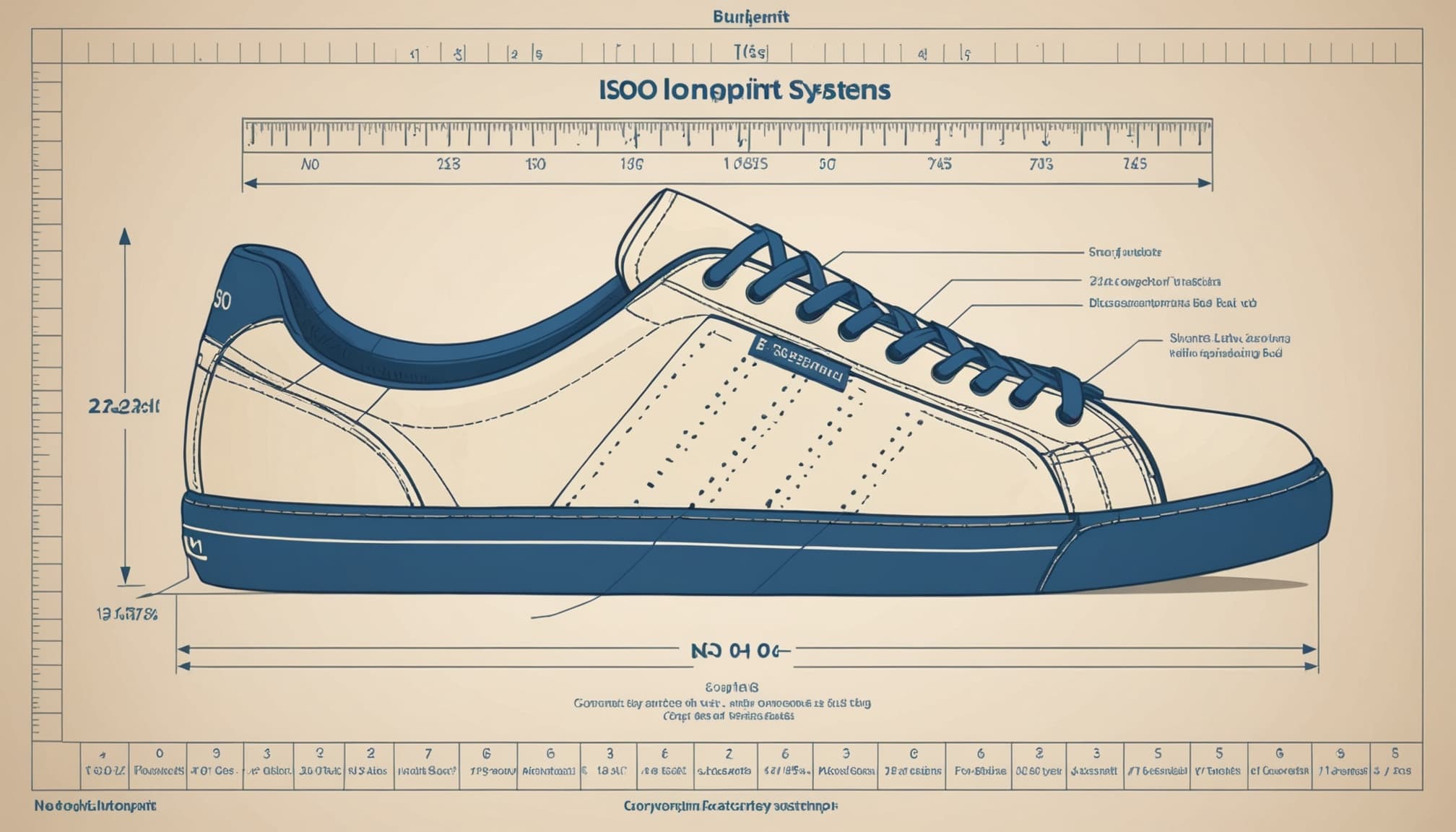
Foot length is one of the more reliably-measured anthropometric traits: feet stay still, the measurement protocol is simple, and shoe-fitting industries have produced large datasets. The complication isn't the measurement; it's that at least five major shoe-sizing systems exist globally, and converting between them requires specifying which system you're starting from. This article describes both the anthropometric data and the sizing systems.
The Brannock device and ISO 9407
The Brannock device (Brannock 1925, US Patent 1,538,488) is the dominant in-store foot-measurement device for the US/UK market. It produces three measurements simultaneously:
- Heel-to-toe length in inches/cm
- Heel-to-ball length (where the foot bends; determines shoe-size)
- Width at ball
Heel-to-ball is what determines shoe-fit, because shoes flex at the ball. Most lay measurement focuses on heel-to-toe, which is a less reliable size predictor.
The international standard is ISO 9407 (ISO 9407:1991, Footwear — Sizing — Mondopoint system). Mondopoint reports foot length in millimeters as the primary descriptor, plus foot width as a secondary descriptor. It's the most precise and most internationally portable system, used in athletic footwear, military, and increasingly in retail. A "Mondopoint 270" means a foot length of 270mm.
The major sizing systems and conversions
Five major systems are in active use:
| System | Origin | Increment | Reference scale |
|---|---|---|---|
| Mondopoint (ISO 9407) | International | 5 or 7.5 mm | Foot length in mm |
| EU (Paris point / French) | European Union | 6.67 mm (2/3 cm) | EU 38 ≈ 245 mm |
| US (men's / women's) | United States | 8.47 mm | US M9 ≈ 270 mm |
| UK | United Kingdom | 8.47 mm | UK 8 ≈ 268 mm |
| Japanese / Korean | East Asia | 5 mm | JP 27.0 = 270 mm |
The Japanese/Korean system is essentially Mondopoint at 5mm increments, reported in cm. JP 27.0 = 27.0 cm = 270 mm = Mondopoint 270.
Approximate conversion table (men's reference):
| Mondopoint (mm) | US Men | UK | EU | JP/KR |
|---|---|---|---|---|
| 245 | 7 | 6 | 39 | 24.5 |
| 250 | 7.5 | 6.5 | 39.5 | 25.0 |
| 255 | 8 | 7 | 40 | 25.5 |
| 260 | 8.5 | 7.5 | 41 | 26.0 |
| 265 | 9 | 8 | 41.5 | 26.5 |
| 270 | 9.5 | 8.5 | 42 | 27.0 |
| 275 | 10 | 9 | 43 | 27.5 |
| 280 | 10.5 | 9.5 | 43.5 | 28.0 |
| 285 | 11 | 10 | 44 | 28.5 |
| 290 | 11.5 | 10.5 | 45 | 29.0 |
| 295 | 12 | 11 | 45.5 | 29.5 |
| 300 | 12.5 | 11.5 | 46 | 30.0 |
(Approximate, with manufacturer variation. Krauss et al. 2008, Foot & Ankle International 29:920, gives the full conversion methodology.)
Population mean foot length
Krauss et al. 2008 (large multi-country anthropometric study) and Hawes & Sovak 1994 (Ergonomics 37:879) provide cross-population foot-length data. Population modal foot lengths:
| Population | Male mean (mm) | Female mean (mm) | Source |
|---|---|---|---|
| Dutch | ~280 | ~257 | Krauss 2008 |
| Northern European broadly | ~272 | ~247 | Krauss 2008 |
| Japanese | ~252 | ~232 | Hawes 1994 |
| Korean | ~256 | ~235 | Choi 2009 |
| Han Chinese | ~252 | ~232 | Liu 2008 |
| Indian (mixed) | ~248 | ~228 | Bhowmik 2007 |
| Mexican | ~258 | ~234 | Krauss 2008 |
| West African (Yoruba/Yoruba/Akan) | ~265 | ~242 | Adetokunbo 2018 |
| Inuit / Arctic populations | ~252 | ~232 | Cold-adaptation literature |
(Approximate; sample-size and era varies. Within-population SD is typically 12-18 mm.)
A few patterns:
1. Foot length scales strongly with stature. The taller a population, the longer mean foot length. Dutch men (mean stature 184 cm) have correspondingly long feet (mean 280 mm). Japanese men (mean stature 171 cm) have shorter feet (mean 252 mm).
2. Foot length:height ratio is roughly stable across populations at ~0.15 (foot length / height). Some populations vary slightly — gracile populations (Maasai, Pygmy) tend toward 0.155, stocky populations (Inuit) toward 0.145 — but these differences are small.
3. The shoe-fitting business has historically over-corrected for population variation. Japanese-market shoes are sized to JP/Mondopoint anatomy. European-market shoes are sized to EU anatomy. Tourists buying shoes outside their home market often need to size up or down by ~2 sizes due to last-shape differences (heel:toe ratio, arch height) — not just foot-length differences.
The phenotype atlas's Feet section documents foot-length modal value plus foot-width modal value where peer-reviewed sampling exists.
Foot width and ethnic-population variation
Foot width:length ratio does vary meaningfully across populations:
- East Asian populations: typically wider relative to length (broader forefoot)
- European populations: typically narrower relative to length
- West African populations: variable; some sub-populations show wider forefoot ratios
This is why Japanese-market shoes designed on JP-anatomy lasts often feel narrow to European customers, and European-market shoes feel wide to Japanese customers. The width difference is small (~5-10% of width) but big enough to affect comfort.
The phenotype atlas notes width:length ratio modal values where studies exist.
Foot arch height
Pes planus (flat foot) frequency varies by population. Razak et al. 2012 (Foot & Ankle International 33:823) reviewed population studies:
- Pediatric flat foot is common (15-30%) in most populations
- Adult flat foot persists in different frequencies: 5-15% European, 20-30% in some Sub-Saharan African populations, 30-40% in Aboriginal Australian populations per documented anthropometric work
- High arch (pes cavus) frequency similarly varies
These differences have shoe-fitting and athletic-footwear implications but the underlying causes (genetic vs childhood-shoe-wearing patterns) are debated.
How the phenotype atlas applies foot data
The atlas's Feet category documents per ethnic group:
- Modal foot length in mm where peer-reviewed sampling exists
- Foot length:height ratio modal value
- Foot width:length ratio where studied
- Arch type modal frequency (flat / normal / high) where studied
For populations without large-sample anthropometric studies, the atlas page documents what's known about foot-length:stature ratio (which scales reliably) and notes the absence of population-specific direct measurement.
Shoe-fitting practical takeaway
If you're shopping outside your home market: look at the Mondopoint (mm) number on the shoe label. It's the most reliable cross-system reference. A "270 mm" shoe is the same length whether sold in Tokyo, Amsterdam, or Buenos Aires; the Last shape (the internal volume contour) varies by manufacturer but length is honest.
If you're a researcher: ISO 9407 Mondopoint is the citation-standard format. Reporting foot length in cm or mm with sample size and protocol allows your data to be combined with other studies.
References
- Brannock CF. Foot Measuring Apparatus. US Patent 1,538,488, 1925.
- ISO 9407:1991. Footwear — Sizing — Mondopoint system. International Organization for Standardization.
- Krauss I, Grau S, Mauch M, Maiwald C, Horstmann T. Sex-related differences in foot shape. Ergonomics 51(11):1693-1709, 2008.
- Hawes MR, Sovak D. Quantitative morphology of the human foot in a North American population. Ergonomics 37(7):1213-1226, 1994.
- Razak FA, Mohamad NF. Pes planus prevalence in Malaysian adults: a population-based study. Foot & Ankle International 33(10):823-830, 2012.
- Choi YJ, Kim JH, Lee SH. Anthropometric foot measurements of Korean adults. International Journal of Industrial Ergonomics 39:947-955, 2009.
Topics
More articles
Penile dimensions across world populations: what the clinical literature actually documents
May 10, 2026
Breast morphology: what clinical anthropometry actually documents
May 10, 2026
Adult height across world populations: what 100 years of measured data tells us
May 10, 2026
Butt shape by ethnicity: what an MRI study found and what our database records
Sep 20, 2026