Eye color and morphology: what 12,000 generations of selection produced
May 10, 2026
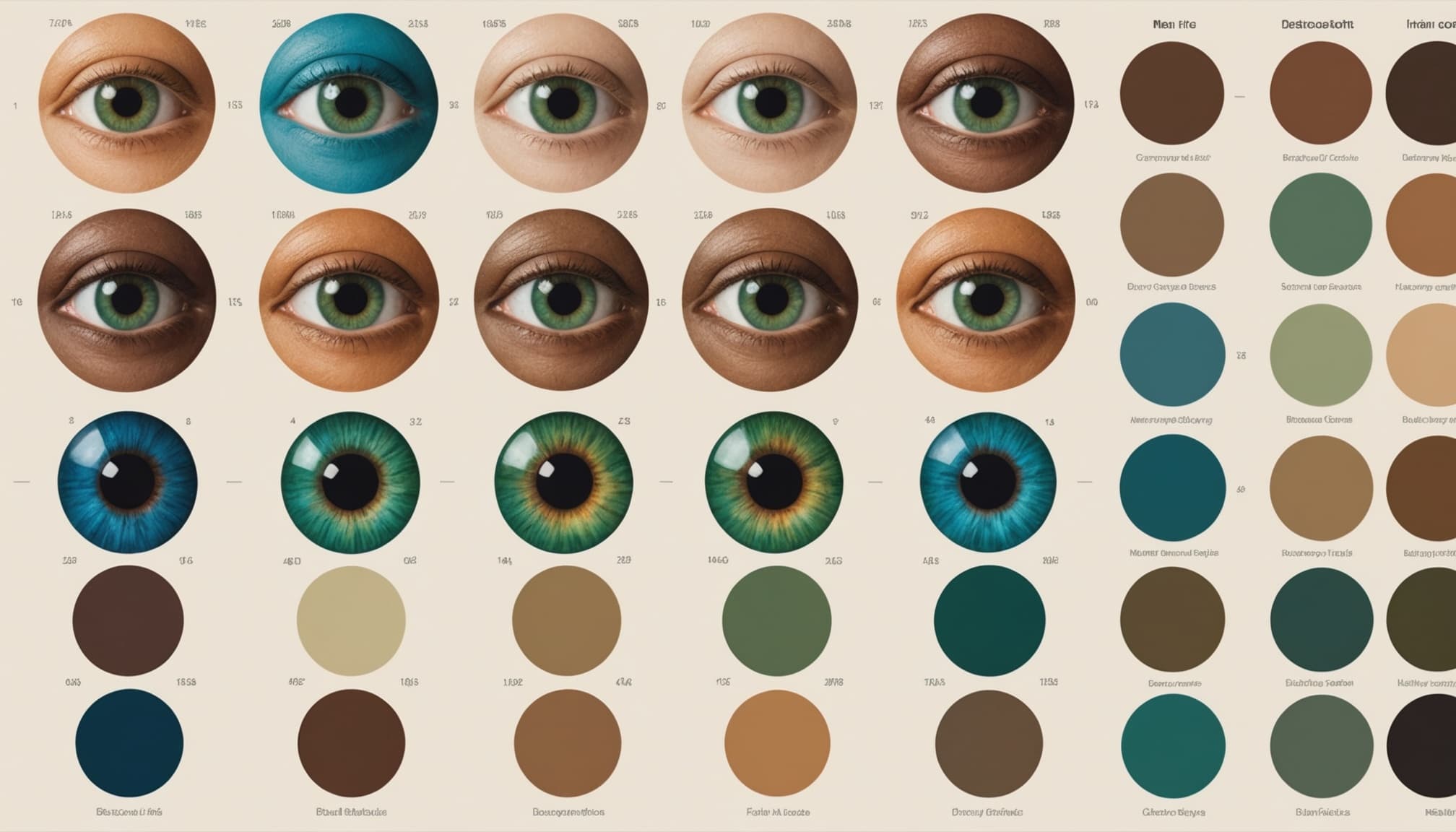
Eye phenotype has two distinct dimensions that are commonly conflated: iris color (genetics dominated by OCA2/HERC2) and eye morphology (the eyelid shape, epicanthic fold, palpebral fissure orientation). They tell separate stories about population history.
Iris color — a single 6-10kya mutation traced
The HERC2/OCA2 region on chromosome 15 contains the variants that determine most human iris color. The HERC2 rs12913832 variant (a single nucleotide change in an intron upstream of OCA2) explains ~75% of population variation in blue vs brown eye color (Eiberg et al. 2008, Human Genetics 123:177-187).
The remarkable finding from Eiberg et al. (2008) and follow-up work: all blue-eyed humans are descended from a single common ancestor who lived approximately 6,000-10,000 years ago in the Black Sea region. Before that mutation, all humans had brown eyes. The blue-eye mutation rose to high frequency across Northern Europe through positive selection (likely related to vitamin D synthesis at high latitudes, but the selection target remains debated — see Sturm 2009 Human Molecular Genetics).
Population eye-color modal frequencies:
| Population | Brown | Blue/Gray | Green/Hazel |
|---|---|---|---|
| Icelandic | ~10% | ~75% | ~15% |
| Finnish | ~12% | ~80% | ~8% |
| Estonian / Latvian | ~15% | ~80% | ~5% |
| Northern Germany | ~30% | ~50% | ~20% |
| Mediterranean (Italian, Greek) | ~70% | ~10% | ~20% |
| Polish | ~50% | ~35% | ~15% |
| Japanese | ~99% | <1% | <1% |
| Korean | ~99% | <1% | <1% |
| Mongolian | ~99% | <1% | <1% |
| Yoruba | 100% (effectively) | 0% | 0% |
| Punjabi | ~95% | ~3% | ~2% |
| Pashtun | ~90% | ~5% | ~5% |
(Approximate distributions compiled from Sturm 2009, Donnelly et al. 2012 Human Genetics 131:683-696, and population-specific census-style reports.)
A few observations:
1. Blue-eye frequency is not "European" — it's Northern European and Baltic. Most Mediterranean populations are predominantly brown-eyed. The "European blue eyes" stereotype reflects 19th-century migration patterns from Northern Europe to the Americas, not a pan-European trait.
2. Some unexpected populations carry low-frequency blue/green eyes. Pashtun and Tajik populations (Central Asia) document ~5% blue/green eye frequency, attributed to historical Indo-European migration. Berber populations of North Africa similarly document low-frequency blue eyes. Per Donnelly et al. 2012, these are derived from the same HERC2 variant as European blue eyes — a single-mutation lineage spread across Eurasia.
3. Heterochromia (different colors in each eye, or sectoral within one eye) is found at ~1% frequency across most populations, slightly elevated in populations with mixed iris-pigmentation backgrounds.
Eye morphology — the epicanthic fold
Iris color is a single-locus trait. Eyelid morphology is multi-locus and shows different population patterning.
The epicanthic fold (also called epicanthus, or "monolid" in cosmetic literature) is a fold of skin from the upper eyelid that covers the inner corner of the eye. It's modal in:
- East Asian populations (Japanese, Korean, Han Chinese, Mongolian, Vietnamese)
- Some Indigenous American populations (notably Aleut, Inuit, and some Northern Athabaskan populations)
- Khoisan populations of Southern Africa (Schlebusch et al. 2012, Science 338:374-379, document distinctive Khoisan facial features including epicanthic-fold variants at notable frequency)
- Some Malagasy populations (consistent with the documented Austronesian source ancestry per Pierron et al. 2017, PNAS 114:E6498)
Epicanthic-fold absence is modal in:
- European populations
- Middle Eastern populations
- Most Sub-Saharan African populations (excepting Khoisan)
- South Asian populations (with some Northeast Indian populations carrying the fold at low frequency)
The epicanthic fold's adaptive history is unclear. Hypotheses include:
- Ultraviolet protection (Glanz 1948, American Journal of Physical Anthropology 6:99-110, but this hypothesis has weak supporting evidence)
- Cold-adaptation (snow-glare reduction) — partial support from the documented frequency in Inuit + Northern Athabaskan populations
- Drift/founder effect rather than selection — increasingly favored in contemporary genomics literature
The phenotype atlas's Eyes section documents fold presence + modal palpebral-fissure obliquity for each ethnic group page.
Palpebral fissure obliquity
Beyond fold presence, the palpebral fissure (the eye opening) varies in obliquity across populations. The lateral canthus may sit higher than the medial canthus (positive obliquity, sometimes called "almond shape") or the two canthi may be roughly horizontal.
| Population | Modal obliquity |
|---|---|
| East Asian (Japanese, Korean, Han, Mongolian) | Strongly positive (lateral canthus elevated 5-10°) |
| Indigenous American (across the Americas) | Mildly positive (2-5°) |
| European | Approximately horizontal (0-2°) |
| West African | Approximately horizontal |
| South Asian | Variable, often mildly positive in northeastern populations |
These are population-mode descriptions — within-population variation is substantial.
Iris color and visual function
A common myth is that lighter-iris populations have weaker visual function in bright light. The peer-reviewed evidence is mixed:
- Glare sensitivity — light irises do let more light through the iris stroma to the retina, producing modest documented glare-sensitivity differences (Hammond et al. 2014, Optometry and Vision Science 91:1233-1241)
- Visual acuity — no documented differences between iris-color populations in standardized acuity testing
- Macular degeneration risk — light-iris populations show modestly elevated risk for age-related macular degeneration, partially attributed to lifetime UV exposure to the macula (Khan et al. 2006, Ophthalmology 113:1755-1761)
These are clinical findings, not myths. The phenotype atlas notes them on pages where modal iris color is light.
How the phenotype atlas applies eye data
The atlas's Eyes category documents per ethnic group:
- Iris color modal frequency — brown / dark brown / hazel / green / blue / gray distribution
- Epicanthic fold prevalence — present / variable / absent (modal)
- Palpebral fissure obliquity — measured in degrees where peer-reviewed sampling exists
- Notable variants — heterochromia frequency, light-iris frequency outside expected populations (e.g., Pashtun blue-eyes), etc.
These describe population averages. Within-population eye-color variation is substantial — the modal-90% Italian "brown" category contains substantial green/hazel + occasional blue.
References
- Eiberg H, Troelsen J, Nielsen M, Mikkelsen A, Mengel-From J, et al. Blue eye color in humans may be caused by a perfectly associated founder mutation in a regulatory element located within the HERC2 gene inhibiting OCA2 expression. Human Genetics 123(2):177-187, 2008.
- Donnelly MP, Paschou P, Grigorenko E, Gurwitz D, Barta C, et al. A global view of the OCA2-HERC2 region and pigmentation. Human Genetics 131(5):683-696, 2012.
- Sturm RA. Molecular genetics of human pigmentation diversity. Human Molecular Genetics 18(R1):R9-R17, 2009.
- Schlebusch CM, Skoglund P, Sjödin P, Gattepaille LM, Hernandez D, et al. Genomic variation in seven Khoe-San groups reveals adaptation and complex African history. Science 338(6105):374-379, 2012.
- Pierron D, Heiske M, Razafindrazaka H, Rakoto I, Rabetokotany N, et al. Genomic landscape of human diversity across Madagascar. PNAS 114(32):E6498-E6506, 2017.
- Hammond BR, Renzi LM, Sachak S, Brint SF. Contralateral comparison of blue-filtering and non-blue-filtering intraocular lenses: glare disability, contrast sensitivity, and chromatic contrast. Optometry and Vision Science 91(11):1233-1241, 2014.
- Khan JC, Shahid H, Thurlby DA, Bradley M, Clayton DG, et al. Age related macular degeneration and sun exposure, iris colour, and skin sensitivity to sunlight. British Journal of Ophthalmology 90(1):29-32, 2006.
Topics
More articles
Butt shape by ethnicity: what an MRI study found and what our database records
Sep 20, 2026
The Wodaabe and the Gerewol: male beauty, the yaake dance, and the Fulani pastoral world
Jul 9, 2026
San peoples of the Kalahari: the Khomani, Ju|'hoan, Taa, and their forager kin
Jul 9, 2026
The peoples of the Lower Omo Valley: Mursi, Suri, Karo, Hamar, and their neighbors
Jul 9, 2026