Help us get this right
Does this portrait look right for Ukrainians?
One tap. It takes a second and it is recorded.
1 says it looks right, 0 say it looks off.
Ukrainians Erotic
Also known as: Ukrainian
Christianity / Eastern Orthodoxy
Poleshuks, Cossacks, along with significant populations in the United States, Brazil, Kazakhstan, Germany, Canada, Italy, Argentina, the Czech Republic, and Romania
About Ukrainians People
Ukrainians are an East Slavic people whose identity has been forged less by isolation than by sitting at one of Europe's most contested seams — the long flat corridor where the steppe meets the forest, where Catholic Poland once pushed east and Orthodox Muscovy pushed west, and where the Black Sea trade routes met the grain belt. The result is a nation that has spent centuries defining itself against pressure from every direction, and a culture that reads as distinctly its own to anyone who has spent time in both Warsaw and Moscow and noticed it sits in neither.
The Ukrainian language is Slavic and mutually intelligible to a degree with Russian and Belarusian, but the differences are not cosmetic — vocabulary, vowel shifts, and a softer phonetic palette set it apart, and Polish loanwords betray centuries inside the Polish-Lithuanian Commonwealth. For much of the imperial and Soviet periods the language was suppressed, banned from print, or dismissed as a peasant dialect; its survival owed a great deal to the village and to a stubborn literary tradition built around figures like Taras Shevchenko, whose poetry still functions as something close to scripture in the national self-image.
Religion is overwhelmingly Eastern Christian, but split along lines that matter. The Ukrainian Orthodox Church (now largely autocephalous, a 2019 break from Moscow) dominates the center and east, while the Ukrainian Greek Catholic Church — Eastern in liturgy but in communion with Rome — anchors the west, particularly Galicia. These are not interchangeable; they map onto distinct historical experiences under Habsburg versus Russian rule and still color regional sensibilities.
The sub-groups reflect that geography. The Poleshuks of the northern marshlands, the Hutsuls and Lemkos of the Carpathians, and the Cossack heritage of the central and southern steppe all carry their own dialects, dress, and music — the Hutsul polyphonic singing and the Cossack duma ballads belong to different worlds. The Cossack legacy in particular looms large in national mythology: a tradition of armed self-government on the steppe frontier that Ukrainians return to whenever they want to talk about who they are.
The diaspora is enormous and old, built in successive waves — late-19th-century homesteaders to the Canadian prairies and Brazil, displaced persons after the Second World War, labor migrants to Italy and Portugal, and the most recent exodus driven by the war that began in 2022. Communities in Canada and Argentina have held onto the language and rite for four generations, which is itself a fact about how Ukrainians tend to organize themselves abroad: through the parish, the cultural hall, and the Saturday school.
Related ethnic groups
Groups that share Ukrainians's homeland, region, language, or religious tradition. These are likely candidates for comparative phenotype reference.
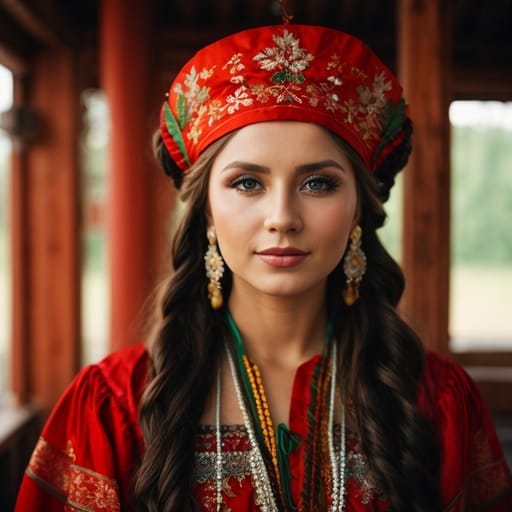
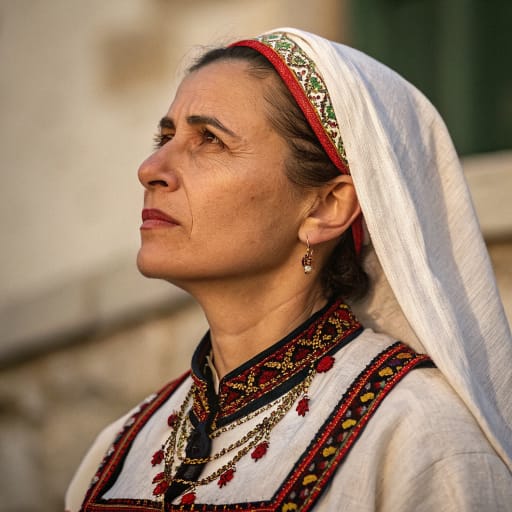
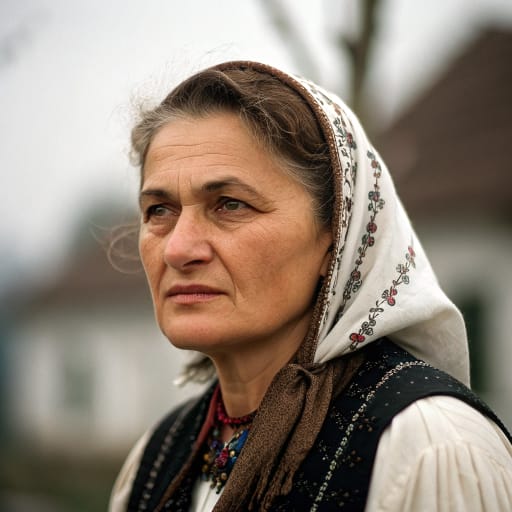
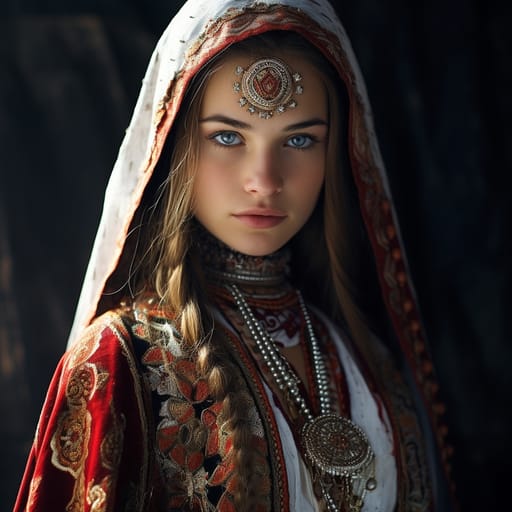
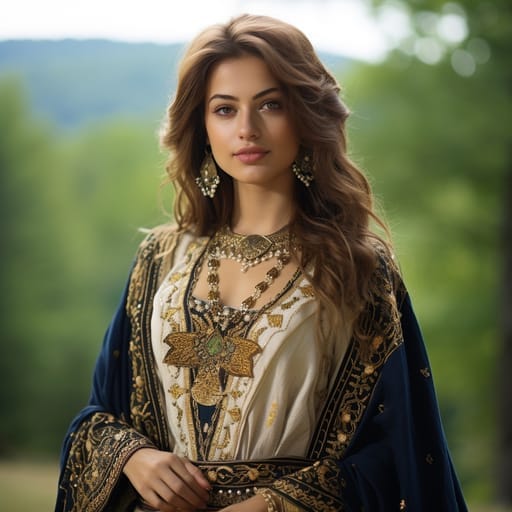
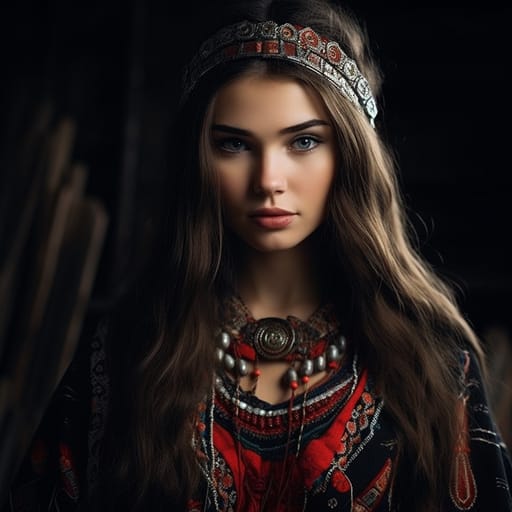
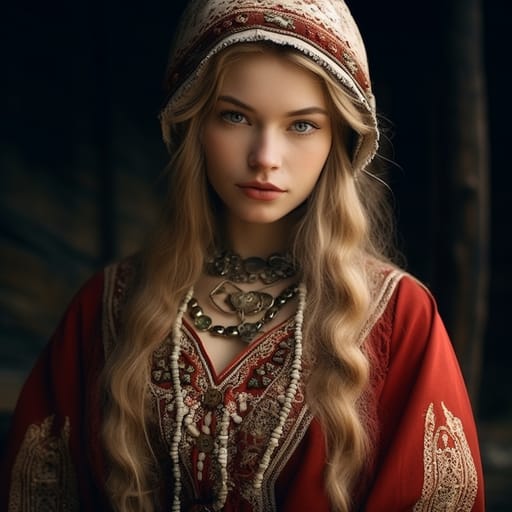
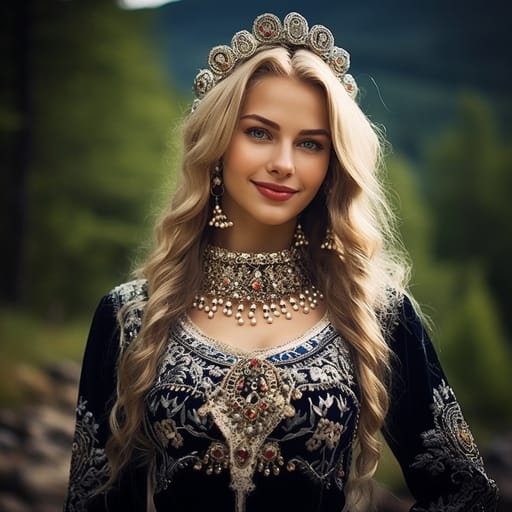
Typical Ukrainians Phenotypes
Reference for AI generation: hair, eyes, skin, facial structure, build
Ukrainian phenotype sits at the western edge of the East Slavic cluster, with measurable Baltic and Carpathian inputs that pull it slightly fairer and taller than the Russian average. Hair runs from ash blond and dark blond through every shade of light brown to chestnut, with true black uncommon outside the Carpathian foothills and the southern steppe, where Pontic and Turkic admixture leaves a darker cast. Texture is overwhelmingly straight to lightly wavy; tight curls are rare. Natural light-brown and dark-blond combinations are probably the modal adult coloring, often darkening from a much lighter childhood shade.
Eye color is unusually variable. Blue, blue-grey, and grey-green are common in the north and west — Volyn, Galicia, the old Poleshuk belt — while hazel and warm brown predominate in the central forest-steppe and the south. Pure dark brown becomes more frequent moving toward the Black Sea coast. Eyelids are open and Europid; epicanthic folds are absent except as occasional traces in the far southeast. Eye shape tends to be almond to slightly downturned, set under a low, often soft brow.
Skin is Fitzpatrick II–III with cool to neutral undertones; a true olive cast appears mainly in Carpathian Rusyn and Bukovinian populations. Cheeks flush easily. Faces are broad through the cheekbone but with a softer, less angular jawline than the classic Russian or Polish template — rounded chins, full mid-face, lips on the fuller side of European norms. Noses are typically straight or with a gentle bridge; aquiline forms cluster in the west, snub forms in the north.
Build is tall and substantial. Adult men average around 178 cm, women around 166 cm, with broad shoulders and long legs; Cossack-descended populations of the Dnipro basin skew taller and heavier-framed still. Boxer Wladimir Klitschko and mathematician Maryna Viazovska sit comfortably inside the central type. Poleshuks read paler, lighter-haired and rounder-faced; Cossack lineages run darker, sharper-featured and physically larger.
Ukrainians Body & Anatomy Reference
Anatomy by feature, Eastern European / Slavic phenotype
Ukrainians Boobs & Breasts
The typical Ukrainians bust is medium-to-large cup, full, moderate-to-high projection, in line with the wider Eastern European / Slavic pattern. Areolas usually fall in the 30-44mm range, with light-pink to medium-brown areolar pigmentation against the fair-to-light-brown skin tone. Compared with the smaller East Asian bust, Ukrainians breasts sit forward and are generally full and projecting, classic Eastern European curvy bust. A faithful AI render of Ukrainians tits keeps that shape and areola size.
Ukrainians Ass & Hips
Butt shape among Ukrainians women: medium-to-full, moderate-to-high projection, over medium iliac crests, full gluteal-femoral fat deposition. This follows Eastern European / Slavic ancestry and looks quite unlike the slim narrow-hip East Asian profile. An accurate Ukrainians ass in adult AI imagery keeps both the silhouette and the overall build (mesomorph, full hip-and-bust deposition) instead of a generic average.
Ukrainians Vagina & Pussy
Vulvar anatomy among Ukrainians women: light-pink to medium-brown labial pigmentation, varied labia minora. Pubic hair tends to be wavy medium texture, blond to dark-brown, in the usual inverted-triangle pattern. Both follow Eastern European / Slavic pigmentation, which is why Ukrainians pussy renders should not fall back on a pale, sparse Western template.
Ukrainians Dicks & Penis
The Ukrainians cock profile, from Eastern European / Slavic anthropometric data: regional mean ~13-14cm erect; moderate girth; light-pink to medium-brown shaft pigmentation. Pubic hair has a wavy medium texture and forms the usual inverted-V pattern. Whether Ukrainians men are circumcised follows religious and cultural practice rather than phenotype.
Ukrainians Body, Curves & Build
Build and curves among Ukrainians women follow the Eastern European / Slavic pattern: mesomorph, full hip-and-bust deposition, mean adult female BMI 23-26. Proportions matter as much as skin tone, so Ukrainians figures should keep their regional height and limb ratios.
Ukrainians Skin Tone & Hair Texture
The Ukrainians skin range is fair to light (Fitzpatrick II-III), and hair tends to be straight-to-wavy 1A-2B, light-blond to dark-brown. That combination marks the Eastern European / Slavic phenotype, and skin tone is the trait AI generators most often get wrong for Ukrainians women.
Data depth
55/100Coverage of image-grounded phenotype observations · drives AI generation diversity
- Sample size
- 31/40· 29 images
- Image quality
- 14/30· 28% high
- Confidence
- 10/20· mean 0.67
- Source diversity
- 0/10· wikipedia
- ·Mostly low-quality source images
- ·Wikipedia-only source, not population-representative
Observed Distribution: Image Sample
Empirical observations from analyzed photographs · supplementary signal, not population truth
Sample: 29 images analyzed (29 wikipedia). Quality: 8 high, 16 medium, 4 low, 0 very_low. Avg analyzer confidence: 0.66.
Skin tone (Fitzpatrick): II (83%), III (14%), unclear (3%)
Hair color: gray/white (69%), black (21%), light/medium brown (3%), dark brown (3%), unclear (3%)
Hair texture: straight (59%), wavy (31%), bald (3%), shaved (3%), unclear (3%)
Eye color: blue (17%), dark brown (17%), hazel (14%), brown (3%), unclear (48%)
Epicanthic fold: 0% present, 93% absent, 7% unclear
Caveats: Quality skews toward older or low-resolution photos; phenotype detail may be lossy. Sample is 100% Wikipedia notable people, which skews toward male, public-life, and modern figures, not population-representative.
Last aggregated: May 7, 2026
Explore phenotype categories
Structured taxonomy with peer-reviewed scales · 22 anatomical categories
Notable Ukrainians People
100 reference figures, sourced from Wikipedia
- English, international language in Ukraine)
- Selig Brodetsky, 1888-1954), British mathematician, President of the Hebrew University of Jeru…
- Vladimir Drinfeld, 1954 (age 71-72)), Fields medal laureate
- Anatoly Fomenko, 1945 (age 80-81))
- Mark Kac, 1914-1984), Jewish, Polish-American mathematician
- Volodymyr Semenovych Korolyuk, 1925-2020)
- Oleksandr Mikolaiovich Sharkovsky, 1936-2022), known for developing Sharkovsky's theorem on the periods of discr…
- Samuil Shatunovsky, 1859-1929), Jewish mathematician
- Mykhailo Vashchenko-Zakharchenko, 1825-1912), major areas of research included the history of geometry in antiq…
- Ivan Śleszyński, 1854-9 March 1931), ethnic Polish Ukrainian mathematician
- Pavel Urysohn, 1898-1924), Jewish mathematician
- Josif Shtokalo, 1897-1987)
- Naum Z. Shor, 1937-2006), Jewish Ukrainian mathematician
- Maryna Viazovska, born 1984), Fields medal laureate, known for her work in sphere packing
- Gersh Budker, nuclear physicist (Budker Institute of Nuclear Physics)
- Georges Charpak, French physicist (Nobel Prize), born in East Galicia
- Abram Ioffe, prominent Soviet physicist (Ioffe Physico-Technical Institute)
- Isaak Khalatnikov, BKL conjecture in general relativity
- Leo Palatnik, thin film physics
- Ivan Pulyui, scientist working with cathode radiation
- George Yuri Rainich, mathematical physicist
- Lubomyr Luciuk, political geographer, community activists
- Vladimir Vernadsky, mineralogist, biochemist
- Israel Dostrovsky, 1918-2010), Russian (Ukraine)-born Israeli physical chemist, fifth president …
- Volodymyr Vernadsky, mineralogist, biochemist
- Selman Waksman, 1888-1973), Jewish, Ukrainian-American, biochemist, Nobel Prize (1952)
- Nikolai Amosov, heart surgeon
- Vitalii Khmel, military thoracic surgeon
- Nikolay Pirogov, inventor of a splint, sling, brace or cast
- Serdyuk Valentin, orthopedic surgeon
- Nicolai L. Volodos, cardiovascular surgeon
- Volodymyr Chelomey, ballistic missile and Ukrainian spacecraft designer
- Valentin Glushko, engineer, designer of Soviet rocket engines
- Mykola Holonyak, first visible diode
- Volodymyr Horbulin, developer of strategic rocket systems and space vehicles of "Kosmos" series
- Sergei Korolev, the father of the Soviet space program, inventor of the first intercontinenta…
- Mykola Kybalchich, rocket science pioneer
- Yuri Kondratyuk, spaceflight pioneer
- Volodymyr Mackiw, mining engineer
- Yevhen Paton, welding engineer
- Igor Sikorsky, aviation pioneer, creator of the first helicopter
- Stepan Tymoshenko, father of modern Ukrainian engineering mechanics
- Mykhailo Tuhan-Baranovsky, 1865-1919)
- Eugen Slutsky, 1880-1948), born in Russian Empire in the territory of Ukraine, Slutsky equation
- Ludwig von Mises, 1881-1973), born in Austria-Hungary in the territory of present-day Lviv), fo…
- Bohdan Hawrylyshyn, 1926-2016), noted economist, visionary and economic advisor to the Ukrainian …
- Vikentiy Khvoyka, discovered Trypillia culture
- Simhah Pinsker, 1801-1864), Polish-Jewish archeologist and scholar
- Volodymyr Antonovych, historian and folklorist
- Kateryna Antonovych-Melnyk, 1859-1942), Ukrainian historian
- Mykhailo Drahomanov, historian, political emigre and folklorist
- Mykhailo Hrushevsky, historian
- Mykola Kostomarov, literary historian, folklorist
- Oleh Kozerod, political scientist
- Peter Loboda, researcher of ancient Ukrainian numismatics
- George S. N. Luckyj, literary historian
- Mykhailo Maksymovych, literary historian, folklorist
- Paul Robert Magocsi, chairman of Ukrainian Studies at the University of Toronto
- Bohdan Osadchuk, journalist
- Omeljan Pritsak, orientalist
- Mikołaj Siwicki, historian
- Viktor Suvorov, spy and WWII researcher
- Dmytro Yavornytsky, Cossack historian, archaeologist
- Hryhorii Skovoroda, philosopher, poet and composer
- Olgerd Bochkovsky, sociologist
- Robert Klymasz, Ukrainian Canadian folklorist
- Yuriy Kovbasenko, Ukrainian philologist and educator
- Volodymyr Kubiyovych, geographer and encyclopedist
- Anton Makarenko, Ukrainian and Soviet educator
- Wilhelm Reich, psychiatrist and psychoanalyst, pro-Ukrainian freedom dissident
- Otto Struve, Ukrainian-Russian-American astronomer
- Evhen Tsybulenko, professor of international law
- Sergiy Vilkomir, computer scientist
- Fedir Vovk, anthropologist and ethnographer
- Ivan Aivazovsky, painter, known for his seascapes
- Nathan Altman, 1889-1970), Ukrainian-Jewish painter and stage designer from Vinnytsia
- Svitlana Biedarieva, artist, art historian, curator
- David Burliuk, avant-garde painter, Ukrainian freedom thinker
- Petro Choldny, 1904-1990), Neo-Byzantine Iconographer
- Sonia Delaunay, avant-garde artist
- Aleksandra Ekster, avant-garde artist
- Nina Genke-Meller, avant-garde artist
- Maurice Gottlieb, 1856-1979), Polish-Jewish painter
- Leopold Gottlieb, 1883-1934), Polish-Jewish painter
- Alexander Khvostenko-Khvostov, avant-garde stage designer
- Boris Lekar, Israeli painter
- Ephraim Moses Lilien, German-Jewish painter
- Kazimir Malevich, avant-garde artist
- Ivan Marchuk, modern painter
- Vadym Meller, avant-garde artist, stage designer
- Solomon Nikritin, painter, avant-garde artist
- Nykifor, primitivist painter
- Vlada Ralko, collage artist
- Kliment Red'ko, painter, avant-garde artist
- Bruno Schulz, 1892-1942), Polish-Jewish painter and writer
- David Shterenberg, painter from Zhytomyr
- Volodymyr Sichynskyi, architect, graphic artist
- Opanas Slastion, folklorist, designer of modern type of bandura
- Avigdor Stematsky, Israeli painter from Odesa
- Sergei Sviatchenko, born 1952)
Erotic Poses & Sex Positions
From the pose catalog: 219 named positions with reference skeletons
Frequently asked questions about Ukrainians people
Where is the Ukrainians homeland?
The Ukrainians homeland is Ukraine in Eastern Europe.
What language do Ukrainians people speak?
Ukrainians people primarily speak Indo-European / Slavic / Ukrainian.
What religion do Ukrainians people practice?
The predominant religion among Ukrainians people is Christianity / Eastern Orthodoxy.
What are other names for Ukrainians people?
Ukrainians people are also known as Ukrainian.






Make your own Ukrainians images
Five a day, free, no credits to buy. The studio starts from this group's phenotype data, so you can set body type, pose and style and keep the traits accurate.
Start with Ukrainians