Help us get this right
Does this portrait look right for Komi?
Nobody has judged this one yet. You would be the first.
Komi Erotic
Russia (Komi Republic, Permyakia)
Christianity / Eastern Orthodoxy
Komi-Zyrians, Komi-Permyaks, Izhma Komi
About Komi People
The Komi are a Permic-speaking people of the northern Russian forests, settled across the basins of the Vychegda, Pechora, and upper Kama. Their homeland is taiga country — long winters, slow rivers, peat bogs, and stretches of spruce that swallow sound — and the older economy was built around it: hunting, trapping sable and squirrel, river fishing, and reindeer herding in the far north. The Komi-Zyrians occupy the Komi Republic proper; the Komi-Permyaks live further south around the Kama in what was their own autonomous district until it merged into Perm Krai in 2005; the Izhma Komi, a northern branch shaped by long contact with Nenets reindeer herders, kept herding as a defining occupation rather than a sideline.
Komi belongs to the Permic branch of Uralic, closely related to Udmurt and more distantly to Hungarian and Finnish — a relationship that surprises people who assume everything in this part of Russia must be Slavic. Komi-Zyrian and Komi-Permyak are usually treated as separate literary languages, close enough to be mutually intelligible but written and standardized apart. The language has its own early literary history: in the fourteenth century the missionary Stephen of Perm devised an original alphabet, the Anbur, to translate scripture before Cyrillic eventually displaced it. That mission also marks the religious turning point. The Komi were Christianized into Eastern Orthodoxy from the late 1300s onward, and Orthodoxy has remained the dominant affiliation since, though older animist habits — keeping the forest on good terms, observances tied to hunting and to the household — survived alongside the church and in places still do, especially among the Old Believer communities that took refuge in these remote drainages after the seventeenth-century schism.
Soviet-era industrialization changed the demographic balance sharply. The Pechora coal basin, the Gulag camps that built much of the region's infrastructure, and later oil and gas development brought waves of Russian-speaking labor into Komi territory, and the Komi are now a minority in their own republic. Language transmission has weakened in cities but holds better in rural districts, and a steady cultural revival since the 1990s has put effort into schooling, publishing, and folklore work. The Komi tend to present themselves matter-of-factly: a northern people who built a life out of a hard landscape, kept a distinct language through centuries of pressure, and are still here.
Related ethnic groups
Groups that share Komi's homeland, region, language, or religious tradition. These are likely candidates for comparative phenotype reference.
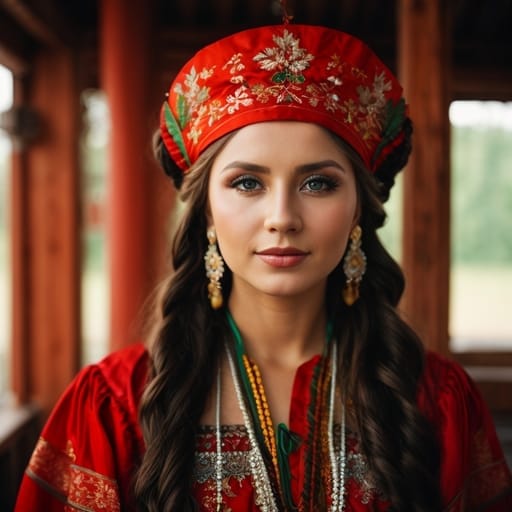
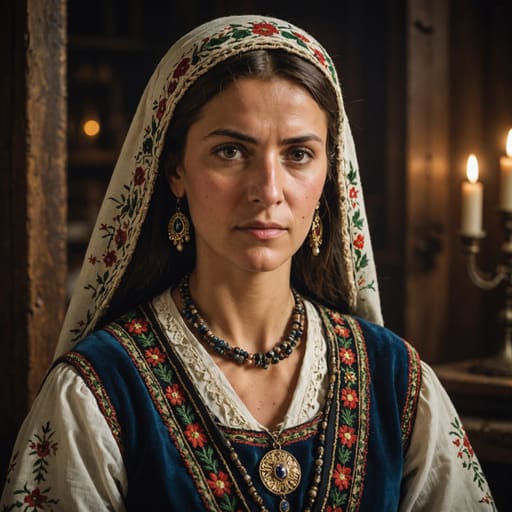
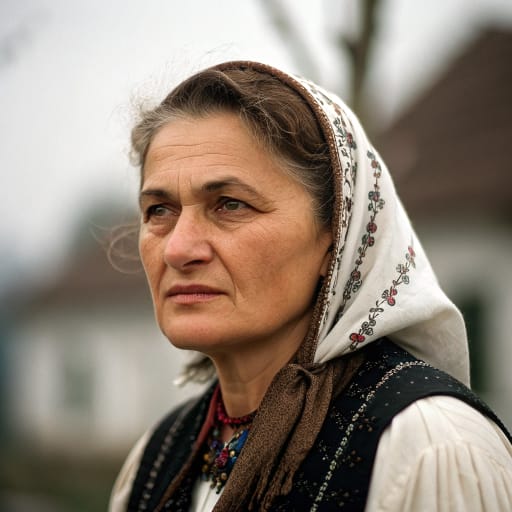
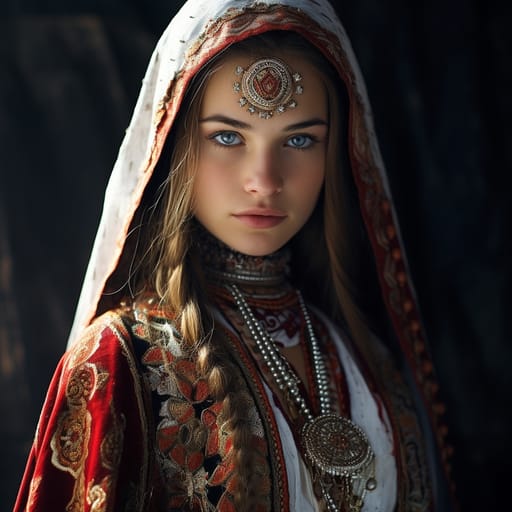
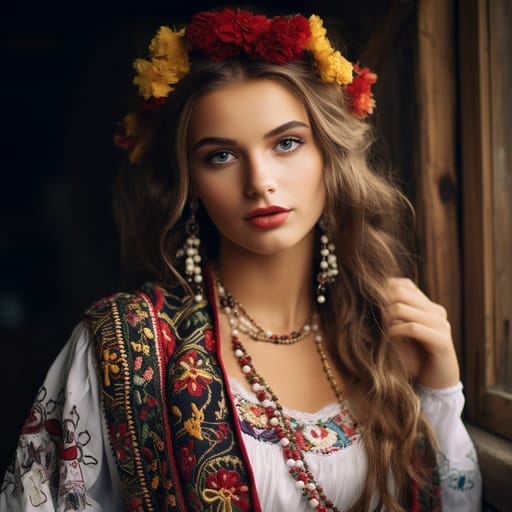
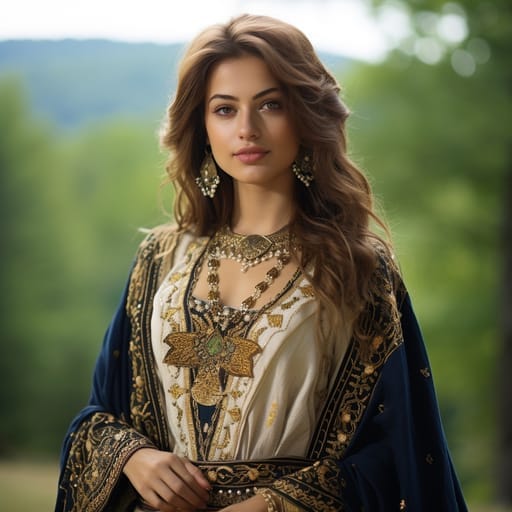
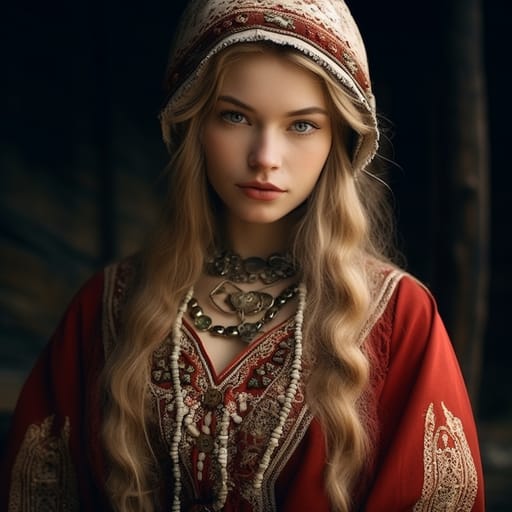
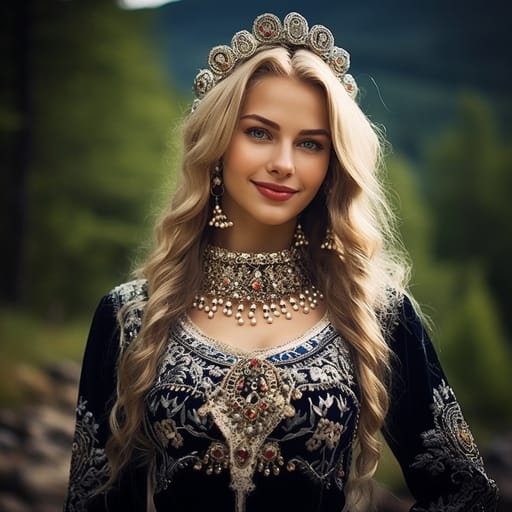
Typical Komi Phenotypes
Reference for AI generation: hair, eyes, skin, facial structure, build
The Komi sit at a recognizable seam between Northern European and Uralic phenotypes — a Permic-speaking population whose appearance reads as predominantly North European with a consistent, if subtle, Siberian undertone visible in eye shape, midface flatness, and pigmentation patterns that don't quite match neighboring Russians. They cluster genetically with other Permic peoples (Udmurts, and more distantly Mari), and the phenotype reflects that mixed northern ancestry rather than a clean European or Asian read.
Hair runs medium to dark brown most often, with a meaningful minority of ash-blond and dark-blond shades, especially among Komi-Zyrians of the western and northern districts. True black hair is uncommon; red and auburn appear at low but noticeable rates. Texture is typically straight to gently wavy, fine to medium in thickness. Eye color is split — grey, blue, and grey-green dominate in roughly half the population, hazel and light brown in the rest, with dark brown a minority. A soft epicanthic fold or slightly hooded inner-canthus is seen in a substantial share of faces without being universal; the eye opening tends to read as narrow and set under a low, straight brow.
Skin is pale, Fitzpatrick II–III, often with a cool or neutral undertone and a tendency to flush rather than tan. Facial structure leans toward broad, flat midface with prominent but rounded cheekbones, a short straight or slightly concave nose bridge with a moderate alar width, and lips of medium fullness. Jaws are typically squared rather than pointed. Build is short to medium — men commonly 168–174 cm, women 156–162 cm — with sturdy, compact proportions, broad shoulders relative to height, and a tendency toward stockiness that holds across both sexes.
Among sub-groups, Komi-Permyaks of the southern Kama basin tend toward slightly darker hair and rounder faces; Izhma Komi, shaped by reindeer-herding life and historical contact with Nenets, show the most visible Siberian features — flatter midfaces, more frequent epicanthic folds, and darker eyes than their Zyrian relatives.
Komi Body & Anatomy Reference
Anatomy by feature, Eastern European / Slavic phenotype
Komi Boobs & Breasts
Komi boobs follow the Eastern European / Slavic profile: medium-to-large cup, full, moderate-to-high projection. Areolar diameter is usually 30-44mm, and the coloring is light-pink to medium-brown areolar pigmentation against the fair-to-light-brown skin tone. Breast shape tracks body composition (mesomorph, full hip-and-bust deposition, mean adult female BMI 23-26), so Komi breasts tend to be full and projecting, classic Eastern European curvy bust. Expect a forward-set shape, not the smaller East Asian bust.
Komi Ass & Hips
Komi ass and hip morphology presents as medium-to-full, moderate-to-high projection, distinctly different from the slim narrow-hip East Asian profile. The Komi pelvic profile shows medium iliac crests, full gluteal-femoral fat deposition, anchored in the Eastern European / Slavic skeletal pattern. Komi butt shots in adult AI imagery should render the medium-to-full, moderate-to-high projection silhouette with the overall build (mesomorph, full hip-and-bust deposition) and the fat distribution typical of the Eastern European / Slavic phenotype.
Komi Vagina & Pussy
Komi pussy anatomy typically shows light-pink to medium-brown labial pigmentation, varied labia minora. Pubic hair is usually wavy medium texture, blond to dark-brown. In AI-generated Komi nudes, labial color should blend into the fair to light skin with a gradual transition, and the hair should keep its wavy medium texture.
Komi Dicks & Penis
Penis reference for Komi men: regional mean ~13-14cm erect, moderate girth. Coloring: light-pink to medium-brown shaft pigmentation. An accurate Komi cock in AI imagery matches the surrounding fair to light skin rather than a generic porn default. Circumcision depends on religion and custom, not ancestry.
Komi Body, Curves & Build
The Komi figure is generally mesomorph, full hip-and-bust deposition, with mean adult female BMI 23-26, characteristic of Eastern European / Slavic ancestry. AI image tools tend to flatten regional body types into a few stock shapes; here the Komi build is kept as its own reference.
Komi Skin Tone & Hair Texture
Skin: fair to light (Fitzpatrick II-III). Hair: straight-to-wavy 1A-2B, light-blond to dark-brown. Both are typical of Eastern European / Slavic ancestry. The most common mistake in AI nudes of Komi women is a body rendered lighter than the face.
Data depth
51/100Coverage of image-grounded phenotype observations · drives AI generation diversity
- Sample size
- 11/40· 4 images
- Image quality
- 25/30· 50% high
- Confidence
- 15/20· mean 0.83
- Source diversity
- 0/10· wikipedia
- ·Small sample (n<10)
- ·Wikipedia-only source, not population-representative
Observed Distribution: Image Sample
Empirical observations from analyzed photographs · supplementary signal, not population truth
Sample: 4 images analyzed (4 wikipedia). Quality: 2 high, 2 medium, 0 low, 0 very_low. Avg analyzer confidence: 0.83.
Skin tone (Fitzpatrick): II (75%), III (25%)
Hair color: black (50%), gray/white (25%), dark brown (25%)
Hair texture: straight (75%), wavy (25%)
Eye color: dark brown (50%), blue (25%), unclear (25%)
Epicanthic fold: 0% present, 100% absent, 0% unclear
Caveats: Sample size 4 is small, so the observed distribution should be treated as suggestive, not definitive. Sample is 100% Wikipedia notable people, which skews toward male, public-life, and modern figures, not population-representative.
Last aggregated: May 7, 2026
Explore phenotype categories
Structured taxonomy with peer-reviewed scales · 22 anatomical categories
Notable Komi People
4 reference figures, sourced from Wikipedia
- Pitirim Sorokin, Russian-American sociologist
- Peter Sorokin, Russian-American physicist
- Konstantin Zyryanov, Russian football manager and a former player
- Katya Shchekina, Russian model
Erotic Poses & Sex Positions
From the pose catalog: 219 named positions with reference skeletons
Frequently asked questions about Komi people
Where is the Komi homeland?
The Komi homeland is Russia (Komi Republic, Permyakia) in Eastern Europe.
What language do Komi people speak?
Komi people primarily speak Uralic / Permic / Komi.
What religion do Komi people practice?
The predominant religion among Komi people is Christianity / Eastern Orthodoxy.






Make your own Komi images
Five a day, free, no credits to buy. The studio starts from this group's phenotype data, so you can set body type, pose and style and keep the traits accurate.
Start with Komi