No portrait yet
Njeguši Erotic
The Njeguši plateau on the slopes of Mount Lovćen, between Cetinje and the Bay of Kotor, in Old Montenegro (Montenegro)
Montenegrin / Serbian, Shtokavian speech (South Slavic, Indo-European)
Eastern Orthodox Christianity
One of the tribes (plemena) of Katuni nahija in Old Montenegro, made up of brotherhoods (bratstva) including the Petrović and Radonjić; part of the wider Montenegrin population
About Njeguši People
Njeguši is a place, a clan and the cradle of a dynasty all at once. The name belongs to a cluster of stone villages in a high karst basin beneath Mount Lovćen. It also belongs to the tribe, or pleme, that held that ground as one of the core communities of Old Montenegro's Katuni district. Language and faith don't set the Njeguši apart from their neighbors, but lineage does. This is the home of the Petrović-Njegoš house, which ruled Montenegro for more than two centuries.
The plateau sits at a hinge. Cetinje, the old capital, is a short drive inland. The Bay of Kotor drops away almost directly below, reached by a switchback road cut into the mountain in the late nineteenth century. Kotor, held by Venice and later by Austria, was the nearest market and the door to the Adriatic. From the end of the seventeenth century the Petrović clan supplied Montenegro's prince-bishops, Orthodox metropolitans who also governed. Bishops could not marry, so power passed from uncle to nephew. In 1852 Prince Danilo made the line secular. Nikola I took the title of king in 1910, then lost the throne in 1918 when Montenegro was absorbed into the new South Slav kingdom.
The best-known son of the plateau is Petar II Petrović-Njegoš, born here in 1813. He worked to pull a quarrelsome set of tribes into a real state. He abolished the office of governor, long held by the rival Radonjić brotherhood, also from Njeguši. He also wrote The Mountain Wreath, an 1847 verse drama that people across the region still recite from memory. His mausoleum stands on a summit of Lovćen nearby. The feud between the Petrovićs and the Radonjićs is a reminder that a pleme was never one family. It was a set of patrilineal brotherhoods, or bratstva, each with its own hamlets and loyalties.
People here speak the Shtokavian South Slavic of the region. Some call it Montenegrin and some call it Serbian, and in Montenegro that choice usually says something about national identity too. Faith is Eastern Orthodox, tied to the dynasty's church past and kept alive at home through the feast day of the family's patron saint. These days the name travels mostly on food: Njeguški pršut, a ham that is salted, smoked and dried where mountain air meets the breeze off the sea, along with a hard local cheese. Like much of highland Montenegro, the villages have thinned out, and many families with Njeguši roots now live in Cetinje, Podgorica or abroad.
Related ethnic groups
Groups that share Njeguši's homeland, region, language, or religious tradition. These are likely candidates for comparative phenotype reference.
Riđani
same region (Southern Europe)
Basques
same region (Southern Europe)
Bosniaks
same region (Southern Europe)
Moldovans
same region (Southern Europe)
Spanish Andorra
same region (Southern Europe)
Sardeates
same region (Southern Europe)
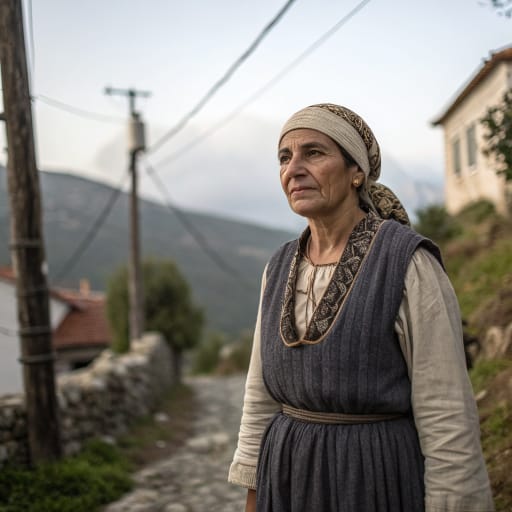
Magnetes
same region (Southern Europe)
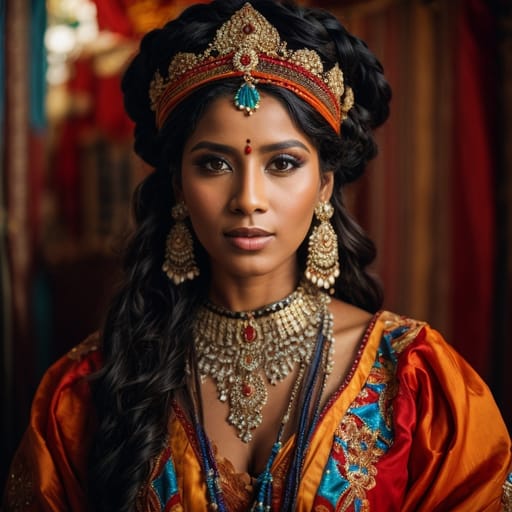
Aromanians
same region (Southern Europe)
Typical Njeguši Phenotypes
Reference for AI generation: hair, eyes, skin, facial structure, build
Njeguši Body & Anatomy Reference
Anatomy by feature, Southern European / Mediterranean phenotype
Njeguši Boobs & Breasts
The typical Njeguši bust is medium-to-large cup, full, moderate-to-high projection, in line with the wider Southern European / Mediterranean pattern. Areolas usually fall in the 32-46mm range, with medium-brown to dark-brown areolar pigmentation against the olive-to-light-brown skin tone. Compared with the lighter pigmentation of the Northern European bust, Njeguši breasts sit forward and are generally full and projecting, generally the classic Mediterranean curvy bust profile. A faithful AI render of Njeguši tits keeps that shape and areola size.
Njeguši Ass & Hips
Butt shape among Njeguši women: medium-to-full, moderate-to-high projection, broader hip profile, over medium-to-wide iliac crests, full gluteal-femoral fat distribution. This follows Southern European / Mediterranean ancestry and looks quite unlike the slim Northern European narrow-hip pattern. An accurate Njeguši ass in adult AI imagery keeps both the silhouette and the overall build (mesomorph with full hip-and-bust deposition) instead of a generic average.
Njeguši Vagina & Pussy
Vulvar anatomy among Njeguši women: medium-brown to dark-brown labial pigmentation, fuller labia minora. Pubic hair tends to be wavy-to-curly medium-coarse dark texture, dense distribution, in the usual inverted-triangle pattern. Both follow Southern European / Mediterranean pigmentation, which is why Njeguši pussy renders should not fall back on a pale, sparse Western template.
Njeguši Dicks & Penis
The Njeguši cock profile, from Southern European / Mediterranean anthropometric data: regional mean ~13-14cm erect; moderate girth; medium-brown shaft pigmentation. Pubic hair has a wavy-to-curly medium-coarse dark texture and forms the usual inverted-V pattern. Whether Njeguši men are circumcised follows religious and cultural practice rather than phenotype.
Njeguši Body, Curves & Build
Build and curves among Njeguši women follow the Southern European / Mediterranean pattern: mesomorph with full hip-and-bust deposition, mean adult female BMI 24-28. Proportions matter as much as skin tone, so Njeguši figures should keep their regional height and limb ratios.
Njeguši Skin Tone & Hair Texture
The Njeguši skin range is olive to medium (Fitzpatrick III-IV), and hair tends to be wavy-to-curly 2B-3B, dark-brown to black. That combination marks the Southern European / Mediterranean phenotype, and skin tone is the trait AI generators most often get wrong for Njeguši women.
Explore phenotype categories
Structured taxonomy with peer-reviewed scales · 22 anatomical categories
Erotic Poses & Sex Positions
From the pose catalog: 219 named positions with reference skeletons
Frequently asked questions about Njeguši people
Where is the Njeguši homeland?
The Njeguši homeland is The Njeguši plateau on the slopes of Mount Lovćen, between Cetinje and the Bay of Kotor, in Old Montenegro (Montenegro) in Southern Europe.
What language do Njeguši people speak?
Njeguši people primarily speak Montenegrin / Serbian, Shtokavian speech (South Slavic, Indo-European).
What religion do Njeguši people practice?
The predominant religion among Njeguši people is Eastern Orthodox Christianity.






Make your own Njeguši images
Five a day, free, no credits to buy. The studio starts from this group's phenotype data, so you can set body type, pose and style and keep the traits accurate.
Start with Njeguši