No portrait yet
Metyktire Erotic
Capoto/Jarina Indigenous Territory along the Xingu River in northern Mato Grosso, Brazil
Mẽbêngôkre, or Kayapó (Northern Jê, Macro-Jê); many also speak Portuguese
Traditional Mẽbêngôkre beliefs and ceremonies, with shamans as healers; some Christian influence in Kayapó communities
A branch of the Kayapó (Mẽbêngôkre), related to the Gorotire, Mekrãgnoti, Kôkraimôrô and Xikrin; part of the wider Northern Jê peoples
About Metyktire People
You may already have seen a Metyktire man without knowing the name. Raoni, the old chief with the wooden lip disc and the feather headdress who has spent decades making the Amazon's case to heads of state, is Metyktire and uses the name as his surname. Older maps and reports call the group Txukahamãe, a word from their Yudjá neighbors usually translated as warriors without bows, after the war clubs they were known for. It was never their own name, and people have mostly stopped using it.
The Metyktire are one of several branches of the Mẽbêngôkre, the people Brazilians call Kayapó, along with the Gorotire, Mekrãgnoti, Xikrin and others. They speak a dialect of Mẽbêngôkre, a Northern Jê language in the Macro-Jê family, and people in other Kayapó villages understand it easily. That sets them apart in the Xingu basin, where most neighbors speak Tupi, Carib or Arawak languages and only a few, such as the Panará and Kisêdjê, speak other Jê languages. Their home today is the Capoto/Jarina Indigenous Territory in northern Mato Grosso, forest and river land along the Xingu just north of the Xingu Indigenous Park.
Steady contact with outsiders began in the 1950s through the Villas-Bôas brothers, the explorers behind the Xingu park. About twenty years later the BR-080 highway was cut across the northern end of the park. It split off land the Metyktire considered theirs and opened it to ranchers. The long fight over that land toughened a generation of leaders. In 1989 Raoni toured the world with the musician Sting, and Kayapó body paint and lip discs became a symbol of the fight to save the rainforest.
Villages are built in a circle around an open plaza with the men's house in the middle. Much of public life runs through age groups and ceremonies. Naming ceremonies, where children receive beautiful names handed down through the family, can take weeks of dancing and preparation. Women paint each other and their children with black genipapo dye in fine geometric lines, and traditionally shave a wide V back from the forehead. Lip discs were once normal for grown men but are now mostly worn by elders. Shamans still treat the sick. Christianity has reached some Kayapó communities, but Metyktire ceremonies are still their own.
Related ethnic groups
Groups that share Metyktire's homeland, region, language, or religious tradition. These are likely candidates for comparative phenotype reference.
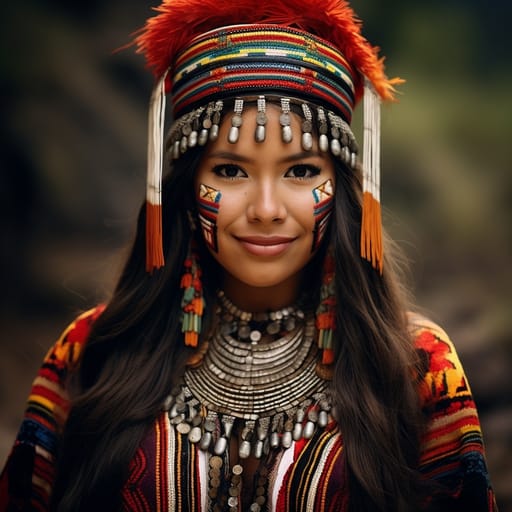
Quechua
same region (South America)
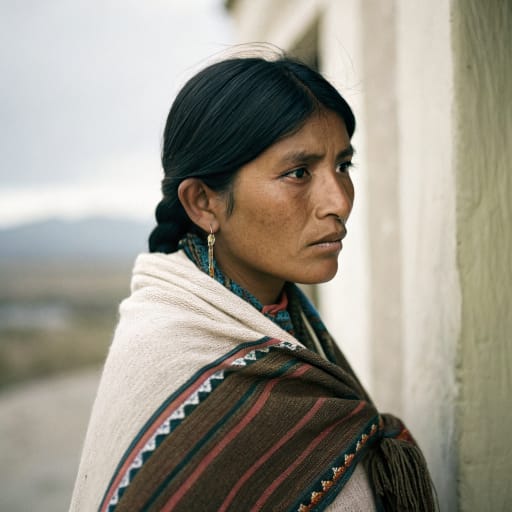
Aymara
same region (South America)
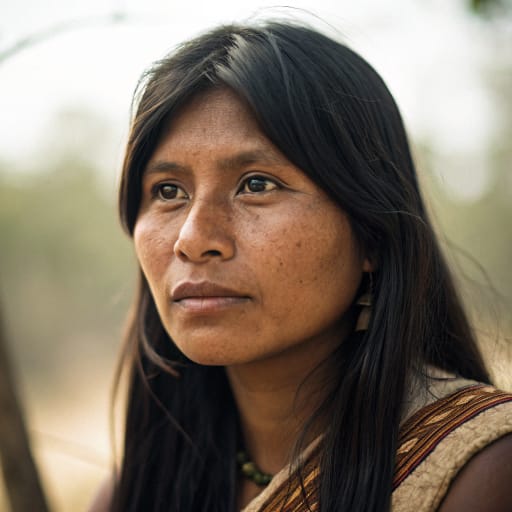
Guaraní
same region (South America)
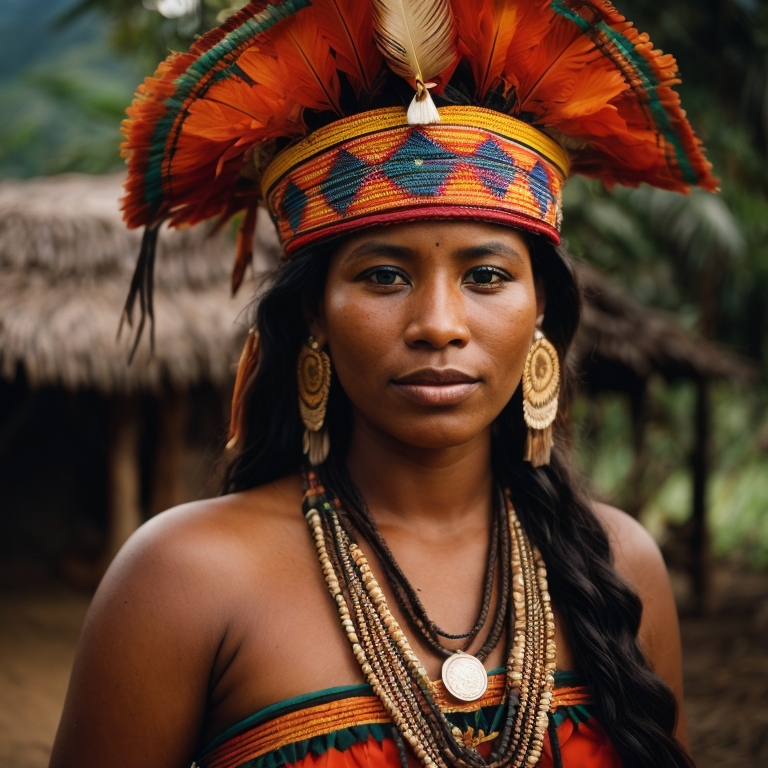
Emberá
same region (South America)
Mapuche
same region (South America)
White Argentine
same region (South America)
Mestizo Argentine
same region (South America)
Middle Eastern Argentine
same region (South America)
Typical Metyktire Phenotypes
Reference for AI generation: hair, eyes, skin, facial structure, build
Metyktire Body & Anatomy Reference
Per-feature anatomical profile for AI nude generation: South American Indigenous / European-Mestizo / Afro-Latino mix phenotype
Metyktire Boobs & Breasts
Metyktire tits and boobs run medium-to-large cup, full, high projection, the classic South American Indigenous / European-Mestizo / Afro-Latino mix bust profile. Metyktire nipples and areolas show medium-brown to dark-brown areolar pigmentation against the tan-to-deep-brown skin tone, with areolar diameter typically in the 32-46mm range and forward-set positioning rather than the smaller bust profile of Andean Indigenous sub-populations. Metyktire breasts trend the classic Brazilian / Latina curvy bust profile in lowland populations; smaller and shorter-set in Andean Indigenous populations, a function of the endomorph-to-mesomorph with high gluteal-femoral deposition body habitus and the mean adult female BMI 25-28. For anatomically accurate AI-generated Metyktire nudes the render preserves the medium-to-large cup, full, high projection shape, 32-46mm areolas with medium-brown to dark-brown pigmentation, and the torso proportions of the South American Indigenous / European-Mestizo / Afro-Latino mix phenotype.
Metyktire Ass & Hips
Metyktire hips and butt usually read as full, high projection, the famous Brazilian / Latina bunda profile. The skeletal base is wide iliac crests, very full gluteal-femoral fat deposition (the hallmark Brazilian / Latina hip-to-waist ratio), the South American Indigenous / European-Mestizo / Afro-Latino mix pattern. Set against the slim narrow-hip East Asian profile, the difference is easy to see, and the hip-to-waist ratio is often what identifies Metyktire women in photos.
Metyktire Vagina & Pussy
Expect medium-brown to dark-brown labial pigmentation, fuller labia minora on Metyktire women, in keeping with South American Indigenous / European-Mestizo / Afro-Latino mix ancestry. The pubic hair is wavy-to-curly coarse dark texture, dense distribution. Coloring should run evenly from the tan to deep-brown skin of the thighs to the labia, and Metyktire nude imagery should keep the hair's wavy-to-curly coarse dark texture.
Metyktire Dicks & Penis
Metyktire dick and penile anatomy in adult AI generation should anchor on the regional reference data: regional mean ~13cm erect, moderate-to-above-average girth, and medium-brown shaft pigmentation. The Metyktire cock profile reflects the South American Indigenous / European-Mestizo / Afro-Latino mix population's anthropometric measurements. The shaft pigmentation should track the surrounding tan to deep-brown skin tone, and the pubic hair should keep its wavy-to-curly coarse dark texture in the typical inverted-V escutcheon.
Metyktire Body, Curves & Build
Metyktire body type: endomorph-to-mesomorph with high gluteal-femoral deposition, with mean adult female BMI 25-28. This is the typical South American Indigenous / European-Mestizo / Afro-Latino mix build. Height range, shoulder-to-hip ratio and fat distribution all follow from it, which is what an accurate Metyktire nude body should show.
Metyktire Skin Tone & Hair Texture
Metyktire skin tone falls in the tan to deep-brown (Fitzpatrick III-VI) band, the surface signal most often miscalibrated by generic AI nude generators. Metyktire hair texture is typically straight-to-curly 1A-3C, varies widely by ancestral composition, characteristic of the South American Indigenous / European-Mestizo / Afro-Latino mix phenotype. In Metyktire nude renders the skin should hold that band consistently across the body.
Explore phenotype categories
Structured taxonomy with peer-reviewed scales · 22 anatomical categories
Erotic Poses & Sex Positions
From the pose catalog: 219 named positions with reference skeletons
Frequently asked questions about Metyktire people
Where is the Metyktire homeland?
The Metyktire homeland is Capoto/Jarina Indigenous Territory along the Xingu River in northern Mato Grosso, Brazil in South America.
What language do Metyktire people speak?
Metyktire people primarily speak Mẽbêngôkre, or Kayapó (Northern Jê, Macro-Jê); many also speak Portuguese.
What religion do Metyktire people practice?
The predominant religion among Metyktire people is Traditional Mẽbêngôkre beliefs and ceremonies, with shamans as healers; some Christian influence in Kayapó communities.






Make your own Metyktire images
Five a day, free, no credits to buy. The studio starts from this group's phenotype data, so you can set body type, pose and style and keep the traits accurate.
Start with Metyktire