No portrait yet
Kawésqar Erotic
Western Patagonian channels and fjords of Magallanes, southern Chile, from the Gulf of Penas to the Strait of Magellan; today mainly Puerto Edén, Puerto Natales and Punta Arenas.
Kawésqar (language isolate, historically labeled Alacalufan); Spanish in daily use.
Traditionally animist, with a creator figure recorded by missionaries; today mostly Catholic.
One of the Fuegian canoe peoples, alongside the Yaghan and the extinct Chono; historically divided into northern, central and southern dialect groups.
About Kawésqar People
The Kawésqar are the canoe people of the western Patagonian channels, the maze of fjords, islands and drowned valleys that runs down the Chilean coast from the Gulf of Penas to the Strait of Magellan. For thousands of years they lived on the water in a way few peoples anywhere have matched: a family's home was a bark canoe with a fire burning on a bed of sand and clay amidships, and land was a place to haul out, build a dome hut of bent branches and skins, and move on. Women did the diving, going into water barely above freezing for mussels, limpets and sea urchins. Men took sea lions, otters and seabirds with harpoons and slings. Rain falls most days of the year here, and the old Kawésqar wore a sea lion or otter cape over the shoulders and little else, relying on grease and a lifetime of exposure to handle the cold.
The language, also called Kawésqar, is an isolate with no proven relatives, though outsiders long knew the people and their speech as Alacalufe, a name they never used for themselves. Its speakers divided the world with a precision the channels demand: jáutok for the sheltered inner waters where families could travel, málte for the exposed outer coast. The Yaghan to the south were fellow canoe nomads with an unrelated language; the Selk'nam across the strait were land hunters; the Chono to the north are gone entirely. Only a handful of fluent speakers remain, most of them elderly, and the language is being recorded phrase by phrase by community members and linguists working together.
Contact was slow and then catastrophic. Sealers, whalers and naval surveyors passed through from the sixteenth century on, bringing disease and occasional violence. In 1881 a group of eleven Kawésqar were seized and shipped to Europe to be displayed in Paris, Berlin and Zurich; most died within the year, and the remains of five were finally returned to Chile and buried in 2010. By the 1930s the Chilean state had drawn the survivors into a single settlement at Puerto Edén on Wellington Island, where a few families still live. Most people who identify as Kawésqar today, a few thousand in the last census, live in Punta Arenas and Puerto Natales, and their organizing has shifted from survival to territory: opposition to salmon farms in the fjords and a role in the enormous Kawésqar National Park created in 2018. Traditional belief held the world to be watched over by spirits of the weather and the sea and, by missionary accounts, a distant creator; Catholicism came late and sits lightly.
Related ethnic groups
Groups that share Kawésqar's homeland, region, language, or religious tradition. These are likely candidates for comparative phenotype reference.
Quechua
same region (South America)
Aymara
same region (South America)
Guaraní
same region (South America)
Emberá
same region (South America)
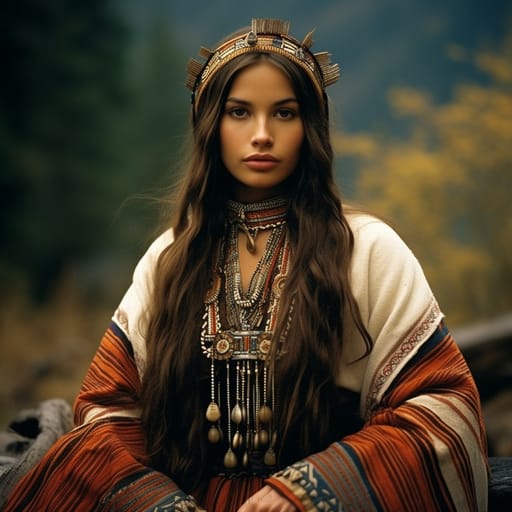
Mapuche
same region (South America)
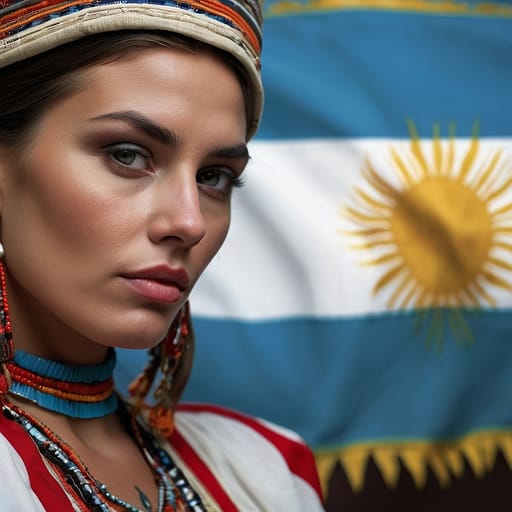
White Argentine
same region (South America)
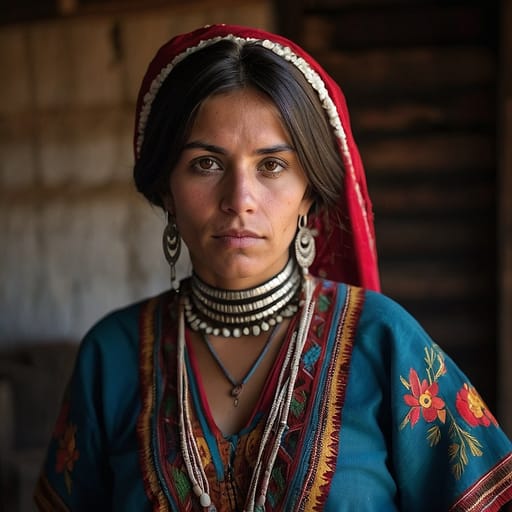
Mestizo Argentine
same region (South America)
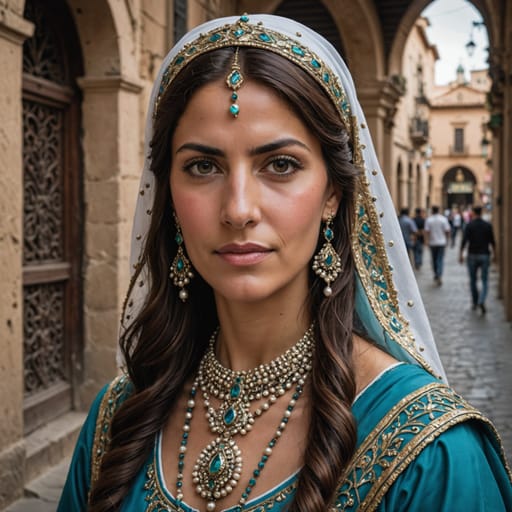
Middle Eastern Argentine
same region (South America)
Typical Kawésqar Phenotypes
Reference for AI generation: hair, eyes, skin, facial structure, build
Kawésqar Body & Anatomy Reference
South American Indigenous / European-Mestizo / Afro-Latino mix phenotype: anatomy reference for AI nude generation
Kawésqar Boobs & Breasts
The typical Kawésqar bust is medium-to-large cup, full, high projection, in line with the wider South American Indigenous / European-Mestizo / Afro-Latino mix pattern. Areolas usually fall in the 32-46mm range, with medium-brown to dark-brown areolar pigmentation against the tan-to-deep-brown skin tone. Compared with the smaller bust profile of Andean Indigenous sub-populations, Kawésqar breasts sit forward and are generally the classic Brazilian / Latina curvy bust profile in lowland populations; smaller and shorter-set in Andean Indigenous populations. A faithful AI render of Kawésqar tits keeps that shape and areola size.
Kawésqar Ass & Hips
Butt shape among Kawésqar women: full, high projection, the famous Brazilian / Latina bunda profile, over wide iliac crests, very full gluteal-femoral fat deposition (the hallmark Brazilian / Latina hip-to-waist ratio). This follows South American Indigenous / European-Mestizo / Afro-Latino mix ancestry and looks quite unlike the slim narrow-hip East Asian profile. An accurate Kawésqar ass in adult AI imagery keeps both the silhouette and the overall build (endomorph-to-mesomorph with high gluteal-femoral deposition) instead of a generic average.
Kawésqar Vagina & Pussy
Vulvar anatomy among Kawésqar women: medium-brown to dark-brown labial pigmentation, fuller labia minora. Pubic hair tends to be wavy-to-curly coarse dark texture, dense distribution, in the usual inverted-triangle pattern. Both follow South American Indigenous / European-Mestizo / Afro-Latino mix pigmentation, which is why Kawésqar pussy renders should not fall back on a pale, sparse Western template.
Kawésqar Dicks & Penis
The Kawésqar cock profile, from South American Indigenous / European-Mestizo / Afro-Latino mix anthropometric data: regional mean ~13cm erect; moderate-to-above-average girth; medium-brown shaft pigmentation. Pubic hair has a wavy-to-curly coarse dark texture and forms the usual inverted-V pattern. Whether Kawésqar men are circumcised follows religious and cultural practice rather than phenotype.
Kawésqar Body, Curves & Build
Build and curves among Kawésqar women follow the South American Indigenous / European-Mestizo / Afro-Latino mix pattern: endomorph-to-mesomorph with high gluteal-femoral deposition, mean adult female BMI 25-28. Proportions matter as much as skin tone, so Kawésqar figures should keep their regional height and limb ratios.
Kawésqar Skin Tone & Hair Texture
The Kawésqar skin range is tan to deep-brown (Fitzpatrick III-VI), and hair tends to be straight-to-curly 1A-3C, varies widely by ancestral composition. That combination marks the South American Indigenous / European-Mestizo / Afro-Latino mix phenotype, and skin tone is the trait AI generators most often get wrong for Kawésqar women.
Explore phenotype categories
Structured taxonomy with peer-reviewed scales · 22 anatomical categories
Erotic Poses & Sex Positions
From the pose catalog: 219 named positions with reference skeletons
Frequently asked questions about Kawésqar people
Where is the Kawésqar homeland?
The Kawésqar homeland is Western Patagonian channels and fjords of Magallanes, southern Chile, from the Gulf of Penas to the Strait of Magellan; today mainly Puerto Edén, Puerto Natales and Punta Arenas. in South America.
What language do Kawésqar people speak?
Kawésqar people primarily speak Kawésqar (language isolate, historically labeled Alacalufan); Spanish in daily use..
What religion do Kawésqar people practice?
The predominant religion among Kawésqar people is Traditionally animist, with a creator figure recorded by missionaries; today mostly Catholic..






Make your own Kawésqar images
Five a day, free, no credits to buy. The studio starts from this group's phenotype data, so you can set body type, pose and style and keep the traits accurate.
Start with Kawésqar